Count sixty seconds, ask for a little time, and recognize the separate record and adjective meanings.
A small interval within a larger stretch
A small interval within a larger stretch
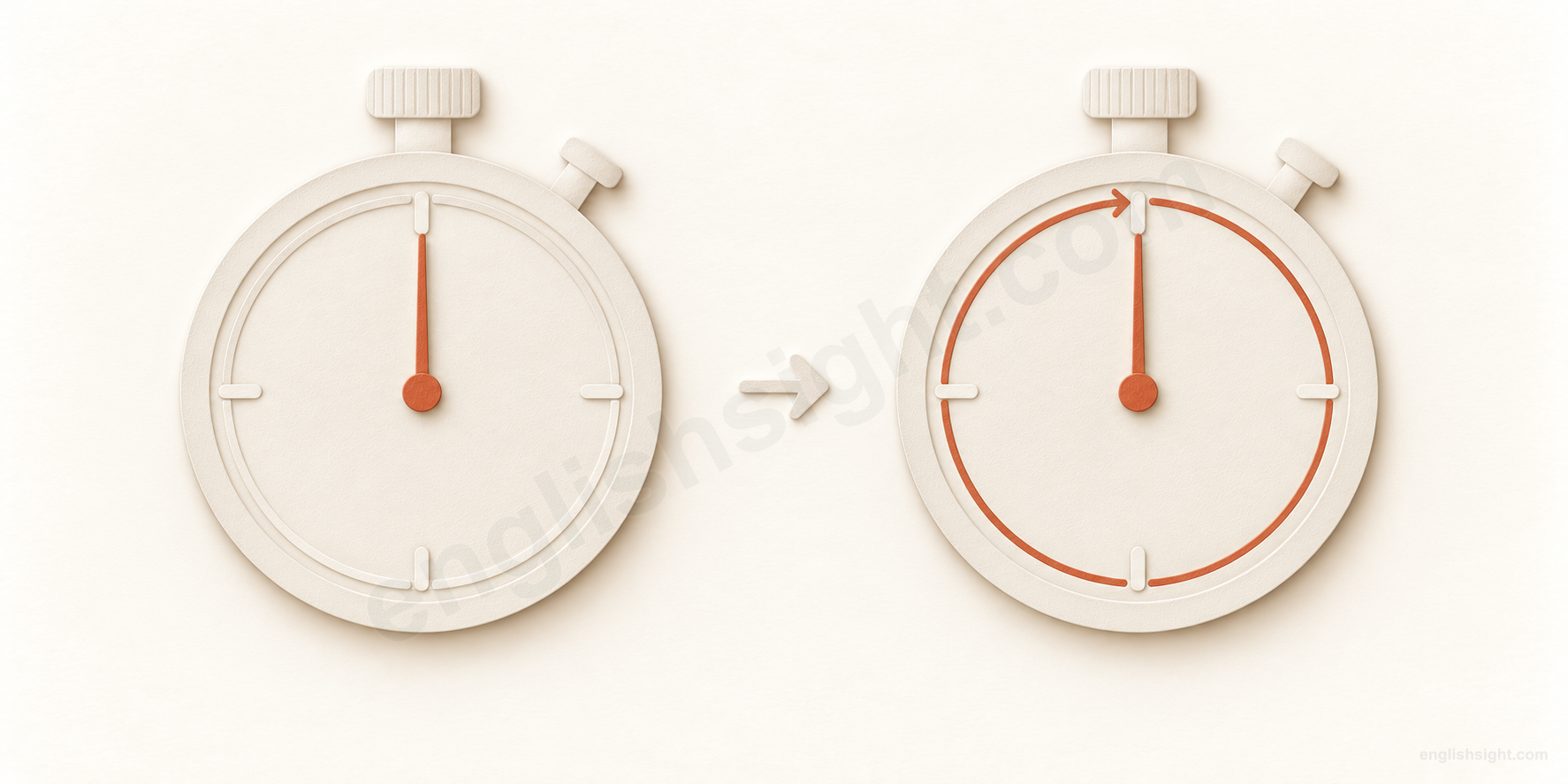
The seconds hand starts at the top.
minute
Sixty seconds have passed: one minute.
One complete clockwise turn measures the interval.
One full turn of this stopwatch’s seconds hand marks a minute: sixty seconds. In conversation, a minute can mean a short while.
A minute measures a small stretch of time: exactly sixty seconds when counted, or a brief interval in ordinary conversation.
Use this model for the time family. The record meaning and the differently pronounced adjective are separate branches; fixed expressions also add meanings of their own.
A minute /ˈmɪnɪt/ is exactly sixty seconds when we measure time. In everyday conversation, a minute can instead mean a short while, or point to a moment when something happens.
The minutes of a meeting are its written record. Minute meaning extremely small or very detailed has a different pronunciation. These branches need their own explanations; the time picture is a guide to the main family, not a rule that generates every use.
01
Count time and describe a duration
Start with the exact unit, then let the surrounding grammar tell you whether it measures a duration, a wait, a rate, or a journey.
01
a / one / half a minute; number + minutes; take / last / spend + minutes
a minute / ten minutes
a unit equal to sixty seconds
Situation
A timer starts.
What the speaker conveys
Sixty seconds pass for each minute counted.
A minute is one of sixty equal parts of an hour.
Minute is a countable time noun: one minute, two minutes, half a minute. The usual written abbreviation is min. Sixty minutes make an hour; sixty seconds make a minute.
A task takes ten minutes if that is the time needed to do it. A noise lasts ten minutes if that is its duration. A person spends ten minutes reading if they use that time on the activity. These verbs describe different relationships to the same unit.
The minute hand on an ordinary clock moves once around the face in an hour. Each of the sixty minute divisions is one minute of that hour; a full turn of a second hand instead marks one minute.
In a sentence
The recording lasts three minutes and twenty seconds.
Watch the difference Use plural minutes after numbers greater than one. Do not confuse a minute with an hour or with a second.
02
number + minutes + past / to + hour; in the + ordinal + minute
five minutes past / to eight
locate a time relative to an hour
Situation
You know the hour and a number of minutes.
What the speaker conveys
Past places the time after that hour; to places it before.
Past and to place minutes on opposite sides of the named hour.
Five minutes past eight is 8:05. Five minutes to eight is 7:55. In time-telling, minutes is often omitted: five past eight or five to eight.
American English also uses after for past: five after eight. In other contexts, five minutes before or after eight gives the same time relationship.
In a timed event, an ordinal identifies a position: in the twentieth minute means during that numbered minute of the event, not for a duration of twenty minutes.
In a sentence
The bus leaves at seven minutes to nine.
Watch the difference Past eight and to eight are different times. A numbered minute in a match is not the same as the clock time at home.
03
for + minutes; in + minutes; within + minutes; minutes + ago / later
for / in / within five minutes
distinguish duration, time until something, and a time limit
Situation
You need to explain how an action relates to five minutes.
What the speaker conveys
The preposition supplies the relationship.
The same amount of time does different jobs after for, in, and within.
Wait for five minutes describes how long the waiting continues. The train leaves in five minutes places departure five minutes after now.
I finished the puzzle in five minutes gives the time needed for completion. Context distinguishes this completion-time use of in from the future-time use.
Reply within five minutes sets a latest time: the reply must arrive before that period is over or at its end. It may arrive earlier. Five minutes ago looks backward from now; five minutes later looks forward from a previously mentioned time.
In a sentence
Please send your answer within five minutes.
Watch the difference Within five minutes allows an earlier answer. In five minutes, in a future arrangement, usually points to the time five minutes from now.
04
a + number-minute + noun; number + minutes’ + walk
a ten-minute break
use a duration to describe a noun
Situation
You want a break that lasts ten minutes.
What the speaker conveys
The duration becomes a modifier before break.
A number-plus-unit modifier keeps minute singular.
Compare The break lasts ten minutes with a ten-minute break. Before the noun, ten-minute works as a compound modifier, so minute stays singular and the words are normally joined with a hyphen.
The same pattern gives a two-minute video or a five-minute walk. You can also say The station is five minutes’ walk from here, with plural minutes and an apostrophe after the s; this is a different grammatical pattern.
In a sentence
We watched a four-minute video before the discussion.
Watch the difference Write a four-minute video, not a four-minutes video. The article belongs to the whole noun phrase, not to minute alone.
05
amount + per minute / a minute; charge + by the minute
per minute / a minute
give an amount or rate for each minute
Situation
A device produces a repeated output.
What the speaker conveys
You express its output for each unit of time.
Per minute expresses an amount for each minute.
A printer that produces twenty pages per minute has that printing rate. Twenty pages a minute uses a with the same each-minute meaning. It does not mean twenty pages only once.
The unit before per may be pages, words, beats, or a price. Charged by the minute says the charge is calculated in units of minutes. The time noun does not itself tell you what is being counted.
In a sentence
The printer can produce eighteen pages per minute.
Watch the difference Pages per minute is a rate; eighteen minutes is a duration. Keep the counted item as well as the time unit.
06
be + number + minutes + away / from + place
ten minutes away / from here
describe distance through journey time
Situation
Someone asks how far the station is.
What the speaker conveys
You describe the time needed to reach it.
The minutes measure the journey, not a fixed physical length.
The station is ten minutes away means the journey normally takes about ten minutes in the relevant circumstances. Ten minutes from here uses the starting place as a reference.
Mention walking, driving, or another travel method when it is not clear. A five-minute walk and a five-minute drive need not cover the same distance.
In a sentence
The station is ten minutes away on foot.
Watch the difference Minutes are not kilometres or miles. The mode of travel and conditions affect the distance covered.
02
Make room for a short time
In conversation, a minute often means a little time rather than a promise of exactly sixty seconds. Tone and the whole expression distinguish waiting, interrupting, and acting immediately.
07
in a minute; not be a minute; take a minute or two
in a minute / I won’t be a minute
say that something will happen very soon
Situation
Someone is waiting while you finish a small task.
What the speaker conveys
You say the remaining wait should be short.
Conversational a minute often means a little time, without an exact count.
I’ll be there in a minute ordinarily promises to come soon. I won’t be a minute reassures someone that you will be ready or back shortly. It does not usually predict a duration of zero seconds.
It’ll only take a minute presents a task as quick. A minute or two leaves the amount approximate. A minute ago may also mean just a short time ago; context decides whether the speaker is timing accurately.
In a sentence
I won’t be a minute; I’m just putting my shoes on.
Watch the difference For a timer, safety instruction, or precise schedule, give and follow the actual measurement rather than assuming that a minute is always loose.
08
just / wait / hold on / hang on + a minute
Just a minute, please.
ask someone to pause briefly
Situation
A caller asks to speak to a colleague.
What the speaker conveys
You ask the caller to wait while you check.
A small interval is requested before the interaction continues.
Just a minute, please asks for a brief wait. Wait a minute, hold on a minute, and hang on a minute can serve the same practical purpose. The listener and the situation supply what is being delayed.
Please and a calm tone help make the request polite. The bare command Wait a minute! can sound abrupt, and in a different context it may introduce an objection rather than a practical delay.
In a sentence
Just a minute, please; I’ll see whether Marta is available.
Watch the difference The phrase is not normally an instruction to start a sixty-second countdown.
09
wait / just + a minute + objection or realization
Wait a minute—…
interrupt to question, correct, or notice something
Situation
You hear a plan that seems to contain a mistake.
What the speaker conveys
You interrupt so everyone can reconsider.
The expression pauses the conversation to make room for a thought.
Wait a minute can introduce a sudden realization or a challenge: Wait a minute—we already paid. The speaker’s main purpose is to raise an issue, not to arrange a timed wait.
Just a minute! can also resist or object to what someone is doing or saying. Intonation and the words that follow tell the listener whether you need time, have noticed something, or disagree.
In a sentence
Wait a minute—didn’t we agree to meet on Friday?
Watch the difference Do not interpret every Wait a minute as disagreement. It can simply ask for a short wait.
10
have / have got / spare + a minute; take a minute + to-infinitive
Do you have a minute?
ask whether someone has a little time available
Situation
You need a brief conversation with a colleague.
What the speaker conveys
You ask whether now is a suitable time.
Have refers to available time for attention or an activity.
Do you have a minute? is a familiar way to ask for a short conversation. Have you got a minute? and the shortened Got a minute? make the same kind of request in conversation.
Can you spare a minute? asks whether someone can make a little time available. A few spare minutes are free time. You can spend a minute checking something or take a minute to think; the following verb gives the activity.
In a sentence
Do you have a minute to look at this message with me?
Watch the difference This asks for availability, not possession of a physical object. It does not guarantee that the conversation will last exactly one minute.
11
(at) any minute (now)
any minute now
expect something very soon
Situation
The bus is due and you are watching for it.
What the speaker conveys
Its arrival could happen at any moment.
Any leaves the exact near-future point unspecified.
Any minute now emphasizes that an event is expected very soon. Any minute and at any minute can do the same job: The battery could fail at any minute.
The expression may show hopeful expectation, worry, or urgency. It is not a precise deadline and does not mean the event repeats once every minute.
In a sentence
The bus should arrive any minute now.
Watch the difference Any minute now predicts a near event; every minute describes repeated or continuous time.
12
(right) this minute; have just this minute + past participle
this minute / just this minute
locate something right now or immediately before now
Situation
Someone asks whether an action can wait.
What the speaker conveys
You insist on now, or explain that news has only just arrived.
This minute points to the present; just can point to a very recent event.
This minute or right this minute means immediately or right now. In a command, it can sound urgent or forceful: Put that down this minute.
I’ve just this minute heard the news means I heard it a moment ago. The completed verb and just put the event immediately before now. Compare I need an answer this minute, which demands action now.
In a sentence
I’ve just this minute received your email.
Watch the difference Just this minute with a completed action is very recent past; in a minute usually points ahead to a short wait.
13
at the minute; at that very minute
at the minute / at that very minute
describe the present situation or a particular moment
Situation
A friend asks about your work.
What the speaker conveys
You locate the situation in the current period.
At presents a time as a point or current situation.
At the minute means at present in informal British English: I’m busy at the minute. The situation can last longer than sixty seconds. At the moment is another natural way to express this.
At that very minute identifies a particular moment in a story, often with surprising simultaneous events. It differs from a future in a minute, which says to wait a little.
In a sentence
I’m working from home at the minute.
Watch the difference Do not replace in a minute with at the minute when you mean a little later.
14
the minute (that) + subject + verb, main clause
the minute (that) something happens
say as soon as another event happens
Situation
You want a message immediately after someone arrives.
What the speaker conveys
The arrival triggers the request.
The following clause names the event that sets the time.
The minute you arrive means as soon as you arrive. That is optional: the minute that you arrive. This time expression introduces a clause, not a number of minutes.
For a future event, use an ordinary present form in this time clause: I’ll call the minute I get there. The main clause can use will; the time clause normally does not use will simply to mark the future.
In a sentence
I’ll message you the minute I reach the hotel.
Watch the difference This does not mean one minute after arrival. Say the minute I reach it, not the minute I will reach it, for an ordinary future time clause.
03
Deadlines, change, emphasis, and familiar idioms
These expressions use small stretches or points of time in established ways. Learn the whole phrase and its purpose; the clock picture cannot predict every meaning.
15
at / until the last minute; last-minute + noun
at the last minute / a last-minute change
act at the latest possible time
Situation
A deadline or departure is close.
What the speaker conveys
Someone acts just before it is too late.
Last identifies the final opportunity, not necessarily the final sixty seconds.
At the last minute describes when something happens. Until the last minute describes how long someone waits: Don’t leave your packing until the last minute.
Before a noun, use the hyphenated modifier last-minute: a last-minute change, last-minute tickets. The phrase describes late timing; it does not by itself say the action succeeds or fails.
In a sentence
They changed the meeting room at the last minute.
Watch the difference A last-minute change may occur more than sixty seconds before an event. Last-minute modifies a noun; at the last minute modifies the timing of an action.
16
one minute + clause, the next (minute) + clause
one minute…, the next…
show a sudden change between situations
Situation
A child is upset.
What the speaker conveys
Soon afterward the same child is laughing.
The paired time expressions contrast two rapidly changing states.
One minute… the next… presents a sharp contrast in quick succession. It need not mean the two events occur exactly sixty seconds apart.
The second part may say the next minute or just the next. Both refer to the following moment in this pattern; next is not naming tomorrow or the next meeting.
In a sentence
One minute the baby was crying; the next she was laughing.
Watch the difference This pattern emphasizes a rapid change. It is not a reliable way to report an exact elapsed time.
17
comparative + by the minute; minute by minute; from minute to minute
by the minute / minute by minute
describe rapid change or follow successive short intervals
Situation
A queue keeps getting longer.
What the speaker conveys
Each passing interval brings further change.
Repeated small intervals make the progression noticeable.
Getting longer by the minute means becoming longer very quickly as time passes. The comparative word supplies the direction of change: worse, better, darker, or more crowded.
Minute by minute follows successive short intervals: it can describe gradual progress, close monitoring, or rapidly changing conditions. From minute to minute also describes change over short intervals. Follow something minute by minute emphasizes close attention as it develops. A minute-by-minute account is a detailed sequence of events.
Charged by the minute is a different use: a charge calculated for each minute. There is no increasing comparison in that rate expression.
In a sentence
The queue is getting longer by the minute.
Watch the difference By the minute after getting longer expresses continuing change; it does not promise a new measurement at exactly sixty-second intervals.
18
every minute of + event / it; every waking minute; every minute counts
enjoy every minute / every minute counts
emphasize all the time or the value of each small interval
Situation
You describe a whole enjoyable visit.
What the speaker conveys
You say that your enjoyment lasted throughout it.
Every can gather all the small intervals into the whole experience.
I enjoyed every minute of it emphasizes enjoyment throughout an event. Every waking minute means all the time that someone is awake, often as an exaggeration about a persistent activity or thought.
Every minute counts says that even a small amount of time matters, especially when time is limited. In a literal schedule, every minute can instead mean once each minute: The display updates every minute.
In a sentence
We enjoyed every minute of our weekend by the sea.
Watch the difference Enjoying every minute is ordinary emphasis, not evidence that someone checked their feelings sixty times an hour.
19
not / never + verb + for a / one minute
not for a / one minute
strongly deny a belief or possibility
Situation
Someone suggests that you doubted a friend.
What the speaker conveys
You deny having any such doubt.
Even the smallest imagined interval is excluded for emphasis.
I didn’t doubt her for a minute means I did not doubt her at all. One can replace a for stronger emphasis. This is an established emphatic negative expression, not a report that doubt lasted fifty-nine seconds.
It often appears with believe, think, doubt, or imagine. A positive I waited for a minute can simply describe a short duration; the strong negative meaning belongs to the whole pattern and its context.
In a sentence
I didn’t doubt your honesty for a minute.
Watch the difference Do not interpret not for a minute as meaning for two minutes instead. Here the speaker excludes the belief altogether.
20
on time / timed / planned + to the minute
to the minute
give or follow an exact time
Situation
You compare an arrival with the timetable.
What the speaker conveys
The stated arrival time matches exactly.
The phrase emphasizes precision in timing.
On time to the minute means exactly on time. If a schedule is planned to the minute, its timing is specified in fine detail.
The expression uses the time noun /ˈmɪnɪt/. Compare in minute detail, where minute is the differently pronounced adjective and describes thorough detail more generally.
In a sentence
The coach arrived at 6:40, on time to the minute.
Watch the difference To the minute concerns exact timing; up to the minute concerns being current or having the latest information.
21
up-to-the-minute + noun; be + up to the minute
up to the minute / up-to-the-minute news
be current or contain the latest information
Situation
A traveller needs current traffic information.
What the speaker conveys
A report includes the latest available developments.
Up to points toward the present as the limit of what is included.
Up-to-the-minute information is as current as the available information allows. This does not necessarily mean a computer refreshes it exactly once every minute.
The expression can also mean very modern or fashionable, as in up-to-the-minute styles. Hyphenate it when it comes before a noun; after be, up to the minute is a usual spelling.
In a sentence
The website provides up-to-the-minute traffic reports.
Watch the difference Up-to-the-minute news is current news. A minute-by-minute report follows events in sequence; it describes a different feature of the report.
22
talk / think / race + a mile a minute
a mile a minute
move, speak, or think very fast
Situation
A friend has a lot to tell you.
What the speaker conveys
The words come out very quickly.
The literal distance-per-time structure is reused as an exaggeration.
Talk a mile a minute means talk very fast. Someone’s mind can race a mile a minute too; no physical journey is required.
In a literal speed calculation, one mile each minute is sixty miles per hour. In this informal idiom, the usual point is great speed, not that exact measurement.
In a sentence
Nora was talking a mile a minute about her new job.
Watch the difference Do not replace mile with an arbitrary unit and expect to keep the same familiar idiom.
23
person / thing + be + a laugh a minute
a laugh a minute
describe someone or something as very funny
Situation
A comic tells one funny story after another.
What the speaker conveys
You describe the whole performance as very amusing.
The familiar phrase suggests frequent laughter rather than a measured rate.
Someone or something that is a laugh a minute is very funny. This informal noun phrase can follow be: The show was a laugh a minute.
A speaker may use it sarcastically about an unpleasant or dull situation, but that opposite evaluation comes from context and tone. The basic expression is positive.
In a sentence
Her stories are a laugh a minute.
Watch the difference Do not count literal laughs to interpret this idiom. It evaluates how amusing someone or something is.
24
someone’s + fifteen minutes of fame
fifteen minutes of fame
a brief period of public attention
Situation
A person suddenly becomes widely noticed.
What the speaker conveys
The attention may soon pass.
The stated duration is a conventional image for short-lived fame.
Someone’s fifteen minutes of fame is a short period when many people know about them. The expression often suggests that the attention is temporary.
Fifteen is part of the familiar expression. The fame does not have to last exactly fifteen minutes; it may last days or longer and still be brief in context.
In a sentence
That unusual photo gave him his fifteen minutes of fame.
Watch the difference This describes temporary fame, not a fifteen-minute performance or appointment.
04
Meeting records and the differently pronounced adjective
The minutes of a meeting are a written record. Minute meaning extremely small or very detailed has a different pronunciation. Keep these branches distinct from counting time.
25
the minutes of + meeting; take / keep / approve + (the) minutes
the minutes / take the minutes
the written record of a meeting
Situation
A committee discusses and decides several things.
What the speaker conveys
A written record preserves the main proceedings and decisions.
Minutes here names records, not the amount of meeting time.
The minutes of a meeting record what was said or decided there. In this meaning minutes is plural: The minutes are ready. It does not say how long the meeting lasted.
Take or keep the minutes means make that record. Read, approve, and circulate the minutes describe later actions with it. Take minutes without the is also possible when describing the general task.
An agenda lists business to be considered before or during a meeting. The minutes record proceedings and decisions. They need not be a word-for-word transcript.
In a sentence
Could you take the minutes at tomorrow’s committee meeting?
Watch the difference The meeting took twenty minutes describes duration. She took the minutes describes recording it.
26
minute + object; be minuted; it is / was minuted that + clause
minute a decision / be minuted
put something in the official meeting record
Situation
A member asks for a decision to be recorded.
What the speaker conveys
The decision appears in the minutes.
The verb makes a meeting record of its object.
To minute a decision, remark, or meeting is to record it in the official minutes. This is a transitive verb used in meeting and administrative language, pronounced /ˈmɪnɪt/ like the time noun.
The forms are minute, minutes, minuted, and minuting. Passive forms are useful when the record matters more than the writer: The decision was minuted. It was minuted that… introduces the recorded statement.
Take the minutes describes the person’s task. Minute a decision names a particular thing recorded. Neither expression means limit the meeting to sixty seconds.
In a sentence
It was minuted that the committee would meet again in June.
Watch the difference Drop the final e before -ing: minuting. This verb has no everyday separable particle-verb family.
27
minute + noun; subject + be + minute; the minutest + noun
a minute amount / minute differences
extremely small in size, amount, or degree
Situation
You compare two almost identical samples.
What the speaker conveys
You find only a very small difference.
This adjective describes smallness, with stress on the second syllable.
Minute here is an adjective, pronounced /maɪˈnjuːt/ in British English and /maɪˈnuːt/ in American English. It can describe particles, amounts, differences, or a very small room. It is not pronounced like the time noun.
It can come before a noun or after be: a minute crack; The crack is minute. Tiny or extremely small often gives a simpler conversational alternative. Minutest is used for emphasis about the smallest details or amounts.
Small does not automatically mean unimportant: a minute defect can matter. Dictionaries also record a small-importance sense, but a minute amount by itself says how small the amount is, not whether its effects matter.
In a sentence
The two keys have a minute difference in shape.
Watch the difference A minute amount is an extremely small amount; a one-minute test is a test lasting sixty seconds. Their spelling overlaps but their pronunciation and grammar differ.
28
in minute detail; in the minutest detail(s); a minute examination / inspection
in minute detail / a minute examination
include or examine even the smallest details
Situation
Someone gives an account of a complicated event.
What the speaker conveys
The account covers its smallest particulars.
The adjective extends attention down to very small details.
In minute detail means with very thorough detail. A minute examination or inspection is careful and detailed, not an examination that lasts one minute.
In the minutest detail or in the minutest details emphasizes how little is left out. This adjective branch shares the idea of small details with minute meaning tiny, but the whole expression describes thoroughness.
A one-minute inspection measures duration. A minute inspection describes the care and detail of the inspection. Pronunciation and context distinguish them.
In a sentence
She described the repair in minute detail.
Watch the difference Detail is singular without an article in in minute detail. Do not read minute as a time unit in this expression.
Listen to the sound and read the whole pattern
Two pronunciations
The time noun, meeting-record noun, and meeting verb use /ˈmɪnɪt/, with first-syllable stress. The adjective meaning tiny or detailed uses /maɪˈnjuːt/ in British English and /maɪˈnuːt/ in American English, with second-syllable stress.
An exact unit can become conversational emphasis
A minute in a measured instruction is sixty seconds. In a minute, any minute now, the minute you arrive, and not for a minute each do a different conversational job. Do not turn a loose reassurance into a precise deadline or assume every expression has a literal duration.
Forms belong to their construction
Use three minutes for a duration and a three-minute break before a noun. Meeting minutes takes plural agreement. The verb has minuted and minuting. For the adjective, minutest is an established emphatic form; smaller or even smaller is a clear everyday way to compare size.
Coverage boundaries
This lesson covers everyday time uses, familiar idioms, meeting records and their verb, and the main tiny/detailed adjective uses. In technical angle measurement, a minute of arc is one sixtieth of a degree, not a time duration. Formal singular minute meaning an official note or memorandum, specialist timing verbs, and separate compounds such as minute steak are not developed here.
Choose the meaning that fits
Use the situation, the preposition, and the whole phrase. A familiar spelling does not always mean the same thing.
1. You continued waiting for five minutes. Which sentence states that duration?
2. You need to describe a break lasting ten minutes. Which form fits before break?
3. You want a call as soon as your friend arrives, without an extra wait. Which sentence fits?
4. A colleague asks you to take the minutes at a meeting. What task are they giving you?
5. An inspector examined a part in minute detail. What does minute describe here?
6. You suddenly realize that the address is wrong and say Wait a minute—this is the old address. What are you doing?
Sources and teaching notes
The dictionary entries below support the usage coverage. Explanations and examples are original. The interval picture is a teaching model for the time family; it does not prove the meanings of the other branches.
The diagram is a teaching aid, not a claim that all English speakers share the same mental picture.