Understand mixed in food, groups, feelings, results, and familiar expressions.
Different elements, one whole
Together without necessarily becoming the same
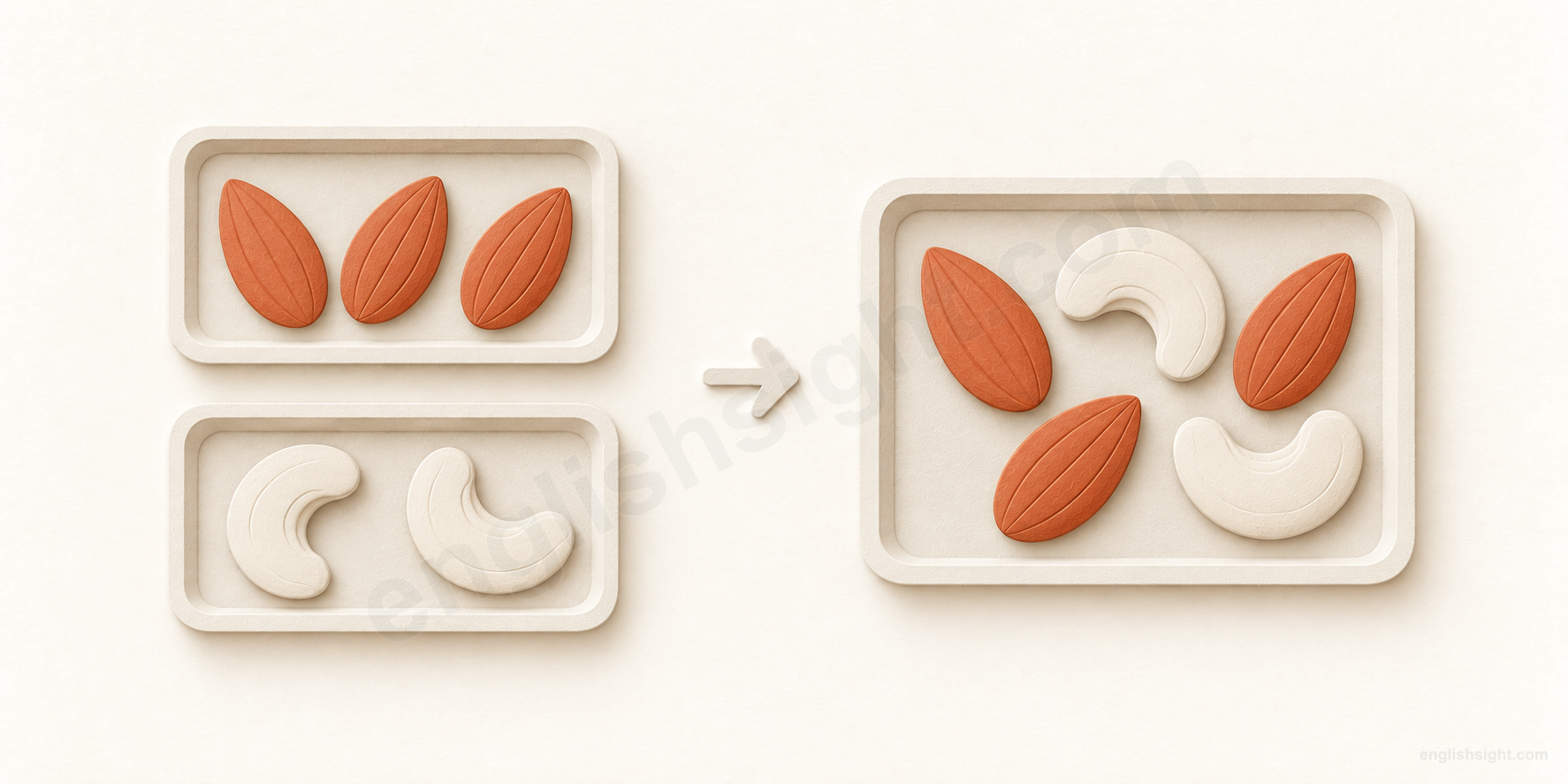
Three almonds and two cashews are kept in separate trays.
mixed
One tray contains both kinds, still visibly distinct.
The two kinds are brought together into one tray.
Different kinds form one assortment without becoming the same.
Mixed describes a whole that contains different elements; those elements need not become identical or lose their separate character.
This is a teaching connection between uses, not a rule that predicts every compound. The adjective describes a state or composition; mixed can also be a form of the verb mix.
Mixed often describes something that includes different elements. Those elements may remain recognizable: mixed nuts are still nuts of different kinds. Other uses describe conflicting feelings, uneven results, or established expressions such as mixed up.
The useful question is: what kinds of thing are together, and in what respect do they differ? The noun and the complete expression supply much of the answer.
01
Different components together
Start with the composition of a whole, then distinguish the adjective from forms of the verb mix.
01
mixed + plural food noun; a mixed + singular noun
mixed nuts / mixed vegetables
several kinds together in one selection
Situation / starting point
You want more than one kind of vegetable.
What the phrase tells us
One serving contains several kinds.
The things share a group without becoming identical.
A mixed selection contains different kinds. Mixed nuts can contain almonds, walnuts, and other nuts; the pieces remain recognizable. A mixed salad works the same way.
Mixed describes composition, not cooking method or quality. For example, mixed vegetables may be fresh or frozen. A salad is not necessarily chopped into tiny pieces.
In a sentence
We served rice with mixed vegetables.
Watch the difference Mixed does not mean that every possible kind is included, or that each kind has an equal share.
02
be well mixed; be being mixed; have mixed; ready-mixed + noun
well mixed / ready-mixed
combined, or already prepared by combining ingredients
Situation / starting point
The ingredients start separately.
What the phrase tells us
They are combined sufficiently for the task.
Mixed can describe the resulting state; mixing names the ongoing activity.
Read the sentence to distinguish a state from an action: The ingredients are well mixed describes their condition; The ingredients are being mixed describes a process happening now.
Mixed is also the past tense and past participle of mix: I mixed the ingredients; I have mixed them; They were mixed by the cook. The last example is passive. The adjective mixed itself does not carry tense.
Ready-mixed means supplied already combined and ready to use, as in ready-mixed concrete. Blend often suggests a smoother or more complete combination; mixed alone does not guarantee smoothness.
In a sentence
Stir until the ingredients are well mixed.
Watch the difference Pronounce mixed /mɪkst/, with no extra syllable for -ed; mix is /mɪks/.
03
A mixed with B; A mixed into B; A and B mixed together
mixed with / mixed into
one component combined with another
Situation / starting point
You name one ingredient and then the other.
What the phrase tells us
The sentence identifies what they are combined with.
With names the other component; into presents the receiving mixture.
In yogurt mixed with honey, mixed with honey describes the yogurt. Honey mixed into yogurt presents the yogurt as the mixture receiving the honey. Together can instead emphasize the combination as a whole.
The same pattern can describe emotions: relief mixed with disappointment. The ingredients need not be physical. Compare mixed by the chef: by identifies the person doing the mixing, not another ingredient.
In a sentence
The dip is made from yogurt mixed with fresh herbs.
Watch the difference Mixed with does not mean confused with: confusing two labels belongs to mixed up with.
02
Who a group includes
Mixed can describe the range of people in a group. The noun and context identify which differences are relevant.
04
a mixed group of + plural noun; a socially / ethnically mixed community
a mixed group / crowd
people of different kinds in one group
Situation / starting point
People differ in age, background, or experience.
What the phrase tells us
They attend the same event or belong to the same group.
The context tells us which differences matter.
A mixed crowd might include students, workers, and retirees. The phrase alone does not specify exactly how the people differ; add details when those differences matter.
There is no necessary judgment of good and bad here. A group can be mixed in age and still share the same interest. An ethnically mixed community describes a different dimension from a mixed-age group.
In a sentence
A mixed group of local residents joined the workshop.
Watch the difference Do not assume mixed always refers to gender or ethnicity. Name the relevant dimension when it is unclear.
05
a mixed school; mixed accommodation; in mixed company
a mixed school / mixed company
including boys and girls, or men and women
Situation / starting point
You need to say who a school or social setting includes.
What the phrase tells us
The usual expression includes both sexes.
In these conventional combinations, mixed specifies the participants.
In British English, a mixed school commonly means a school for both boys and girls, also called a coeducational school. Mixed accommodation or mixed bathing likewise contrasts with provision for only men or only women.
Mixed company traditionally means a social group including men and women. In remarks about what is suitable to say in mixed company, it can carry older assumptions about acceptable conversation. It does not simply mean a noisy or varied group.
In a sentence
She moved from a girls’ school to a mixed school.
Watch the difference A racially mixed school and a mixed-ability class specify other differences; they are not synonyms for coeducational.
06
mixed-ability + class / teaching; of mixed ability
a mixed-ability class
learners at different skill levels taught together
Situation / starting point
Some learners are beginners and others have more experience.
What the phrase tells us
They learn in the same class.
Ability varies across learners in this class.
Mixed-ability, especially in British educational usage, describes a class or teaching arrangement that includes different levels of ability. The contrast concerns skill level, not necessarily age.
Write a mixed-ability class with a hyphen before the noun. You can also say students of mixed ability. This does not mean that every student is unsure how to do the task.
In a sentence
The teacher prepared two versions of the task for a mixed-ability class.
Watch the difference Mixed ability does not mean poor ability: stronger and less experienced learners may study together.
07
be of mixed race; mixed-race + noun; a mixed marriage
mixed race / a mixed marriage
more than one racial, ethnic, or religious background, as the phrase specifies
Situation / starting point
A person or couple has family connections across backgrounds.
What the phrase tells us
The phrase identifies a particular kind of background difference.
Race, religion, and nationality are distinct; the noun and context matter.
Of mixed race and mixed-race describe family background involving different racial or ethnic groups. These are possible self-descriptions, not a way to infer someone’s identity from appearance.
A mixed marriage traditionally refers to partners of different ethnic groups or religions. It does not mean an unhappy marriage. Being of different nationalities does not by itself establish a difference in race or religion.
When background is relevant, follow the person’s own wording or name the backgrounds specifically. Oxford also records alternatives such as dual heritage and multiracial; preferences differ.
In a sentence
In the interview, she describes herself as being of mixed race.
Watch the difference Do not use mixed by itself as a general substitute for a person’s background or preferred identity.
08
play mixed doubles; a mixed doubles match
mixed doubles
a sport format with a man and a woman in each pair
Situation / starting point
Four players form two pairs.
What the phrase tells us
Each pair has a male player and a female player.
Mixed defines the composition of each pair, not a change of partners.
In tennis and similar racket sports, mixed doubles is the established name for this format. Doubles supplies the two-player teams; mixed specifies their composition.
Play mixed doubles or enter the mixed doubles. This is a sports term, so do not interpret it as simply two different sports being played together.
In a sentence
Maya and Leo entered the mixed doubles at the club tournament.
Watch the difference Ordinary doubles need not be mixed doubles; doubles alone only identifies the paired format.
03
More than one side of a response
Feelings, judgments, outcomes, and messages can differ within one situation. Read the noun to see what is mixed.
09
have mixed feelings about + noun / -ing; with mixed feelings / emotions
have mixed feelings about
feel both positively and negatively about the same thing
Situation / starting point
A move offers opportunities but means leaving friends.
What the phrase tells us
You feel excited and sad at the same time.
Different feelings coexist within one person’s response.
Have mixed feelings about something expresses a divided reaction. With mixed feelings or with mixed emotions describes how someone receives news or acts. The positive and negative feelings need not be equally strong.
I have mixed feelings about moving can be followed by the reasons: I want the new job, but I will miss my friends. That is different from simply having no opinion.
In a sentence
I have mixed feelings about moving: I want the new job, but I will miss my friends.
Watch the difference Use feelings in the plural in this familiar expression; mixed is not the verb feel.
10
receive / get mixed reviews; meet with a mixed reaction; the response was mixed
mixed reviews / a mixed reaction
approval and criticism in a response
Situation / starting point
People evaluate the same film or proposal.
What the phrase tells us
There is praise as well as criticism.
The mixture may be across people or within their evaluations.
Mixed reviews tells you that the overall critical response includes both favorable and unfavorable assessments. It can also describe reviews that praise some features and criticize others.
A mixed reception, a mixed response, and mixed reactions work similarly. The noun gives the kind of response. Contrast a mixed crowd: that describes who is present, not whether they approve.
In a sentence
The play received mixed reviews: critics praised the acting but disliked the ending.
Watch the difference Mixed does not necessarily mean average, or that exactly half the reviewers liked it.
11
with mixed results / success; results were mixed; mixed fortunes
mixed results / mixed success
some outcomes are favorable and others are not
Situation / starting point
You try several ways of solving a problem.
What the phrase tells us
Some work well and others disappoint.
Assess the outcomes rather than the feelings of the people involved.
With mixed results summarizes uneven outcomes. Mixed success and mixed fortunes are related ways to describe successes alongside setbacks. The phrase does not mean that the results have been accidentally put in the wrong order.
The results were mixed is natural: here mixed follows be. Mixed weather can likewise describe spells of better and worse weather; the meaning depends on what is being evaluated.
In a sentence
We tried the new schedule for a month, with mixed results.
Watch the difference Mixed results differ from mixed-up results: the latter can suggest a sorting or recording error.
12
send / give mixed messages; send / get mixed signals
send mixed messages / signals
communicate inconsistent indications that are hard to interpret
Situation / starting point
Someone’s words encourage a plan but their actions discourage it.
What the phrase tells us
You cannot work out one consistent intention.
The conflict is in what is communicated.
Mixed messages can come from contradictory statements, or a mismatch between words and actions. Mixed signals is a related expression for signs that point in different directions.
This differs from mixed feelings: feelings belong to someone’s inner response; messages and signals are what another person receives or interprets. The sender may not intend to cause confusion.
In a sentence
You are sending mixed messages: you ask us to hurry, then tell us to wait.
Watch the difference Several different messages are not automatically mixed messages. In this expression the problem is inconsistency.
13
be / prove a mixed blessing
a mixed blessing
something beneficial that also brings disadvantages
Situation / starting point
A new arrangement gives you more freedom.
What the phrase tells us
It also creates extra work or another difficulty.
Benefits and costs belong to the same development.
A mixed blessing evaluates a situation as helpful in some respects and troublesome in others. It often qualifies something that initially looks like good news.
You can feel delighted about a mixed blessing, or have mixed feelings about something with no clear practical advantage. The first phrase evaluates effects; the second describes emotions.
In a sentence
Working from home is a mixed blessing: I save time on travel, but I miss my colleagues.
Watch the difference Use the article a for one such situation. The expression does not mean a religious ceremony.
14
a mixed bag of + plural noun; be a mixed bag
a mixed bag
a varied collection, often with uneven quality
Situation / starting point
You consider a collection of activities or items.
What the phrase tells us
Its contents vary, sometimes in quality as well as type.
Bag is a metaphorical collection; no actual bag is required.
An informal mixed bag can be a diverse assortment. It often carries an evaluation: some parts are good and others disappointing. Context decides whether variety alone or uneven quality is the point.
Oxford emphasizes different types; Collins COBUILD highlights good and bad elements, while the broader Collins entries also allow a varied assortment. Both readings matter. Say a mixed bag of activities or simply The course was a mixed bag.
In a sentence
The workshop was a mixed bag: the demonstrations were useful, but the talks were repetitive.
Watch the difference A mixed blessing concerns advantages and drawbacks of something; a mixed bag emphasizes its varied contents or parts.
04
Mixed up: disorder, confusion, and involvement
Up is essential in these established expressions. Keep mistaken identity separate from association with people or events.
15
mix something up; get / be mixed up; mix them up
get the papers mixed up
lose the intended order or grouping
Situation / starting point
Two sets of papers have been sorted separately.
What the phrase tells us
They become jumbled and need sorting again.
Up belongs to the established particle verb mix up.
I mixed the papers up describes the action that scrambled them. The papers got mixed up focuses on the resulting problem. Here the mixture is unwanted disorder, not simply a useful assortment.
The verb is separable: mixed the papers up or mixed up the papers. A pronoun must go between: mixed them up. In the passive or result construction, the papers are the subject: They were mixed up.
In a sentence
The two sets of forms got mixed up during the move.
Watch the difference Mixed papers could just be papers of different types. Mixed-up papers points to confusion in their arrangement.
16
be / feel mixed up; a mixed-up + noun
feel mixed up
feel confused or emotionally unsettled
Situation / starting point
A person has trouble making sense of a situation.
What the phrase tells us
They describe their confusion informally.
Mixed up describes the person’s confused state.
When someone says I feel mixed up, they mean confused or unsettled, not that several kinds of person have physically combined. The adjective is informal and can concern thoughts or emotions.
Use a hyphen before a noun: a mixed-up character in a story. After be or feel, write mixed up. This is stronger than merely saying I have mixed feelings about the choice: divided feelings can be perfectly clear to the person having them.
In a sentence
After the argument, I felt mixed up and needed some time alone.
Watch the difference He is mixed does not normally convey this meaning; keep up in the expression.
17
mix A up with B; A be mixed up with B
be mixed up with someone else
be mistaken for another person or thing
Situation / starting point
Two people have similar names.
What the phrase tells us
Someone assigns information to the wrong person.
With introduces the person or thing mistaken for the other.
I mixed you up with your brother means I confused your identities. I was mixed up with another applicant means somebody else made that error about me.
This construction also works with things: I mixed Tuesday up with Thursday; I mixed the dates up. With names the alternative you confused something with. It does not describe ingredients being combined.
In a sentence
I was mixed up with another applicant who had the same surname.
Watch the difference Compare getting mixed up with a dishonest group: in that context it means involvement, not mistaken identity.
18
be / get mixed up in + situation / activity
be / get mixed up in something
be involved in a situation, often one viewed negatively
Situation / starting point
A dispute is developing around you.
What the phrase tells us
You become involved in it.
In introduces the situation or activity.
Get mixed up in a dispute presents becoming involved; be mixed up in it describes existing involvement. It often suggests that the involvement is troublesome, dishonest, or unwanted.
The whole expression supplies this meaning. It does not necessarily say the person is confused or prove that they did anything wrong. However, saying someone was mixed up in an investigation usually casts their involvement in a negative light; it is not simply a neutral way to say they took part.
In a sentence
I do not want to get mixed up in their argument.
Watch the difference This is not a neutral substitute for every use of participate in. For a welcome activity, joined the club is usually clearer.
19
be / get mixed up with + person / group
get mixed up with somebody
become associated with someone, often with disapproval
Situation / starting point
A person begins spending time with a questionable group.
What the phrase tells us
The speaker worries about that association.
With introduces the people associated with, rather than the activity.
In this idiom, get mixed up with someone suggests becoming involved with them, often when the speaker thinks the association is unwise. Be mixed up with describes the ongoing association.
Context separates this from mistaken identity: She got mixed up with a dishonest crowd concerns her connections; She was mixed up with another customer concerns somebody confusing two people.
In a sentence
He got mixed up with a crowd who kept getting into trouble.
Watch the difference For a neutral friendship, became friends with does not add the disapproval often carried by this idiom.
05
Recognize the whole expression
These useful compound terms specify what is combined. Learn their conventional meanings rather than treating mixed as a complete definition.
20
order / serve a mixed grill
a mixed grill
a dish containing several grilled foods
Situation / starting point
You read a menu offering several grilled items together.
What the phrase tells us
One dish contains different grilled meats and possibly vegetables.
Grill identifies the preparation; mixed identifies the assortment.
On a British menu, a mixed grill is a hot dish of different grilled meats and vegetables. The exact ingredients depend on the restaurant.
This is a compound noun: a mixed grill can be one dish, while mixed vegetables describes vegetables of several kinds. You cannot predict every menu item just from the word mixed.
In a sentence
He ordered a mixed grill with steak, sausages, and vegetables.
Watch the difference Grill here names a dish, not a kitchen appliance made from different materials.
21
work in mixed media; a mixed-media + noun
mixed media
several artistic materials or methods used together
Situation / starting point
An artist works with paint, paper, and photography.
What the phrase tells us
The work combines different artistic methods.
Media names the artistic means used in the work.
In an art description, mixed media can include combinations such as paint and collage. Read the label or artist’s note to find out which materials or techniques were used.
Use works in mixed media or a mixed-media artwork. This is not the same as mixed reviews, which describes the response to the artwork.
In a sentence
The exhibition includes drawings and works in mixed media.
Watch the difference Media here concerns artistic means, not inconsistent news reports or messages.
22
a mixed economy
a mixed economy
an economy with both state-owned and privately owned businesses
Situation / starting point
Some businesses belong to the state and others to private owners.
What the phrase tells us
Both ownership types operate in the same economy.
The relevant difference is ownership, not the number of industries.
A mixed economy combines state and private ownership. This is a conventional term found in lessons and news, so learn which two elements it brings together.
It does not by itself tell you whether the economy is successful, or how large each part is. That evaluative question is different from saying economic results are mixed.
In a sentence
The textbook describes a mixed economy with both state-owned and private businesses.
Watch the difference Mixed does not imply a fifty-fifty division between public and private ownership.
23
use / avoid a mixed metaphor
a mixed metaphor
incompatible figurative pictures combined in an awkward way
Situation / starting point
A speaker begins with one figurative image.
What the phrase tells us
They add an expression from an incompatible image.
The combination makes the imagined scene awkward or absurd.
A mixed metaphor combines metaphors or idioms whose pictures do not fit together. For example, We must steer this ship back onto the rails combines navigating a ship with running a train.
A writing teacher might suggest We must get the project back on track instead. The problem belongs to the combination of images, not to any unusual word alone.
In a sentence
The editor pointed out the mixed metaphor and suggested a simpler sentence.
Watch the difference This is a term for figurative language; mixed messages concern inconsistent communication and need not contain a metaphor.
Choose the whole expression
Mixed is not automatically negative
Mixed nuts and a mixed group describe composition. Mixed reviews evaluate a response. Mixed-up expressions can concern disorder, confusion, mistaken identity, or an association viewed negatively. The surrounding words make the difference.
Adjective and verb form
The adjective does not change for plural nouns: a mixed group, mixed groups. The verb forms are mix, mixes, mixed, mixed, mixing. I mixed it is past tense; I have mixed it uses a participle. The ingredients are being mixed is a passive process, while they are well mixed describes their condition.
Not always before a noun
Many combinations come before nouns, such as mixed nuts and mixed-ability classes. Others naturally follow be: The reaction was mixed. Mixed alone after a person usually does not express confusion; use mixed up.
Different, varied, blended, and mixed
Different compares things; mixed describes their combination or composition. Varied emphasizes variety. Blended often suggests a more complete combination. Mixed feelings can remain sharply different, just as pieces in a mixed assortment remain recognizable.
Scope
This lesson covers the adjective, essential mix forms, and familiar mixed expressions. It is not a full lesson on the verb mix or a glossary of every technical compound. No frequency ranking is claimed.
Read the situation and the pattern
Choose the expression that states the intended relationship.
1. A packet contains almonds and walnuts. What does mixed tell you?
2. You want to move for a new job but feel sad about leaving friends. Which fits?
3. A receptionist mistakes you for another applicant. Which reports the error?
4. The mixer is running now and combining the ingredients. Which describes the ongoing process?
5. Your manager says to start immediately, then says to wait for approval. Which describes the inconsistent instructions?
6. A promotion brings better pay but much longer hours. Which evaluates its benefits and drawbacks?
Sources and teaching notes
The sources below support the meanings and patterns. Explanations and examples are original. The diagram presents a teaching connection rather than a dictionary definition.
The diagram is a teaching aid, not a claim that all English speakers share the same mental picture.