Recognize the animal, then learn what each informal expression adds.
From an animal name to established expressions
Name the animal; read the whole expression
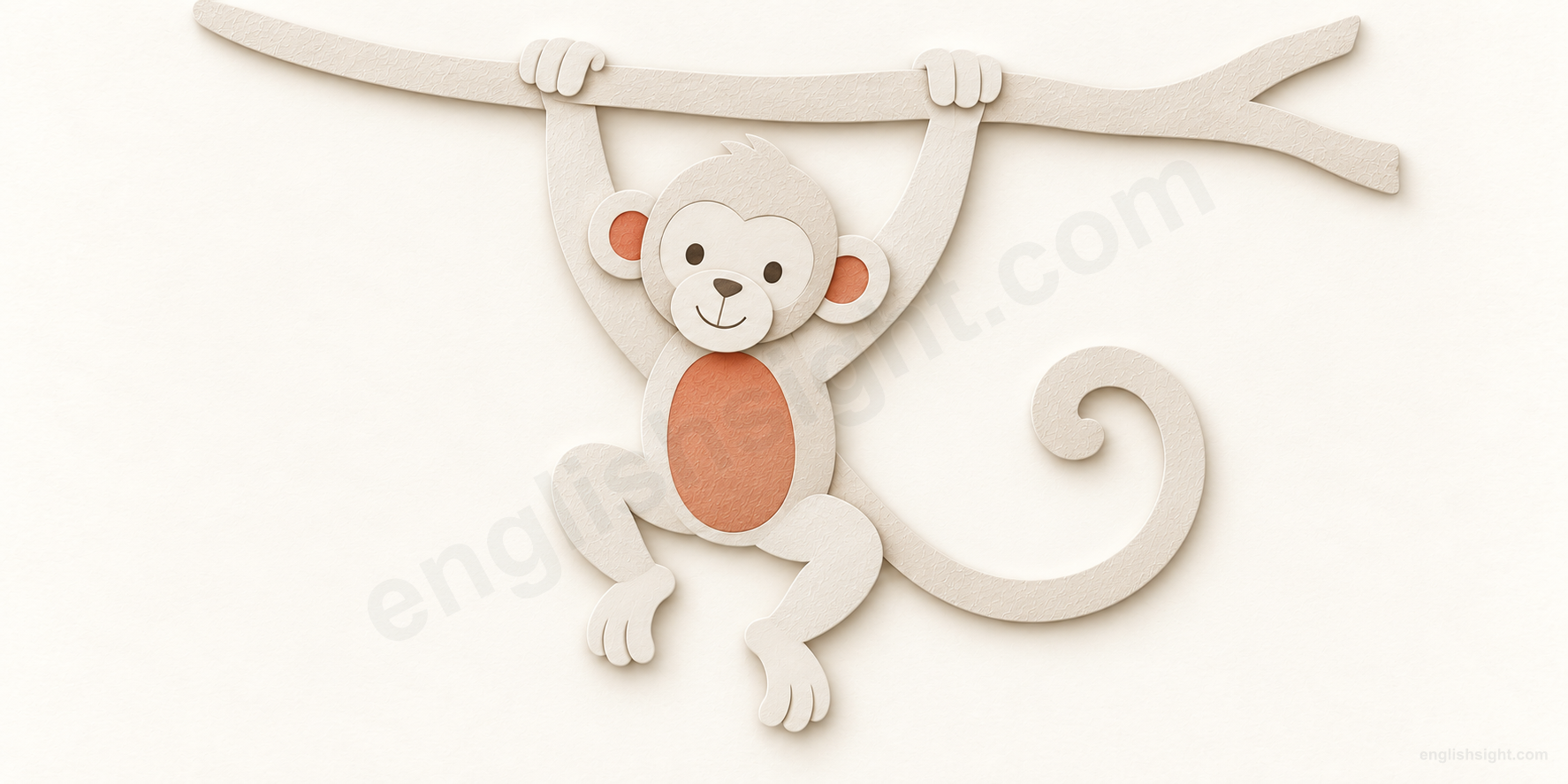
A long-tailed monkey hangs beneath a branch.
monkey
The curled tail and grasping hands help identify the animal.
Both hands grip the branch, and its legs bend below.
This monkey anchors the animal noun. Fixed expressions need their own explanations.
A monkey is a primate, typically with a tail and grasping hands; some informal expressions draw on associations with lively or meddling behavior.
The animal is the literal reference point. Foolishness, dishonest activity, an enduring burden, and a tool name are not interchangeable meanings, and the drawing cannot predict them.
Monkey most directly names a primate. Informal descriptions can borrow an association with playful mischief; other compounds and idioms have meanings you need to learn as whole expressions.
The animal sketch anchors the literal noun. It is a teaching aid, not a claim that every speaker pictures the same animal or that every phrase follows from its behavior.
01
The animal and familiar names
Start with the animal noun, then recognize a playful personal description and two established compounds.
01
a / the + monkey; plural monkeys; a troop of monkeys
a monkey / monkeys
name the animal
Situation
You notice an animal gripping a branch.
What the expression communicates
You identify it as a monkey.
The ordinary noun names an animal, not a kind of behavior.
Monkey is a countable animal name: a monkey, two monkeys. A troop of monkeys names a group. Keep the y in monkeys; do not write monkies.
Monkeys are primates. Many have long tails and climb well. In careful animal descriptions, distinguish monkeys from apes such as chimpanzees; everyday speech sometimes blurs that distinction. The drawing shows one long-tailed monkey, not a definition of every species.
In a sentence
Two monkeys were climbing above the path.
Watch the difference Monkey and monk are different words: a monk is a member of a religious community.
02
a little / cheeky monkey; you + (cheeky) little monkey
you cheeky little monkey
affectionately describe a mischievous child
Situation
A child hides your hat as a joke.
What the expression communicates
You gently tease the child about the trick.
Tone and relationship turn the animal name into a playful description.
You little monkey! can be an affectionate response to a lively child’s trick. Cheeky little monkey adds mild, playful disapproval. This is informal speech, not a description of the child’s species.
The animal provides an association with lively mischief, but the affectionate reading comes from context. It is not a general polite label for strangers or adults.
In a sentence
You cheeky little monkey—you hid my hat again!
Watch the difference Affectionate teasing requires a familiar relationship; the word alone does not guarantee friendliness.
03
the monkey bars; play / climb on the monkey bars
monkey bars
name playground climbing equipment
Situation
Children hang and move along a set of high bars.
What the expression communicates
You name that part of the playground.
The whole compound names equipment for climbing and hanging.
Monkey bars are a playground structure that children climb on or move along while hanging by their hands. The animal connection is a useful memory cue for climbing, not a rule for naming every climbing frame.
The name is plural: The monkey bars are wet. One crosspiece is a bar on the monkey bars, rather than normally being called a monkey bar in this equipment sense.
In a sentence
The children waited for a turn on the monkey bars.
Watch the difference Bars here are physical rails, not places that serve drinks.
04
a grease monkey; plural grease monkeys
a grease monkey
recognize an informal name for a car mechanic
Situation
An older speaker describes a person who repairs cars.
What the expression communicates
You understand the occupation being referred to.
This compound labels a person’s job, not an animal covered in grease.
A grease monkey is an old-fashioned, informal term for someone who repairs cars. In I used to be a grease monkey, the speaker is talking about mechanical work.
Use mechanic as the neutral job name. Grease monkey can sound dismissive when used about someone else, so understanding it does not require adopting it as your usual title for that person.
In a sentence
My uncle calls himself a grease monkey, but his job title is mechanic.
Watch the difference Do not assume that every compound ending in monkey means a mischievous person.
02
Silliness, interference, and suspicious behavior
Read the grammar and context: playing around, changing controls, and dishonest dealings are different uses.
05
monkey around; stop + monkeying around
monkey around
play or behave foolishly instead of being serious
Situation
People are playing jokes when work needs doing.
What the expression communicates
Someone asks them to take the task seriously.
The verb describes behavior; no actual monkey is involved.
Monkey around is informal and intransitive: the people monkeying around are the subject. It can describe harmless silliness or disapprovingly describe wasted time.
Around belongs to the established expression. It does not require movement in a circle. The forms are monkeys around, monkeyed around, and monkeying around. Stop monkeying around uses an -ing form after stop.
British informal English also uses monkey about: We monkeyed about instead of packing. About here has the same time-wasting or unserious sense, rather than introducing a topic.
In a sentence
Stop monkeying around and help me fold these chairs.
Watch the difference This is not a separable verb with a direct object: do not say monkey the task around.
06
monkey with + noun / pronoun; monkey around with + noun / pronoun
monkey with / around with something
interfere with or fiddle with something
Situation
Someone changes controls without knowing what they do.
What the expression communicates
You ask them to leave the controls alone.
With introduces the thing being handled or interfered with.
Monkey with the settings means tamper or fiddle with them. Monkey around with an engine can also describe informal tinkering; context decides whether this is playful experimenting or unwelcome interference.
Compare They are monkeying around, which focuses on silly behavior, with They are monkeying with the controls, which names the object of interference. Keep a pronoun after with: Don’t monkey with it.
British informal monkey about with something also covers unserious tinkering or careless handling: He spent the afternoon monkeying about with an old radio. It is not a precise technical description of a repair.
In a sentence
Please don’t monkey with the thermostat; it is already set correctly.
Watch the difference Say monkey with it, not monkey it with. For a neutral repair, use adjust or repair rather than implying careless interference.
07
no / some + monkey business; get up to monkey business
no monkey business
no silly tricks or mischief
Situation
A group is about to start an activity.
What the expression communicates
The leader asks them to behave sensibly.
The noun phrase describes behavior rather than a commercial activity.
In a playful warning, No monkey business! means no tricks or silliness. The phrase can echo the mischief associated with a little monkey, but it is learned as a whole noun expression.
Business is uncountable here: no monkey business or some monkey business, not a monkey business for one prank. A stricter tone can make the warning serious.
In a sentence
You can use the art room, but no monkey business with the paint.
Watch the difference Business does not mean buying and selling in this expression.
08
monkey business + with + noun; monkey business is going on
monkey business with the accounts
suspicious or dishonest activity
Situation
The financial records do not match the payments.
What the expression communicates
Someone suspects wrongdoing.
The same expression can imply dishonesty, not just harmless fun.
Monkey business with the accounts suggests dishonest dealings. In this setting it is an informal allegation of misconduct, rather than a light description of children playing.
Some monkey business is going on means the speaker suspects questionable activity. The surrounding facts supply the serious interpretation; monkey alone does not specify fraud.
In a sentence
The missing receipts made us suspect monkey business with the accounts.
Watch the difference Do not automatically soften this phrase to a harmless joke in a financial or official context.
03
Learn the complete expression
These phrases express humiliation, burdens, imitation, or disruption. The animal image cannot predict their full meanings.
09
make a monkey (out) of + person
make a monkey (out) of someone
make someone look foolish
Situation
A person is tricked in front of others.
What the expression communicates
The trick makes that person appear foolish.
Make describes the effect on someone’s public appearance, not a literal transformation.
Make a monkey of someone and make a monkey out of someone mean make that person seem ridiculous. The object of of is the person embarrassed: Don’t make a monkey out of me.
The phrase often expresses resentment about being deceived or humiliated. Make a fool of someone is a useful alternative. Learn the full expression rather than treating monkey as a productive adjective after make.
In a sentence
You gave me a fake invitation and made a monkey out of me.
Watch the difference The affected person follows of: make a monkey out of me, not make me a monkey out.
10
have a monkey on + possessive + back; get the / that monkey off + possessive + back
a monkey on your back / get it off your back
a persistent burden, or relief from it
Situation
A problem keeps causing stress over time.
What the expression communicates
You finally resolve it and describe the relief.
On the back presents an ongoing burden; off marks release from it.
Have a monkey on your back is informal and, in the burden sense, especially associated with American usage. It can mean a serious, persistent problem. The phrase can also refer to drug addiction; context matters.
Get the monkey off your back means free yourself from that burden: After years of debt, she finally got that monkey off her back. A repeated sporting failure can also be the burden.
The image of carrying a troublesome animal is a memory aid for this idiom, not the literal animal identification shown in the diagram.
In a sentence
The unpaid loan was a monkey on my back for years.
Watch the difference Do not infer addiction without context. Get off my back! by itself asks someone to stop pressuring you and is a different expression.
11
Monkey see, monkey do.
Monkey see, monkey do.
comment on copying without thinking
Situation
One child copies another child’s silly action.
What the expression communicates
An adult comments on the imitation.
The saying describes imitation, not every use of monkey.
Monkey see, monkey do is a fixed saying about copying what someone else does without much thought. It may be humorous, but it can also criticize a lack of independent judgment.
The short, nonstandard-looking form belongs to the saying. In an ordinary description, use standard agreement: A monkey sees what another monkey does. Do not generalize the saying’s grammar to normal sentences.
In a sentence
One child tapped the window and the others copied him—monkey see, monkey do.
Watch the difference This saying is not a neutral compliment about someone learning a skill carefully.
12
a monkey wrench; plural monkey wrenches
a monkey wrench
name an adjustable gripping tool
Situation
A repair needs a tool whose jaws can fit different widths.
What the expression communicates
The speaker asks for a monkey wrench.
This established compound names a tool, not an animal’s action.
A monkey wrench has an adjustable part for gripping and turning objects of different widths. It is a countable tool name: a monkey wrench, two monkey wrenches.
You may also hear adjustable wrench in North American English or adjustable spanner in British English. Learn the tool name as a unit; the behavior-based memory image does not explain its technical name.
In a sentence
He opened the toolbox and took out a monkey wrench.
Watch the difference The literal tool sense and the plan-disrupting idiom need different contexts.
13
throw a (monkey) wrench in / into + plan / process
throw a monkey wrench into the plans
cause a problem or delay in a plan
Situation
Travel arrangements are ready.
What the expression communicates
A cancellation disrupts the arrangements.
The whole expression means interference with a plan.
In North American English, throw a monkey wrench into something means disrupt what is being planned or done. You can also hear throw a wrench in the works; a British counterpart is throw a spanner in the works.
The cause need not be a person acting deliberately. A sudden illness or cancelled flight can throw a monkey wrench into plans. No actual tool is thrown.
In a sentence
The cancelled ferry threw a monkey wrench into our travel plans.
Watch the difference This does not automatically mean the plan is permanently impossible; it can mean a problem or delay.
14
play monkey in the middle; be / feel like the monkey in the middle
monkey in the middle
a keep-away game, or someone caught between opposing sides
Situation
Two people disagree and each wants you to take their side.
What the expression communicates
You feel caught between them.
The whole expression names a game or a difficult social position.
In North American English, monkey in the middle names a children’s game: two players pass a ball over a third player, who tries to catch it. For example: The three children played monkey in the middle with a soft ball.
It also describes someone caught between people or groups in conflict. The shared link is a middle position, but the argument sense is figurative. British English uses piggy in the middle or pig in the middle. These are established expressions, not meanings you can predict from the animal sketch.
In a sentence
When my two roommates argue, I feel like the monkey in the middle.
Watch the difference An actual monkey or ball is not involved in the argument sense.
04
Regional slang to recognize
Some expressions have a strong tone or a limited regional setting; neutral alternatives are useful.
15
not give a monkey’s + about + noun; not give a monkey’s + whether-clause
not give a monkey’s
strongly say you do not care
Situation
Someone dismisses other people’s opinions.
What the expression communicates
The speaker expresses complete lack of concern.
The fixed negative expression conveys an attitude.
I don’t give a monkey’s means I do not care at all. It is British slang and can sound rude or dismissive. I couldn’t give a monkey’s is another established form.
The apostrophe belongs to the expression, not to an ordinary plural. For a neutral response, say I don’t mind or It doesn’t matter to me, choosing according to the situation.
In a sentence
He said he didn’t give a monkey’s about the reviews.
Watch the difference Recognize the strong tone; it is unsuitable for a tactful reply to someone’s concern.
Keep meaning, grammar, and tone separate
Forms and constructions
Say /ˈmʌŋki/. The plural is monkeys; the verb forms are monkey, monkeys, monkeyed, monkeying. The everyday verb is usually used with around or with. With takes its own noun or pronoun; the lesson does not teach a productive direct-object causative pattern. The rare verb meaning imitate is outside the active-learning scope.
Human labels depend on context
A family’s affectionate little monkey does not make monkey a safe general label for people. Animal comparisons can be insulting. Monkey imitations directed at Black players are a form of racist abuse, not affectionate teasing. Choose neutral descriptions outside clearly welcome familiar teasing.
Extra British recognition notes
A monkey can mean £500 in British slang: It cost a monkey can mean it cost five hundred pounds. Brass monkey weather, or It’s brass monkeys, means very cold weather in British slang. These are recognition notes, not neutral replacements for five hundred pounds or very cold.
Choose by context
Decide whether the expression names something or describes an action, attitude, or problem.
1. Someone is changing settings that should be left alone. Which request names that interference?
2. The missing money suggests monkey business with the accounts. What is being suggested?
3. After paying a long-standing debt, you say you got that monkey off your back. What changed?
4. Choose the correctly written plural animal name.
5. A cancelled train threw a monkey wrench into the schedule. What does this mean?
Sources and teaching notes
The sources below support the meanings and usage distinctions. The explanations, examples, and visual teaching model were created for this lesson; the diagram does not establish the origins of the expressions.
The picture is a teaching aid, not an image shared by every native speaker.