Locate events, measure durations, and recognize the patterns that connect them.
One unit between days and a year
One unit between days and a year
A year contains twelve calendar months.
month
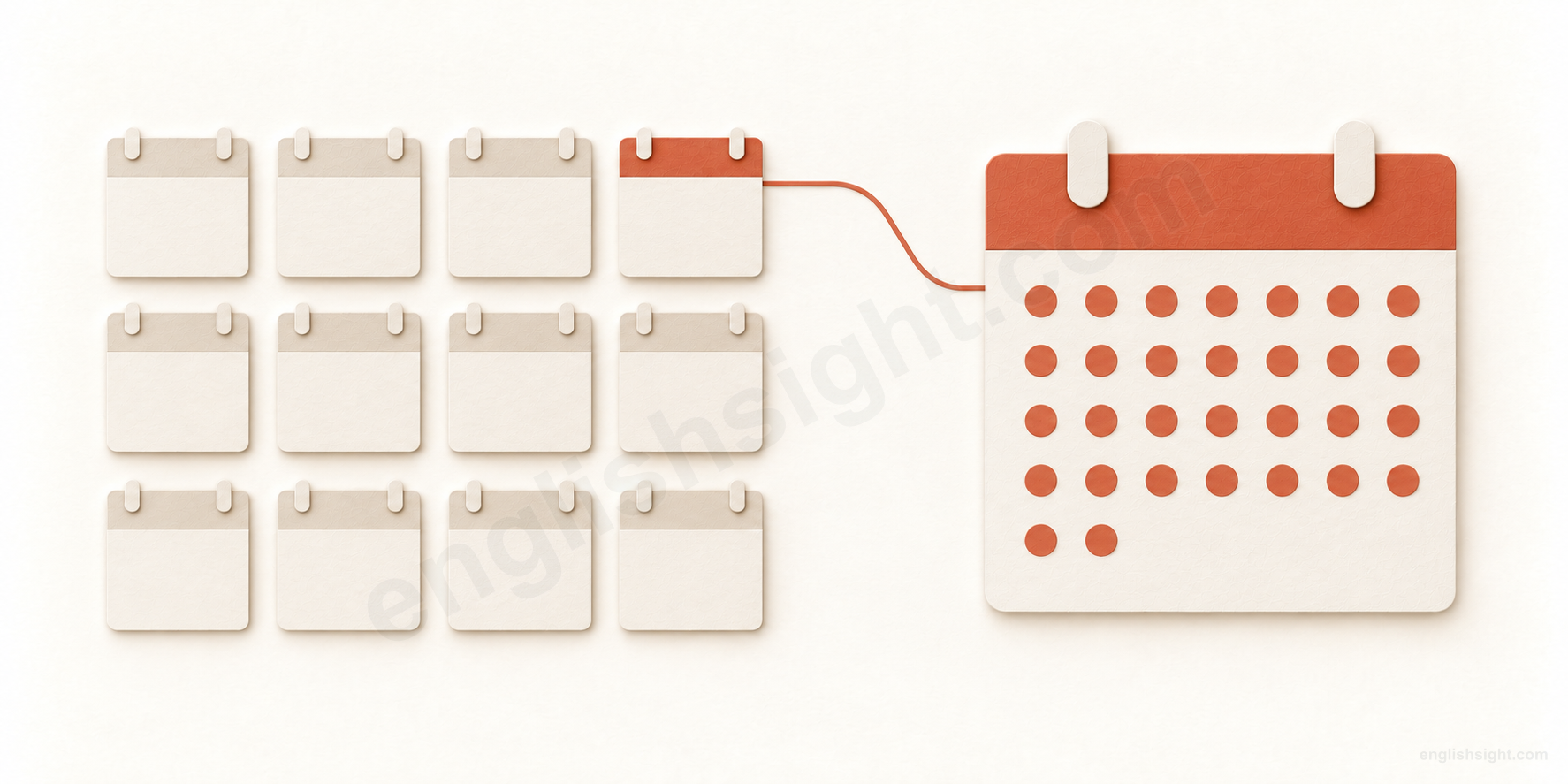
Thirty day markers fill this example month.
One highlighted month is enlarged.
A month is one part of a year and a unit of time. This example has thirty days; calendar months vary in length.
A month is one of the twelve calendar divisions of a year, and it also serves as a unit for measuring time between dates.
The calendar view explains the ordinary unit. Prepositions, determiners, and the sentence tell us whether it is a location, a duration, a rate, or a recurring interval. Fixed idioms need their own explanation.
A month can name a part of the year or measure a stretch of time. In May, for a month, and in a month use the same unit to answer different questions.
Start with the calendar relationship, then read the surrounding words. Some familiar expressions, such as a month of Sundays, have meanings established by the whole phrase. The sketch is a teaching model, not a claim about a picture shared by every English speaker.
01
Find a place in the calendar
A named month locates an event within the year. Other words locate it relative to now or within that month.
01
a / the + month; the month of + name; in + named month
a month; the month of May
one of the twelve divisions of a year
Situation / reference point
You need to name the part of the year.
What the expression tells us
May identifies the relevant month.
A month can be a calendar position, not just a length of time.
Month is a countable noun. A year in the everyday Gregorian calendar has twelve months, January through December. Say a month, one month, or two months.
A named month may stand alone: May is busy. The month of May adds an explicit category. Use in May for an event somewhere within it, but on May 8 for a particular date.
Calendar months have 28, 29, 30, or 31 days. The enlarged calendar in the sketch is just one example; month does not mean exactly four weeks.
In a sentence
The course begins in the month of May.
Watch the difference Capitalize May and the other month names; ordinary month is lowercase.
02
this / next / last + month; the month before last / after next
this month / next month / last month
identify a month relative to now
Situation / reference point
It is April as you make a plan.
What the expression tells us
Next month points to May.
The month changes when the speaking date changes.
This month includes now; next month is the following calendar month; last month is the preceding one. In ordinary time adverbials, these expressions need no in: We met last month.
The month before last means the one before last month. If it is April, that is February. The month after next similarly points past next month, to June.
Next month is not the same as in a month: one names a calendar division, while the other measures an interval from now.
In a sentence
We are visiting the museum next month.
Watch the difference Say next month, not in next month, when answering when.
03
at the beginning / end of the month; in the middle of the month; by the end of the month
at the end of the month
locate an event within a month
Situation / reference point
A deadline falls near the month’s closing days.
What the expression tells us
The end of the month identifies that part.
At locates a time; by sets a latest acceptable time.
Use at the beginning, in the middle, and at the end of the month to locate events. Early this month and late next month are useful shorter expressions.
We will send it at the end of the month says when. Send it by the end of the month allows an earlier date too: the end is the deadline.
During the month places an event somewhere within that period; it does not by itself mean continuously all month. All month or throughout the month can express that wider duration.
In a sentence
Please return the form by the end of the month.
Watch the difference Do not replace by with until for a completion deadline: return it by Friday; keep it until Friday.
04
in recent / the past few months; over the next few months; the first / final months of + noun
in recent months; over the next few months
look across a group of months
Situation / reference point
Several months form the relevant period.
What the expression tells us
You describe events across that period.
Determiners tell us which stretch of months matters.
In recent months looks back from now; over the next few months looks forward across a developing period. A few means a small number: a few months.
Last month names the preceding calendar month. In the last month usually looks back over roughly one month up to now. The last month of the course instead means its final month.
The phrase “the summer months” groups months by season. The phrase “the first months of a project” groups them by a stage of an activity; neither expression creates a new length for the unit.
In a sentence
We have added two new classes in recent months.
Watch the difference The last month can mean most recent or final; read the surrounding words.
02
Measure a stretch of time
The same unit measures how long something lasts, how far away an event is, or how old someone is. The construction supplies the relationship.
05
for + number + month(s); take + duration; spend + duration + -ing
for a month; take two months
say how long a situation lasts
Situation / reference point
A stay runs from July 10 to August 10.
What the expression tells us
You measure the stay as one month.
A duration need not begin on the first day of a named month.
For a month gives the length of a situation: We stayed for a month. A month can run from a date in one month to the corresponding date in the next.
Take two months measures time needed: The repair took two months. Spend two months doing something focuses on the person’s use of that time.
Four weeks is always 28 days, whereas a month varies. For bookings or agreements where the precise length matters, confirm the dates and the relevant rules rather than treating month as an exact number of days.
In a sentence
We stayed in the village for a month.
Watch the difference For answers how long; in August answers when. A calendar month can also mean a date-to-corresponding-date interval.
06
in + number + month(s); in a month’s time; within a month
in a month; in a month’s time
place an event one month from now
Situation / reference point
Today is September 12.
What the expression tells us
A one-month interval leads to October 12.
In plus a duration can locate a future event.
I will return in a month puts the return about one month after now. In a month’s time makes the same relationship explicit.
If today is September 12, next month means October generally; in a month points to around October 12. The exact date still depends on how precise the plan is.
Within a month means no later than one month from the reference point, possibly sooner. For a month instead describes the length of the stay or activity.
In a sentence
I will be back in a month.
Watch the difference In a month does not mean that the return itself lasts a month.
07
number + month(s) + ago / later; number + month(s) + before / after + event
a month ago; two months later
measure from a time reference
Situation / reference point
You choose now or a past event as the reference.
What the expression tells us
Ago looks back from now; later looks forward from that event.
The reference point comes from the whole expression.
A month ago counts backward from now. A month later normally counts forward from an already mentioned time: We arrived in June and left a month later.
A month before the exam and a month after the move attach the measurement to a named event. The noun month supplies the unit; before or after supplies the direction.
How many months ago? asks for a count. How long ago? leaves the choice of unit open.
In a sentence
We moved here two months ago.
Watch the difference Use ago with a past reference from now: We moved two months ago, not since two months.
They finished the model in a month measures the interval from starting to finishing. The endpoint comes from finished, not from month alone.
Compare They worked on it for a month. That measures the activity but does not tell us it was finished. They will start it in a month instead locates a future start.
Ask How long did it take? for time needed, and When did you finish? for the date. Both answers may contain month, but they give different information.
In a sentence
They built the model in a month.
Watch the difference Read the verb and tense before deciding whether in a month means time taken or a future interval.
09
be + number + months old; a + number-month-old + noun; be + number + months pregnant
six months old; in her sixth month
measure age or a stage of pregnancy
Situation / reference point
A baby’s birth is the starting point.
What the expression tells us
Six months have passed since that point.
Age is a duration measured from a beginning.
The baby is six months old uses a plural unit after six. For an age question, ask How old is the baby? or How many months old is the baby?
A six-month-old baby uses singular month inside the compound description before the noun. The baby is six months old uses separate words and plural months.
She is in her sixth month can refer to pregnancy when that context is clear. She is six months pregnant states duration; it does not mean that she herself is six months old. These are ways of speaking, not precise clinical dating instructions.
In a sentence
Their baby is six months old today.
Watch the difference Say six months old, not six month old; use a six-month-old baby before the noun.
03
Build useful month expressions
Rates, schedules, descriptions, and time-related possessives use the month as a unit in different grammatical patterns.
10
amount + a / per month; paid by the month
€20 a month; per month; by the month
express an amount for each monthly unit
Situation / reference point
You compare subscription prices.
What the expression tells us
The price is stated for each month.
A and per can set the unit for a rate.
Twenty euros a month and twenty euros per month give a price for each month. Per is especially useful in price lists and other concise statements.
Paid by the month describes the basis on which pay is arranged. It does not alone tell you the payment date. A monthly salary names the corresponding one-month amount.
Compare twenty euros for a month’s access: this describes what one purchase covers. The amount may be the same, but the wording does not by itself promise an ongoing subscription.
In a sentence
The online course costs twenty euros a month.
Watch the difference Keep month singular after a or per: per month, not per months.
11
once / twice a month; every / each month; every two months / every other month
twice a month; every other month
say how often an event happens
Situation / reference point
You arrange a recurring visit.
What the expression tells us
The visit occurs twice within each month.
Frequency counts occasions per unit, not length per occasion.
Once a month means one occasion per month; twice a month means two. Every month and each month describe recurrence without specifying an exact day. Monthly can describe something happening once a month or every month: a monthly meeting.
Every two months and every other month both describe a two-month interval between occasions. That differs from twice a month, which fits two occasions into one month.
We meet on the first Monday of every month gives a rule for the day as well. Month sets the calendar unit; the added phrase chooses a point within it.
In a sentence
We meet twice a month to practise speaking.
Watch the difference Twice a month and every two months are different schedules.
12
a + number-month + noun; a month-long + noun
a three-month course; a month-long trip
use a duration to describe a noun
Situation / reference point
You need to describe the length of a course.
What the expression tells us
Three months becomes a compound description.
A unit inside a number-plus-unit modifier stays singular.
A three-month course is a course lasting three months. The hyphen joins the words that work together before course, and month has no plural s there.
Compare The course lasts three months: here months is an ordinary plural noun. A month-long trip describes a trip lasting about one month.
Monthly lessons are recurring lessons. A three-month course describes total length; it does not say whether the lessons happen daily, weekly, or monthly.
In a sentence
I have enrolled in a three-month course.
Watch the difference Write a three-month course, not a three-months course.
13
a month’s + noun; number + months’ + noun; this month’s + noun
a month’s notice; this month’s news
connect a month with a quantity or related thing
Situation / reference point
A rule requires notice one month before departure.
What the expression tells us
The notice period is expressed with a possessive form.
The apostrophe marks a time relationship, not literal ownership.
A month’s notice is notice given one month in advance. Two months’ notice uses a plural time expression, with the apostrophe after the s.
This month’s news means news associated with this month. It does not mean that the month literally owns the news. A month’s work similarly means work amounting to or done over a month.
A two-month notice period uses a compound modifier instead: singular month, hyphen, no possessive apostrophe. Keep this structure distinct from two months’ notice.
In a sentence
The agreement requires a month’s notice.
Watch the difference One month: month’s. Two months: months’. Neither is the spelling of the ordinary plural months.
04
Repetition, emphasis, and fixed expressions
Some expressions count successive months; others have an established figurative meaning that needs to be learned as a whole.
14
for months; take months; not + perfect verb + in / for months
for months; not in months
emphasize a long interval without giving an exact count
Situation / reference point
A reply has still not arrived.
What the expression tells us
You stress that the wait is long.
Plural months can leave the number unstated.
We have waited for months gives a long duration without a precise count. It took months has the same open-ended unit with take.
I haven’t heard from her in months means that no message has arrived during a long recent period. I haven’t heard from her for months is also natural.
The plural does not always exaggerate: a speaker may literally mean several months. Context tells you whether the emphasis is mainly emotional or factual.
In a sentence
I haven’t used this camera in months.
Watch the difference In months here describes an interval with no event; it does not place an event in the future.
15
month after month; month in, month out
month after month; month in, month out
emphasize continuing recurrence
Situation / reference point
The same delay happens across successive months.
What the expression tells us
You emphasize how persistently it repeats.
The repetition belongs to the whole expression.
Month after month highlights recurrence or continuation across a series of months. It can describe welcome progress or frustrating delay; it is not necessarily negative.
Month in, month out likewise stresses repeated monthly experience, often a familiar routine. It is an established time expression, not a verb with separable particles.
Every month states a schedule neutrally. These longer expressions draw more attention to persistence over time.
In a sentence
Month after month, the volunteers keep the garden tidy.
Watch the difference Keep singular month in both halves; do not interpret in and out as physical movement.
16
verb + month by month; a month-by-month + noun
month by month
follow change or details one month at a time
Situation / reference point
You arrange records in monthly stages.
What the expression tells us
Each month can be considered separately.
By highlights successive units in a process or account.
Month by month can track gradual change: My confidence grew month by month. It can also describe an ordered account: We reviewed the spending month by month.
Month after month often emphasizes persistence. Month by month often emphasizes stages, comparison, or development. The two can overlap; they are not rigid opposites.
Before a noun, write a month-by-month plan. The connected words describe how the plan is organized.
In a sentence
We reviewed the spending month by month.
Watch the difference Month by month does not mean that every month’s figures must rise or improve.
17
selected noun + of the month
employee of the month
identify a monthly selection or honour
Situation / reference point
A workplace chooses one person for recognition.
What the expression tells us
That person receives the month’s award.
Of the month can mark a choice made for that month.
Employee of the month is a title for someone selected for special recognition during a particular month. Book of the month can similarly label a featured selection.
Compare the first day of the month: this is an ordinary part-of relationship, not an award. The noun and situation determine which reading fits.
The label alone does not say how the selection was made or whether it was objectively best.
In a sentence
Mina was named employee of the month.
Watch the difference Do not assume every of the month phrase describes a competition.
18
be + (the) flavour / flavor of the month
flavour / flavor of the month
describe someone or something currently fashionable
Situation / reference point
A new style attracts widespread attention.
What the expression tells us
It is very popular for the moment.
The idiom concerns current popularity, not a measured duration.
Calling something the flavour of the month presents it as a current favourite. The wording can suggest that enthusiasm may not last, although it does not guarantee a quick decline.
Flavour is British spelling; flavor is American spelling. The established idiom may describe a person, an idea, a product, or a trend.
On an ice-cream sign, flavour of the month can also have a literal promotional meaning: a flavour featured that month. In the figurative use, no food or exact one-month limit is required.
In a sentence
Minimalist packaging seems to be the flavour of the month.
Watch the difference Popularity belongs to the idiom as a whole; month itself does not mean fashionable.
19
take a month of Sundays; not / never in a month of Sundays
a month of Sundays
emphasize an extremely long time or an unlikely outcome
Situation / reference point
Someone proposes finishing a huge job very quickly.
What the expression tells us
You reject the proposed timescale emphatically.
This informal idiom uses exaggeration rather than calendar arithmetic.
A month of Sundays means a very long time. It took a month of Sundays to sort those papers is an informal exaggeration, not a precise record.
Not in a month of Sundays often says something is extremely unlikely or effectively impossible. The negative makes the refusal or disbelief especially strong.
The calendar sketch can remind you that months contain time, but it cannot predict this established idiom. Learn the full expression and its tone.
In a sentence
We couldn’t finish all these repairs in a month of Sundays.
Watch the difference Do not count the Sundays or use this idiom as an exact deadline.
20
it is + that time of the month
that time of the month
an indirect way to refer to a menstrual period
Situation / reference point
Someone refers indirectly to having their period.
What the expression tells us
The phrase is understood from the personal context.
The established phrase supplies the indirect meaning.
It’s that time of the month can mean that the speaker is having their menstrual period. This is a euphemism: an indirect expression used instead of naming something directly.
The words can also be literal. At this time of the month, we send the bills simply identifies a point in a monthly routine. Context distinguishes the readings.
Month alone does not mean menstruation. Learn the whole expression; the calendar model does not by itself explain this established use.
In a sentence
It’s that time of the month; could you buy me some pads?
Watch the difference Period names it directly; that time of the month refers to it indirectly.
Keep the unit separate from the pattern
Month is a noun
The ordinary forms are month and months. This noun lesson has no verb tense, passive, causative, or phrasal-verb family to invent. The common pronunciation is /mʌnθ/; do not confuse month with the separate word moon.
How many, how long, or when?
How many months? asks for a count. How long? asks for duration. What month? asks for a calendar name, and When? may take a date or a relative expression. Choose the pattern for the question you are answering.
Calendar months and lunar months
A lunar month, in its common new-moon-to-new-moon sense, averages about 29½ days. It is not simply another name for every calendar month. Technical astronomical varieties and detailed calendar systems are outside this everyday lesson.
Spelling carries grammar
Three months is a plural count. A three-month course uses a singular unit in a compound. Three months’ work uses a plural time possessive. These spellings express different structures.
Choose the time relationship
Use the situation and the whole phrase, not just the word month.
1. It is April 25. You want to say that the visit is somewhere in May, without naming a date. Which fits?
2. Your stay lasted one month. Which sentence gives its duration?
3. A club meets in January, March, May, and so on. Which schedule describes it?
4. Choose the correct description before the noun course.
5. Which sentence says that the model reached completion after one month of work?
6. Someone says, “Not in a month of Sundays!” What do they mean?
Sources and teaching notes
Publisher definitions and usage examples support the inventory below. The explanations, situations, examples, and calendar model were created for this lesson; the picture is a teaching interpretation.
The calendar is a teaching model of the time unit, not a universal mental picture.