Use morning to locate routines, clock times, greetings, and the start of a day.
The day’s early stretch
The day’s early stretch
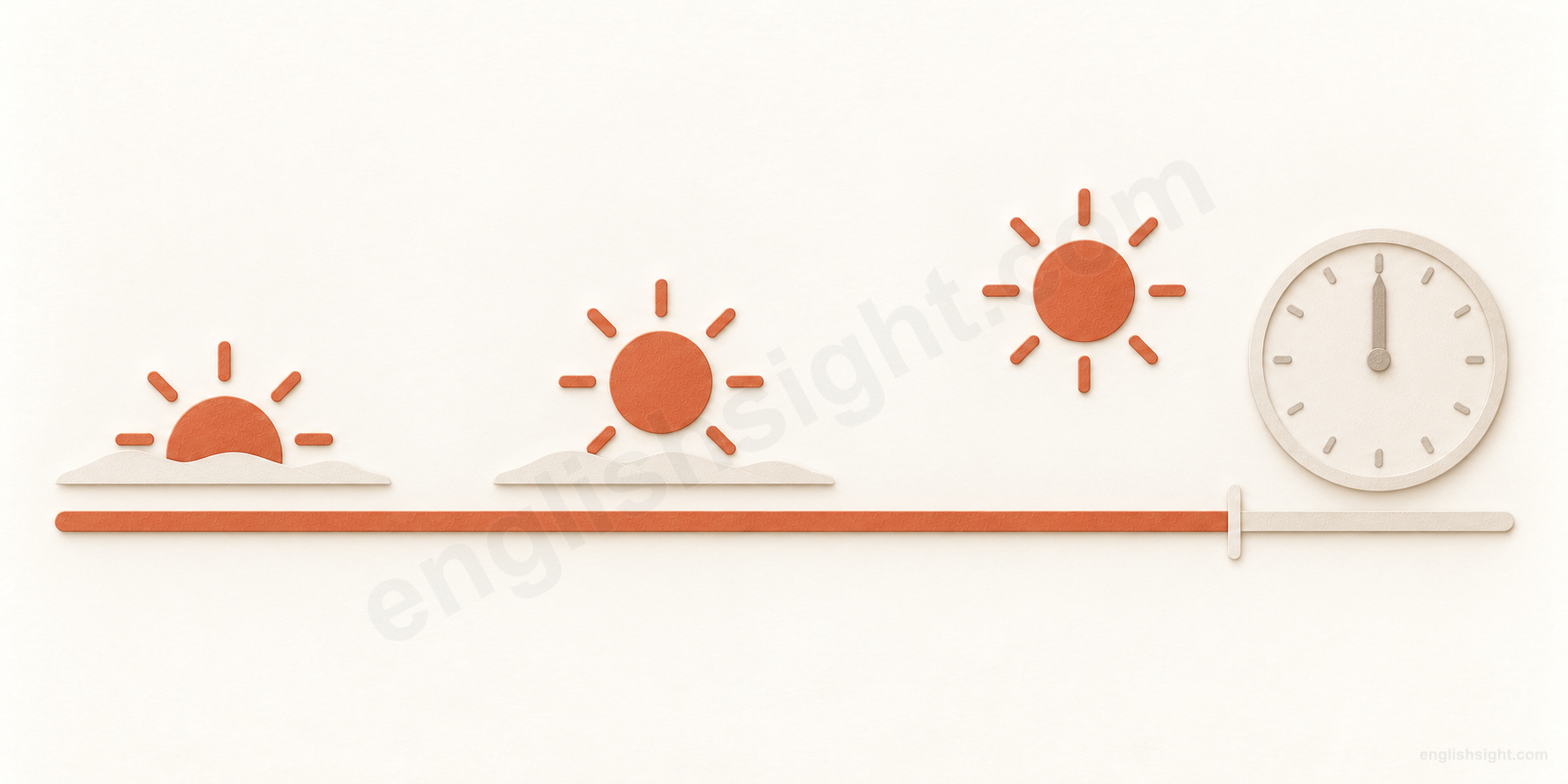
Daylight begins with a low sun at the horizon.
morning
The strip ends at a boundary beside a clock showing noon; pale time continues beyond it.
A continuous orange strip links successive stages of the early day.
Morning covers the early hours before noon, not just sunrise.
Morning names the early part of a day before noon; with a clock time, it can also include the hours after midnight.
The daylight sketch illustrates the familiar everyday use. Clock expressions such as two in the morning extend the range into darkness. A greeting and fixed expressions have additional conventions.
Think of a day opening up: daylight arrives, people begin their activities, and the hours lead toward noon. Morning names that early time period. It does not name just sunrise or breakfast.
The time phrase around morning tells you which day is meant and how an event relates to it. Established expressions such as a morning person add a meaning that must be learned with the phrase.
01
A part of the day
Start with the time period, then distinguish everyday daylight from the wider clock-time use.
01
a / an + adjective + morning; plural mornings; early morning
a quiet morning
one early part of a day
Situation
You describe the hours before lunch.
What you communicate
You treat them as one period.
Morning names a stretch of time, not only the moment of sunrise.
Morning is normally a noun. In everyday plans it brings attention to the opening hours of the day, usually after people wake and before noon. Noon is twelve in the daytime; afternoon follows it.
A quiet morning and two busy mornings treat individual periods as countable. Compare It was early morning, where early morning names the time of day without an article.
Until morning can point to the arrival of daylight. Dawn is the beginning of daylight, whereas a morning normally lasts much longer. Neither word guarantees sunshine.
In a sentence
We had a quiet morning at home before lunch.
Watch the difference Do not reduce morning to breakfast time: someone can miss breakfast and still have a busy morning.
02
at + clock time + in the morning; at + time + a.m.
two in the morning
a clock time after midnight and before noon
Situation
A train arrives while it is still dark.
What you communicate
You specify 2 a.m., not 2 p.m.
Clock-time morning can include darkness after midnight.
At two in the morning, morning identifies the midnight-to-noon half of the clock. A person can still be awake from the night before; the phrase does not mean they have started their normal daytime routine.
Use at to introduce the clock time: at two in the morning. At 2 a.m. is a compact alternative. At two in the afternoon instead means 2 p.m.
The expression the early hours of the morning often refers to the hours just after midnight. The wider clock use and the everyday waking-hours use overlap without having exactly the same starting point.
In a sentence
Our train arrived at two in the morning.
Watch the difference Two in the morning does not require daylight. Do not write 2 a.m. in the morning: it repeats the same time information.
02
Which morning, and when?
Choose a time expression that identifies a day, a habit, a duration, or a deadline.
03
in / during the morning
in the morning
place an activity in the early part of the day
Situation
You choose between a morning walk and an evening walk.
What you communicate
You name your preferred part of the day.
In places an activity within the time period.
In the morning answers When? without naming a weekday. It can describe a general preference or a particular morning supplied by context.
In an evening conversation, I’ll check in the morning commonly means tomorrow morning. The next-day interpretation comes from the plan and context; morning itself does not mean tomorrow.
During the morning also places something within that period, often while recounting what happened. It does not automatically say that the activity lasted all morning.
In a sentence
I like to read in the morning before work.
Watch the difference Use in the morning as the ordinary general time phrase; at morning is not its usual replacement.
04
this / yesterday / tomorrow morning; early / late + time phrase
this / yesterday / tomorrow morning
identify a morning relative to today
Situation
You make a plan for the day after today.
What you communicate
You specify tomorrow’s early hours.
These time phrases normally need no preposition.
This morning belongs to today, yesterday morning to the previous day, and tomorrow morning to the following day. Their reference changes with the day of speaking.
Use them directly as time expressions: I called yesterday morning; I’ll call tomorrow morning. Early this morning and late tomorrow morning further locate the time.
This morning does not force a past tense. Before a planned event you can say We’re meeting this morning. The verb and context show whether the event is past, current, or future.
In a sentence
I’ll bring the forms tomorrow morning.
Watch the difference Say tomorrow morning, not in tomorrow morning.
05
on + day + morning; on the morning of + date / event; on a + adjective + morning
on Monday morning
identify a morning by its day or date
Situation
You arrange a Monday appointment.
What you communicate
You locate it in the morning of that day.
On introduces a specified day’s morning.
Use on Monday morning, on Christmas morning, or on the morning of June 8. Naming the day or date gives a more specific time than the general in the morning.
A description can also pick out one occasion: on a cold morning. The article a belongs to the noun phrase; on places the event on that occasion.
Monday morning without on is also used, especially in American English: We’ll meet Monday morning. Keeping on is a useful clear pattern for learners.
In a sentence
The interview is on Monday morning.
Watch the difference Compare in the morning with on Monday morning; avoid in Monday morning.
06
the next / following morning; the other morning
the next / following / other morning
locate a morning in a sequence or recent past
Situation
You tell a story about arriving on Tuesday.
What you communicate
You move the story to Wednesday morning.
Next and following depend on the story’s reference point.
The next morning and the following morning normally move forward from a day already mentioned. We arrived on Tuesday. The next morning we unpacked puts unpacking on Wednesday.
Tomorrow morning instead normally counts forward from the day of speaking. It need not identify the same date as the next morning in a past story.
The other morning means on a recent morning, without stating exactly which one. It is a familiar conversational expression, not necessarily yesterday and not the second of two mornings.
In a sentence
We arrived on Tuesday and unpacked the following morning.
Watch the difference Do not translate every next morning in a past story as tomorrow morning.
07
every morning; most mornings; in the mornings; on + day + mornings; work mornings
every morning / on Sunday mornings
describe a recurring routine
Situation
You explain when you regularly swim.
What you communicate
You identify a repeated morning slot.
Plural mornings can refer to recurring occasions.
Every morning means each morning in the relevant routine. Most mornings allows exceptions. In the mornings describes a usual time of day without requiring that it happens every single day.
On Sunday mornings names a repeated weekly occasion. On Sunday morning can identify just one Sunday; context may also make a routine clear.
In I work mornings, mornings functions adverbially and describes a regular work period. Compare two mornings, where mornings is an ordinary plural noun being counted.
In a sentence
I swim on Sunday mornings, but not during the week.
Watch the difference Every takes singular morning: every morning, not every mornings. Most takes plural mornings.
08
all morning; spend the morning + -ing / on + noun; for part of the morning
all morning / spend the morning doing…
describe how the morning is used
Situation
You explain why the kitchen is finally clean.
What you communicate
You describe a morning occupied by cleaning.
A time span can tell us how long an activity occupies us.
All morning presents the morning as the duration of an activity. It usually means the relevant morning hours, not necessarily every minute from midnight.
Spend the morning doing something describes how someone uses that time. Spend the morning on a task is another pattern; the activity comes from doing or the noun after on.
For part of the morning explicitly limits the duration. Compare during the morning, which locates an event and does not itself say how much of the period it occupied.
In a sentence
We spent the morning cleaning the kitchen.
Watch the difference Say spent the morning cleaning, not spent the morning to clean. All morning normally has no in before it.
09
by / until / before morning
by morning / until morning
set a time limit or an end point
Situation
You need a document ready for the start of the next day.
What you communicate
You give a deadline for finishing it.
By and until relate an event differently to the same time boundary.
By morning sets a latest time: I’ll finish by morning allows completion earlier. The exact morning intended is supplied by context.
Until morning says a state or activity continues up to that point: We stayed until morning. In I won’t leave until morning, the negative delays leaving until then.
Compare before morning, which places an event earlier than morning. These meanings come from the prepositions; morning supplies the time boundary.
In a sentence
I’ll finish the report by morning.
Watch the difference I’ll work until morning describes continuing work; I’ll finish by morning gives a completion deadline.
10
first thing in the morning; first thing tomorrow morning
first thing in the morning
do something at the start of the morning’s activities
Situation
You promise to handle a request promptly tomorrow.
What you communicate
You put it near the beginning of your day.
First thing gives the task early priority.
First thing in the morning means very early in the morning’s routine, often as one of the first things someone does. It need not mean the exact moment they open their eyes.
An office worker may mean soon after starting work; a person at home may mean soon after getting up. Ask for an actual time if a deadline needs precision.
In I’ll send it first thing tomorrow morning, tomorrow identifies the day and first thing gives the early position within it.
In a sentence
I’ll reply to your message first thing in the morning.
Watch the difference Do not treat first thing as a guarantee of a particular clock time.
03
Activities and people
Morning can describe a routine or activity, and it also appears in a greeting and familiar descriptions of people.
11
morning + noun
morning coffee / morning news
classify something by its connection with the morning
Situation
You distinguish your early meeting from an afternoon meeting.
What you communicate
You call it a morning meeting.
Before another noun, morning identifies a time association.
A morning meeting takes place in the morning; morning news is news presented then; morning coffee is coffee associated with that part of the day. The head noun tells us what the thing is.
Learner dictionaries may describe morning as a noun used before another noun, a modifier, or an adjective in this use. The practical pattern is the same: morning + noun.
Morning usually stays singular in this position: two morning meetings. The plural ending belongs to meetings because those are the things being counted.
In a sentence
Our morning meeting starts at nine.
Watch the difference Say morning meetings, not mornings meetings. A morning coffee is a drink; a coffee morning names a social event.
12
Good morning (, name)!; Morning!; Have a good morning.
Good morning! / Morning!
greet someone during the morning
Situation
You meet a colleague at the start of the day.
What you communicate
You acknowledge them with a greeting.
The whole expression performs a social action.
Good morning is a polite greeting. Morning! is its shorter, informal version. Used alone this way, morning functions as an exclamation rather than a time phrase.
A greeting does not assert that the weather is good. The words work as an established way of acknowledging someone.
Have a good morning wishes someone a pleasant period ahead. Good morning is primarily a greeting, though formal usage can also use it when taking leave in the morning.
In a sentence
“Morning, Maya!” “Good morning, Ben!”
Watch the difference Keep the article in have a good morning; leave it out of the greeting Good morning!
13
be + a morning person; not be + a morning person
a morning person
someone who functions well early in the day
Situation
You discuss when you have the most energy.
What you communicate
You describe mornings as your preferred time.
The phrase describes a personal preference or tendency.
A morning person tends to enjoy mornings or feel alert and effective then. A person who is not a morning person may prefer to do demanding work later.
This is about a usual tendency, not simply someone who happened to get up early once. You can get up early for a train without describing yourself as a morning person.
Morning modifies person, but the familiar combination conveys more than a person located in the morning. Compare a morning meeting, which just identifies the meeting’s time.
In a sentence
I’m not a morning person, so I plan difficult tasks for the afternoon.
Watch the difference Do not infer someone’s actual wake-up time from this description alone.
04
Expressions to learn as a whole
These phrases add meanings that the time period alone cannot supply. Context and the full expression matter.
14
the morning after + event; the morning after (the night before)
the morning after (the night before)
the following morning, sometimes with a drinking-related implication
Situation
Friends discuss how they felt after a late party.
What you communicate
The next morning is understood in relation to that night.
After supplies the sequence; an established humorous use adds an implication.
The morning after the storm is literal: it names the morning following the storm. After does not by itself imply a party or drinking.
The morning after, especially the morning after the night before, can humorously refer to the morning following an evening of drinking, with its unpleasant effects understood. Context selects that established reading.
If you only mean a later time in an ordinary story, the next morning is a straightforward alternative. Do not assign the drinking implication to every phrase containing morning after.
In a sentence
We joked about the morning after the night before, when nobody wanted breakfast.
Watch the difference The morning after a storm is normally literal; the longer humorous expression is learned as a whole.
15
from morning till / to night; morning, noon and night
from morning till night / morning, noon and night
emphasize a long day or very frequent repetition
Situation
You describe how persistently a child talks about a new game.
What you communicate
You emphasize that the subject comes up constantly.
Listing or spanning parts of the day can emphasize duration or frequency.
From morning till night, also from morning to night, describes a span covering much of the day. It often emphasizes how long someone works or how persistent an activity is.
Morning, noon and night means constantly or very frequently. It need not describe exactly three occurrences or a literal twenty-four-hour schedule.
The first phrase builds a span with from and till; the second lists times as an idiom. In a precise schedule, use actual times instead of relying on this emphasis.
In a sentence
He talks about that game morning, noon and night.
Watch the difference Do not assume morning, noon and night means exactly three times daily.
16
hold / organize / attend + a coffee morning
a coffee morning
a morning social gathering, often for charity
Situation
A community group advertises a fundraiser.
What you communicate
People gather for conversation and refreshments.
Word order distinguishes an event from a drink.
In British English, a coffee morning is a social event held in the morning, commonly involving donations for charity. The phrase names the gathering, not merely one person’s coffee.
Compare my morning coffee: coffee is the head noun, so this is a drink. In a coffee morning, morning is the head noun and the whole combination names an event.
Use attend, organize, or hold a coffee morning. More than one such event gives the plural coffee mornings.
In a sentence
The library is holding a coffee morning to raise money for new books.
Watch the difference Coffee morning is a British event name; do not reverse it when you simply mean your morning drink.
17
have / experience + morning sickness
morning sickness
an established name for pregnancy-related nausea
Situation
You read a personal account of early pregnancy.
What you communicate
You recognize the meaning of a fixed term.
Some combinations need their own definition.
Morning sickness names nausea or vomiting associated with pregnancy, especially its early months. Learn the combination as a term; it is not a general label for every illness felt in the morning.
Sickness is uncountable in this expression: have morning sickness, without a. Someone can have a headache in the morning without that being morning sickness.
The lesson explains the expression so that you can recognize it in conversation or reading. It does not use the word morning to establish a medical timetable.
In a sentence
Her account of early pregnancy included a paragraph about morning sickness.
Watch the difference Do not use morning sickness as the name for an ordinary morning cold or headache.
Choose the time phrase, then check the context
Two useful starting points
Everyday morning often begins with waking or daylight; clock-time morning starts after midnight. The same speaker can say two in the morning about a dark night and get up in the morning about their later routine.
Grammar and sound
The noun has the regular plural mornings. Before another noun it normally stays singular. Morning is not an -ing form of a verb in these uses. Mourning, meaning grief, has the same pronunciation in standard British and American English but a different spelling and meaning.
The model has limits
Morning can poetically describe an early stage, as in the morning of a new era. That extension is useful to recognize but is not a productive substitute for beginning in ordinary plans. Fixed names and idioms need their own definitions; the daylight picture cannot generate all of them.
Find the right morning
Use the day, clock time, and whole phrase to choose the intended meaning.
1. The train arrived at 2 a.m., while it was still dark. Which description fits?
2. A meeting is scheduled for the early part of tomorrow. Which time phrase is standard?
3. You promise that a report will be finished no later than morning. Which sentence gives that deadline?
4. The notice advertises a British social event collecting donations. What does it call the event?
5. A story says, “We arrived on Tuesday. The following morning we unpacked.” When did they unpack?
Sources and teaching notes
Usage was checked against the publisher pages below. Explanations and example sentences are original. The diagram is a teaching model of the time period.
The diagram supports learning; it does not claim that every speaker pictures the word the same way.