Land that rises high; a scale for size and effort.
Describe mountains, place things around them, and understand familiar images of quantity and difficulty.
High land, substantial size, and difficult effort
A substantial rise above the surrounding land
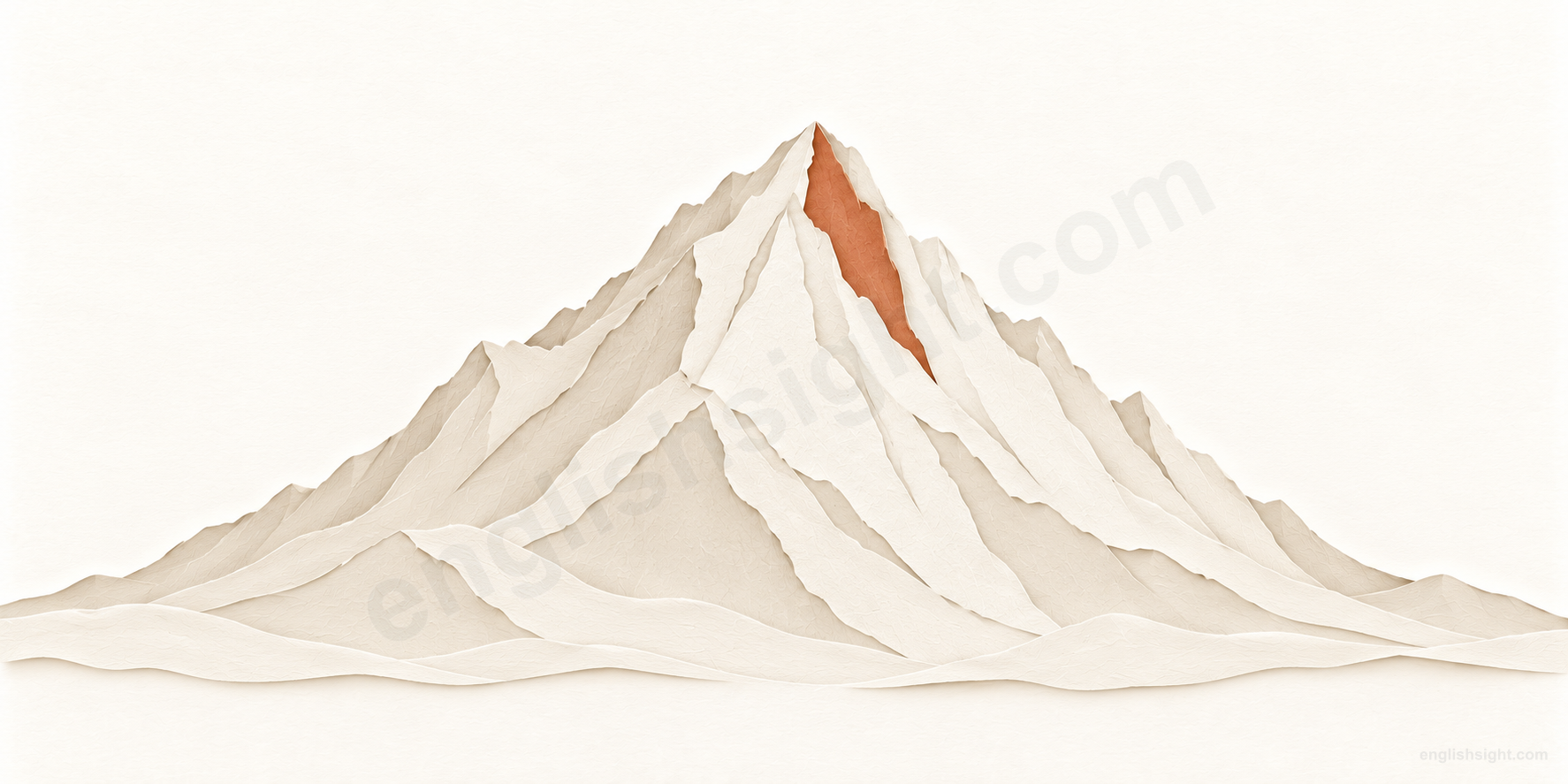
Low ground extends out on both sides.
mountain
One large mountain stands above the surrounding ground.
The slopes rise toward a high rocky summit.
High land above lower surroundings: height and mass help connect mountain with great size and demanding effort.
A mountain is a large natural rise in the land; its height and mass provide a useful image for great size or difficult effort.
The physical relationship is high land against lower surroundings. No change of state is required. Quantity expressions and idioms select different aspects of that image and have their own established meanings.
Start with a mountain as a large natural rise above the surrounding land. Its height and mass also provide useful connections to descriptions of huge amounts and demanding tasks.
These connections help you remember uses; they do not calculate the meaning of every compound or idiom. Learn the whole expression and notice what the surrounding grammar contributes.
01
Mountains, locations, and routes
Name the landform, choose a location phrase, and distinguish one mountain from a connected range.
01
a / the / this + mountain; adjective + mountain
a high mountain
a large natural rise in the land
Situation / starting point
You look beyond the lower ground.
Description / intended meaning
You identify a large, high landform.
Height and substantial rising land distinguish the object.
Mountain is a countable noun: one mountain, two mountains. A singular reference usually needs a determiner, as in a mountain or this mountain. A hill is generally smaller or lower; ordinary English does not give every mountain a single universal minimum height.
A mountain need not have snow or a sharply pointed top. High, steep, rocky, and snow-covered describe particular features. The mountain is high describes height; the mountain is steep describes the angle of its sides. These are different observations.
In a sentence
A high mountain rises behind the lake.
Watch the difference Say We saw a mountain, not We saw mountain, when you mean one ordinary unnamed mountain.
02
in the mountains; on / near + the mountain(s)
in the mountains
in an area with mountains
Situation / starting point
You choose a region for a holiday.
Description / intended meaning
You describe staying among mountains.
The plural can identify a whole landscape rather than one slope.
In the mountains describes a mountainous area. It does not mean inside solid rock. On the mountain locates something on a particular mountain: There is snow on the mountain, or The hut is on the mountain.
Compare We stayed in the mountains with We stayed near the mountains. Near places the accommodation close to that area and does not necessarily put it within it. The surrounding words supply the location relation; mountain itself does not mean in, on, or near.
In a sentence
We rented a small house in the mountains.
Watch the difference For a general mountain holiday, in the mountains is natural; in the mountain normally suggests a location inside one mountain.
03
climb + a / the mountain; halfway up / down + the mountain
climb a mountain
go upwards on a mountain
Situation / starting point
Walkers begin at a lower point.
Description / intended meaning
They travel upwards, perhaps all the way to the top.
Climb names the action; mountain is what is climbed.
Climb a mountain and climb up a mountain can describe upward travel. Climb does not always mean using ropes or specialist equipment: context tells you how difficult the route is. A plan to climb a mountain does not itself guarantee reaching the summit.
We climbed halfway up the mountain explicitly gives an incomplete ascent. We reached the top of the mountain explicitly states the endpoint. Walk down the mountain gives the reverse direction. These are ordinary verb and location combinations, not phrasal verbs built from mountain.
In a sentence
We climbed halfway up the mountain before the rain began.
Watch the difference Use reach the top to make successful arrival explicit; do not assume every mention of climbing reports a completed ascent.
04
at the foot / top of + the mountain; on the side of + the mountain
the foot / side / top of a mountain
identify parts of a mountain
Situation / starting point
You need to locate a village or a route.
Description / intended meaning
You name the lower edge, slope, or highest part.
Part words locate something more precisely than mountain alone.
The foot of a mountain is its base area, the side is a sloping part, and the top or summit is its highest part. In this setting foot is a conventional way to name a base; it does not describe a body part.
At the foot of the mountain places a village or starting point near its base. On the side of the mountain places it on a slope. At the top emphasizes reaching or occupying the highest part. Learn the whole location phrase rather than assigning one preposition to every mountain location.
In a sentence
The village lies at the foot of the mountain.
Watch the difference The foot of a mountain is its base, not its highest peak; a peak can also mean a pointed summit.
05
a mountain range; a range of mountains; mountain ranges
a mountain range
a connected group or chain of mountains
Situation / starting point
You see several neighboring mountains.
Description / intended meaning
You describe the connected group as one range.
Range names the group; mountain tells us what forms it.
A mountain range is a group of connected or neighboring mountains, often extending in a line. A range of mountains presents the same kind of grouping with an of-phrase. It is more specific than several mountains, which need not be treated as one system.
Keep mountain singular before range: one mountain range, two mountain ranges. The plural ending belongs to range because ranges are being counted. Compare The mountains are visible with The mountain range is visible.
In a sentence
A mountain range stretches along the northern edge of the valley.
Watch the difference The ordinary compound is a mountain range, not a mountains range.
02
Mountains in everyday combinations
Mountain can connect a road, village, or bicycle type with a setting or intended use. The whole combination matters.
You want to describe a road or the air in a region.
Description / intended meaning
Mountain identifies its setting or association.
The following noun names the thing being described.
In mountain roads, mountain villages, and mountain air, mountain modifies the following noun. It can indicate where something is found or what it is associated with. Mountain roads are roads in mountain country, not roads made of mountains.
The modifier usually stays singular even when the region contains many mountains: mountain villages. Dictionaries may label this use as a noun used before another noun or as an adjective. The useful pattern is the same. A mountainous area has many mountains or a strongly mountain-like landscape; mountain air names a kind of air by its setting.
In a sentence
The bus follows narrow mountain roads.
Watch the difference Say mountain roads, not mountains roads. Mountainous roads does not convey the same ordinary description.
07
a mountain bike; mountain bikes; go mountain biking
a mountain bike
a bicycle designed for rough ground
Situation / starting point
You choose a bicycle for an uneven trail.
Description / intended meaning
You select a type built for rough terrain.
A familiar compound names a designed type, not just its current location.
A mountain bike is a sturdy bicycle designed for rough ground, typically with broad tires. It can be ridden away from mountains too. Conversely, an ordinary bicycle taken into the mountains does not become a mountain bike simply because of where it is.
The activity is mountain biking: We go mountain biking at weekends. Learn this compound as the established name of an activity. Here mountain tells you something about the type or intended use; it does not assert that every ride involves a mountain.
In a sentence
I use my mountain bike on the rough trail beside the river.
Watch the difference Do not infer a mountain location from mountain bike alone; it names the bicycle type.
03
Very large amounts and striking size
The landform’s size can supply an emphatic comparison. A quantity of things and the size of one person use different patterns.
08
a mountain of + uncountable / plural noun; mountains of + uncountable / plural noun
a mountain of work / mountains of food
emphasize an extremely large amount or number
Situation / starting point
You face more work or food than expected.
Description / intended meaning
You describe its quantity vividly.
Size is transferred from land to an amount; the shape may be imaginary.
A mountain of laundry can describe a real tall pile. A mountain of work describes a large workload without claiming that tasks have a physical mountain shape. This informal use adds emphasis rather than an exact measurement.
Use of before the thing involved: a mountain of paperwork, mountains of food, or mountains of letters. An uncountable noun such as work stays uncountable; a countable item normally appears in the plural, such as letters. The choice of singular mountain or plural mountains intensifies the image but gives no precise total.
In a sentence
After the festival, we had a mountain of dishes to wash.
Watch the difference Say a mountain of work, not a mountain of works, when work means tasks in general.
09
a mountain of a man
a mountain of a man
a strikingly large, strongly built man
Situation / starting point
A man’s physical size stands out.
Description / intended meaning
A speaker describes him with an emphatic comparison.
This of a pattern compares one person’s size with a mountain.
A mountain of a man is an expressive description of a very large, often powerfully built man. It refers to one person, not a large number of men. The size comparison connects with the mountain image, but the whole pattern has to be recognized.
Compare a mountain of dishes, which emphasizes quantity, with a mountain of a man, which describes the size of an individual. The second a matters. This vivid, somewhat literary description can sound personal; a tall, strongly built man is a more neutral description.
In a sentence
The guard was a mountain of a man, with broad shoulders.
Watch the difference Do not interpret a mountain of a man as many men; this pattern describes one individual.
04
Difficult tasks, great efforts, and exaggeration
Learn these established expressions as wholes. The mountain image helps explain them, but the verbs and the full phrases determine the message.
10
have + a mountain to climb
have a mountain to climb
face a very difficult task or obstacle
Situation / starting point
A team falls far behind its goal.
Description / intended meaning
Someone emphasizes the effort still needed.
The remaining task is compared with a demanding ascent.
Have a mountain to climb means that achieving a goal will be very difficult. The person or group has not literally acquired a landform. The to-infinitive points to the challenge still ahead: We still have a mountain to climb.
This expression is especially associated with British English and sports or news reporting. It emphasizes difficulty, not impossibility. A mountain of work emphasizes how much there is; a mountain to climb emphasizes the challenge of succeeding, even when it is not a pile of separate tasks.
In a sentence
After losing the first two games, our team has a mountain to climb.
Watch the difference The idiom does not say success is impossible, and it does not require a literal mountain.
11
move mountains; would move mountains to + verb
move mountains
make extraordinary efforts to achieve something
Situation / starting point
An important goal faces serious obstacles.
Description / intended meaning
Someone works exceptionally hard to make it happen.
Moving something enormous suggests exceptional effort or achievement.
Move mountains is an idiom for making extraordinary efforts, often overcoming great obstacles to get something done. In I would move mountains to help her, the speaker expresses strong willingness; it is not a report that the goal has already been achieved.
The plural mountains is the familiar idiom form. Compare have a mountain to climb, which presents a difficult task ahead, with move mountains, which focuses on exceptional effort. The idiom is emphatic, so use it when an ordinary made an effort would understate the commitment.
In a sentence
The volunteers moved mountains to get the shelter ready before winter.
Watch the difference Do not treat move mountains as a promise that every obstacle can be removed; context determines whether it reports action or willingness.
12
make a mountain out of a molehill
make a mountain out of a molehill
treat a small issue as if it were a major problem
Situation / starting point
A minor mistake has little practical effect.
Description / intended meaning
Someone reacts as though it were a serious crisis.
The expression contrasts the actual small issue with an exaggerated version.
A molehill is a small heap of soil made by a mole. The idiom sets that small mound against a mountain: a speaker thinks someone is giving a minor matter far too much importance. It usually expresses criticism of the reaction.
It does not simply mean solve a difficult problem or turn a small project into a large success. Saying You’re making a mountain out of a molehill can sound dismissive if the other person sees a real problem. Use it with attention to their concern, rather than as a neutral measurement of seriousness.
In a sentence
It was one late reply, but he made a mountain out of a molehill.
Watch the difference Keep the direction: a small molehill becomes an exaggerated mountain in someone’s reaction.
Keep the noun, the pattern, and the context together
Forms and word class
Mountain is normally a countable noun, with plural mountains. Before another noun it usually stays singular: mountain roads. Some dictionaries classify this modifying use as adjectival. The verb constructions, tense, passive voice, and particle placement of a verb lesson do not form a separate mountain grammar family.
Mountain, hill, and Mount
A hill is generally lower or smaller than a mountain; ordinary names do not follow one universal numerical boundary. Capitalized Mount or Mt occurs in names such as Mount Everest. It is not an all-purpose replacement for mountain: an unnamed landform is a mountain, not normally a mount in modern everyday English.
An image has limits
A mountain of work can be manageable, and a mountain to climb can be overcome. Do not turn an expression of quantity or difficulty into a claim of impossibility. Compounds that name animals or plants and specialized historical uses need their own explanations.
Choose the meaning and the pattern
Use the situation to decide whether mountain names land, quantity, or an established comparison.
1. Your holiday house is in a region containing many mountains. Which wording describes that setting?
2. A bus uses roads through mountain country. Which is the ordinary noun combination?
3. You mean a large amount of work, with no claim that success is impossible. Which phrase fits?
4. A team is far behind but still has a chance. What does “They have a mountain to climb” mean?
5. A colleague made extraordinary efforts to arrange urgent help. Which expression emphasizes those efforts?
6. A tiny spelling error causes no difficulty, but someone treats it as a disaster. Which expression criticizes that reaction?
Sources and teaching notes
The linked dictionary entries support the uses and distinctions in this lesson. Explanations and example sentences are original; connections to the visual model are teaching interpretations.
The diagram is a learning aid; English speakers need not share one mental picture.