Follow mouth from the body part to openings, ways of speaking, and familiar idioms.
An opening used for eating and speaking
The body part and its two everyday functions
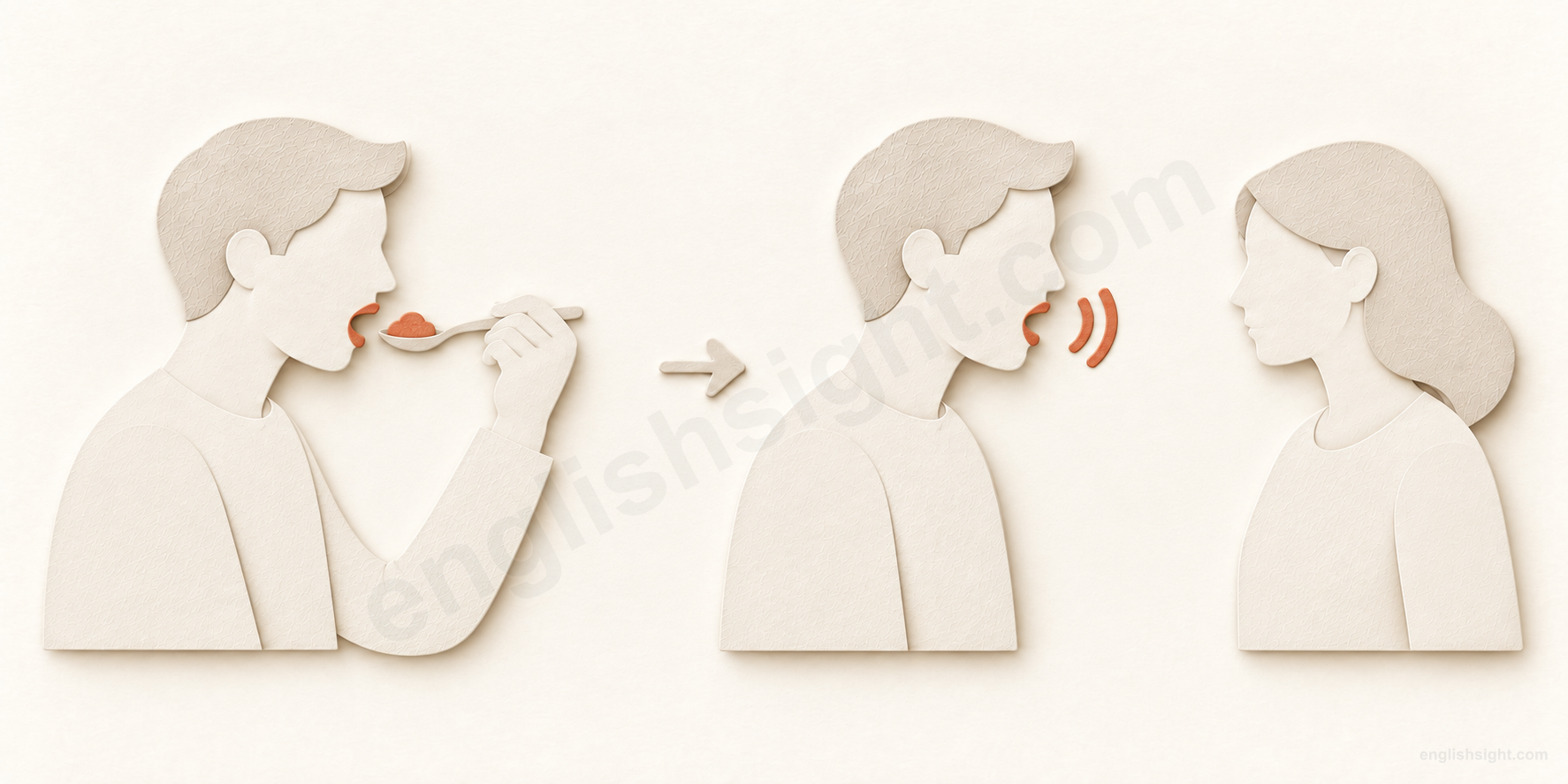
Food is brought toward the open mouth.
mouth
The same person then uses the mouth to speak to a listener.
The orange-edged opening stays the focus as its use changes.
The mouth takes in food and helps form speech.
Mouth names the opening in the face and the space behind it, used to take in food and form speech.
The picture identifies the body part. Openings in objects extend the opening idea; speech expressions focus on what comes from it. Fixed idioms have additional meanings that the picture alone cannot predict.
A mouth is the opening in a person’s or animal’s face and the space inside it. Eating and speaking provide useful connections to several other uses of the word.
The opening of a cave resembles a mouth; mouths to feed counts people through their need for food. Other expressions are established idioms and must be learned as whole expressions. The connections here are teaching aids, not a claim about a picture shared by every English speaker.
01
Eating, speaking, and the body
Start with the body part. Read the surrounding words to distinguish an action, a physical state, and a familiar expression about food.
01
possessive + mouth; in / around + possessive + mouth
your mouth
the opening in the face and the space inside it
Situation
A person finishes a drink.
What happens or is meant
They wipe the area around their lips.
Context can focus on the visible lips or the inner space.
Mouth is countable: one mouth, two mouths. It includes more than the lips alone; the lips border it, while the teeth and tongue are inside. Your mouth usually identifies the owner of this body part.
Compare She wiped her mouth with There is something in her mouth. The first can concern the outside area; in points inside. The roof of your mouth is its upper inner surface, and the corners of your mouth are where the lips meet at the sides.
Common actions keep this physical meaning: Close your mouth asks someone to bring their lips together, and She covered her mouth when she coughed describes putting a hand or another covering over the opening. Covering the mouth does not necessarily mean closing it.
In a sentence
There is a piece of rice in your mouth.
Watch the difference Lips names the two outer edges; it does not normally name the whole inner space.
02
open + possessive + mouth; possessive + mouth + fall / drop open
open your mouth
open the lips, or begin to speak
Situation
A person is about to answer.
What happens or is meant
They begin speaking.
The same movement can introduce speech or show surprise.
Open your mouth can be a physical instruction, or refer to starting to speak: Before I could open my mouth, she answered for me. The speaking interpretation comes from the context, not a separate meaning of open.
His mouth fell open when he saw the bill describes surprise, not a fall to the floor. Open-mouthed is an adjective: We stared open-mouthed at the enormous cake. These forms focus on a visible reaction.
In a sentence
I opened my mouth to reply, but the bell rang.
Watch the difference Open-mouthed describes the person or reaction; it is not a past-tense form of the verb mouth.
03
with + possessive + mouth + full; mouth + be full of + food
with your mouth full
while food is still in your mouth
Situation
A child is chewing.
What happens or is meant
They wait before answering.
With introduces the state accompanying an action.
Talk with your mouth full describes talking while food remains inside. Full refers to the mouth containing food; it need not mean that every bit of space is occupied.
Your mouth is full of rice names the contents. Compare a mouthful of rice: mouthful is a separate noun for an amount, not an alternative plural of mouth.
In a sentence
He tried to answer with his mouth full.
Watch the difference The plural of mouth is mouths; mouthfuls counts amounts.
04
possessive + mouth + water; make + possessive + mouth + water
make your mouth water
make you eager to eat something appetizing
Situation
Warm bread comes out of the oven.
What happens or is meant
Its smell makes someone want a bite.
Water is a verb describing saliva forming.
My mouth is watering often expresses anticipation of delicious food. In The smell made my mouth water, make takes the mouth as its object and water as a bare infinitive: no to is needed.
The food need not be in your mouth yet. Mouth-watering is a related adjective: a mouth-watering display of cakes. The bodily reaction makes the connection with appetite easy to remember.
In a sentence
The smell of those rolls made my mouth water.
Watch the difference Say made my mouth water, not made my mouth to water.
05
food + melt in + possessive + mouth
melt in your mouth
be pleasantly tender or soft to eat
Situation
A diner tastes a piece of slow-cooked beef.
What happens or is meant
It is very easy and pleasant to chew.
This can praise texture without literal melting.
Food that melts in your mouth is especially soft or tender. Chocolate may actually melt; a tender piece of meat need not turn into liquid for this expression to fit.
Compare mouth-watering, which can describe how appealing food seems before eating. Melt in your mouth describes the eating experience.
In a sentence
The beef was so tender that it melted in my mouth.
Watch the difference Do not take this praise as a statement that every food literally becomes liquid.
06
have + number / another + mouth(s) to feed
mouths to feed
people whose food and living needs must be provided for
Situation
A family makes its weekly budget.
What happens or is meant
The speaker counts the people depending on that income.
A body part stands for the whole person needing food.
Three mouths to feed means three people to provide for. To feed identifies the need or responsibility; it is not the claim that someone is feeding detached body parts.
Another mouth to feed commonly refers to an additional dependent. It can emphasize financial pressure, so it may sound impersonal if used carelessly about a person.
In a sentence
With two extra mouths to feed, they had to rethink the budget.
Watch the difference Use mouths after a number greater than one.
07
take / be taken + by mouth
by mouth
through the mouth rather than another route
Situation
A reader checks a product label.
What happens or is meant
The wording identifies a route into the body.
By introduces the means or route; the phrase has no possessive.
In take something by mouth, by mouth describes how it enters the body. This is a set route expression, unlike in my mouth, which simply locates something.
The pattern can occur in instructions and descriptions. Learning its grammar does not tell you whether a particular product should be swallowed; that depends on its actual instructions.
In a sentence
The label describes a medicine taken by mouth.
Watch the difference Keep the fixed form by mouth, not by a mouth or by my mouth.
02
Openings in things and landscapes
Mouth can name an opening that resembles a bodily mouth. A river mouth has its own geographical meaning.
08
the mouth of + cave / tunnel / bottle / jar; wide-mouthed + noun
the mouth of a cave / bottle
the opening of a hollow place or container
Situation
Walkers reach a cave.
What happens or is meant
They stop at the opening before going inside.
The shared feature is an opening, not eating or speaking.
The mouth of a cave or tunnel is its opening. The mouth of a bottle or jar is the opening through which its contents pass. This extension resembles a body’s mouth in shape or function.
At the mouth of the cave places someone by the entrance; inside the cave places them beyond it. A wide-mouthed jar has a broad opening. Mouth does not replace door or entrance in every building description.
In a sentence
We left our bags at the mouth of the cave.
Watch the difference For an ordinary house, the front door or entrance is usually the natural choice.
09
the mouth of + river; river + mouth
the mouth of a river
the place where a river flows into a larger body of water
Situation
A river runs toward the coast.
What happens or is meant
Its water enters the sea.
A mouth is at the downstream outlet, not the source.
A river mouth is where its water reaches the sea, a lake, or another larger body of water. River mouth and the mouth of the river are both useful noun patterns.
Compare the source of the river, where it begins. Not every river mouth forms a delta, so the two geographical terms are not interchangeable.
In a sentence
Fishing boats gathered near the mouth of the river.
Watch the difference Do not use river mouth for the upstream starting point.
03
What people say and how they say it
The organ used for speech can stand for speech itself. Learn the whole expression, including its tone and the person each possessive refers to.
10
spread / hear about something + by word of mouth; word-of-mouth + noun
by word of mouth
through people telling one another
Situation
A customer tells a friend about a small café.
What happens or is meant
More people visit after personal recommendations.
Mouth stands for spoken communication.
By word of mouth describes information passing between people rather than through a written announcement. It can concern news, stories, or recommendations; it does not itself mean the information is true.
Word-of-mouth recommendations uses the expression before a noun as a hyphenated adjective. The fixed phrase is by word of mouth, with singular word and no article before mouth.
Straight from the horse’s mouth instead emphasizes hearing information directly from someone involved: I heard it from the owner, straight from the horse’s mouth. It identifies the source, whereas by word of mouth identifies how information spreads.
In a sentence
Most guests heard about the café by word of mouth.
Watch the difference Do not confuse personal recommendation with official confirmation.
The context decides whether silence is general or about one topic.
Keep your mouth shut about the party means do not reveal it. Without an about phrase, the expression can mean holding back an opinion or simply remaining silent.
This is informal and can sound harsh as an order. I kept my mouth shut about the mistake describes the speaker’s own restraint; Please keep this private is often more tactful when asking another person.
In a sentence
I kept my mouth shut about the surprise.
Watch the difference Shut your mouth! is a rude command, not a neutral request for silence.
12
watch + possessive + mouth; have a foul mouth; foul-mouthed
watch your mouth
be careful not to use offensive language
Situation
Someone swears during an argument.
What happens or is meant
Another person tells them to change their language.
Watch means monitor your speech, not look at your lips.
Watch your mouth! is a warning about rude or offensive speech. A foul mouth, and the adjective foul-mouthed, describe a tendency to use such language.
The warning can sound stern or confrontational. Please don’t swear is more explicit and often less aggressive. The noun mouth here represents a person’s way of speaking.
Mouth can also be an uncountable informal noun for disrespectful talk. Don’t give me any mouth means do not answer me rudely, and I won’t take any mouth from you rejects such replies. This can sound confrontational; any mouth here does not count body parts.
In a sentence
“Watch your mouth,” she said when he started swearing.
Watch the difference It does not ask him to check his face in a mirror.
13
have a big mouth; me and my big mouth
have a big mouth
talk too much, boast, or reveal private information
Situation
A friend reveals a plan that was meant to be private.
What happens or is meant
The speaker criticizes their lack of discretion.
The expression judges speech, not the size of a body part.
You have a big mouth can criticize someone for revealing secrets. It can also criticize excessive, loud, or boastful talk: He has a big mouth, but he never listens. The surrounding situation selects the criticism.
Me and my big mouth! is a familiar self-critical reaction after saying something unwise, for example offering to do a job you now regret. Calling someone a big mouth can be insulting.
In a sentence
You told everyone about the trip—you’ve got a big mouth!
Watch the difference A physical description such as a wide mouth does not automatically carry this criticism.
14
put words in / into + possessive + mouth
put words in someone’s mouth
attribute words or a meaning to someone unfairly
Situation
A speaker says a plan is expensive.
What happens or is meant
Someone claims they said it should be cancelled.
The person after in owns the misrepresented statement.
Don’t put words in my mouth objects to someone presenting a claim as yours when you did not say or mean it. In and into both occur in this idiom.
The issue is inaccurate attribution, not someone speaking before you. Compare You took the words out of my mouth, which normally acknowledges that another person said what you were about to say.
In a sentence
Don’t put words in my mouth—I said it was expensive, not impossible.
Watch the difference Keep the possessive tied to the person whose words are being misrepresented.
15
take the words + (right) + out of + possessive + mouth
take the words out of someone’s mouth
say what someone else was just about to say
Situation
You are about to suggest leaving early.
What happens or is meant
A friend makes that suggestion first.
Out of contrasts with in, but the whole expression supplies the meaning.
You took the words right out of my mouth often expresses agreement or surprise because the other person voiced your exact thought first. Right adds emphasis.
This does not normally accuse someone of stealing your published writing, and it does not simply mean interrupting you. The key is that their words match what you intended to say.
In a sentence
“Let’s leave before the traffic gets worse.” “You took the words right out of my mouth.”
Watch the difference Do not swap in and out of: put words in my mouth makes a different complaint.
16
put + possessive + money + where + possessive + mouth + be
put your money where your mouth is
support your stated commitment with practical action
Situation
A person says a local project deserves support.
What happens or is meant
They contribute funds to it.
The expression challenges or demonstrates commitment.
The expression asks for evidence that someone means what they say. Money can be literal funding; the broader idiomatic point is backing words with action.
He put his money where his mouth was changes the possessive and tense to match he. The phrase is informal and can sound like a challenge when addressed directly to someone.
In a sentence
She put her money where her mouth was and funded the first workshop.
Watch the difference The two possessives normally refer to the same person; change is to was when the context requires it.
17
person + be + all mouth
be all mouth
talk boldly without acting as claimed
Situation
Someone repeatedly boasts about confronting a problem.
What happens or is meant
When action is needed, they avoid it.
All makes the criticism about talk unsupported by action.
He’s all mouth is an informal criticism of someone whose bold talk is not matched by action or courage.
Compare have a big mouth, which may concern secrets or excessive talk without saying anything about courage. Neither expression describes someone’s anatomy.
In a sentence
He says he’ll confront the manager, but I think he’s all mouth.
Watch the difference This is a dismissive judgment, not neutral encouragement.
18
shoot + possessive + mouth + off + (about something); run off at the mouth
shoot your mouth off
boast carelessly or reveal something private
Situation
Someone talks loudly about being the best player.
What happens or is meant
Other people hear boastful claims.
Boasting and disclosure are distinct uses of the same idiom.
He was shooting his mouth off about his skills criticizes boastful talk. Don’t shoot your mouth off about our plans instead warns against making private information public.
Run off at the mouth, especially in North American informal speech, criticizes talking too much or foolishly: He ran off at the mouth for an hour. It does not necessarily mean revealing a secret.
In a sentence
He was shooting his mouth off about how easily he would win.
Watch the difference These informal criticisms can insult the person; they are not neutral synonyms for speak.
19
talk / speak out of both sides of + possessive + mouth
talk out of both sides of your mouth
make conflicting claims in different situations
Situation
Someone supports a policy in one meeting.
What happens or is meant
They oppose it when speaking to a different audience.
The criticism concerns inconsistent messages.
This expression is especially associated with US usage. It accuses someone of giving different or incompatible opinions to different people, often to please each audience.
It does not simply mean considering both sides of an argument honestly. The criticism belongs to the whole idiom; both sides of the mouth are not literal speaking positions.
In a sentence
He supports the plan here and attacks it elsewhere; he’s talking out of both sides of his mouth.
Watch the difference Discussing advantages and disadvantages openly is not necessarily this kind of inconsistency.
04
Using mouth as a verb
The verb has a voiced final sound. Its objects and context distinguish silent lip movements, empty statements, and handling an object with the mouth.
20
mouth + words / quoted speech + (to someone)
mouth a word
form words with the lips without speaking aloud
Situation
A performer is on stage, away from a friend.
What happens or is meant
The friend sees a silent thank-you.
The object names the message formed by the lips.
She mouthed “thank you” describes visible lip movements without an audible voice. Mouth can take a word, a message, or quoted speech, and to can identify the recipient.
The verb is normally pronounced /maʊð/, with the voiced sound of this at the end; the noun is /maʊθ/, ending like thin. Its regular past form is mouthed and its -ing form is mouthing.
In a sentence
From the stage, she mouthed “thank you” to her brother.
Watch the difference Mouth does not always mean speak quietly; in this use there is no voice.
21
mouth + promises / slogans / platitudes
mouth empty promises
say words without genuine belief or commitment
Situation
A leader repeats promises about helping staff.
What happens or is meant
Their behavior shows no commitment to those promises.
Here the words may be audible; the criticism is insincerity.
Mouth promises, slogans, or platitudes is a disapproving use. It suggests that someone repeats the words without sincerely believing, understanding, or acting on them.
Compare the silent-lip sense: He mouthed “sorry” could describe no sound, whereas He merely mouthed an apology can criticize a hollow apology. Context is needed to select the reading.
In a sentence
They mouthed promises of change but kept the same unfair rules.
Watch the difference Do not assume that every use of mouth as a verb means silence.
22
mouth + physical object
mouth a toy
take or hold something in the mouth
Situation
A puppy picks up a soft toy.
What happens or is meant
It moves the toy around gently in its mouth.
The object is a thing, not a spoken message.
An animal may mouth a toy; a baby may mouth objects while exploring them. This means using the mouth on the object, without necessarily swallowing it or biting hard.
The meaning follows the body part directly. Compare chew, which stresses repeated biting, and swallow, which describes taking something down the throat. Mouth alone does not assert either.
In a sentence
The puppy was mouthing a soft toy beside the sofa.
Watch the difference Do not translate this as saying the name of the toy.
23
mouth off + (about something) + (to / at someone)
mouth off
talk rudely or complain loudly
Situation
A passenger becomes angry about a delay.
What happens or is meant
They direct rude remarks at a member of staff.
Off forms an established phrasal verb here.
Mouth off often criticizes loud, rude, or insolent talk. About introduces a topic; to or at can identify the person addressed: He mouthed off to the referee.
This is intransitive: say mouth off to her, not mouth her off. Unlike mouth a word, it normally involves audible speech. It is informal and disapproving.
In a sentence
He started mouthing off to the referee after the decision.
Watch the difference Do not insert a direct object between mouth and off.
05
Feelings, mistakes, and circumstances
These established expressions describe situations beyond the body part. The literal picture may help memory, but cannot predict the idiomatic meaning.
24
put + possessive + foot + in + possessive + mouth
put your foot in your mouth
say something tactless or embarrassing
Situation
Someone asks a visitor when her baby is due.
What happens or is meant
They discover that she is not pregnant.
The phrase describes a social mistake, not a physical action.
I put my foot in my mouth often acknowledges an awkward remark that offends or embarrasses someone. The speaker may have made the remark unintentionally.
British English also uses put your foot in it. Compare put words in someone’s mouth: that concerns misrepresenting another person’s statement, not making your own tactless remark.
In a sentence
I put my foot in my mouth by asking her when the baby was due.
Watch the difference The foot and mouth normally belong to the same person who made the mistake.
25
possessive + heart + be in + possessive + mouth; with + possessive + heart in + possessive + mouth
your heart is in your mouth
you feel very nervous or frightened
Situation
The results are about to be announced.
What happens or is meant
You wait in intense suspense.
This is a description of emotion, not anatomy.
My heart was in my mouth captures intense nervousness, fear, or excited suspense. With my heart in my mouth is a related phrase describing how someone does something.
A possessive identifies the person feeling the emotion: Her heart was in her mouth. It does not mean she cannot speak or has swallowed something.
In a sentence
My heart was in my mouth as they announced the winner.
Watch the difference Read the whole expression as an emotional description.
26
be / look / feel + down in the mouth
down in the mouth
unhappy or discouraged
Situation
A person hears that their trip is cancelled.
What happens or is meant
They look disappointed.
The phrase describes mood.
You look down in the mouth means you seem unhappy or discouraged. The expression is informal and can describe someone after disappointing news.
In is part of the established expression. It does not locate an object inside the mouth, and it is not an instruction to lower your head.
In a sentence
Sam looked down in the mouth after the trip was cancelled.
Watch the difference For a simple neutral description, sad or disappointed is often easier.
27
experience / behavior + leave a bad / nasty taste in + possessive + mouth
leave a bad taste in your mouth
leave an unpleasant feeling after an experience
Situation
A team wins by treating an opponent unfairly.
What happens or is meant
The victory still feels unpleasant afterwards.
A lasting emotional reaction is compared with a lingering taste.
An unfair incident can leave a bad or nasty taste in your mouth even when no food is involved. The expression often conveys disgust, resentment, or unease about what happened.
Compare This drink leaves a bitter taste in my mouth, which may describe a literal flavour. The subject and situation distinguish a physical aftertaste from an upsetting experience.
In a sentence
The way they treated the losing team left a bad taste in my mouth.
Watch the difference The idiom does not require a meal or a problem with your sense of taste.
28
foam / be foaming + at the mouth + (about something)
foam at the mouth
be extremely angry; literally have foam around the mouth
Situation
A person discovers a large unexpected charge.
What happens or is meant
They react with intense anger.
A literal bodily description also has an exaggerated emotional use.
He was foaming at the mouth about the charge is an informal exaggeration meaning he was furious. It does not necessarily report any visible foam.
An animal foaming at the mouth can instead be a literal description. Context matters; the phrase by itself does not identify a medical cause.
In a sentence
He was foaming at the mouth about the extra charge.
Watch the difference The fixed phrase uses the mouth, not usually his mouth.
29
live + (from) + hand to mouth; a hand-to-mouth existence
live from hand to mouth
have just enough income for immediate basic needs
Situation
A person receives their weekly wages.
What happens or is meant
Essentials use up the money, leaving no savings.
The idiom concerns financial insecurity.
Live from hand to mouth, also live hand to mouth, describes having little or nothing left after paying for immediate necessities. The income is used almost as soon as it arrives.
A hand-to-mouth existence uses a hyphenated adjective before a noun. This is not a description of eating with your hands, and it does not necessarily mean having no income at all.
In a sentence
During the first year, we lived from hand to mouth.
Watch the difference Do not add possessives such as from my hand to my mouth to the financial idiom.
30
be born with a silver spoon in + possessive + mouth
born with a silver spoon in your mouth
born into a wealthy, advantaged family
Situation
Someone describes a person’s privileged childhood.
What happens or is meant
They contrast it with having to earn everything alone.
The birth expression describes family circumstances.
She was born with a silver spoon in her mouth means she started life with wealth or family advantages. The spoon is not a literal report about a newborn.
The expression can imply criticism of privilege, depending on the context. It does not automatically mean the person has no ability or has never worked.
In a sentence
He was born with a silver spoon in his mouth, but later built his own business.
Watch the difference Do not infer every detail of someone’s character from the idiom.
31
do not + look a gift horse in the mouth
look a gift horse in the mouth
find fault with something received free
Situation
A friend offers you a free ticket.
What happens or is meant
You focus on its imperfect seat instead of appreciating it.
The proverb warns against being overly critical of a gift.
Don’t look a gift horse in the mouth means do not pick faults in something freely given. The negative form is especially familiar, and no actual horse is required.
The image recalls judging a horse by its teeth, but the modern use can concern any gift or unexpected benefit. It expresses an attitude of gratitude, not a rule that every offer must be accepted.
In a sentence
The seat isn’t perfect, but the ticket was free—don’t look a gift horse in the mouth.
Watch the difference Use a gift horse, not your gift mouth; this is a fixed proverb.
32
look as if / as though + butter wouldn’t melt in + possessive + mouth
butter wouldn’t melt in your mouth
you look innocent although you may behave badly
Situation
A child denies taking the missing biscuits.
What happens or is meant
Their innocent expression hides what they have done.
This is often an ironic comment on apparent innocence.
She looks as if butter wouldn’t melt in her mouth suggests an innocent appearance that the speaker doubts. The expression contrasts appearance with actual or possible behavior.
Compare These biscuits melt in your mouth, which praises food texture. The negative butter idiom is not a comment on body temperature or an instruction about eating butter.
In a sentence
He looked as if butter wouldn’t melt in his mouth, but he had hidden all the biscuits.
Watch the difference The innocent appearance is usually presented with irony or suspicion.
Read the whole expression
Noun and verb sounds
The noun mouth is /maʊθ/; the usual verb is /maʊð/. The usual plural mouths is /maʊðz/. Verb forms are mouth, mouths, mouthed, mouthing. The final sound changes in these standard learner forms, even though the spelling keeps th.
Mouth, lips, and voice
Mouth includes an opening and inner space. Lips are its outer edges. Voice concerns the sound of speech. A person can mouth a message silently; their lips move even though you do not hear their voice.
Grammar belongs to the construction
Mouth a message and mouth a toy are transitive; a message can be mouthed silently. Mouth off is intransitive and takes to/at for an addressee or about for a topic. Make my mouth water is a make construction, not a special phrasal verb of mouth.
Scope and register
This lesson covers everyday noun senses, useful verb senses, and a broad selection of familiar expressions, without claiming a frequency ranking or every regional idiom. Compounds such as mouthful, mouthpiece, and mouth-to-mouth have their own entries; specialist horse-training and musical-instrument senses are outside this lesson.
Choose the meaning in context
Use the situation, grammar, and tone to choose.
1. A boat is where a river flows into the sea. Where is it?
2. Lena shapes “thank you” with her lips, but no sound comes out. What did she do?
3. Someone says exactly what you were just about to say. Which response expresses that?
4. A friend reveals your secret. Which use of mouth criticizes that?
5. A stew is extremely tender and pleasant to eat. Which description fits?
6. A family has enough income for essentials but cannot save. Which expression fits?
Sources and teaching notes
Dictionary entries below were read to check meanings, constructions, and idioms. The lesson’s explanations, situations, examples, and compatibility diagram are original teaching material.
The picture identifies a useful starting point; it does not represent every speaker’s mental image or explain every idiom.