Follow changes of position, home, progress, and feeling—and learn the expressions that need their own explanation.
A change of position
A change of position
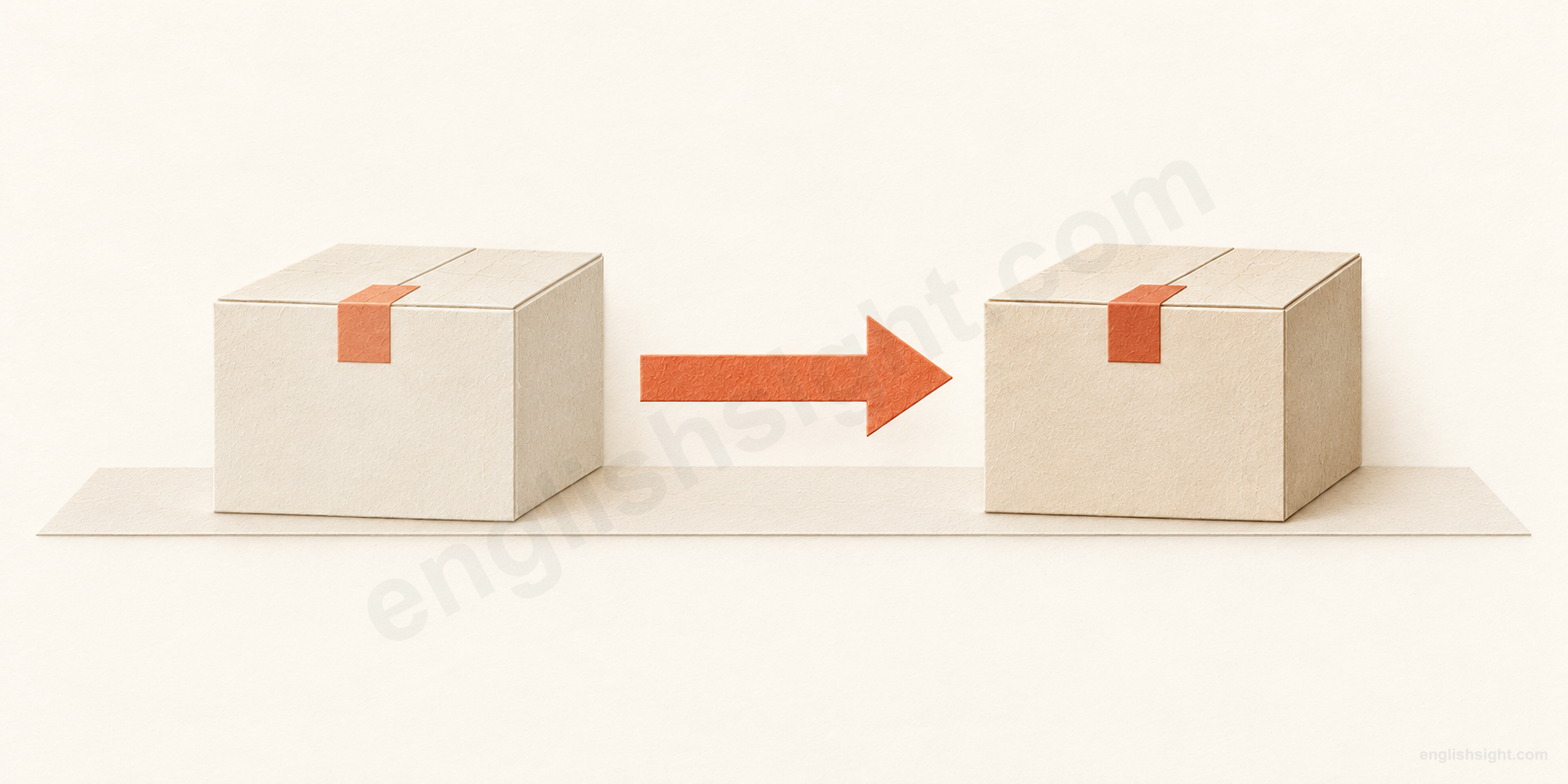
The sealed box in its earlier position
move
The same box in its later position
The arrow shows a change of position.
Move highlights a change of position; the picture leaves who moved the box and how unspecified.
To move is to change position, or to cause someone or something to change position. This physical use is a starting point for understanding several wider uses.
A date, a project, or a viewpoint can shift figuratively. Emotional influence, social circles, formal proposals, and fixed idioms have established meanings that a physical picture cannot predict by itself.
Start with a change of position: a box moves, or someone moves it. The word leaves the exact method open. Following words tell us whether something goes away, comes back, changes homes, or advances to another stage.
English also uses move for emotional influence, formal proposals, and countable actions. Some connections are useful teaching comparisons; established phrases still need to be learned in context. This lesson does not claim that every speaker pictures the word in the same way.
01
Bodies, objects, and room to pass
Ask what changes position and whether the subject causes that change. Direction words supply a path, destination, or purpose.
01
move; be moving; keep moving; don’t move
move / keep moving
change position or be in motion
Situation before
A bus is standing at a stop.
What changes
It begins travelling.
The subject itself is the thing that moves.
In The bus moved, the bus changes position; no object is needed. Move leaves the manner open: a person might walk, crawl, or slide. Walk tells you how, while move emphasizes motion. The wind can move and a branch can move without making a deliberate choice.
The forms are move, moves, moved, moved, moving. The bus is moving describes motion in progress; keep moving asks for continued motion. Don’t move asks for stillness, not necessarily for someone to stay in the same town.
In a sentence
The bus began to move before I had found a seat.
Watch the difference Move does not by itself say how fast, how far, or by what method something travels.
02
move + object + place/direction; object + be moved + place/direction
move something
cause a person or thing to change position
Situation before
A heavy box blocks the floor.
What changes
You put it in another position.
The subject causes the object’s change of position.
Compare The box moved with We moved the box. In the second sentence, we cause the change and the box is the direct object. Move does not specify whether we lift, pull, push, or use a trolley. Move your arm asks someone to change the arm’s position.
A passive puts the moved object first: The box was moved upstairs. A person can also be reassigned or transferred: The patient was moved to another ward. This is a genuine transitive use, not a reason to add an object to every occurrence of move.
In a sentence
We moved the box beside the window, and the table was moved outside.
Watch the difference Put stresses placing something somewhere; move stresses a change from its previous position. Both can fit the same event.
03
move away from / towards + place; move back (to + place); move (object) around / across / through / into / out of + place
move away / back / around
specify the path or direction of motion
Situation before
You are standing near a hot pan.
What changes
You increase your distance from it.
The following word tells us where or how the position changes.
Move away from the pan increases distance; move towards the door reduces it. Move back can mean return to an earlier position or go backwards, depending on context. Move around the room describes motion within or through different parts of the room; it does not imply changing homes.
Across, through, into, and out of introduce different spatial relations: We moved the chairs out of the kitchen. A destination noun follows the preposition: move into the room, move into it. These ordinary spatial combinations need not all be memorized as separate idioms.
In a sentence
Move away from the cooker, then move the chair back against the wall.
Watch the difference Move to the door names a destination; move towards the door names a direction and does not guarantee arrival.
04
move over; move up; move + object + over
move over / move up
change your position to leave space for someone
Situation before
Two people occupy most of a bench.
What changes
They shift so a third person can sit.
The purpose is to make room, not necessarily to go upwards.
Could you move over a little? asks someone to shift sideways. Move up is also used for making space, especially along a seat or row; up need not describe vertical movement. These requests normally have no direct object.
For a thing, name it: Move the bag over or Move it over. The object pronoun comes before over in this arrangement. This differs from move over the bridge, where over introduces the route rather than the make-room expression.
In a sentence
Could you move over a little so my daughter can sit beside me?
Watch the difference A bare Move over! can sound abrupt. Could you…? and please make an ordinary request more considerate.
05
move on / along; move + person + on / along; move on to + place
move on / move along
leave a place instead of standing there
Situation before
A group is blocking an entrance.
What changes
An official asks them to leave that spot.
On or along asks for continued movement away from the stopping place.
Move on and move along can be instructions to stop standing in one place. An official who moves people on or moves them along makes them leave, often by telling them to go rather than physically pushing them.
The transitive particle pattern allows move the crowd on / move them on and move the crowd along / move them along. A pronoun stays between move and the particle. In We moved on to the next town, the travellers themselves continue their journey.
In a sentence
The steward moved us along because we were blocking the exit.
Watch the difference Move someone on concerns making them leave a spot; move on to a new subject concerns changing discussion. The complements matter.
06
vehicle / group + move off
move off
start travelling away
Situation before
A train is waiting at the platform.
What changes
It starts its journey.
Off marks departure from the stopping place.
Move off commonly describes a vehicle, or a group such as a procession, starting to travel. It focuses on the beginning of departure. It does not specify the final destination.
A train that moves off has started moving; a train that moves on continues beyond a stopping point or onward to another place. These ideas overlap in some situations, but they do not make every use of off and on interchangeable.
In a sentence
We waved from the platform as the train moved off.
Watch the difference Move off is about setting off, not the everyday expression for finishing a work shift.
02
Changing where you live
Moving home changes your base, not merely your position for a moment. In, out, into, and with identify different parts of that change.
07
move (from + old place) (to + new place); move house; move offices
move / move house
change your home or place of business
Situation before
Your family lives in one city.
What changes
You make another city your home.
A move changes your base, not merely where you are for a moment.
In We’re moving to Bristol, the usual meaning is that Bristol will become our home. The destination and the life context distinguish relocation from a short trip. A company can likewise move its offices or move to larger premises.
Move house is especially British English. Move is also used alone when the housing context is clear: Are you moving soon? Move from X to Y gives both old and new locations. Moving back to a town means returning to live there in this context.
In a sentence
We’re moving from Leeds to Bristol because my partner has a new job.
Watch the difference Go to Bristol can describe a visit. Move to Bristol normally suggests establishing a new home or base.
08
move in; move into + home; move out; move out of + home
move in / move out
start or stop living in a particular home
Situation before
The old tenants are leaving a flat.
What changes
New tenants start living there.
In highlights the new home; out highlights leaving the old one.
Move in means begin living in a new home; move out means leave the home where you have been living. The place can remain understood: The tenants moved out on Friday. Name it with move into the flat or move out of the flat.
For example, We move out on Friday and move into the new flat on Monday separates leaving from arriving. Someone can move a chair into a flat without moving in: entering or relocating an object does not by itself establish residence.
In a sentence
The tenants move out on Friday, and we move into the flat on Monday.
Watch the difference Say move out of the flat, not move out the flat. Move the boxes out is a different transitive structure.
09
move in with + person; move in together
move in with someone
begin sharing the home where someone already lives
Situation before
Your sister already has a home.
What changes
You begin living there with her.
With identifies the existing resident you will live with.
Move in with my sister means start living in her home. It can be temporary, and it does not require a romantic relationship. Move in together often describes people establishing a shared home; context explains their relationship.
Compare I moved with my sister: we both relocated, but that sentence does not itself say I joined her existing household. Keep the whole pattern move in with + person when that is the intended message.
In a sentence
I moved in with my sister while I looked for a flat of my own.
Watch the difference With takes the person: move in with her. Into takes the home: move into her flat.
10
a / the / our + move (from + place) (to + place or job)
a move to a new home
refer to relocation as one event
Situation before
There are boxes, transport, and a new address to arrange.
What changes
You discuss the whole change as one move.
The countable noun packages the relocation.
As a noun, a move can refer to changing where you live or work: our move to Madrid. The move may include practical arrangements as well as the change of address. Use an article, possessive, or other determiner for an ordinary singular countable use.
The noun can also describe a job transfer: Her move to the sales team starts next month. Moving can name the activity, but movement is not the usual replacement in We’re planning a move to Madrid.
In a sentence
Our move to Madrid is planned for June, so we’re sorting the boxes now.
Watch the difference The verb needs no article: We move in June. The countable noun does: Our move is in June.
03
Work, arrangements, and progress
A job, date, price, or project can be treated as occupying a position. Read the complement to discover which kind of change is meant.
11
move from + role + to + role; move into + field; move + person + to + team
move into a different role
change the field, role, or activity you work in
Situation before
You work in customer support.
What changes
You start a role in training.
The new position is a role rather than a physical spot.
Move from support to training changes the kind of work someone does. Move into management describes entering a field or type of role; move someone to another team describes a transfer arranged by someone else.
The position model helps organize the change, but it does not tell you whether the new role is better. A sideways or lateral move changes a job without necessarily increasing rank. Move into a market can similarly describe a business beginning to operate there.
In a sentence
After three years in support, Maya moved into staff training.
Watch the difference Move into management does not mean entering a manager’s office. The noun after into identifies the relevant domain.
12
move over to + system / method; move from + old method + to + new method
move over to a new system
stop using one method and adopt another
Situation before
A team uses paper records.
What changes
It begins keeping records digitally.
The destination is a method, not a physical place.
Move over to a new system means change to using it. For example, The practice moved over to digital records last year. The practice changes its working method; its staff need not change offices. Over emphasizes the switch, while to introduces the new system.
You can also say move from paper records to digital records. The fuller from…to… pattern names both methods. This established use of move over differs from shifting sideways to make room on a seat.
In a sentence
The practice moved over to digital records last year.
Watch the difference Keep to before the new method: move over to it. Move it over instead has a direct object and can describe moving a thing sideways.
13
move over (and let + person + take over / lead / try)
move over and let someone else take over
give up a role or position so another person can have it
Situation before
One person holds a leadership role.
What changes
They are asked to let someone else fill it.
Making room can concern a role rather than a seat.
Move over can mean leave a position so another person can take it. For example, After twenty years as chair, she decided to move over and let a younger colleague lead. The context makes this about succession, rather than changing seats.
This use is an established figurative comparison with making room. A demand such as Move over and let someone else try can sound critical. Move to another role describes a different change and does not by itself say someone is being asked to give way.
In a sentence
After twenty years as chair, she decided to move over and let a younger colleague lead.
Watch the difference Move over does not necessarily mean retire from all work; here it means give way in the relevant role.
14
move up / down; move up to + level; move towards / away from + position or policy
move up / down / towards
change a level, value, or direction of policy
Situation before
A price, rank, or opinion has one position.
What changes
It shifts higher, lower, or towards a new position.
The direction word defines a scale or tendency.
Prices can move up or down; a worker can move up to a more senior role. No object needs to travel physically. With a ranking, She moved up two places tells you the size of the change, while moved up to third place gives the resulting rank.
Move towards an agreement means develop in that direction; move away from an old policy means rely on it less. Towards does not guarantee that the endpoint is reached. These are direction-based extensions, not claims that all change is improvement.
In a sentence
The team moved up to third place, while ticket prices moved down slightly.
Watch the difference Move up can mean make room on a seat or rise on a scale. Read the situation before choosing an interpretation.
15
move + event + from + old time/place + to + new time/place; event + be moved to…; move + event + up (from + old time + to + earlier time)
move a meeting to Friday
change an event’s time or place
Situation before
A meeting is scheduled for Thursday at ten.
What changes
The organizer sets it for Friday at two.
The event changes its position in a timetable.
Move the meeting to Friday reschedules the event. Move it to Room 4 changes its location instead. The object identifies the event, and the following phrase tells you which arrangement changes. A passive is natural: The meeting has been moved to Friday.
Move a meeting forward or back can cause confusion if speakers picture the change differently. Give the old and new time when accuracy matters: We’ve moved it from Thursday at ten to Friday at two. The new date or time is the information your listener actually needs.
Move a meeting up means schedule it earlier: We moved the call up from Friday to Wednesday. The particle can follow a noun object, and must follow an object pronoun: move the call up, move it up. State both dates when confirming the change. This timetable use is separate from moving up to a higher rank.
In a sentence
The interview has been moved from Thursday at ten to Friday at two.
Watch the difference Do not rely on forward or back alone when a missed appointment is possible; state the actual new time.
16
process + move along; move + process + along; get + object + moving
move things along / get things moving
make a process develop or start progressing
Situation before
A project has stalled.
What changes
A clear decision allows the work to continue.
The thing changing is the stage of a process.
The project is moving along means it is progressing. We need to move things along asks for action that helps progress. Here along does not describe a street or corridor. In move it along, it is the project or process being advanced.
Get things moving emphasizes starting progress, especially after delay. It uses get + object + -ing, not a special tense of move. A sentence such as Events are moving quickly describes rapid developments and does not necessarily mean events are improving.
In a sentence
A short planning meeting helped us move the project along and get the design work moving.
Watch the difference Moving quickly describes pace. Moving in the right direction adds an evaluation of that progress.
17
move quickly / fast; move to + verb
move quickly to do something
take action in response to a need or opportunity
Situation before
A supplier warns of a shortage.
What changes
The team acts before stocks run out.
Move can mean act, without any journey.
Move quickly to fix a problem means take prompt action. The to-infinitive states the purpose or intended action: The council moved to protect the site. The subject is the actor; nobody needs to move a physical object.
Compare The team moved to protect the records with The warning moved the team to act. The first has no direct object and reports the team’s response; the second says what prompted that response. Neither pattern guarantees success.
In a sentence
When the leak was found, the team moved quickly to protect the records.
Watch the difference Move to protect describes taking steps towards a goal; manage to protect says the protection succeeded.
18
move + stock / goods; goods + move well / fast
move stock
sell goods, or be sold
Situation before
Products remain in a shop.
What changes
Customers buy them.
Business language treats sales as stock moving out.
A shop that needs to move old stock needs to sell it. The shop is the seller and stock is the object. In These coats are moving well, the coats are selling well; the sentence does not describe them being carried to another shelf.
The physical departure of goods is a useful memory connection, but the selling meaning belongs to established business usage. Moving stock to another warehouse can instead be literal transport, so check the destination and commercial context.
In a sentence
We reduced the price to move the last of the winter coats.
Watch the difference This selling sense is common in retail discussion; sell is usually the clearest general-purpose word.
19
move in on + person / market / territory
move in on someone’s territory
approach to take control or gain an advantage
Situation before
A business has an established market.
What changes
A rival starts trying to take part of it.
In on adds the idea of closing in or encroaching, not joining a household.
Move in on a competitor’s territory means take steps to gain control, customers, or influence there. In a physical situation, police moving in on a suspect are approaching to capture or control the person. The expression can sound threatening or competitive.
Compare move into a new market, which can neutrally describe business expansion, with move in on another company’s market, which highlights encroachment. Keep the order move in on it. This is not the separable object pattern move it in, which can mean carry an object indoors.
In a sentence
A large chain is moving in on the local shops’ market.
Watch the difference Move in with someone means share a home. Move in on someone or something suggests approaching to capture, control, or encroach.
04
Feelings, decisions, and formal language
Move can affect someone inwardly or introduce a proposal. These uses have their own patterns and cannot be inferred from a physical arrow alone.
20
something + move + person; be (deeply) moved by…; move + person + to tears
be moved by something
feel a strong emotional response
Situation before
You hear a personal story.
What changes
You feel sympathy, sadness, or deep appreciation.
The person’s feelings are affected; their body need not move.
Her letter moved me makes the letter the emotional cause and me the person affected. I was deeply moved by her letter presents the same response from my side. Moved here often suggests tenderness, sympathy, gratitude, or sadness, rather than just any change of mood.
Moved to tears names a result: the emotion makes someone cry or brings tears to their eyes. A moving story causes such feelings; a moved listener experiences them. This emotional sense is an established branch, not a literal change of location.
In a sentence
I was deeply moved by the children’s letter and read it twice.
Watch the difference Moving is the cause of the feeling; moved describes the person affected. I was moving usually describes motion.
21
cause + move + person + to + verb; be / feel moved to + verb
move someone to do something
prompt or inspire someone to act
Situation before
A report makes you recognize a need.
What changes
You decide to volunteer.
The cause influences a person towards an action.
The report moved me to volunteer means the report prompted or inspired my action. This sounds more formal or reflective than made me volunteer. It need not involve force, and it does not necessarily mean I cried or felt sad.
I felt moved to write says I felt an impulse or reason to write; moved follows felt as a description of that feeling. I was moved to write is the corresponding passive pattern. In moved to tears, to is a preposition before a noun; in moved me to write, to introduces an infinitive. The different complements distinguish an emotional result from a prompted action.
In a sentence
The volunteers’ dedication moved me to offer a few hours of my own time.
Watch the difference Use to + verb, not move someone doing something, for this motivating sense. It is not the ordinary way to order someone about.
22
would not / will not be moved; remain unmoved by + appeal or argument
not be moved
refuse to change a decision or opinion
Situation before
Others argue for a different choice.
What changes
You keep your original decision.
A position can stay fixed figuratively.
In We tried to persuade her, but she would not be moved, moved concerns her decision. She does not give way to persuasion. The negative passive is a familiar pattern; it is not a report that nobody could lift her.
The related adjective unmoved can mean emotionally unaffected or unpersuaded: He remained unmoved by the appeal. Context decides whether the appeal failed to touch his feelings or failed to change his judgment; the two can overlap.
In a sentence
We offered several alternatives, but the chair would not be moved.
Watch the difference I wasn’t moved by the film concerns emotional impact; I wouldn’t be moved in an argument often concerns refusal to change position.
23
move + motion / amendment; move that + clause; (legal) move for + request
move that… / move a motion
formally propose something for a decision
Situation before
A committee is ready to vote.
What changes
A member puts forward an official proposal.
Move introduces a proposal under a formal procedure.
At a formal meeting, I move that we postpone the vote puts a proposal before the group. Move a motion or move an amendment similarly identifies a formal proposal. This is a procedural sense: it does not mean changing where the motion is written.
A that-clause states the proposed action. In I move that the report be accepted, be is a formal subjunctive form; should be accepted is another possible form. The related legal pattern move for a new trial makes a formal request, and belongs to specialist legal procedure.
In a sentence
I move that the committee postpone the vote until Monday.
Watch the difference For an ordinary suggestion between friends, suggest is more natural. This use of move belongs to meetings or other formal procedures.
24
move in + social / professional circles
move in certain circles
spend time among a particular kind of people
Situation before
Someone regularly mixes with artists.
What changes
That group forms part of their social world.
This is social association, not a path in a circle.
Move in artistic circles says someone spends time with people in that social group. Circles means networks or groups of acquaintances. It does not require walking around a room, and it need not describe a change from one group to another.
Compare She moved into publishing, which describes entering a field of work, with She moves in publishing circles, which describes the people she regularly mixes with. Treat social move in as an established pattern alongside, rather than a literal prediction from, the position model.
In a sentence
Through his work at the gallery, he moves in artistic circles.
Watch the difference Move in with an artist means begin sharing that person’s home. Move in artistic circles means associate with a group.
05
Going beyond the present stage
Move on can lead to another topic, activity, or chapter of life. Moving forward can describe progress or simply introduce future plans.
25
move on; move on from + previous stage; move on to + noun / -ing
move on to the next topic
leave one activity or topic and begin another
Situation before
A discussion has finished one question.
What changes
The group starts the next question.
On continues beyond the current stage; to names the next stage.
Let’s move on to the next topic directs attention to another part of a discussion. Move on can also mean take a different job or begin a new activity when the current one has run its course. A physical journey is only a comparison here.
To is a preposition in move on to the next question and move on to discussing costs. Use a noun or an -ing activity after it in that pattern. This differs from move to solve a problem, where to solve is an infinitive giving an intended action.
In a sentence
We’ve agreed on the dates, so let’s move on to discussing the budget.
Watch the difference Move on to it keeps on and to before the object. Move it on is a different transitive arrangement.
26
move on; move on after + event; move on from + experience
move on from a difficult experience
continue life beyond something painful or limiting
Situation before
A disappointment still occupies your attention.
What changes
You gradually build a life beyond it.
The change is in how life continues, not in a person’s address.
Move on after a breakup can mean resume ordinary life and develop emotionally beyond that experience. Move on from a mistake can mean stop letting it dominate your actions. It does not require forgetting what happened or deciding it was unimportant.
This personal meaning is an established extension of continuing beyond a stage. Advice such as Just move on can sound dismissive when someone is grieving or upset. Acknowledging the situation makes the intended support clearer.
In a sentence
It took her time to move on after the breakup, but she is enjoying life again.
Watch the difference Moving on does not prove all sadness has ended. Avoid treating the expression as a deadline for someone else’s feelings.
It advances the work or describes its future approach.
Forward can mark progress; the discourse phrase can simply mean in future.
We can now move forward with the plan means proceed with it. The shared position model helps picture progress, although the plan need not literally travel. A new process can let us move the project forward, with the project as object.
Moving forward, we will send monthly updates uses moving forward as a business-style introduction meaning from now on. It does not itself say the organization is improving. In everyday writing, from now on or in future may be more direct.
In a sentence
Moving forward, we’ll send one monthly update instead of several short emails.
Watch the difference Move forward with a plan reports proceeding. In the business-style example here, moving forward sets a future time frame; in other contexts the same words can describe actual movement or progress.
06
A move: an action, turn, or departure
As a countable noun, move can package a change or action as one event. Fixed expressions specify whether you are planning, playing, leaving, or hurrying.
28
a good / smart / false / career move; make a move; make your move; a move to + verb
a good move / make your move
an action chosen as part of a plan
Situation before
You consider several possible actions.
What changes
You choose one to improve the situation.
A countable move is a step or choice with a purpose.
A good move evaluates a decision or action: Asking for advice was a good move. A career move is a work-related choice. Your next move is the action you will choose next, not necessarily the next time you physically move.
Make your move means take the action you have been preparing to take. A move to reduce costs can be an attempt or initiative; the to-infinitive describes its aim, not proof of success. A false move can be a physical movement or a mistaken action that creates danger.
In a sentence
Keeping a copy was a smart move; it saved us when the original file disappeared.
Watch the difference Use make a move for a strategic action. Take action and take a step are related expressions, but their nouns have different usual verb partners.
29
it’s + person’s + move; a chess / dance move; watch + person’s + every move
your move / dance moves
a turn in a game or a recognizable bodily action
Situation before
A chess player has a turn, or a dancer learns a sequence.
What changes
One action or turn is identified as a move.
Move can count a discrete action rather than movement in general.
In a board game, It’s your move says it is your turn to play. A legal move is an action allowed by that game’s rules; legal here does not concern national law. Move the knight is the verb use, while a clever move is a noun phrase.
Dance moves are recognizable bodily actions; a sporting move can be an attacking or defensive action. In I watched her every move, move means each action or change of position. Movement is the broader word for motion or its manner, rather than necessarily one countable turn or technique.
In a sentence
It’s your move in the game; after that, show me the dance moves you learned.
Watch the difference Moves is the plural noun or the third-person verb: two moves; she moves. The surrounding grammar tells you which.
30
make the first move; make a move on + person
make the first move / make a move on someone
take the initiative; in a different expression, show romantic or sexual interest
Situation before
Two people are waiting for the other to act.
What changes
One takes the initiative.
The whole expression and its context distinguish general initiative from a romantic advance.
Make the first move means act before the other person, perhaps by starting a conversation, making peace, or beginning a negotiation. It is not automatically romantic: Someone has to make the first move and apologize.
Make a move on someone is a different informal expression: attempt to begin romantic or sexual involvement. For example, At the party he tried to make a move on me, but I said I wasn’t interested. The on + person often signals this meaning; context can also give make a move or make your move a romantic interpretation without on.
In a sentence
Neither wanted to restart the conversation, so I made the first move and apologized.
Watch the difference For a neutral initiative, say make the first move and identify the action. Adding on + person often suggests a romantic advance.
31
make a move; had better make a move; get moving
make a move
start leaving, especially in informal British English
Situation before
A visit is coming to an end.
What changes
You announce that it is time to leave.
The fixed expression can refer to setting off.
We’d better make a move commonly means we should leave now in informal British English. The visiting or travel context supplies this meaning. The same words can instead mean take an action in a plan or play a game turn.
Let’s get moving can likewise suggest leaving or getting started promptly. It is broader than moving house: the speaker may only be ending a visit. The words around move and the shared situation tell you what kind of start is intended.
In a sentence
It’s nearly midnight, so we’d better make a move before the last bus leaves.
Watch the difference A visitor saying make a move is usually announcing departure, not a plan to change homes.
32
be on the move; keep + person + on the move
be on the move
be travelling, continually active, or making progress
Situation before
A person spends the day going from task to task.
What changes
They remain active with little time to rest.
The whole expression describes activity or continuing movement.
On the move can describe travel from place to place: Her work keeps her on the move. It can also mean already moving, as in The convoy is on the move, or busy and active, as in I’ve been on the move since breakfast.
These meanings share an idea of not remaining inactive, but only the travel context necessarily involves different destinations. The phrase has fixed the: on the move. It does not by itself mean moving house.
The expression can also describe development: With new firms opening every month, the local economy is on the move. Here the economy is advancing or becoming more active, rather than travelling to another place. This is an additional established use, especially in descriptions of business or society.
In a sentence
With deliveries all morning and meetings all afternoon, I’ve been on the move all day.
Watch the difference On the move can describe travel, busy activity, or progress; in a move to… introduces an action with a purpose.
33
get a move on; had better get a move on; move it!
get a move on! / move it!
tell someone to hurry
Situation before
There is little time before departure.
What changes
Someone asks for a faster start or pace.
The urgency belongs to the whole informal expression.
Get a move on means hurry up. We’d better get a move on includes the speaker in the need to hurry; Get a move on! directly tells someone else. These are informal expressions rather than literal instructions to obtain a move.
Move it! is a sharper command to hurry. Its it need not refer to an object already mentioned, unlike Move it beside the door, where it is the object being relocated. Tone and relationship matter: a polite request is safer with someone you do not know.
In a sentence
We’d better get a move on; the gates close in ten minutes.
Watch the difference Move it! can sound impatient or rude. Could we hurry a little, please? is more considerate.
07
Established pictures and expressions
Some expressions use movement as a memorable comparison. Learn their conventional meaning and tone, rather than assembling a new meaning word by word.
34
move the goalposts; keep moving the goalposts
move the goalposts
change requirements unfairly after others have begun trying to meet them
Situation before
A target has been agreed.
What changes
Someone changes what counts as success.
The goal changes after the effort has started.
If a manager keeps adding new conditions after you meet the agreed ones, you may accuse them of moving the goalposts. The picture is a game whose target changes, but the expression commonly concerns rules, requirements, or assessment.
The phrase expresses disapproval. It is stronger than neutrally saying the requirements changed: it suggests an unfair shift that makes success harder or gives someone an advantage. This conventional meaning comes from the full expression, not move alone.
In a sentence
We met the agreed target, but the client moved the goalposts and demanded twice as much.
Watch the difference Do not use the idiom for every agreed change of plan; it normally criticizes unfairly changed conditions.
35
move heaven and earth to + verb; move mountains (to + verb)
move heaven and earth / move mountains
make extraordinary efforts or achieve something that seems almost impossible
Situation before
A goal appears extremely hard to reach.
What changes
Someone puts exceptional effort into reaching it.
These are strong conventional images of effort and difficulty.
Move heaven and earth to do something emphasizes trying every possible way: She moved heaven and earth to find a place for her son. It stresses the effort; success still depends on the rest of the sentence.
Move mountains suggests overcoming apparently enormous difficulties or achieving what seems impossible. Both expressions are emphatic. They are useful for determination, but the words do not describe physical relocation or guarantee that any request will succeed.
In a sentence
The team moved heaven and earth to reopen the clinic before winter.
Watch the difference These expressions deliberately exaggerate the scale of the effort. For a routine task, try hard or make an effort may fit better.
36
not move a muscle; without moving a muscle; not move an inch
not move a muscle
remain completely still
Situation before
You need to avoid disturbing a resting animal.
What changes
You hold your body still.
Negation turns even a tiny movement into the relevant limit.
Don’t move a muscle means stay completely still. He sat without moving a muscle emphasizes an absence of visible movement, often from fear, concentration, or determination. It is an idiomatic exaggeration, not a physiological claim that all muscles stop working.
Don’t move an inch similarly emphasizes not changing position at all. In a disagreement, refusal to move can instead concern a decision, as in She would not be moved. Use the bodily situation or the argument to separate stillness from resistance to persuasion.
In a sentence
The fox paused beside the path, and we stood without moving a muscle.
Watch the difference The singular a muscle is part of the expression. It does not mean one specific injured muscle is unable to move.
37
move with the times
move with the times
adapt ideas or methods to modern conditions
Situation before
An organization keeps an outdated method.
What changes
It updates how it works.
The change follows developments in the surrounding world.
Move with the times means change ideas, behavior, or methods so they fit modern expectations. A business that begins accepting online bookings may be described this way. It concerns adaptation, not the speed of a clock.
The expression often approves of updating or criticizes failure to update. That evaluation is a speaker’s view: being modern does not automatically make every change wise. Learn with the times as the established partner of move here.
In a sentence
The small hotel moved with the times and began accepting online bookings.
Watch the difference Move with the times means adapt. Move the meeting time means change when one particular meeting happens.
Check the object and the whole expression
Who changes, and who causes it?
The chair moved has no direct object. We moved the chair names a cause and an object; The chair was moved is passive. Move someone to another ward transfers them, while move someone to volunteer motivates an action. The following words do essential work.
Particles and prepositions have different patterns
Say move it over, move them on, and move it along when it/them is the object of a separable particle pattern. Say move into it, move out of it, move on to it, or move in on it when the pronoun follows the relevant preposition. Not every direction phrase is an idiom.
Motion, emotion, and proposal are different branches
The house was moved concerns relocation; I was moved by the story concerns feeling; I move that we adjourn is a formal proposal. Context and grammar distinguish them. The drawing supports a teaching connection, not a rule for inventing new expressions.
Scope and register
This lesson covers modern everyday uses and selected work, retail, and meeting expressions. It is a useful selection, not a frequency ranking or every dictionary use. Technical bowel-related uses, detailed legal procedure, rare historical senses, and offensive hurry-up commands are not expanded. Move mountains and move heaven and earth are emphatic, while Move it! can sound sharp.
Choose the intended meaning
Read the situation, then check the object, following words, and tone.
1. You want someone to put a chair somewhere else. Which instruction clearly names the thing to relocate?
2. You are beginning to live in your aunt’s existing home. Which expression states that?
3. A letter makes you feel deep gratitude. Which sentence describes your emotional response?
4. The dates are settled; the group should discuss costs next. Which sentence fits?
5. A meeting changes from Tuesday at nine to Wednesday at eleven. Which message gives the clearest new arrangement?
6. At a committee meeting, a member says “I move that the report be accepted.” What are they doing?
7. Two friends have argued. One wants to take the initiative and apologize. Which expression describes that without adding romantic intent?
8. After you meet agreed requirements, someone adds harder ones to give themselves an advantage. Which expression criticizes that?
Sources and teaching notes
Usage was checked against the dictionary pages below. The explanations and examples are original. Connections between physical position and wider meanings are teaching interpretations, with their limits stated in the lesson.
The diagram illustrates a change of position. Individual speakers need not share one mental picture.