Use much for quantity, extent, comparison, and familiar reactions.
An extent on a continuous scale
An extent on a continuous scale
A continuous amount
much
A substantial extent
Assess how far it extends
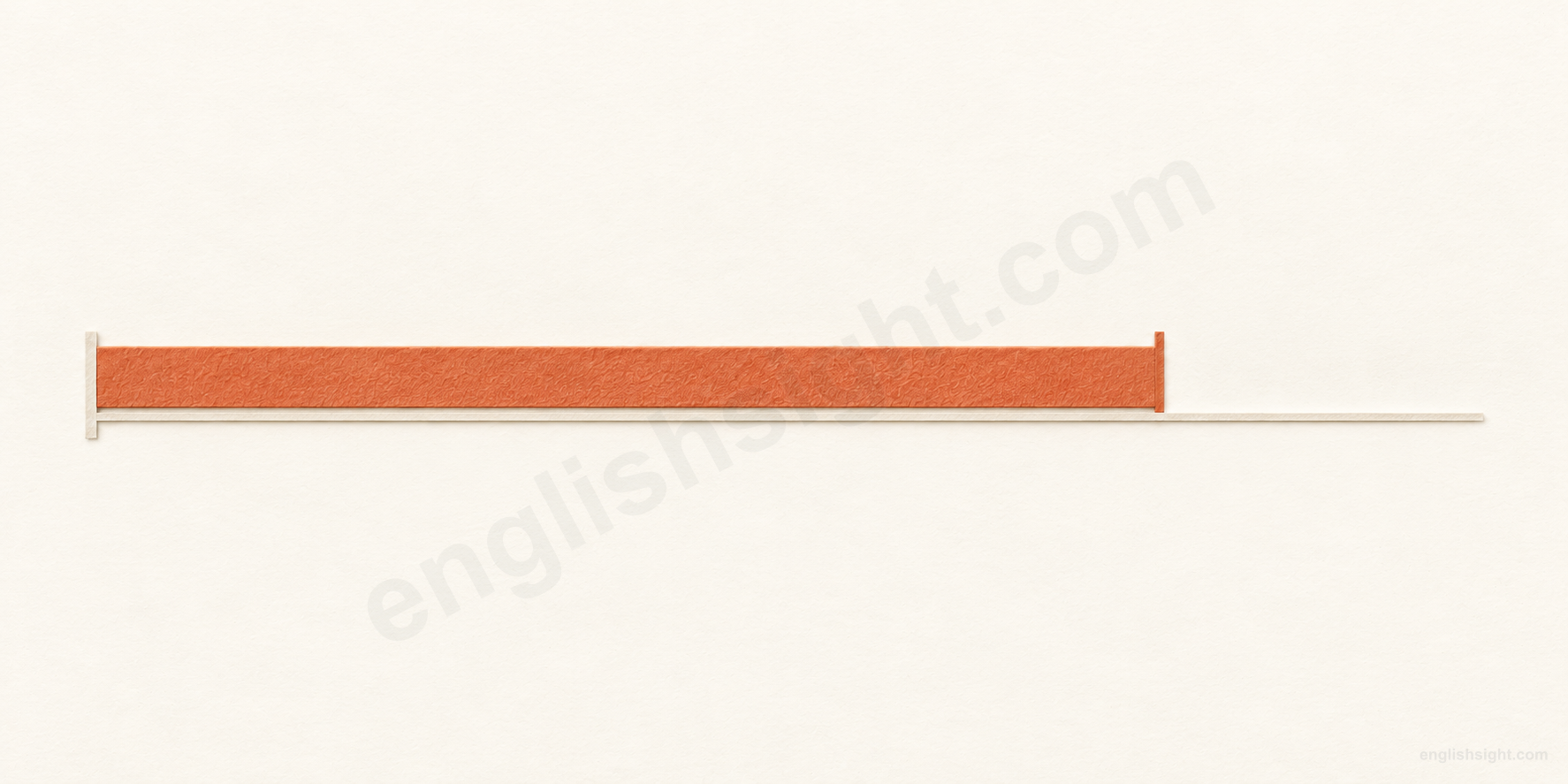
The orange strip represents a substantial amount or degree, not separate items. The pale continuation is a reference, not a fixed maximum. How much and not much need not describe a large amount; the whole construction matters.
Think about how far an amount or degree extends, rather than counting separate units.
The diagram illustrates a substantial extent. How, not, too, and comparison patterns change the interpretation; much does not always assert that a large quantity exists.
With much, English often treats something as an amount rather than a set of separate items: time, effort, change, or feeling. The surrounding words turn this into a question, a limit, a comparison, or emphasis.
The amount model connects many uses, but fixed expressions also carry meanings of their own. This lesson groups common modern uses, without claiming a frequency ranking or a single mental picture shared by all speakers.
01
Amounts without counting individual things
Use much for an uncountable amount, ask its size, or refer to a share of a known whole.
01
(not) much + uncountable noun
not much time
an amount that is not large
Situation
A deadline is close.
Intended message
You describe limited available time.
Time is treated as an amount, not a set of objects.
Much before a noun measures a mass: time, money, water, information. Negative sentences and questions are natural homes for it. Not much leaves room for some; it does not necessarily mean none.
Use many with plural countable nouns: many minutes, many coins. In an ordinary positive conversation, We have a lot of time is usually more natural than We have much time. Formal writing allows bare much more freely: Much work remains.
Original example
We don’t have much time before the last train.
Watch the difference Say much information or many facts; not much informations or much facts.
02
how much + noun / clause; how much + be / cost
How much…?
ask for an amount, price, or degree
Situation
You need to buy paint.
Intended message
You ask what quantity is necessary.
How asks for the size of the amount; it does not assume that it is large.
How much paint do we need? asks for an uncountable quantity. How much is this? asks the price, with money understood. How much do you miss home? asks about emotional degree.
The same words introduce an embedded question: Tell me how much we need. Keep statement order after tell me, not how much do we need. Contrast How many tins? which asks for a count.
Original example
How much paint do we need for this wall?
Watch the difference How much is it? asks about price; How many are there? asks about number.
03
much of + the / this / possessive + uncountable noun; much of + pronoun
much of the work
a substantial share of a specified whole
Situation
A project has several stages.
Intended message
A large share is already complete.
Of connects the amount to an identified whole.
Much of the work refers to a share of that particular work. Of is needed before the, this, a possessive, or a pronoun: much of this time, much of our money, much of it.
Much work refers more generally to an amount of work. Neither expression requires more than half, and neither means all. With plural countable things, use many of the tasks.
Original example
Much of the work is already finished.
Watch the difference Use singular agreement for work: much of the work is, not are.
04
not much; much + to-infinitive; nothing much
not much / much to do
leave the amount’s noun understood
Situation
Someone asks what is left for dinner.
Intended message
You give a short answer about the remaining quantity.
Much can stand without a following noun.
“Is there any soup left?” “Not much.” The previous question supplies what is being measured. There is much to do means a large amount of work remains; bare affirmative much here is more formal than a lot.
Nothing much is a related conversational expression: “What happened?” “Nothing much.” It dismisses events as unimportant or unremarkable, rather than guaranteeing that absolutely nothing happened.
Original example
“Is there any soup left?” “Not much, but enough for you.”
Watch the difference Much does not take an article: not a much.
05
only / just so much + noun / clause
only so much
an amount or capacity has a limit
Situation
You have helped with a difficult task.
Intended message
You explain that your help cannot solve everything.
Only puts an upper limit on the amount.
There is only so much I can do acknowledges a practical limit. The amount need not be tiny: the point is that it cannot keep increasing.
Only so much time similarly limits a resource. This differs from so much time, which often emphasizes abundance. Do not drop only if the intended message is limited capacity.
Original example
There is only so much I can do without the missing files.
Watch the difference This does not necessarily mean I am unwilling to help.
06
it + be + as much as + subject + can / could do + to-infinitive
as much as I could do
barely manage a difficult action
Situation
After a long shift, you feel exhausted on the bus home.
Intended message
Staying awake takes all the effort you can manage.
The action reaches the limit of someone’s ability.
It was as much as I could do to get home means getting home was difficult and I barely managed it. The whole construction marks a limit of capacity, not just a comparison between quantities.
This often looks back at a difficult effort. Contrast I did as much as I could, which says I did everything possible, without necessarily naming one barely completed action.
Original example
After the long shift, it was as much as I could do to stay awake on the bus.
Watch the difference Keep the to-infinitive for the difficult action: as much as I could do to stay awake.
02
How strongly, how often, and how different
With verbs and modifiers, much measures extent. The surrounding construction determines whether that means intensity, frequency, excess, or a difference.
07
verb + (not) + (very / all that) much
not change much
measure the extent of an action or change
Situation
You compare an old photograph with the place today.
Intended message
The difference is small.
Much measures extent, rather than the number of objects.
The town hasn’t changed much says the change is small. Much here modifies the verb phrase, not a noun. Compare It has changed a lot in ordinary affirmative speech.
I don’t like it much expresses limited liking, not necessarily complete dislike. Not very much and not all that much can make the limitation explicit; stress and context affect how mild the criticism sounds.
Original example
The town hasn’t changed much since we moved away.
Watch the difference Ordinary affirmative I like it much sounds unnatural; use I like it a lot or very much.
08
do + subject + verb + much?; not see much of + person
Do you travel much?
ask how often an activity happens
Situation
A new colleague mentions several countries.
Intended message
You ask whether trips are frequent.
With repeated activities, extent is understood as frequency.
Do you travel much? asks whether traveling happens often. I don’t go out much reports infrequent outings; it is not normally a claim about their physical size.
I don’t see much of my cousin means that we meet or spend time together infrequently. Much of a person in this construction concerns contact, not a physical portion of their body.
Original example
Do you travel much for work?
Watch the difference Frequency comes from the activity and context; much is not always interchangeable with often.
09
verb + object + very much; very much + like / aware / alive
very much
strong degree with suitable verbs and expressions
Situation
A friend helped you through a hard week.
Intended message
You emphasize your appreciation.
Very strengthens much; together they intensify the feeling.
Thank you very much and I miss you very much express strong appreciation or feeling. Very alone cannot normally modify miss in this way. End position after the object is a useful default.
I would very much like to join is also natural. Very much can strengthen selected adjective phrases, such as very much aware or very much alive. It is not a general substitute for very before every adjective.
Original example
I appreciate your help very much.
Watch the difference Say very tired, not much tired or very much tired.
10
much + comparative; much more / less + noun; much the + superlative
much better / much more
a large difference on a comparison scale
Situation
Two routes take different amounts of time.
Intended message
You emphasize the size of the difference.
Much measures the gap between alternatives.
Much faster emphasizes how far one speed exceeds another. Much more carefully works with an adverb; much more time and much less money work with amounts. With plural countable nouns, say many more tasks or many fewer mistakes, rather than much more tasks.
Much does not itself mean better: much worse also marks a large gap. Much the best is a more formal superlative pattern meaning clearly superior to all the others. Do not confuse it with the ordinary comparative much better. In the fixed response If it arrives early, so much the better, the earlier arrival makes the situation even more favorable. So much the worse likewise means that a circumstance makes things even worse.
Original example
The train is much faster than the bus on this route.
Watch the difference Use much better or very good; very better is not standard.
11
too much + uncountable noun; verb + too much; much too + adjective / adverb
too much / much too
more than a suitable or manageable amount
Situation
Your weekly workload keeps growing.
Intended message
It exceeds what you can cope with.
Too supplies excess; much supplies the amount or strengthens the excess.
Too much work is an excessive amount of work; work too much describes excessive working. This is too much for me can mean the situation is beyond my emotional or practical capacity.
Much too difficult puts much before too plus an adjective. Compare too much noise with much too noisy. The first measures a noun’s quantity; the second intensifies an excessive quality.
Original example
This is too much work for one person.
Watch the difference Say too many tasks, too much work, and much too hard.
12
so much + uncountable noun + (that + clause); verb + so much
so much…that…
emphasize a large amount or strong degree
Situation
Rain continues throughout the night.
Intended message
Its quantity causes flooding.
So highlights the amount; that introduces its result.
So much rain that… links a large quantity to a consequence. I miss you so much similarly emphasizes emotional degree without needing a following that-clause.
So much does not automatically mean too much: an amount can be impressive without being excessive. With plural countable nouns use so many: so many messages that I missed yours.
Original example
There was so much rain that the road flooded.
Watch the difference Use so much rain, not so much rains, for rainfall as an amount.
13
a much- + past participle + noun; be + much + past participle
much loved / much-needed
intensify selected participles
Situation
A community values its local library.
Intended message
You describe it as deeply loved.
Much strengthens the participial description.
A much-loved library is one that people love greatly. The library is much loved is the corresponding description after be. Much-needed and much-improved are other established combinations.
Hyphens commonly join the words when the compound comes before a noun. Learn these combinations as patterns with suitable participles; they do not license much plus every ordinary adjective.
Original example
The village is trying to save its much-loved library.
Watch the difference A much-needed break is natural; a much-happy child is not.
14
much to + possessive + reaction noun, + clause
much to my surprise
a strong reaction to what happens
Situation
You expect your old key to fail.
Intended message
It works, and you are very surprised.
Much strengthens the reaction named after to.
Much to my surprise introduces something that caused considerable surprise. Similar patterns use relief, disappointment, or delight. The possessive names the person who has the feeling.
To here links an event with its emotional effect; it is not movement toward a place. The whole construction supplies that link, while much marks the reaction’s strength.
Original example
Much to my surprise, the old key still worked.
Watch the difference Use the noun surprise after to my, not the adjective surprised.
03
Equal amounts and close similarity
Read the whole comparison: equality, a surprisingly high amount, and approximate similarity are different uses.
15
as much + uncountable noun + as; twice / half as much as
as much as
compare amounts or degrees
Situation
Two households use electricity.
Intended message
You describe your usage as twice your neighbors’ usage.
The paired as words establish the reference amount; twice specifies a two-to-one ratio.
As much electricity as compares an uncountable amount. Twice as much doubles the reference amount; half as much halves it. Spend as much as you need sets the amount by your need rather than by a fixed number.
I don’t earn as much as you means my earnings are lower. As much as possible asks for the greatest feasible amount or extent. With countable items, compare as many tickets as instead.
Original example
We use twice as much electricity as our neighbors.
Watch the difference Twice as much is two times the total amount, not two times more added on top.
16
as much as + stated amount
as much as £200
highlight a surprisingly high amount
Situation
A repair might be costly.
Intended message
You emphasize its possible upper cost.
Before a stated amount, as much as gives it emphasis.
It could cost as much as £200 presents £200 as a high possible figure. With could, it need not be the actual final cost. It cost as much as £200 can instead emphasize an actual high cost.
This is different from It costs as much as the new model, which directly compares two prices. Read whether a number or a comparison partner follows.
Original example
Replacing the screen could cost as much as £200.
Watch the difference Do not treat every as much as phrase as a claim of equal quantities.
17
much the same (as); much like + noun; much as + clause
much the same / much like
approximately or closely similar
Situation
You check two versions of a timetable.
Intended message
Their main details are alike.
Here much marks close similarity, not a large count.
Much the same means largely unchanged or very similar, allowing small differences. Much like the old version also emphasizes resemblance. Neither guarantees exact identity.
Much as before can describe doing something in a similar way. That comparative use differs from concessive Much as I like it, I cannot buy it, where the whole clause means although.
Much of a muchness is a British idiom for things being very similar: These two offers are much of a muchness. Learn it as a whole expression; the ordinary much of + uncountable noun rule does not explain its unusual wording.
Original example
The timetable is much the same as last year’s.
Watch the difference Do not insert a: much the same, not much a same.
18
pretty much + adjective / clause / noun phrase
pretty much
almost completely or approximately
Situation
You have completed most of a report.
Intended message
Only minor finishing work remains.
The complete situation is nearly true.
Pretty much finished is an informal way to say nearly finished. That’s pretty much what I meant means the description is close to your intended meaning.
Pretty here softens precision rather than describing attractiveness. The expression often allows small exceptions, so it is unsuitable when you must promise exact completion.
Original example
The report is pretty much finished; I just need to check the headings.
Watch the difference Pretty much finished does not guarantee completely finished.
04
Judging quality, importance, and demands
These expressions evaluate something rather than count it. Their established meanings need context.
19
not much of a / an + singular countable noun
not much of a…
a weak example, limited ability, or little enthusiasm
Situation
Someone invites you to sing.
Intended message
You modestly describe your ability.
The expression grades how well a person or thing fits a category.
I’m not much of a singer normally means I do not sing well. I’m not much of a football fan means limited enthusiasm, not poor skill at being a fan. Context selects the standard.
It wasn’t much of a holiday says the experience was disappointing or too limited to deserve the name fully. Keep of a before a singular countable category.
Original example
I’m not much of a singer, but I’ll join the chorus.
Watch the difference This does not measure a physical portion of a singer.
20
not + think much of + noun / pronoun
not think much of
have a low opinion of something
Situation
You try a recommended app.
Intended message
You are unimpressed with it.
The whole think…of expression evaluates quality.
I don’t think much of it gives an unfavorable opinion. It does not merely report that you spent little time thinking about it.
Compare I don’t think about it much, which concerns how often you consider it. Of and about lead to different readings here. The evaluation pattern is especially common in negatives.
Original example
I don’t think much of the new app; it keeps losing my notes.
Watch the difference Think much of and think about…much are not interchangeable.
21
make much of + person / thing; cannot make much of + information
make much of
give importance or attention; make sense of
Situation
A manager notices a minor mistake.
Intended message
She treats it as more important than you expected.
The meaning depends on the full make…of construction.
Make much of a mistake means give it considerable importance. With a person, it can mean give special, admiring attention. These are established uses, not literal making.
I couldn’t make much of his handwriting has a different reading: I could understand very little of it. The handwriting context and negative ability construction signal interpretation rather than publicity.
Original example
The manager made much of one small mistake in an otherwise excellent report.
Watch the difference Distinguish emphasizing something from being able to understand it.
22
be + a bit much; a bit much + to expect / ask
a bit much
excessive or unreasonable
Situation
A guest expects you to cook at midnight.
Intended message
You object to the demand.
A bit softens a judgment that something exceeds a reasonable limit.
That’s a bit much criticizes a demand or behavior as excessive. It is informal and especially associated with British usage. A bit can soften the wording without making the complaint trivial.
Compare too much food, a literal excessive quantity. Here the whole phrase judges what is reasonable or tolerable; much alone does not express annoyance.
Original example
It’s a bit much to expect me to cook a full meal at midnight.
Watch the difference The phrase can sound critical; it is not simply a neutral quantity measurement.
23
thing + be + not up to much; not much good (at + activity)
not up to much
of disappointing quality
Situation
You try the café’s expensive breakfast.
Intended message
It fails to impress you.
Up to much evaluates a standard in this fixed negative expression.
The breakfast wasn’t up to much means it was not very good. This is informal British English. It can concern food, a performance, a business, or another thing being assessed.
Compare I’m not up to much today in a conversation about plans: be up to can also mean be doing, giving the reading not doing much. Context distinguishes activity from quality.
Not much good is a related negative pattern: This charger isn’t much good means it is not very useful; The film wasn’t much good criticizes its quality or entertainment value. I’m not much good at chess concerns ability. Good is a special established combination here; do not generalize it to much tired.
Original example
The café looked lovely, but the breakfast wasn’t up to much.
Watch the difference Do not infer low price or small quantity; the criticism is about quality.
24
person / thing + be + not much to look at
not much to look at
not visually attractive or impressive
Situation
A small restaurant has a plain exterior.
Intended message
You distinguish its appearance from its excellent food.
The assessment concerns how something looks.
Not much to look at is an informal judgment about appearance. The building isn’t much to look at says it is visually unimpressive, without necessarily criticizing its usefulness.
It can also describe a person’s appearance, but that can sound unkind. The fixed wording does not mean that there are few things available to see.
Original example
The restaurant isn’t much to look at, but the food is excellent.
Watch the difference An unimpressive appearance does not establish poor quality in other respects.
25
plan / effort + not come to much
not come to much
produce little success or importance
Situation
A group announces an ambitious project.
Intended message
The project produces little of lasting value.
The evaluation concerns what develops from a plan or effort.
The project didn’t come to much means that it achieved little success or became unimportant. Come to contributes the idea of a resulting state; the whole expression evaluates the outcome.
Contrast The repairs didn’t come to much in a discussion of a bill: there, come to can mean cost in total, so the sentence may mean the repairs were inexpensive. Context selects outcome or total cost.
Original example
We had ambitious plans for a club, but they never came to much.
Watch the difference The outcome reading does not describe physical movement or distance.
05
Connecting statements and reacting
Familiar combinations use much to acknowledge information, correct a description, concede a point, or comment on an outcome.
26
think / guess / suspect / say + as much
I thought as much.
acknowledge that news confirms an expectation
Situation
A colleague says the outdoor event is cancelled.
Intended message
You say you already suspected it.
As much refers back to the content of the news.
I thought as much means that was what I expected. I guessed as much and She said as much similarly refer to the same idea or information.
This is not about doing a large amount of thinking. In conversation it can sound unsurprised or knowing, so tone matters.
Original example
“The picnic has been cancelled.” “I thought as much when I saw the forecast.”
Watch the difference As much here refers to a proposition, not the duration of thought.
27
not so much + X + as + Y
not so much X as Y
offer a more accurate description
Situation
A plan is described as difficult.
Intended message
You explain that cost is the real issue.
The second description is presented as a better fit.
Not so much difficult as expensive corrects the emphasis: expense is the more relevant description. It need not deny that the plan is also difficult.
Keep the compared parts parallel where possible: not so much a rule as a suggestion; not so much what you say as how you say it. The pattern is about classification or emphasis, not necessarily measurable quantities.
Original example
The plan is not so much difficult as expensive.
Watch the difference This differs from not as much money as, a comparison of amounts.
28
much as + subject + verb, + contrasting clause
Much as I like it,…
concede a fact before a contrasting conclusion
Situation
You like an apartment.
Intended message
You cannot afford its rent.
The whole much as clause introduces a concession.
Much as I like it, I can’t afford it acknowledges strong liking while giving a reason against buying or renting. This is a relatively formal alternative to Although I like it very much.
As much as I like it can also introduce the concession. Do not confuse this with I like it as much as you do, which compares degrees of liking.
Original example
Much as I like the apartment, I can’t afford the rent.
Watch the difference This construction means although, not because or in the same way.
29
negative / limiting statement, + much less + stronger alternative
much less
certainly not a more demanding possibility
Situation
You cannot afford a bicycle.
Intended message
A car is even further beyond reach.
The second possibility is even less plausible than the first.
I can’t afford a bicycle, much less a car adds a stronger negative conclusion. The second item is normally harder, costlier, or less likely in the relevant context.
This fixed connective differs from much less money, where much simply intensifies a smaller quantity. Still less is a similar connective; let alone is a common conversational alternative.
Original example
I can’t afford a bicycle, much less a car.
Watch the difference Order the alternatives logically; a car is the more expensive possibility here.
30
without so much as + -ing; did not + so much as + base verb
without so much as…
not even perform a minimal expected action
Situation
Someone leaves after receiving help.
Intended message
They give no thanks at all.
So much as emphasizes a minimum that was not reached.
Without so much as saying thank you suggests that even this small expected courtesy did not occur. She didn’t so much as smile has the same not even force.
After without, use an -ing form. After didn’t, use the base verb. With other auxiliaries, use the form they require: She hasn’t so much as smiled. The expression means not even, rather than an equal-amount comparison.
Original example
He left without so much as saying thank you.
Watch the difference Do not use without so much as say in this sentence.
31
statement, + so much so that + result
so much so that…
link a strong preceding claim to a consequence
Situation
A team enjoys a game.
Intended message
They decide to play it again immediately.
The second so stands for the quality or situation already mentioned.
So much so that reaches back to a previous statement and introduces evidence or a result showing its strength. You do not need to repeat the earlier adjective or verb.
Compare so much noise that…: that directly follows a quantity phrase. In We enjoyed it, so much so that…, the whole connector resumes the preceding enjoyment.
Original example
We enjoyed the game, so much so that we played it again straight away.
Watch the difference So much so needs an earlier situation to refer back to.
32
so much for + noun phrase
So much for…
dismiss a failed expectation or close a topic
Situation
Rain ruins a planned walk.
Intended message
You comment that the plan has failed.
The fixed expression comments on the fate of a plan or topic.
So much for our walk! reacts to the failure of the plan, often with disappointment or irony. The words do not specify a literal amount for the walk.
So much for the costs; now let’s discuss the schedule closes one topic and moves to the next. This second use can be neutral: it does not necessarily say the costs were wrong or unimportant.
Original example
It’s pouring with rain. So much for our walk!
Watch the difference Context distinguishes dismissal from a neutral transition to a new topic.
33
this much + subject + know / can say; say this much for + person
this much I know
state a definite limited claim
Situation
Many details of an event remain uncertain.
Intended message
You state one point you can confirm.
This much introduces the extent of what you can confidently claim.
This much I know: the door was locked singles out a definite point without claiming to know everything. I’ll say this much for her introduces a specific favorable acknowledgment.
A literal gesture can also identify this much rice or that much space. In the discourse pattern, the following statement supplies the content rather than a measured physical quantity.
Original example
This much I know: the door was locked when I arrived.
Watch the difference The expression limits the claim; it is not a promise that the whole account is complete.
34
there + be + not much in it
not much in it
very little difference between alternatives
Situation
Two runners finish almost together.
Intended message
The winning margin is small.
The amount being assessed is the gap between the alternatives.
There wasn’t much in it says the difference was small, often in a close contest or comparison. The context supplies the two performances, prices, or other alternatives.
This is an established comparative expression. It is different from There isn’t much in the box, which describes the box’s contents literally.
Original example
Maya won the race, but there wasn’t much in it.
Watch the difference It does not mean that the race was unimportant or had few competitors.
35
positive assessment, + but that’s not saying much
that’s not saying much
an apparent compliment does not establish a high standard
Situation
One poor film is slightly better than another.
Intended message
You explain why that comparison offers little praise.
The earlier claim gives little evidence of impressive quality.
That’s not saying much qualifies an apparently positive assessment. If both films are weak, calling one better than the other gives it very limited praise.
Saying refers to what the claim establishes here, not how many words somebody uses. The expression can sound dismissive, so use it carefully when judging someone’s work.
Original example
This film is better than the first one, but that’s not saying much; I disliked them both.
Watch the difference It does not mean the speaker has been quiet or used few words.
Choose the noun and the construction together
Amount versus count
Much goes with uncountable nouns in its ordinary quantity use. Use many for plural countable nouns. The same resource can be packaged differently: much time, many hours; much money, many coins. Much of a problem is a separate degree pattern with a singular category, as in not much of a problem.
Positive statements and tone
Bare affirmative much often sounds formal, especially before nouns. A lot of is a useful conversational alternative. Combinations such as so much, too much, as much, very much, and much better are natural in positive clauses too; do not turn the question-and-negative preference into a ban.
Forms and scope
Pronunciation is /mʌtʃ/. The comparison forms are more and most, not mucher and muchest. Dictionaries may call standalone much a pronoun or noun and some evaluative uses adjectives; this lesson teaches their sentence functions. Much is not a verb, so verb tense, passive, causative, and particle-verb families are not applicable.
Read the whole expression
Much too expensive differs from too much money. Not so much X as Y corrects a description; without so much as means not even; so much for can signal failure or a topic change. These meanings belong to the constructions, not to the scale alone.
Choose the construction that fits
Use the situation, the noun type, and the intended meaning.
1. You have very little time before departure. Which sentence uses the noun naturally?
2. The price is far beyond your budget. Which phrase correctly intensifies expensive?
3. You dislike the quality of an app. Which sentence gives that opinion?
4. You like the apartment but cannot pay its rent. What does Much as I like it, I can’t afford it mean?
5. A speaker says, So much for the costs; now let’s discuss the schedule. What are they doing?
Sources and teaching notes
The linked publisher pages support the usage inventory. The explanations, examples, exercises, and scale diagram were created for this lesson. The diagram is a teaching interpretation, not dictionary evidence.
This diagram illustrates amount and degree; it does not claim that every native speaker shares the same mental image.