Connect sounds, musical art, and written notes—and learn the expressions that use them.
A pattern that unfolds in sound
A pattern that unfolds in sound
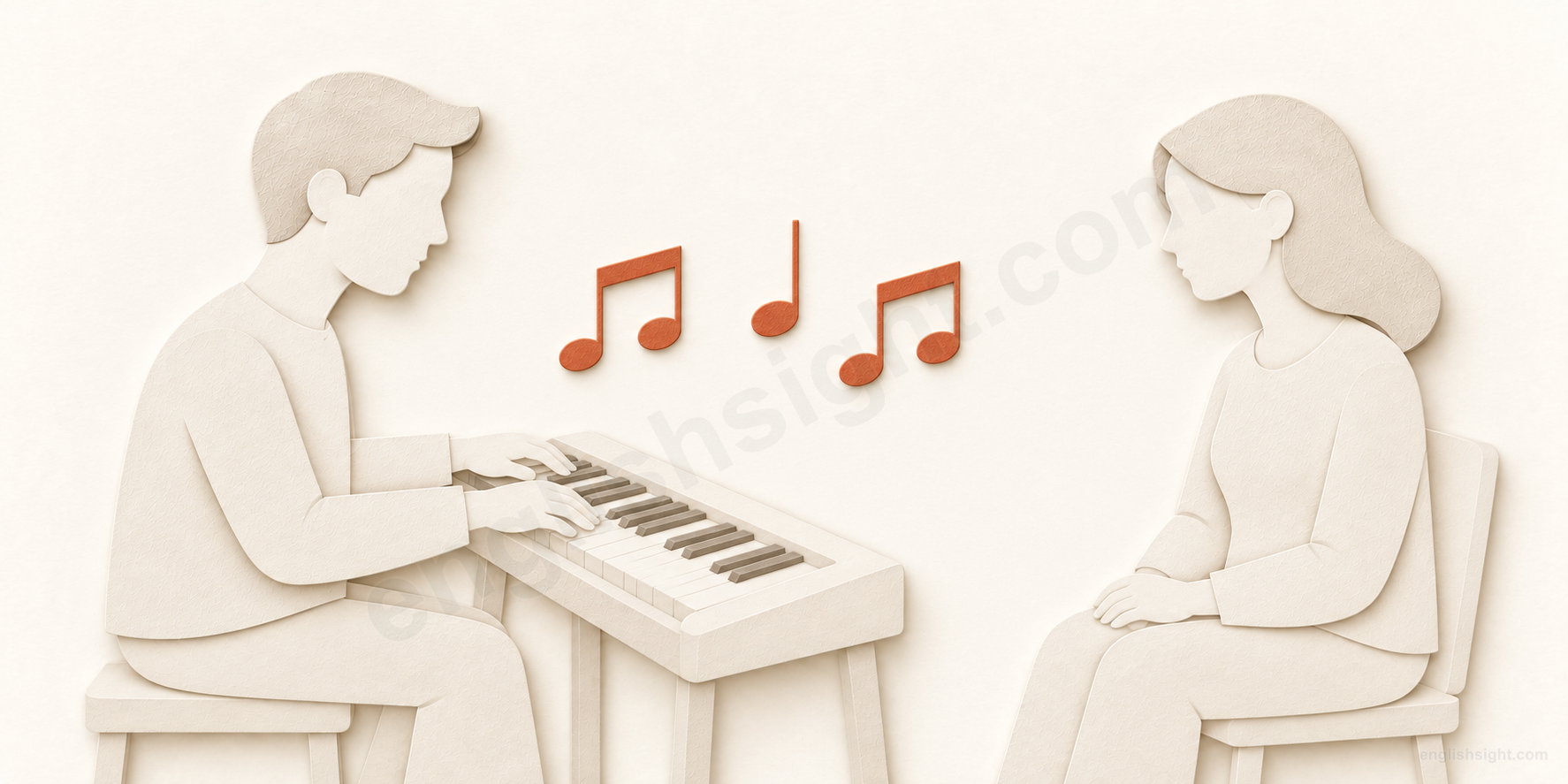
The player shapes tones at the keyboard.
music
The listener hears the phrase.
The tones form a musical phrase.
The notes represent a pattern in sound, not objects travelling through the air.
Music is sound shaped into a pattern over time, through such features as rhythm, melody, or harmony.
The player and listener make the sound relationship visible. The art and written-notation senses name practices and representations connected with that sound; the picture does not predict fixed idioms.
Music commonly names sound shaped into a musical pattern over time. The same word also names the art of creating or performing it and the written signs used to represent it.
A useful learning picture is a player shaping tones and a listener hearing a connected phrase. It is a teaching model, not a claim that all English speakers see the same image. Fixed expressions still need their own explanations.
01
Sounds, pieces, and preferences
Start with what you hear. Then distinguish a whole field of sound from one piece and from a style you enjoy.
01
music + singular verb; hear + music
hear music
sound experienced as a musical pattern
Situation
Tones come from the open window.
What is meant
You recognize a tune being played.
Music names a pattern unfolding in sound, not the instrument that makes it.
A melody, a rhythm, or voices and instruments working together can be music. A single noise is a sound; calling something music treats it as a musical whole. Music can be quiet, loud, cheerful, or unsettling.
The picture uses a player and a listener to make this connection concrete. Neither a live player nor a separate listener has to be present every time music exists: a recording or someone singing alone is music too.
Example in English
Music was drifting through the kitchen window.
Watch the difference Music is a noun: say Music is playing, not Music are playing.
02
a piece of music; two pieces of music; some music
a piece of music
one musical work within the uncountable category
Situation
You want to describe two short compositions.
What is meant
You count the pieces, rather than music itself.
Count a piece, song, or track; ordinarily do not count music.
Use some music, a little music, or a lot of music for an amount. For a single work, say a piece of music; for several, say two pieces of music. There is no ordinary everyday plural musics in this sense.
A song normally has words intended to be sung. A piece of music can be instrumental. A track is a recording of a single song or piece of music, so these count nouns do not always refer to exactly the same thing.
Use music without the when speaking generally: Music helps me concentrate. Use the music for identifiable music: The music in this café is too loud.
Example in English
She wrote two short pieces of music for the school concert.
Watch the difference Avoid a music and two musics for ordinary individual works.
03
kind of music; the music of + person / place; taste in music; be into + music
classical music / taste in music
a style, tradition, or body of work, and someone’s preferences
Situation
Friends compare the recordings they enjoy.
What is meant
They name styles and describe their preferences.
A modifier narrows the kind of music; in introduces the field of someone’s taste.
Pop music, rock music, folk music, classical music, and electronic music identify different kinds. Music remains uncountable: I like folk music, rather than I like a folk music.
The music of a composer, place, or period identifies a body of work. A composer’s music does not mean the composer owns every recording.
Ask What kind of music do you like? Taste in music means musical preferences. Be into music is informal for being interested in it; be into jazz narrows that interest.
Example in English
Our taste in music is different: I like folk music, but Nia is into jazz.
Watch the difference Say taste in music; the preposition describes an area of preference.
02
Listening, playing, and creating
Music names the sound or art; the verb tells you whether someone listens, performs, creates, records, or studies it.
04
listen to + music; hear + music
listen to music / hear music
pay attention to music, or simply perceive it
Situation
A radio is playing in the next room.
What is meant
You may notice it or choose to listen closely.
Listen to marks attention; hear does not require a deliberate listening activity.
Listen to music describes directing your attention toward it. Hear music describes the sound reaching your hearing; it need not be what you intended to listen to.
Compare I listen to music while I cook with I can hear music upstairs. In the first, listening is part of your chosen activity. In the second, you report an audible sound. The difference comes from listen and hear, not from two different kinds of music.
Example in English
I could hear music downstairs, but I was listening to a language lesson.
Watch the difference Keep to after listen: listen to music. Hear takes its object directly: hear music.
05
put on + music / put music on; put it on; play / stream / download music
put on / play / stream music
make recorded music available to hear
Situation
The room is quiet and your phone has a playlist.
What is meant
You start playback and adjust the volume.
Playing music can mean operating a recording rather than performing on an instrument.
Could you put some music on? asks someone to start a recording or broadcast. Put it on places a pronoun between put and on. Turn the music down asks for less volume; it does not necessarily ask for silence.
Play music can describe a device producing sound: My phone is playing music. Stream music means listen through an internet service as the data arrives; download music means save the data to a device. Neither action means composing it.
Example in English
Let’s put some music on, but keep it quiet while the baby sleeps.
Watch the difference In put music on, the particle belongs to put. Music itself is not part of a phrasal verb.
06
play / make / perform music; play music on + instrument
play / make music
produce musical sound by performing
Situation
Friends bring voices and instruments together.
What is meant
They create an actual performance.
The performer produces the sound; music is the result or activity.
Someone who plays music on a violin performs it. A person who plays music on a phone may simply start a recording. The instrument, device, and surrounding situation help resolve play.
Make music often means sing or play, especially with other people. It does not require composing something new: friends can make music by performing familiar songs. Perform music focuses on the act of presenting it, often to an audience.
Example in English
We make music together on Fridays, with one guitar and three voices.
Watch the difference Play music is natural. Do music is not the usual general expression for performing it, though do music at school can mean take the subject.
07
write / compose music; record / release music
write / compose / record music
create a musical work, or capture its sound
Situation
A composer develops a tune and later enters a studio.
What is meant
There is a new work and then a recording of it.
Creating the work and recording a performance are different activities.
Write music and compose music describe creating a musical work. Write does not require using a pen: someone can write music with software or an instrument.
Record music means capture a performance or other musical audio for later listening. You can record music that someone else composed. Release music means make it publicly available; that is another step, not a synonym for compose.
Example in English
Mara composed the music at home and recorded it with her band a month later.
Watch the difference Recording music does not by itself establish who wrote it.
08
study / teach music; music + noun; a career in music
study music / work in music
the art as a subject, activity, or professional field
Situation
A student enjoys playing and wants deeper training.
What is meant
She studies the subject and considers a career.
Music can name the wider discipline rather than sound happening now.
Study music can include performance, composition, theory, and other musical study. Have music lessons means receive instruction. It need not mean that a recording is being played at that moment.
A career in music and work in the music industry refer to the professional field. Music teacher, music lesson, and music festival use the noun music before another noun to identify its area. Musical is a related adjective: a musical instrument, not normally a music instrument.
Example in English
He studies music and hopes to become a music teacher.
Watch the difference Music is the field; a musician is a person who makes music.
03
Written music and words
Music can name the notation that represents sound, and it can contrast with the words sung to that sound.
09
read music; be able to read music
read music
understand the written signs for musical sounds
Situation
You are given notes to perform.
What is meant
You interpret the symbols and know what to play.
Written music represents sound; reading it is not the same skill as listening.
Read music means understand musical notation, not read a review or article about music. A person may play by ear, using what they hear, without being able to read music.
This is a related sense of the noun: it names the system or written representation rather than the sounding performance. Reading music may happen silently; it does not require singing the notes aloud.
Example in English
I can learn a tune by ear, but I cannot read music yet.
Watch the difference Read about music means read information on the topic; read music means interpret notation.
10
the music + place expression; sheet music; play without the music
the music / sheet music
the written or printed material used for performance
Situation
A player puts a score on a stand.
What is meant
The written notes remain available to follow.
Context can make music refer to the physical pages carrying notation.
Where is the music? can ask where the printed notes are when performers are preparing. Put the music on the stand refers to those pages, not to placing a sound on a stand.
Sheet music distinguishes written or printed notation from recorded audio. It is also normally uncountable. Playing without the music in this context means playing without consulting the written score, often from memory.
Example in English
Please put the music on the stand before the rehearsal.
Watch the difference A music stand supports the written notes; it is not a speaker.
11
the words and music; write the music for + song
the words and music
the verbal and musical parts of a song considered separately
Situation
One person writes lyrics and another creates the tune.
What is meant
The song combines both contributions.
Music here contrasts with the words rather than excluding all singing.
In credits, words and music separates the lyrics from the tune and musical composition. The same person may create both, or two people may share the work.
Music alone is broader: singing can be music, and a song includes musical sound. The contrast is useful when discussing authorship; it does not mean voices can never count as music.
Example in English
I wrote the words, and my brother wrote the music for our song.
Watch the difference A song normally combines words with music; instrumental music need not contain words.
12
set + text + to music; text + be set to music
set a poem to music
compose music for existing words
Situation
A poem exists as a written text.
What is meant
A composer gives it a musical setting that can be sung.
Set to music links a text with a newly composed musical part.
To set a poem to music is to create music for its words. The object after set is the text being given a musical setting; to introduces music, not an infinitive verb.
The past and past participle of set are also set: The poem was set to music. This is a passive form of the whole expression, not a passive form of the noun music. Merely playing a recording while reading is not necessarily setting the poem to music.
Example in English
A local composer set the children’s poem to music for the concert.
Watch the difference Do not confuse composing music for words with simply putting a recording on in the background.
04
Music in a situation
Prepositions and modifiers explain how music accompanies an activity or serves a particular purpose.
13
dance / move to (the) music; in time to the music
dance / move to music
move with music as accompaniment or a rhythmic guide
Situation
A tune begins and dancers hear its beat.
What is meant
Their movement follows the musical timing.
To connects the activity with the sound guiding or accompanying it.
Dance to music and move to the music put the musical sound alongside the action. In time to the music adds a more precise idea: the movement keeps the beat.
The is appropriate when you mean the particular music playing now. To in these expressions is not movement toward a destination and not the to of listen to, even though the forms look alike.
Example in English
The children clapped in time to the music.
Watch the difference Dance with someone names a partner; dance to music names the accompaniment.
14
live / background / theme + music; music for + purpose / instrument
live / background / theme music
music described by its presentation or purpose
Situation
You choose sound for an event or a programme.
What is meant
The modifier says what role it serves.
These modifiers classify music; they do not create new countable objects.
Live music is performed as it happens, rather than simply played from a recording. A live performance can also be recorded, so a recording of live music is possible.
Background music supports another activity without being its main focus. Theme music is associated with a particular programme or film. Music for a film identifies a purpose; music for piano identifies the instrument intended to play it.
A music video pairs a song or track with moving images; a music festival is an event featuring performances. In each compound, the final noun names the thing.
Example in English
The café has live music on Fridays and quiet background music on other days.
Watch the difference Live describes how the performance happens, not whether the music is fast or lively.
05
Pleasant sounds and fixed expressions
Some uses compare another experience with music. Learn fixed idioms as whole expressions, especially when their meaning is not pleasant.
15
the music of + natural sound source
the music of the rain
a pleasing natural sound described poetically as music
Situation
Rain makes a gentle, repeating sound on the roof.
What is meant
A writer compares that sound with a musical pattern.
The description treats a natural sound as something musical to enjoy.
The music of the rain is a literary way to describe an enjoyable or patterned natural sound. It does not say someone composed or performed it.
This comparison builds on the sound sense. Ordinary conversation can simply say the sound of the rain. Calling a sound music expresses a way of experiencing it, rather than a technical classification.
Example in English
We fell asleep to the soft music of the rain on the roof.
Watch the difference This is an expressive description, not the neutral name for every kind of weather noise.
16
be music to + possessive + ears; be music to the ears of + person
music to someone’s ears
news that is especially welcome
Situation
You have waited for good news about a repair.
What is meant
You hear that it will cost nothing and feel relieved.
The pleasant effect of music becomes a comparison for welcome information.
That’s music to my ears means I am very pleased to hear that. The possessive form identifies the person receiving the welcome news: music to her ears, music to our ears.
The news need not be sung, rhythmic, or literally musical. Be music to the ears of someone is another form. The whole expression is the idiom; music by itself does not mean good news in every sentence.
Example in English
“The repair is covered by the warranty.” “That’s music to my ears!”
Watch the difference Keep to and the plural ears in the familiar expression.
17
face the music; have to face the music
face the music
accept criticism or other unpleasant consequences of your actions
Situation
You made a mistake and cannot keep avoiding the discussion.
What is meant
You return to explain it and accept the response.
This fixed idiom concerns responsibility, not an enjoyable musical experience.
Face the music is an informal way to say that someone deals with the criticism, punishment, or difficult consequences of what they have done. It often appears with have to or must when avoidance is no longer possible.
In this expression, face means confront, and the whole combination has an established meaning. The pleasant-sound model does not explain it reliably. You do not need to invent a literal concert or a historical origin to understand the present use.
Example in English
I deleted the wrong file, so I’ll tell the team and face the music.
Watch the difference Keep the in this idiom. Face music without the is not the usual fixed expression.
Keep the sound, the grammar, and the expression distinct
Music is normally uncountable
Use Music is…, some music, and a piece of music. The specialized plural musics can discuss distinct musical traditions in academic writing; it is not the beginner’s ordinary way to count songs.
Sound, music, song, and noise
Sound is the broad category. Music treats sound as a musical pattern or work; a song normally includes sung words. Noise often suggests unwanted or irregular sound, but one person’s music can be another person’s unwanted noise.
The noun does not supply the action
Music is the noun in play music, study music, and read music. Verb tense and passive patterns belong to play, study, read, or another verb. There is no everyday music verb or particle-verb family to learn here.
A helpful picture has limits
Not all music has words, a regular beat, a live instrument, or a happy mood. The picture illustrates one musical phrase, not a technical definition of every musical tradition. Face the music must be learned as a fixed idiom.
Choose the meaning in context
Use the whole expression and the situation to decide.
1. You are introducing three short instrumental works. Which description fits ordinary English?
2. A pianist says, “I can play by ear, but I cannot read music.” What is missing?
3. “My phone is playing music in the next room.” What does playing most naturally mean here?
4. A composer set a poem to music. What did the composer do?
5. “Your replacement ticket is free.” “That’s music to my ears!” What does the reply express?
6. You damaged a borrowed camera and now have to face the music. What must you do?
Sources and teaching notes
The dictionary sources support the meanings and expressions. Explanations, examples, and the visual teaching model were created for this lesson.
The diagram is a teaching aid, not an image shared by every English speaker.