Keep the body part separate, then follow fastening into firm results and familiar idioms.
From loose to securely fixed
From loose to securely fixed
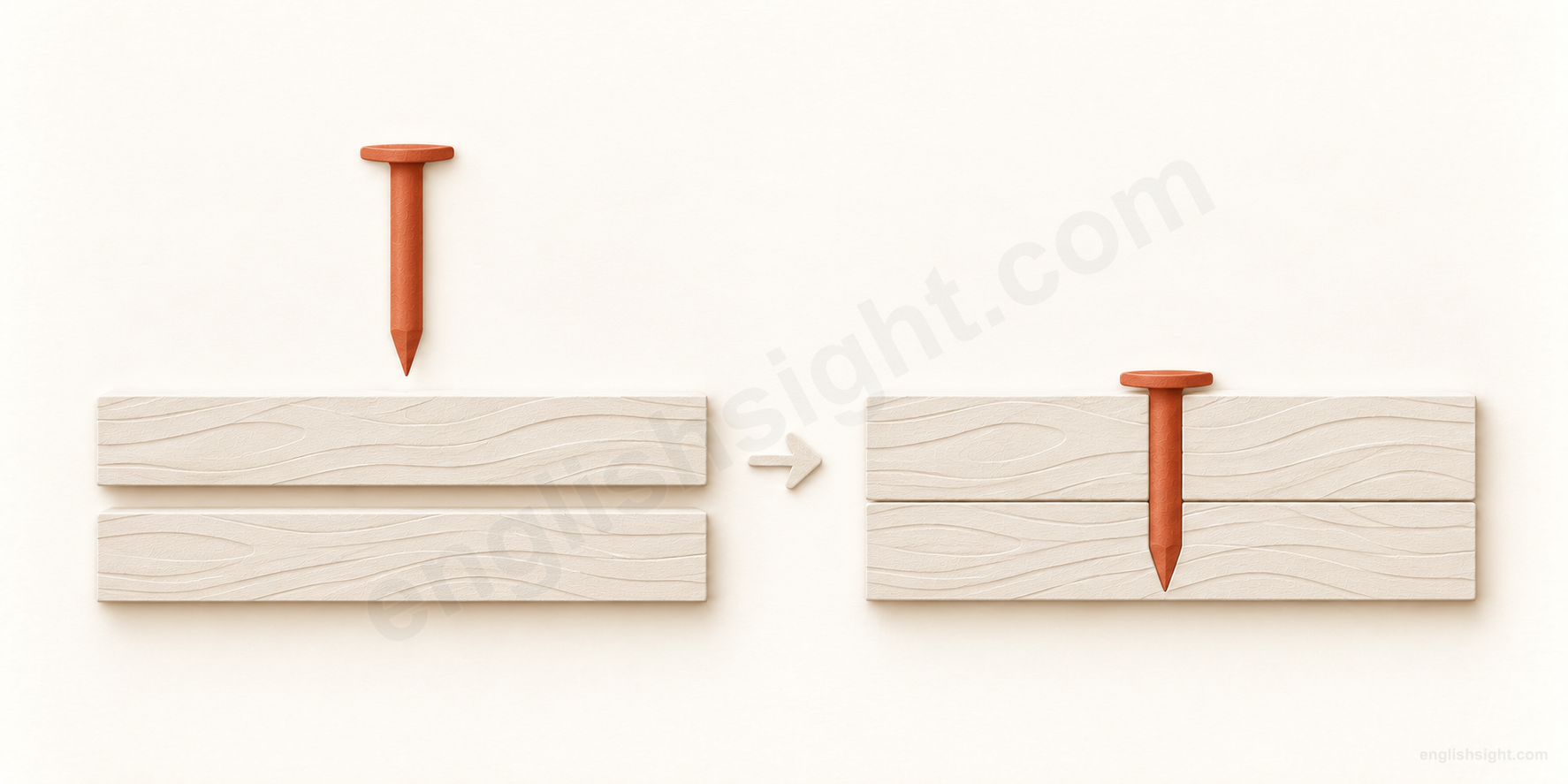
Two boards are separated, with a nail above them.
nail
The boards touch and are held together by the nail.
The nail is driven through the upper board and into the lower one.
Driven through one board and into the next, a nail holds them together.
A metal nail is driven into material to hold parts firmly in place.
This picture explains the metal fastener and literal fastening verb. Firmness can help connect some figurative uses, but the body-part meaning is a separate branch and fixed expressions have their own meanings.
A nail may be the hard covering on a finger or toe, or a pointed metal fastener. These are two everyday noun meanings, so begin with the object and context rather than one universal translation.
The fastening use gives a helpful teaching connection for several verb uses: something becomes securely fixed, definitely settled, or successfully achieved. Other meanings and idioms still need to be learned in their own constructions.
This lesson offers a memory model and common uses, not a claim that every native speaker sees the same picture or that every expression follows from one physical action.
01
Two everyday objects
A nail can be part of your body or a separate metal fastener. The surrounding words tell you which branch is meant.
01
a nail; fingernails / toenails; verb + your nails; nail + care noun
a nail / your nails
the hard covering at the end of a finger or toe
Situation / starting point
A finger or toe has a hard covering near its tip.
Meaning / result
You refer to that covering as a nail.
A fingernail or toenail is part of the body, not a metal fastener.
Nail is countable: a nail, one broken nail, ten nails. Fingernail specifies the hand; toenail specifies the foot. In a conversation about hands, nails usually means fingernails.
Use possessives naturally: I broke a nail; there is dirt under my nails. Cut, trim, file, and paint your nails describe different kinds of nail care. Nail polish, also called nail varnish in British English, is the colored or clear coating. Nail clippers cut them; a nail file smooths their edges.
Bite your nails names a real habit, often associated with worry. A nail-biting finish is an exciting, tense ending, and a nail-biter is an event that keeps people anxious about the result. Those related forms do not say everyone actually bites their nails.
In a sentence
I trimmed my nails before the cooking class.
Watch the difference Do not call an entire finger a nail. Nail polish is a substance, not another name for the body part.
02
hammer / drive + a nail + into something; hammer it in; pull it out
a nail / hammer a nail in
a pointed metal piece used to hold or hang things
Situation / starting point
Two pieces of wood need a fastening.
Meaning / result
A metal nail can be driven through them.
The head receives the blow; the point enters the material.
The hardware noun is countable too: a nail, a box of nails. A typical nail has a flat head and a pointed shaft. It can join pieces or support a hanging object.
Hammer a nail into the wood names the tool action; drive a nail into the wood focuses on making it enter. Hammer it in and pull it out describe insertion and removal. Here nail is the noun, and in or out belongs with the other verb.
A screw has a thread and is normally turned into place. A nail is normally driven in. The two may do similar jobs, but they are different fasteners.
In a sentence
We drove two nails into the board.
Watch the difference Distinguish a nail in the wood from nail the wood: the first uses a noun; the second uses a verb.
02
Fastening and closing
As a literal verb, nail tells you how something is secured. The object and following words tell you what is fixed and where it ends up.
03
nail + object + to + support; nail + objects + together / in place
nail something to something
attach an object using nails
Situation / starting point
A small board is separate from the fence.
Meaning / result
Nails hold the board against the fence.
The object is what gets attached; to introduces the support.
In nail a board to a fence, a board is the direct object and a fence is the support. The verb names the fastening method, so no separate with nails is required.
Nail the boards together describes joining them to each other. Nail it in place emphasizes the final position. The passive is natural when the work or result matters: The boards were nailed together.
Compare hammer the board, which only says you strike the board, with nail the board to the fence, which says you attach it. You can hammer a nail, but nailing usually takes the thing being secured as its object.
In a sentence
Maya nailed a small board to the fence.
Watch the difference Say nail it to the fence; to is a preposition here, not an infinitive marker.
04
nail + object + shut; nail + object + up / nail up + noun
nail something shut / nail something up
secure an opening or container so it cannot be opened normally
Situation / starting point
A wooden lid or window can be opened.
Meaning / result
Nails hold it closed.
Shut states the result; up can also mark securing something closed.
Nail the lid shut means use nails to keep the lid closed. Shut describes the resulting state of the lid; it does not mean hitting a moving lid. The passive is common: The window was nailed shut.
Nail up a door or window can likewise mean secure it against opening. Collins also records nail up a wooden container, with its lid secured. Compare nail up a sign: there up means fasten it to a support, not close it.
With the particle up and a pronoun, use nail it up. With shut, say nail it shut. The object and context distinguish these patterns.
In a sentence
They nailed the wooden lid shut before shipping the crate.
Watch the difference Up does not always mean upward movement: a door nailed up may simply be secured closed.
05
nail down + noun; nail + object + down
nail something down
fasten something in position with nails
Situation / starting point
A floorboard is loose.
Meaning / result
It is secured to the surface beneath it.
Literal down concerns securing something against its support.
Nail down the board and nail the board down are both possible. Down helps specify a firmly secured position, often against a lower surface. It does not turn every use into a literal downward journey.
A pronoun goes between the verb and particle: nail it down. The same word order applies when nail down is figurative, but the object changes the meaning.
In a sentence
This floorboard is loose; we need to nail it down.
Watch the difference Not nail down it. Place an unstressed object pronoun before down.
06
nail up + noun; nail + object + up
nail something up
attach something to a wall, post, or other support
Situation / starting point
A notice board is not attached.
Meaning / result
It is fixed where people can see it.
Here up concerns putting the object in position on a support.
You can nail up a board or nail a board up. The phrase describes attaching it with nails, often for display or use in a raised position. A pronoun must come between: nail it up.
Putting up a sign does not specify the fastening method; nailing it up does. The closed-opening meaning of nail up needs a different object or context, such as a door secured closed.
In a sentence
We nailed the wooden notice board up beside the gate.
Watch the difference Do not infer that every object nailed up has been closed or blocked.
03
Getting a firm result
Informal uses concern success, evidence, a decisive hit, or a definite answer. These are established meanings; a physical nail is not involved.
07
nail + task / performance; nail it
nail it / nail a performance
do something especially well or successfully
Situation / starting point
You face a difficult task.
Meaning / result
You carry it out just right.
This informal use evaluates a successful result.
You nailed it! is informal praise after someone gets a task or performance right. It can apply to a presentation, a jump, a song, an answer, or another challenge; no hammer is involved.
An explicit object can replace it: nail the landing or nail the interview. It refers to the task already understood in context. This is a normal verb plus object, not a phrasal verb with an invisible particle.
The image of a firm, accurate result may help you remember the use. It is a teaching connection, not a rule that predicts every meaning of nail.
In a sentence
Your explanation was clear and confident—you nailed it.
Watch the difference Nail it is informal; carry out successfully is a more neutral choice in formal reporting.
08
nail + person + (for + offence); be nailed for something
nail somebody for something
catch someone and establish responsibility for wrongdoing
Situation / starting point
Investigators suspect someone but lack proof.
Meaning / result
Evidence connects that person to the offence.
The person is the object; for can introduce the offence.
In informal accounts of wrongdoing, nail someone suggests catching them and proving their involvement, rather than merely noticing them. For identifies what they are held responsible for.
He was nailed for fraud is a passive version. Depending on context, the expression may focus on catching, charging, or punishing; it is not the name of one precise legal procedure.
Use neutral wording such as identify the suspect or prove involvement when that is exactly what you mean. The firmness connection is figurative, not a statement about physical restraint with nails.
In a sentence
The investigators finally nailed the accountant for fraud.
Watch the difference This informal expression can sound forceful. Do not equate it with a technical finding of conviction in every context.
09
nail + lie / myth
nail a lie / myth
show that a claim is false
Situation / starting point
A false story continues to circulate.
Meaning / result
Evidence exposes its falsity.
The object is the false claim, not the person who believes it.
Nail a lie or myth means expose it as untrue. This informal use concerns disproving something, not confirming the claim or making the lie more convincing.
Compare nail the culprit, which concerns a person’s responsibility, with nail the myth, which concerns the truth of a claim. The object is essential to interpreting the verb.
In a sentence
The original recording helped nail the lie about what she had said.
Watch the difference Nail a myth means disprove it; it does not mean learn it perfectly.
10
nail + thing / person; nail somebody on + body part
nail the ball / nail somebody
hit something or someone hard or accurately
Situation / starting point
A ball approaches the player.
Meaning / result
The player strikes it forcefully.
In a physical action context, nail can mean strike.
In informal sports talk, nail the ball can describe a forceful hit. Nail someone can also mean hit them, so context must distinguish a blow from catching someone for an offence.
Compare She nailed the ball with She nailed the landing. The first can describe a strike; the second praises a successful landing. Read the object and situation rather than translating the verb in isolation.
In a sentence
He nailed the ball into the far corner of the net.
Watch the difference This use does not require fastening the ball to anything.
11
nail down + arrangement; nail + object + down
nail down the details / an agreement
make an arrangement definite
Situation / starting point
People have discussed several possible arrangements.
Meaning / result
They settle on definite terms.
Figurative down turns uncertainty into a firm arrangement.
Nail down a date, the details, or an agreement means settle it so people can act on it. The phrase often suggests that discussion or effort was needed.
You can nail the details down or nail them down. The result is a definite decision, not simply a note written down. This use extends the idea of fastening, but it is learned as an established expression.
In a sentence
Let’s nail down the delivery date before we book the truck.
Watch the difference Writing down a possible date does not necessarily nail it down; it may still be undecided.
12
nail down + cause / source / exact information
nail down the cause
find out exactly what something is
Situation / starting point
Several possible causes remain.
Meaning / result
Investigation identifies the specific cause.
The result is exact knowledge, rather than an agreed arrangement.
Nail down an unknown cause or source means determine it precisely. You investigate evidence rather than negotiate a convenient answer.
Compare nail down the meeting date, which can mean settle an arrangement, with nail down the source of a noise, which means identify it. The same particle verb has different tasks according to its object.
In a sentence
We still haven’t nailed down the cause of the strange noise.
Watch the difference Knowing that there is a problem is not the same as nailing down its cause.
13
nail + person + down + to something; nail somebody down on + topic
nail somebody down to something
get a definite commitment or exact answer from someone
Situation / starting point
A colleague keeps giving a vague answer.
Meaning / result
You obtain a specific promise or intention.
The person is the object; to introduces what they commit to.
Nail someone down to a time or decision suggests pressing them to stop being vague. It can sound more forceful than ask someone to confirm.
Say nail her down to a date, not nail down her to a date. Collins also records on with the topic: nail someone down on the deadline. The promise meaning comes from the full construction, not from to alone.
In a sentence
I can’t nail him down to a time for our next meeting.
Watch the difference This is figurative pressure for a clear answer, not physical fastening.
04
Expressions to learn as a whole
Accuracy, determination, toughness, failure, public support, and prompt payment each have their own established expression.
14
hit the nail on the head
hit the nail on the head
say exactly what is right about a situation
Situation / starting point
People are trying to explain a problem.
Meaning / result
One comment identifies it exactly.
The whole idiom praises a precise observation or explanation.
You hit the nail on the head tells someone their comment is exactly right. The literal image is an accurate blow to the nail’s head, but the ordinary idiom often concerns speech or understanding.
For example, after a colleague says the instructions are unclear, you can agree with this phrase. Compare You nailed it, which can praise many successful performances, not only an accurate comment.
In a sentence
You hit the nail on the head when you said the instructions were too vague.
Watch the difference Keep the fixed wording: the nail on the head, not a nail in the head.
15
fight tooth and nail to + verb; fight + object + tooth and nail; fight tooth and nail for something
fight tooth and nail
make every effort to achieve or resist something
Situation / starting point
A valued service is threatened with closure.
Meaning / result
People resist with great determination.
Tooth and nail intensifies the struggle; it does not require violence.
Fight tooth and nail to keep something means do everything you can to keep it. Fight a proposal tooth and nail means oppose it determinedly. For can introduce the cause you support.
Teeth and nails provide a physical image of fierce resistance. The expression can describe petitions, arguments, and other peaceful efforts; it does not say those efforts succeed.
In a sentence
The residents fought tooth and nail to keep their library open.
Watch the difference Use singular tooth and nail in this fixed expression, without articles.
16
a / another / the final nail in + somebody’s / something’s coffin; a nail in the coffin of something
a nail in the coffin
a development that makes an end or failure more likely
Situation / starting point
A project is already in difficulty.
Meaning / result
Another setback brings it closer to failure.
A coffin image makes this a strongly negative expression.
A nail in the coffin of a plan or organization is a damaging event. Another nail adds to earlier damage; the final nail in the coffin suggests the decisive last setback.
The idiom usually concerns the end of a project, business, hope, or similar thing rather than an actual burial. An ordinary nail holds things together, but this full expression specifically signals decline.
In a sentence
Losing the main sponsor was the final nail in the festival’s coffin.
Watch the difference A nail in the coffin is harmful to the thing named, even though nail can express success elsewhere.
17
(as) hard as nails; (as) tough as nails
hard as nails / tough as nails
very unsympathetic or very resilient, depending on the expression
Situation / starting point
Someone faces a situation that tests emotion or endurance.
Meaning / result
You describe their hardness or ability to withstand difficulty.
Hard often judges lack of kindness; tough often praises resilience.
Someone who is hard as nails may show little sympathy or kindness. It can suggest fearlessness as well, but it is not automatically praise.
Tough as nails usually emphasizes strength and the ability to withstand difficult conditions. It can be admiring. The two overlap in toughness, but the tone and focus can differ, so check the surrounding comment.
Both use a comparison with metal nails. Say as hard as nails or hard as nails; nails stays plural. You do not need literal nails in the scene.
In a sentence
Our coach is tough as nails and never gives up when training gets difficult.
Watch the difference Do not assume hard as nails always means physically fit or kind under pressure.
18
nail + possessive + colours / colors + to the mast
nail your colours to the mast
state your beliefs or support openly and firmly
Situation / starting point
Someone’s position has not been clearly stated.
Meaning / result
They publicly declare where they stand.
The expression concerns a clear public commitment.
Especially in British English, nail your colours to the mast means announce your beliefs or whom you support. The image is a ship’s flag fixed to its mast; a flag stands for a declared side.
The possessive changes with the subject: she nailed her colours to the mast. American spelling uses colors. This is a marked idiom, useful to recognize in political or public discussion; state your position is plainer.
In a sentence
By backing the proposal in public, Elena nailed her colours to the mast.
Watch the difference The idiom does not just mean decorate something with bright colors.
19
pay + (amount) + on the nail
pay on the nail
pay immediately, without delay
Situation / starting point
Payment becomes due.
Meaning / result
The customer pays promptly.
This regional informal idiom concerns timing of payment.
On the nail is British informal usage for immediate payment. It is useful for recognition, though pay immediately is more widely transparent.
The phrase is fixed: on the nail. It has no productive connection to hammering, and it does not simply mean paying eventually or paying the correct amount.
In a sentence
The customer paid the full amount on the nail.
Watch the difference Do not infer that payment was made with coins or at a particular physical location.
Let context choose the meaning
Forms and grammar
Noun: nail, nails. Regular verb: nail, nails, nailed, nailing. The verb normally takes an object; literal actions can be progressive and passive: They are nailing the boards together; the lid was nailed shut. Nail + object + shut is a result construction, not a separate causative family.
Particle, preposition, or fixed phrase?
Nail down and nail up allow noun objects on either side of the particle; a pronoun goes before it: nail it down, nail it up. In nail it to the post, to introduces the support. In hit the nail on the head, learn the full idiom rather than replacing its prepositions freely.
Register and boundaries
The body and hardware nouns and the fastening verb are neutral. The success, catch, disprove, and strike verbs are informal. Nail can also be vulgar sexual slang; recognize that possibility in adult contexts, but do not use it as a neutral substitute for a relationship expression. Technical fastener types, animal-claw terminology, the obsolete cloth measure, and specialized sports uses are not developed here.
One picture has limits
The diagram is a fastening model. It does not explain a human nail as a tool for attaching things, and it cannot tell you the meaning or tone of every idiom. Figurative descriptions of eyes or attention being nailed on something mean fixed intently there; these less central literary uses are outside the main practice.
Read the object and the whole expression
Choose the sentence or meaning that fits the situation.
1. You want to shorten the hard coverings on your fingertips. Which request fits?
2. A loose board needs securing with nails. Choose the normal pronoun position.
3. Your friend has just given an excellent presentation. What does “You nailed it!” mean?
4. The team has “nailed down the cause of the noise.” What have they done?
5. A wooden window has been nailed up so that it cannot open. What does up indicate here?
6. A report calls the loss of funding “another nail in the project’s coffin.” Is this good news?
Sources and teaching notes
The dictionary pages below support the senses and constructions. Explanations and examples are original; the connection through firmness is a teaching interpretation. The coverage record gives source-to-unit mappings and exclusions.
The diagram offers a teaching connection; it is not a picture shared by every native speaker.