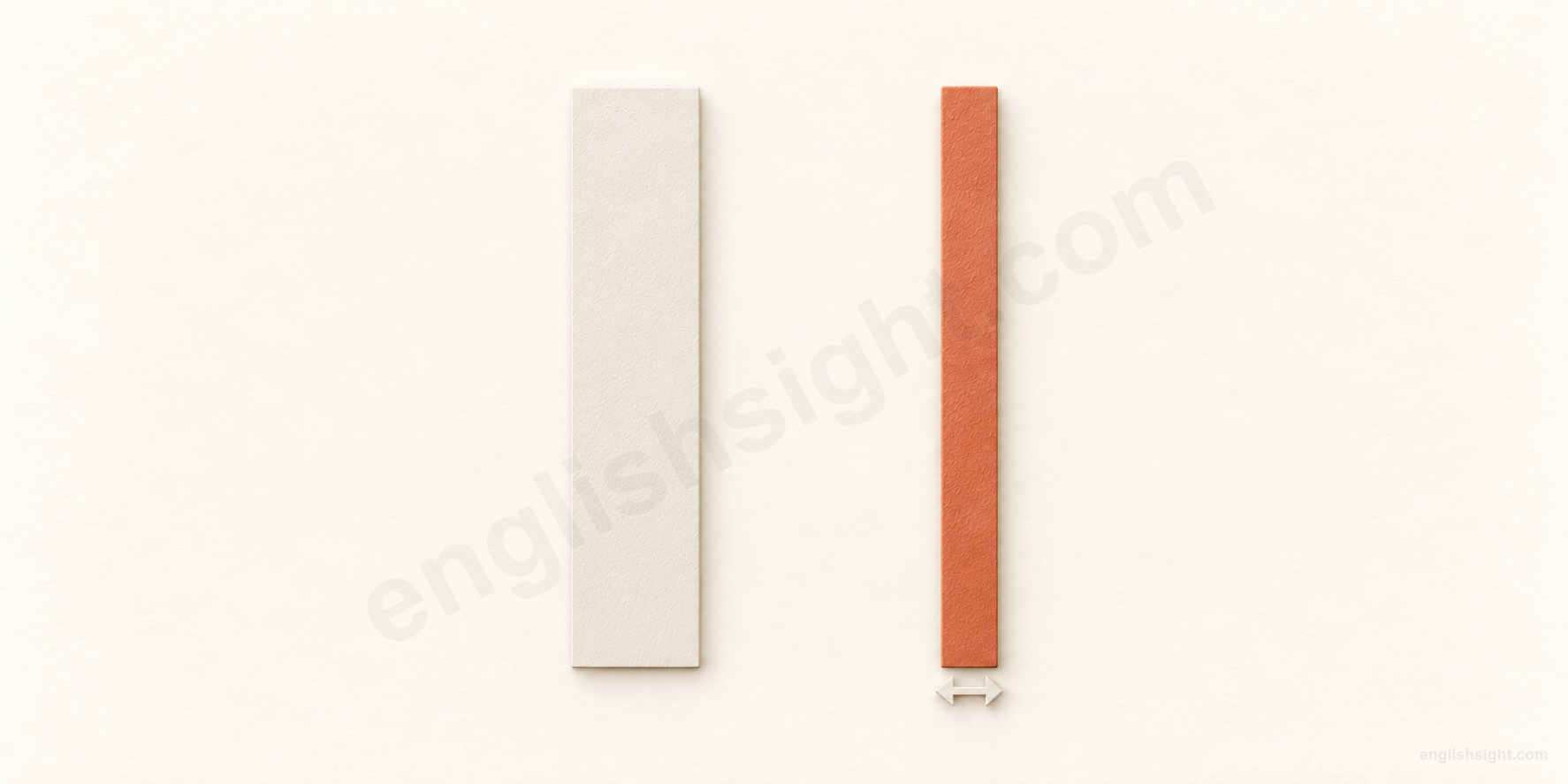
Use narrow for limited width, restricted scope, close results, and reductions.
Find the limited dimension
Find the limited dimension
The wider ivory strip provides a comparison.
narrow
The terracotta strip is narrow but just as long.
Compare side-to-side width while keeping length equal.
Equal length, different width: the right strip is narrow. The arrow measures width, not movement or change over time.
Narrow describes little side-to-side width. Related uses concern a restricted range or a small margin; the verb describes making or becoming more limited.
A narrow thing need not have changed. The verb supplies change; nouns such as victory and escape supply the outcome. Fixed expressions still need their own explanations.
A street can be long and narrow; a selection can be narrow even when it contains many items. Look for the particular dimension or range being limited.
The comparison in the sketch is a teaching model. It connects several uses without claiming that every English speaker pictures the word in the same way.
01
Width, range, and viewpoint
First ask what has little room: a physical width, a range of choices, a definition, or someone’s outlook. A limited range can be useful or undesirable; context decides.
01
a narrow + noun; be narrow; narrower than; too narrow for + noun
a narrow street
small from one side to the other
Situation or comparison
You judge how much space there is across the street.
What is limited or reduced?
There is little room side to side.
Narrow concerns width, not necessarily length or overall size.
A narrow street can run for several miles. A narrow ribbon can also be very long. Ask about the dimension across the thing, rather than how much of it exists altogether.
Use narrow before a noun or after a linking verb: a narrow shelf; the shelf is narrow. Compare narrower than and the narrowest. Too narrow for the box means the available width is insufficient.
Small describes size more generally; thin often describes thickness. A board can be narrow across its face but thick from front to back. For an opposite in width, use wide or broad.
In a sentence
The street is too narrow for two buses to pass.
Watch the difference A short road lacks length; a narrow road lacks width. These are different descriptions.
02
a narrow range of + plural noun; narrow in scope
a narrow range
limited variety or extent
Situation or comparison
You consider how many different things are available or covered.
What is limited or reduced?
Only a restricted selection falls within the range.
The relevant dimension is variety or scope, rather than physical width.
A narrow range of sizes means little variety in sizes. It does not tell you how many items are in stock: a shop might have hundreds of shirts, all in two sizes.
Narrow in scope states what is limited: The study is narrow in scope. A narrow circle of friends similarly describes a restricted social circle; circle is not a literal shape here.
A narrowly focused project can be sensible when time is short. Limited scope does not by itself mean poor quality. Criticism becomes clearer with too narrow or a context showing what was left out.
In a sentence
The shop offers a narrow range of sizes.
Watch the difference Do not equate a narrow range with a small number of items; range concerns the spread or variety.
03
in the narrow / narrower sense (of + noun)
in the narrow sense
using a restricted definition
Situation or comparison
A word can include a larger set of cases.
What is limited or reduced?
For this discussion, only a smaller defined set counts.
A narrower meaning includes fewer cases; it need not be mistaken.
In the narrow sense tells listeners that you are using a restricted definition. State the boundary so they know which cases count.
For example: By family in the narrow sense, I mean parents and their children. That is a definition for this discussion, not a claim that other family relationships do not exist.
The contrast is in the broad sense. In a narrower sense compares this use with another, more inclusive one. This is about a word’s meaning, not about someone refusing to consider new ideas.
In a sentence
In the narrow sense used here, travel means journeys outside your home country.
Watch the difference Explain the chosen definition; narrow does not provide the boundary by itself.
04
a narrow view of + noun; narrow in outlook; narrow-minded
a narrow view
a limited outlook that overlooks other perspectives
Situation or comparison
Several perspectives deserve consideration.
What is limited or reduced?
Someone’s view leaves important perspectives out.
This use often criticizes a person’s outlook, not their intelligence.
A narrow view of an issue can disregard relevant experiences or arguments. Narrow in outlook describes this limitation more generally.
Narrow-minded is a related adjective used to criticize unwillingness to consider unfamiliar ideas or other people’s opinions: Dismissing every unfamiliar custom is narrow-minded.
Distinguish a deliberately narrow research question from a narrow-minded reaction to evidence. Choosing one manageable topic need not involve rejecting other viewpoints.
In a sentence
Judging a school only by exam scores gives a narrow view of education.
Watch the difference A narrow-minded person is being criticized for closed attitudes; the word does not mean physically small-minded or unintelligent.
05
a narrow window (of opportunity) to + verb
a narrow window of opportunity
little time in which an action is possible
Situation or comparison
An action is possible only during a certain period.
What is limited or reduced?
That period leaves little time to act.
Window is figurative here: the available interval is short.
A narrow window of opportunity is a limited period when circumstances allow you to do something. The window may close even though you still want to act.
We have a narrow window to repair the roof before the next storm describes timing, not a small physical opening. To repair tells us which action the period permits.
Narrow adds the idea that the opportunity is tightly limited. It does not specify an exact number of minutes, and it does not guarantee that you will use the opportunity.
In a sentence
We have a narrow window to plant the seeds before the rain arrives.
Watch the difference Read the context: a narrow window in a wall can instead describe literal width.
02
Close results and close calls
Here the small distance is between two outcomes. The noun or following verb tells you whether someone won, lost, or avoided trouble.
06
a narrow victory / defeat / majority; by a narrow margin; win / lose narrowly
a narrow victory
a result with only a small difference between the sides
Situation or comparison
The final scores are very close.
What is limited or reduced?
One side finishes just ahead of the other.
Narrow measures how close the result is; victory or defeat names the outcome.
A narrow victory means the winner finished only a little ahead. A narrow defeat is still a loss. By a narrow margin identifies the small difference in votes, points, or another relevant measure.
A narrow majority means support exceeds the relevant majority threshold by little. In a vote of 51 in favor and 49 against, supporters have a narrow majority.
Use narrowly to modify the verb: We narrowly won; we narrowly lost. Bare narrow normally modifies a noun in these result expressions. Narrow does not mean that success was comfortable.
In a sentence
Our team won by a narrow margin, 21–20.
Watch the difference The final verb or noun matters: narrowly lost means lost, not almost lost.
07
have a narrow escape; narrowly escape / avoid / miss + noun
a narrow escape
getting through a situation when trouble nearly happened
Situation or comparison
A falling branch nearly hits you.
What is limited or reduced?
You avoid being hit, but only just.
The unwanted event was close to happening; it did not happen in the stated respect.
Have a narrow escape presents a close call. You may escape injury even if an accident causes damage to your bicycle; name what was avoided when that distinction matters.
She narrowly avoided a collision says there was no collision. She narrowly missed the bus normally says she failed to catch it by very little. Narrowly adds closeness; avoided and missed determine what happened.
A narrow squeak is an informal expression for a close escape. For example: That falling branch missed us—that was a narrow squeak! Learn it as an expression, rather than interpreting squeak as a sound here.
In a sentence
We had a narrow escape when a branch fell just behind us.
Watch the difference Do not read a narrow escape as escape through a physically narrow doorway.
03
Making or becoming more limited
The verb narrow describes a reduction. Name the thing changing, or name an agent and the thing they reduce. Narrow down is especially useful when selecting possibilities.
08
something narrows; narrow + object; be narrowed; narrow to + noun
the road narrows
become less wide, or make something less wide
Situation or comparison
The road has more width at one point.
What is limited or reduced?
Farther along, there is less width.
The verb can describe a change without naming anyone who causes it.
The road narrows needs no object: the road itself becomes less wide along its course. It need not be shrinking over time; you may be comparing successive points on a route.
The builders narrowed the entrance adds an agent and an object. The entrance was narrowed is the corresponding passive. Be narrow describes a state; become narrow or narrow describes a change.
Narrow to can give an endpoint: The path narrows to a ledge. Use the progressive for an unfolding change when appropriate: The opening is narrowing as the material cools.
In a sentence
The road narrows just beyond the bridge.
Watch the difference You do not need down for a physical change in width: the river narrows is ordinary.
The gesture is visible; its reason comes from the situation.
You can narrow your eyes at someone, or your eyes can narrow. These are two grammatical ways to describe the same kind of movement.
It can accompany suspicion, anger, concentration, or a reaction to bright light. He narrowed his eyes against the glare gives a physical reason; the gesture alone does not prove anger.
This means partly closing the eyelids, not making the eyeballs smaller. It is a familiar description of behavior, especially in narrative.
In a sentence
Mia narrowed her eyes against the glare from the water.
Watch the difference Do not automatically translate the gesture as anger; check the context.
10
the gap between A and B narrows; narrow the gap; narrow to + amount
narrow the gap
reduce a difference between two sides
Situation or comparison
The two amounts or levels are farther apart.
What is limited or reduced?
They move closer together.
The gap is a difference; narrowing it does not necessarily remove it.
The price gap narrowed says the difference became smaller. The company narrowed the price gap names an agent that reduced it. The gap may concern prices, scores, pay, or performance.
Add between A and B to identify the sides, and to plus an amount to give the remaining difference: The gap narrowed to two points.
Narrowing a gap does not say which side changed. If one price is 10 and another falls from 15 to 12, the gap narrows even though the lower price stays the same. Close the gap can instead suggest eliminating it.
In a sentence
Extra practice helped us narrow the gap between our scores and theirs.
Watch the difference A smaller gap is not necessarily equality. Narrow does not mean that both sides improved.
11
narrow the focus / scope / search (to + noun)
narrow your focus
limit what you concentrate on
Situation or comparison
A project covers several possible subjects.
What is limited or reduced?
You concentrate on a smaller area.
A smaller scope can make a task manageable without implying a closed mind.
Narrow your focus or narrow the scope of a project means reduce what the task deals with. The object is an area of attention, not a person you are physically moving.
To can identify the remaining subject: We narrowed the investigation to one building. A passive is also possible: The search was narrowed to the ground floor.
Compare broaden your focus, which includes more. Narrow down often emphasizes selecting possibilities; narrow the scope emphasizes setting the boundaries of the task. The expressions overlap, so context matters more than a rigid rule.
In a sentence
We narrowed the scope of the report to local transport.
Watch the difference Narrow the report’s scope is natural; make the report narrow may sound like a comment on the page width.
12
narrow down + noun; narrow + noun / pronoun + down (to + noun)
narrow it down
reduce the set of possible choices or explanations
Situation or comparison
Several answers or options remain possible.
What is limited or reduced?
A smaller set remains under consideration.
Down marks reduction here, not downward movement.
You can narrow down the choices or narrow the choices down. With a pronoun, put it between verb and particle: narrow them down, not narrow down them.
To gives the remaining set: We narrowed it down to three hotels. From gives the starting set: from ten hotels to three. You have made progress toward a decision, but you have not necessarily selected just one.
This pattern also works for possible causes: The tests narrowed the fault down to one of two sensors. The tests reduce uncertainty; they do not make a sensor physically smaller.
In a sentence
We narrowed the list down to three hotels near the station.
Watch the difference Use to for the resulting set: narrow it down to three, not narrow it down three.
04
An established expression about behavior
The straight and narrow is a whole idiom. Its meaning is conventional and cannot be worked out from the adjective alone.
13
stay / keep on the straight and narrow; keep someone on the straight and narrow
on the straight and narrow
living honestly and avoiding misconduct
Situation or comparison
Someone may be tempted to get into trouble.
What is limited or reduced?
They try to follow an acceptable way of living.
The whole idiom concerns behavior, not road dimensions.
Stay on the straight and narrow means continue behaving honestly or properly. Keep someone on the straight and narrow means help them continue that way.
For example: His new job helped keep him on the straight and narrow after years of trouble. The expression is informal and can sound approving, moralizing, or lightly humorous depending on the speaker.
The image of following a restricted path can help you remember the phrase, but honest behavior is the conventional meaning of the whole expression. Do not use bare narrow as a general synonym for honest.
In a sentence
Regular work helped him stay on the straight and narrow.
Watch the difference Keep the fixed words the straight and narrow; on a narrow street is a literal location.
Check the dimension, the grammar, and the outcome
Forms and word class
The adjective has narrower and narrowest. The verb has narrow, narrows, narrowed, and narrowing; progressive and passive forms are possible when the meaning calls for them. Narrowly is an adverb, and narrowness is a noun. A narrow street is a description; the street narrows describes a change in width along it or over time.
Limited does not always mean bad
A narrow topic may be a sensible choice for a short essay. A narrow-minded response criticizes refusal to consider alternatives. Judge the evaluation from the whole expression, rather than assigning one emotional meaning to every use.
Scope of this lesson
This lesson covers everyday adjective and verb uses, narrow down, close-result expressions, and the straight and narrow. The geographical noun narrows and specialist terms such as narrow money, narrow phonetic transcription, and narrow-gauge railway are outside the main course. Other readings such as narrow scrutiny and look narrowly at someone meaning inspect closely are not expanded here.
Choose the meaning that fits
Identify what is limited and read the complete expression.
1. A ribbon is two meters long but only one centimeter across. Which description fits?
2. Your team lost 10–11. Which sentence reports the result accurately?
3. You have reduced a long list to two choices. Which sentence uses the pronoun correctly?
4. Ana narrows her eyes against bright sunlight. What can you conclude from this sentence?
5. A branch falls just behind you and does not hit you. Which expression fits?
6. The gap between two scores narrows from eight points to three. What has happened?
Sources and teaching notes
Usage was checked against Oxford and Collins publisher pages. Explanations and examples are original; the diagram offers a teaching comparison rather than an account of everyone’s mental imagery.
The diagram compares widths; related uses and fixed expressions need the explanations below.