Understand nation as a country, its people, or a people with a shared identity.
People understood as a national community
People understood as a national community
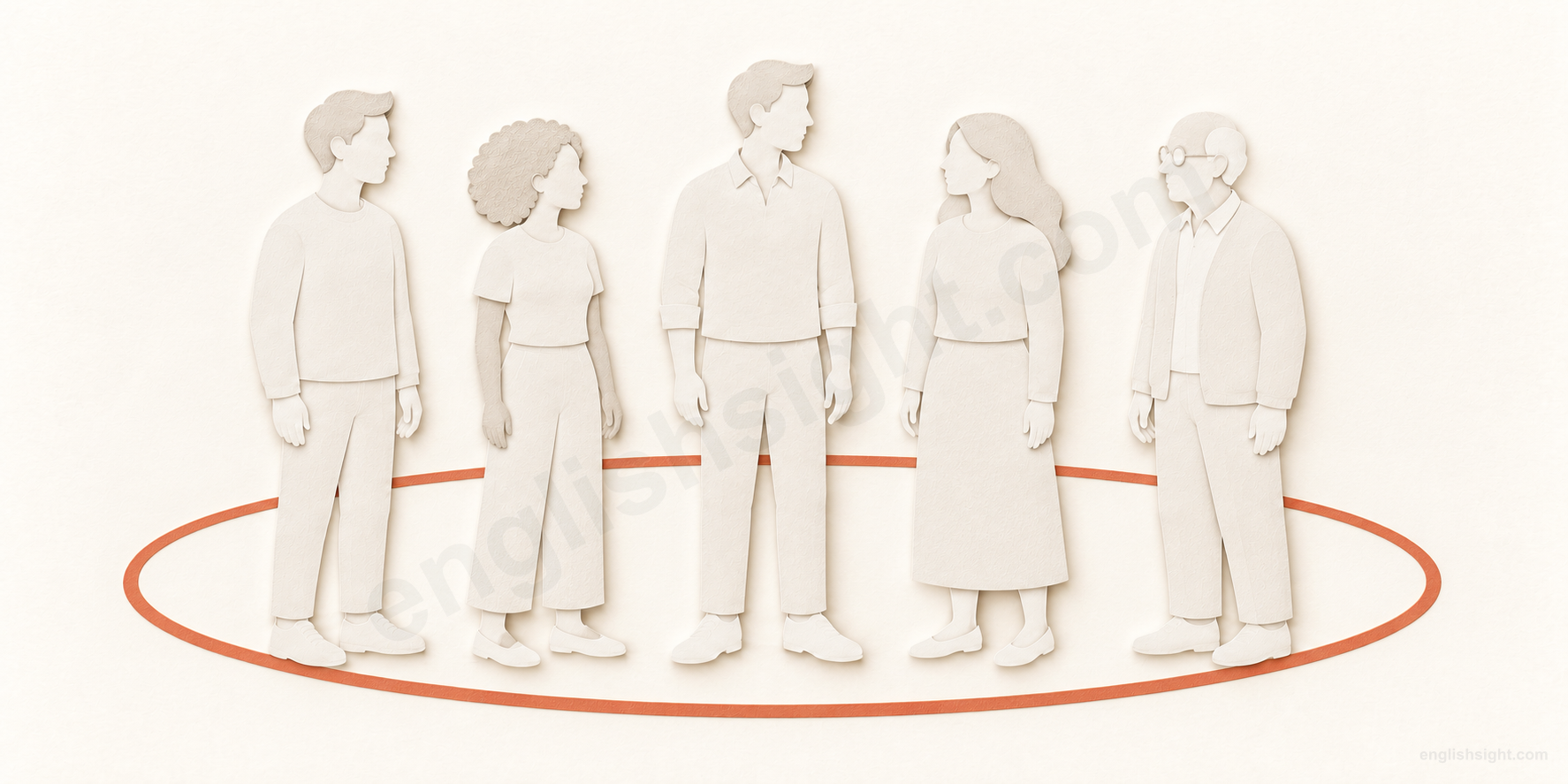
Five distinct people stand together.
nation
They represent a larger national community.
One oval groups them without making them identical.
Different individuals are viewed as one national community. This is a static grouping; the oval is not a border.
A nation is a people understood as a community through shared identity, history, or political life; the word can also name their country.
This is a static relationship, not a change from separate people into identical people. Shared identity can coexist with different languages, cultures, and opinions.
Nation often asks us to see people together as a national community. In news and international discussion it can name a country; in a public response it can mean the population; in history and identity it can name a people without an independent state.
These uses are connected, but no simple picture defines every nation. The community model below is a teaching aid, not a claim about a mental picture shared by every English speaker.
01
A country, a people, and a shared identity
Nation can name a country as a community, or a people with a shared identity. These uses overlap, but they are not identical.
01
a / the + (adjective) + nation; plural nations
a small island nation
a country viewed as a social and political community
Situation
You describe a country and the people who live there.
What the expression presents
You present it as one national community.
Nation brings people and public life into the description of a country.
In this use, a nation is a country considered together with its people and institutions. Island tells us about geography; small describes size. Neither is part of the meaning of nation itself.
Country is usually the easier everyday word in questions such as Which country are you from? Nation often suits public discussion, history, or comparisons between countries. A state, in its political sense, emphasizes political organization; a government is the group or system governing it.
In a sentence
The small island nation imports most of its fuel.
Watch the difference Nation is a countable noun here: say a nation or several nations, not several nation. It is not another word for a city.
02
a nation; a nation without a state
a nation without a state
a people with a shared national identity
Situation
A community shares a history and a sense of belonging.
What the expression presents
Its members regard themselves as a people, even without their own state.
National identity and independent government need not coincide.
Nation can refer to a historical or cultural people, not only an independent country. Shared history, language, culture, or ancestry may matter, but these are not a checklist that every person must satisfy.
Without a state adds the absence of an independent political state of their own. It does not mean that the people live outside all countries. The group in the diagram stands for a continuing community, not any crowd that happens to gather.
In a sentence
The book describes a nation whose people live in several countries.
Watch the difference Do not assume that every nation has exactly one language, one ancestry, or its own independent state.
03
the + name + Nation; a First Nation; First Nations people
Indigenous nations / First Nations
named Indigenous peoples and communities
Situation
A text names an Indigenous people or community.
What the expression presents
Nation recognizes the community as a people, rather than an ordinary club.
Nation also occurs in the names and descriptions of Indigenous peoples.
Nation is used for Indigenous peoples, including in names such as the Cherokee Nation. Follow a community’s own name and capitalization; the word does not imply that it is an independent country in the ordinary country-counting sense.
In Canadian usage, First Nations refers to Indigenous peoples other than Inuit and Métis; it is not an umbrella term for all Indigenous Canadians. First Nations is also used in Australia. The relevant region and the specific community determine the reference.
In a sentence
The museum worked with several First Nations to plan the exhibition.
Watch the difference Do not use First Nations as a general label for all Indigenous peoples everywhere. Preserve the actual community name.
04
a nation state / nation-state; plural nation states / nation-states
a nation state
an independent country formed around a national community
Situation
A discussion distinguishes national identity from political organization.
What the expression presents
The compound brings the two together.
Nation state names a political concept, not a subdivision of a country.
A nation state combines the idea of a national people with an independent state. State contributes political organization; nation contributes the people and their shared identity.
You may also see the spelling nation-state. The plural is nation states or nation-states. This is a term used in history and politics; it does not guarantee that everyone within the borders has an identical culture or agrees about national identity.
In a sentence
The course examines how the idea of the nation state developed.
Watch the difference State can also mean a region within a federal country. That regional meaning is not the one used in nation state.
02
Talking about the country and its people
News, speeches, and everyday descriptions treat a large population as a whole. Read the verb and the surrounding phrase to see what is meant.
05
address / speak to + the nation; the (whole / entire) nation + verb
address the nation
speak to the people of a country as a whole
Situation
A speaker prepares a public broadcast.
What the expression presents
The country’s population is the intended audience.
The nation can mean the public, not the land or just the government.
Address is a verb meaning speak to an audience here. Address the nation means speak publicly to the population. It has nothing to do with a street address.
The entire nation celebrated and The news shocked the nation use the same population sense. Such statements describe a broad public response; they need not report literally every person’s feelings. Nation is singular, and singular agreement is a straightforward choice when treating it as a whole.
Unite the nation and divide the nation describe bringing the population together or separating it into opposed groups. The nation as a whole and the nation at large both direct attention to the wider public rather than one small group.
In a sentence
The prime minister will address the nation on television this evening.
Watch the difference A speech to the nation is aimed at the public. A speech to the government has a different audience.
06
across / throughout / in + the nation
across the nation
throughout many parts of the country
Situation
An activity takes place in many locations.
What the expression presents
You describe its reach over the country.
Across gives the national extent; it need not describe a journey.
Across the nation and throughout the nation describe wide geographical reach. In Schools across the nation took part, across connects many schools in different places; no one has to travel across a border.
In the nation simply locates something within the country. Across the nation emphasizes its spread. The definite article points to the country already understood in the conversation or report.
In a sentence
Libraries across the nation are holding free reading events.
Watch the difference Do not read across as across national borders here. For several countries, use across several nations or an explicit phrase such as in several countries.
07
a nation of + plural people-description / number + people; the nation of + country name
a nation of gardeners
a population characterized by a group or habit
Situation
You notice a widespread interest or social pattern.
What the expression presents
You describe the population through that characteristic.
Of introduces the people or characteristic used to describe the national whole.
A nation of gardeners presents gardening as characteristic of the population. It is a broad description, often vivid or playful, rather than a claim that every resident gardens.
Of can also introduce population size: a nation of forty million people. Compare the nation of Japan: there, of Japan identifies the country by name. In a nation of gardeners, gardeners describes the people. The phrase after of determines which relationship is meant.
In a sentence
The survey suggests that we are becoming a nation of online shoppers.
Watch the difference For a description of a shared habit, use a plural people-description such as shoppers or food lovers. A number phrase such as forty million people describes population size instead. Avoid treating a broad cultural description as a fact about every individual.
08
the / our nation’s + noun; plural nations’ + noun
the nation’s future
something belonging or relating to the country or its people
Situation
You discuss a shared history, economy, or future.
What the expression presents
The possessive connects it with the national community.
The possessive relates things to a nation; it does not require literal ownership.
The nation’s future means the future of the country or its people. The same possessive pattern works in the nation’s history, economy, or capital. These are relationships, not objects owned by one person.
For one nation, put the apostrophe before s: the nation’s future. For several nations, put it after the plural s: the nations’ economies. In many adjective combinations, use national instead: national identity and the national team.
In a sentence
Young people want a voice in the nation’s future.
Watch the difference Say the national team or the nation’s team, rather than assuming nation can replace national before any noun.
03
Countries acting and developing
Modifiers and familiar combinations specify a nation’s role, independence, or development. The extra meaning comes from those words, not from nation alone.
09
cooperation / relations between nations; among nations; adjective + nations
cooperation between nations
countries working together as political communities
Situation
Several countries face a shared problem.
What the expression presents
Their representatives or institutions coordinate a response.
Nation can stand for a country acting through its representatives.
Nations cooperate, trade, or sign agreements through people and institutions. This is an ordinary way of talking about collective action, not a claim that the country is a single human being.
Between nations describes relations linking countries; among nations can describe something within a group of countries. Developing and industrialized in developing nations and industrialized nations describe economic circumstances. They do not introduce new senses of nation.
In a sentence
The project depends on cooperation between three neighboring nations.
Watch the difference Between is possible with more than two participants when their relationships are in focus; do not automatically replace it with among whenever the number exceeds two.
10
the host nation; a member nation; member nations
the host nation / member nations
countries identified by their role in an event or organization
Situation
Countries take different roles in an international activity.
What the expression presents
One hosts the event; others belong to an organization.
Host and member specify a role, not a permanent type of nation.
The host nation provides the setting and facilities for an international event. In sports reporting, context may also use the host nation to mean its representative team: The host nation reached the final.
Member nations are countries belonging to an organization. A member nation need not host its events. In these combinations, host and member are nouns used before nation; the final noun takes the plural: host nations and member nations.
In a sentence
The host nation welcomed athletes from all the member nations of the sports federation.
Watch the difference A host nation is identified by hosting a particular event. It is not simply a country with a large hotel industry.
11
an independent nation; a sovereign nation
an independent / sovereign nation
a country with political independence or authority over its affairs
Situation
A text discusses who governs a country.
What the expression presents
A modifier states its political status.
Independent and sovereign add political information that nation alone does not always supply.
An independent nation is a country that is not governed by another country. Sovereign emphasizes its authority to govern its own affairs. These expressions often overlap in public discussion.
Nation alone also has the people-and-identity use, so it cannot establish a community’s legal or international status by itself. The diagram highlights community membership; it does not certify independence or settle a political claim.
In a sentence
The agreement respects each sovereign nation’s right to make its own laws.
Watch the difference Learn the political adjectives with the noun. Do not infer sovereign status solely from the presence of Nation in a name.
12
build / rebuild a nation; nation-building
nation-building
creating or strengthening a national community and its institutions
Situation
People face the task of establishing a functioning shared public life.
What the expression presents
They work to develop the nation over time.
Building is figurative: the object is a community, not a physical structure.
Build a nation can refer to developing its shared institutions and identity. Nation-building names that process, especially after major political change. It can involve public services, institutions, and relationships between communities.
The noun nation-building is normally uncountable: a period of nation-building. Rebuild a nation emphasizes recovery after damage or disruption. Neither expression means simply constructing houses; the exact work depends on the context.
In a sentence
The documentary follows years of nation-building after independence.
Watch the difference Do not confuse a nation-building project with the construction of one building. Nation-building is a separate compound noun.
Keep the people, the country, and the grammar distinct
A shared identity does not mean uniformity
A nation can include people of different backgrounds and languages. The word is used in more than one way; a short dictionary definition or the teaching oval cannot settle questions of identity, citizenship, borders, or recognition.
Forms, sound, and articles
Nation is a noun, pronounced /ˈneɪʃən/, with first-syllable stress. Its plural is nations. Use a nation for one unspecified country, the nation for an understood country or public, and nations for more than one. Our nation already has a determiner: do not add the before our.
Nation and national do different jobs
Nation names the community or country. National is the related adjective in national identity, national news, or the national team. Compounds such as nation state and nation-building have their own established forms; they do not make nation a freely interchangeable adjective.
Public language and scope
Nation often appears in public, historical, or political language. Country is an easy everyday choice when asking where someone is from. This lesson covers the modern noun and useful combinations, not a complete theory of nations or a ranking of phrase frequency.
Choose what nation refers to
Read the whole expression: the verb, modifier, and preposition help identify the relationship.
1. A leader will address the nation on television. Who is the intended audience?
2. A book describes a nation whose people live in several countries. What follows from the word nation alone?
3. Which phrase naturally names the team representing a country?
4. Libraries across the nation offer the service. What does across the nation emphasize?
5. A report calls a country the host nation for a tournament. What role does it have?
Sources and teaching notes
The dictionary pages below were read to check modern meanings, constructions, and combinations. Explanations and examples are original. The community model is a teaching interpretation, not a dictionary claim about mental imagery.
The diagram highlights a relationship; it does not claim that every speaker imagines the same scene.