Understand natural in the world, in people, and in the course of events.
Arising from its own nature
Arising from its own nature
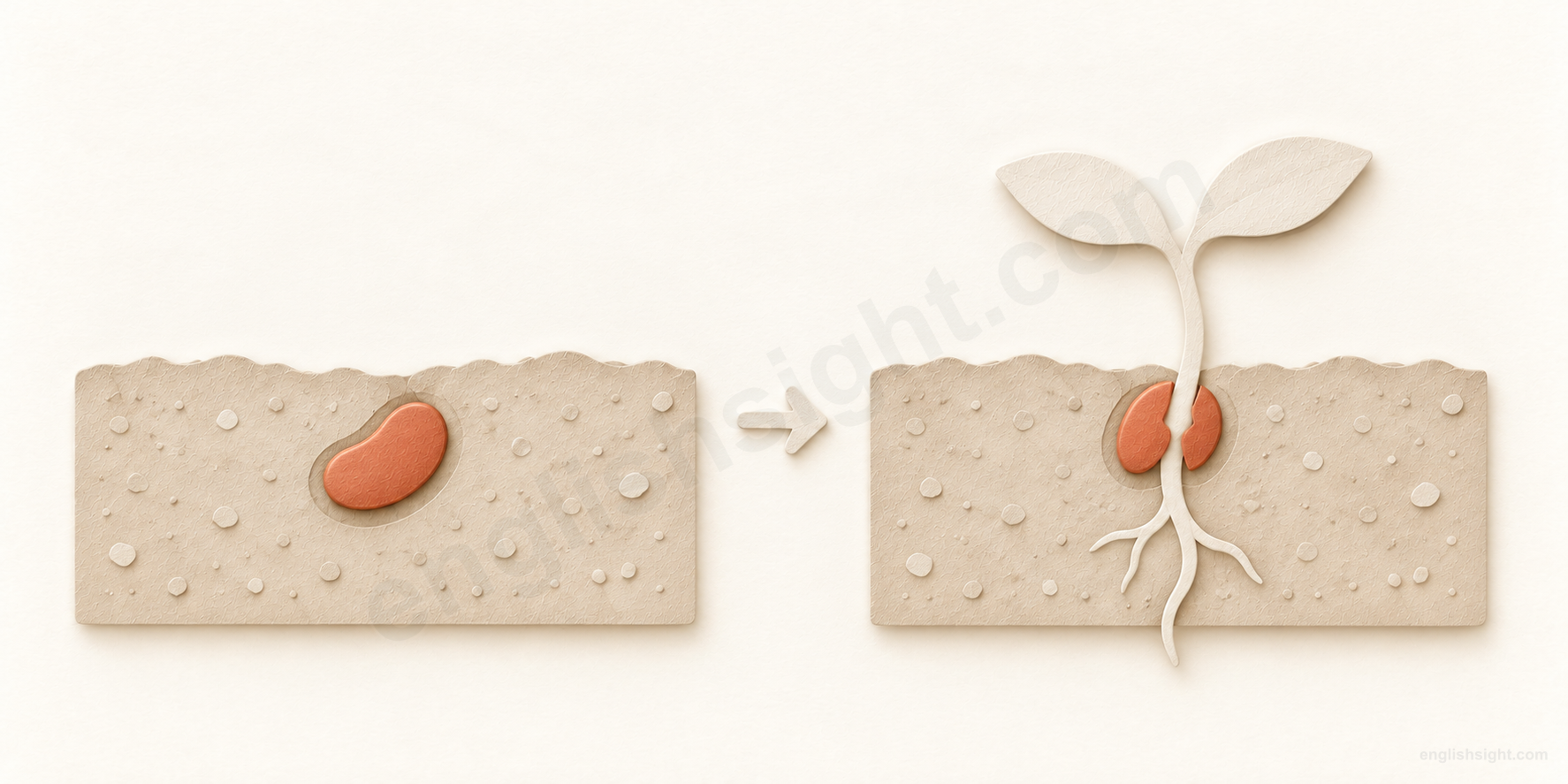
A seed in suitable soil
natural
A rooted shoot with two leaves
Growth unfolds from the seed’s own nature.
A seed grows into a shoot under suitable conditions: a memory link to what arises from its own nature, not a rule for every use of natural.
Natural often presents a thing or response as arising from its own nature or normal circumstances, rather than being artificial or forced.
The sketch connects natural growth with intrinsic qualities and expected development. It does not predict fixed terms such as F natural or prove that something natural is good, safe, or inevitable.
Natural can identify a source in nature, an apparent inborn quality, or something that fits the circumstances. It can also describe a relaxed manner or a convincing appearance. First ask what contrast the speaker is making.
The seed-and-shoot sketch is a teaching connection: growth unfolds from the living thing’s own nature under suitable conditions. It helps link several uses without claiming that every meaning comes from plant growth or that every English speaker imagines the same picture.
01
Nature, materials, and appearance
Ask whether natural describes the source, an original state, or an appearance. These are related judgments, but they are not interchangeable.
01
natural + noun: world / habitat / light / disaster
the natural world; natural light; a natural explanation
existing or happening in nature
Situation / contrast
You compare a river valley with a built reservoir.
What natural identifies
You identify what was formed by nature.
Natural can identify origin without judging whether something is pleasant.
Use natural before a noun to contrast something found in nature with something made or brought about by people. A natural lake differs from an artificial lake. Natural light comes from the sun rather than an electric lamp.
The natural world covers living things and their surroundings. An animal’s natural habitat is the environment where it normally lives; natural disaster names an event such as an earthquake. The noun supplies the particular topic.
Natural can also contrast with supernatural: a natural explanation accounts for an event through ordinary physical processes rather than magic or spirits. For example, There may be a natural explanation for the strange noise. Here the contrast concerns how an event is explained, not whether people were involved.
The growing shoot in the diagram illustrates a natural process. It does not mean that people cannot water or care for a plant.
In a sentence
The reading room has plenty of natural light.
Watch the difference Natural does not mean harmless: an earthquake can be a natural disaster.
02
natural + material / fibre; material + be + natural
natural materials; natural fibres
materials with a source in nature rather than synthetic substitutes
Situation / contrast
You choose between cotton and polyester.
What natural identifies
You describe the source of the fibre.
A natural material can still be used in a manufactured object.
Natural fibres include cotton and wool. Calling a shirt’s fibre natural describes its material, not whether the shirt was sewn by people. Natural wood similarly contrasts with an imitation or, in some contexts, emphasizes an untreated surface.
Compare real leather and natural leather: real stresses authenticity, while natural may stress the source or finish. The precise contrast depends on the product. The materials are natural is also a possible sentence; natural is not restricted to the position before a noun in every use.
In a sentence
We chose curtains made from natural fibres.
Watch the difference Do not assume natural means unprocessed: spinning and weaving do not make cotton synthetic.
03
natural + food / ingredients / yogurt
natural ingredients; natural yogurt
food described as minimally processed or without certain additions
Situation / contrast
You compare plain yogurt with a flavored variety.
What natural identifies
You select a product without added flavor.
Here natural describes processing or additions, not a complete ingredient list.
In food descriptions, natural often suggests little processing or no artificial additions. In British shopping language, natural yogurt commonly means plain yogurt, without added flavor. You can add fruit yourself.
Natural is not an exact synonym of organic, fresh, or sugar-free. A food can contain naturally occurring sugar. Read the specific description rather than turning this adjective into a promise about every property.
In a sentence
I mixed natural yogurt with chopped cucumber.
Watch the difference The word alone does not establish how a product was farmed or whether it suits a particular diet.
04
one’s natural + colour / hair; a natural blonde
natural colour; natural hair
an original colour or texture rather than an altered one
Situation / contrast
A person has dyed their hair for several years.
What natural identifies
They let the original colour grow back.
Natural can contrast an existing bodily feature with an artificial alteration.
Your natural hair colour is the colour your hair has without dye. A natural blonde has blond hair without needing to dye it; the adjective does not describe personality.
Natural hair can also refer to hair worn with its own texture rather than chemically straightened, especially in discussion of Black hair. Context tells you whether colour, texture, or both are relevant. In product colour names, natural may instead mean a pale, undyed-looking shade.
In a sentence
After years of dyeing it, Jo returned to her natural hair colour.
Watch the difference Natural hair and naturally blond hair are related expressions, but natural is an adjective and naturally is an adverb.
05
look + natural; a natural look; natural-looking + noun
look natural; a natural look
look convincing or close to an unaltered appearance
Situation / contrast
A wig is made by people.
What natural identifies
Its appearance resembles real growing hair.
Looking natural does not prove that something has a natural source.
A wig, a painted background, or makeup can look natural even though it was deliberately made or applied. This judges the appearance: it does not look obviously artificial.
Compare natural hair, which may name unaltered hair, with a natural-looking wig, which may be an imitation. A natural look is often a style intended to appear simple or unforced. The word look changes the claim from origin to appearance.
In a sentence
The new wig looks natural even in bright daylight.
Watch the difference Do not infer that an object is unmodified merely because it looks natural.
06
natural resources; natural gas [uncountable]
natural resources; natural gas
resources supplied by nature, including a particular fuel
Situation / contrast
You read about a country’s forests and underground fuel deposits.
What natural identifies
You identify resources available from nature.
The compound natural gas names a fuel, not every gas found in nature.
Natural resources include things such as forests, water, and mineral deposits that people can use. Resources is the head noun; natural identifies their source.
Natural gas is an established uncountable compound for a fuel obtained from underground deposits, including deposits beneath the sea. Oxygen in the air is a gas occurring in nature, but we do not therefore call it natural gas.
In a sentence
The building uses natural gas for heating.
Watch the difference Use some natural gas or a supply of natural gas, not a natural gas when referring to the fuel as a substance.
02
Understandable reactions and expected results
Away from forests and materials, natural often means that a response or choice fits the circumstances. Read the following clause or noun to find out what is being evaluated.
07
it is (only / perfectly) natural (for someone) to + verb; it is natural that + clause
It is natural for someone to…; It is natural that…
a reaction is understandable in the circumstances
Situation / contrast
A friend is nervous before their first performance.
What natural identifies
You reassure them that the feeling is understandable.
The clause specifies whose response is being evaluated.
It is natural for you to feel nervous uses it to introduce an evaluation. For you supplies the person who feels nervous; to feel supplies the response. If the person is general or obvious, use It is natural to feel nervous.
A that-clause gives the same kind of judgment in a full clause: It is natural that she feels disappointed. You may also hear that she should feel disappointed, especially in British usage; should here need not advise her to feel that way.
Only natural and perfectly natural strengthen the reassurance. Only here means that the reaction is unsurprising, rather than limiting how much emotion is allowed.
In a sentence
It is perfectly natural for you to miss your old home.
Watch the difference For you to miss identifies the person and action; avoid It is natural you to miss.
08
a natural consequence / result of + noun; the natural course of events
a natural consequence; the natural course of events
a result or development that follows in an expected way
Situation / contrast
A team repeatedly loses experienced staff.
What natural identifies
Its remaining staff face a heavier workload.
Natural connects a result with the conditions that make it unsurprising.
A natural consequence of something is a result that follows understandably from it. This can concern human decisions as well as physical processes; it need not mean that no people were involved.
The natural course of events or the natural order of things describes a usual or expected development. Calling a situation natural expresses a view about it; it does not establish that the situation is fair, desirable, or impossible to change.
In a sentence
The heavier workload was a natural consequence of the staff cuts.
Watch the difference A natural result can be unwelcome. Natural and good do not have the same meaning.
09
be the / a natural choice for + noun; be a natural for + role
the natural choice for…
an obvious or especially suitable choice
Situation / contrast
One team member already knows the route and the local language.
What natural identifies
The group chooses that person to lead the trip.
Suitability follows from the person’s qualities and the task.
The natural choice for a job or task is the person who seems especially well suited to it. This does not say the person was literally born with the job or was selected without human involvement.
The noun form is possible too: She is a natural for the role. With the adjective, choice is the noun; with a natural, natural itself is a countable noun.
In a sentence
With her knowledge of the region, Ana was the natural choice to lead the tour.
Watch the difference Natural choice stresses suitability; first choice merely gives a preference or ranking.
03
Ability, ease, and being yourself
Natural can describe an apparent inborn gift, an unforced manner, or an expression that fits ordinary usage. The grammar distinguishes these uses.
10
natural + ability / talent / gift / instinct / tendency; a natural + role
natural ability; a natural leader
a skill or disposition presented as inborn
Situation / contrast
A child notices musical patterns with unusual ease.
What natural identifies
You describe the child’s apparent aptitude.
Natural attributes ease or ability to the person’s own make-up.
Natural talent, a natural gift, and natural ability suggest an aptitude that is not simply the result of instruction. A natural leader describes a person who seems to possess the qualities needed to lead.
A natural instinct or tendency describes a characteristic response, such as an animal’s urge to hide. A tendency is a likelihood, not a rule without exceptions. These expressions are not measurements of how much biology or training contributed.
The plant’s own growth provides a memory link to qualities coming from within. Human talent still develops through experience and practice; the diagram does not prove a claim about a person’s abilities.
In a sentence
Ravi has a natural talent for telling stories.
Watch the difference A natural talent for something does not mean the person never needs to learn or practise.
11
be a natural (at + activity / with + people or things)
be a natural; a natural at / with…
a person who seems effortlessly good at something
Situation / contrast
A new volunteer quickly puts nervous children at ease.
What natural identifies
You compliment the volunteer’s easy skill.
The article a signals that natural is a countable noun here.
You are a natural is an informal compliment. Add at to name an activity, or with to name people or things someone handles well. You can also leave the activity understood from the conversation.
Compare She is a natural teacher and She is a natural. In the first, natural describes teacher; in the second, natural names the talented person. The plural is naturals: They are both naturals.
In a sentence
You’re a natural with children; they trusted you straight away.
Watch the difference Use the article in the noun compliment: You’re a natural. You’re natural normally describes an unforced manner instead.
12
activity + come / comes naturally to + person
come naturally to someone
be easy for someone to do well
Situation / contrast
You compare two activities that demand different effort from you.
What natural identifies
One feels easy; the other takes conscious work.
The activity is the subject; to names the person who finds it easy.
In Writing comes naturally to me, writing is what comes easily and me identifies the person. This established expression concerns ability or ease, not physical arrival.
The adverb naturally is required in this expression. Compare Writing feels natural to me: natural is an adjective after feels and describes how the activity seems. Something can feel natural after practice as well as from an early aptitude.
In a sentence
Remembering names comes naturally to Leo, but I have to work at it.
Watch the difference In standard usage say comes naturally, not comes natural. There is no object to move between come and naturally.
Natural judges the manner, rather than whether the person learned a skill.
A natural smile or a natural manner seems genuine rather than deliberately performed. Be natural can encourage someone to stop forcing their behavior. This differs from You are a natural, the noun compliment about skill.
After a linking verb use the adjective: She seemed natural on camera. To describe how someone acts, use the adverb: She acted naturally. A skilled actor can deliberately produce a natural performance, so natural does not always mean unplanned.
In a sentence
After a few minutes, the speaker looked relaxed and natural.
Watch the difference Natural does not mean naive. A relaxed, genuine person can still be experienced and careful.
14
sound + natural; natural English; natural language
sound natural; natural English
fit the way people ordinarily express something
Situation / contrast
A sentence is understandable but uses an unusual word combination.
What natural identifies
You choose wording that better fits ordinary usage.
Sound is a linking verb here; natural describes the wording.
Natural English fits established usage in the relevant situation. A sentence can be grammatical yet stiff, or fluent but too informal for a particular setting. Saying wording sounds natural evaluates how it fits, not whether the writer is a native speaker.
For example, make a decision is a usual English combination; do a decision is not the ordinary combination for this meaning. Learning combinations helps an expression sound natural.
The technical term natural language is different: it means a human language developed through communication, as opposed to computer code or an invented system. It does not mean that every sentence in that language is fluent.
In a sentence
“Could you give me a hand?” sounds natural when you ask a friend for help.
Watch the difference Use sounds natural, not sounds naturally, when judging the expression. Naturally would describe the manner of an action.
04
Established meanings to recognize
Some combinations have a specific established meaning. Learn the whole expression instead of trying to derive every detail from the seed-and-shoot model.
15
die of / from natural causes; a natural death
die of natural causes
die from illness or age rather than an accident or violence
Situation / contrast
A report gives the broad circumstances of a death.
What natural identifies
It distinguishes illness or age from external injury.
Natural causes is an established expression about the cause of death.
The usual patterns are die of natural causes and die from natural causes. A natural death is a related expression. Neither expression identifies a specific disease or tells you whether the death was expected at that moment.
This is a conventional category, not a conclusion to draw from the growth diagram. In ordinary reading, understand the contrast with an accident or violence.
In a sentence
The family said that their grandfather had died of natural causes.
Watch the difference Keep causes plural in this expression; it is not normally die of a natural cause as the fixed phrase.
16
natural + parent / mother / father / child
natural parents; natural mother
biological family relationship
Situation / contrast
A biography distinguishes biological and adoptive family relationships.
What natural identifies
Natural identifies the biological relationship in that account.
This use concerns birth, not which family bond is more real.
In some accounts, natural mother or natural parents means biological mother or biological parents. Biological or birth parent is often clearer when that precise relationship matters.
Older or formal texts can use natural son or natural daughter for a child whose parents were not married. That is a separate historical use; do not assume that every mention of a natural child has the same meaning.
In a sentence
The biography explains that her aunt raised her after her natural mother died.
Watch the difference Natural is not a judgment that adoptive parents are less genuine parents. Context must establish the intended relationship.
17
note name + natural; a natural; a natural sign
F natural; a natural
a note that is neither sharp nor flat, or the relevant sign
Situation / contrast
A musician distinguishes F sharp from F without the sharp.
What natural identifies
They name the second pitch F natural.
The musical term is a separate convention, not a judgment of musical quality.
After a note name, natural specifies the pitch without a sharp or flat: F natural. As a noun, a natural can refer to the note or the sign ♮ that cancels a sharp or flat in the relevant musical context.
The sign may raise or lower the pitch relative to the altered note: it does not always mean play lower. This lesson gives recognition vocabulary rather than a full explanation of key signatures and accidentals.
In a sentence
Play F natural here, not F sharp.
Watch the difference A natural voice means an unforced or characteristic voice in ordinary speech; it does not by itself name a natural note.
18
the natural sciences; natural history; natural selection
You encounter labels in a museum and a biology lesson.
What natural identifies
You interpret each as a whole term.
History and selection have specialized meanings in these combinations.
The natural sciences study the physical world: biology, chemistry, and physics are examples. Natural here identifies the subject being studied; it does not suggest that the research happens without people or equipment.
Natural history concerns the study of plants and animals, or an account of a place’s plant and animal life. A natural history museum is not simply a museum of events that happened without human intervention.
Natural selection names a biological process: inherited differences that affect survival and reproduction can become more or less common across generations. It does not describe a person consciously selecting the best animal.
These terms connect with nature as the subject of study. They need their own definitions; the adjective alone does not provide a biology lesson.
In a sentence
The museum’s natural history collection includes insects from the island.
Watch the difference Do not read natural selection as an individual choosing to change its body because it needs to.
Choose the meaning from the contrast
Natural, normal, real, and organic
Normal emphasizes what is usual or expected; natural may emphasize origin or an unforced manner. Real emphasizes authenticity. Organic has its own uses and is not a replacement for natural in every food description. Ask what the noun and situation actually establish.
Adjective, noun, and adverb
Natural is usually an adjective. After be, look, seem, feel, or sound it can describe the subject. A natural is a countable noun for a gifted or well-suited person, and also has a musical use. Naturally is the adverb in act naturally and come naturally to someone. Nature names the world of living things and physical processes, or someone’s character; it is not the adjective in natural light.
Degree depends on the sense
More natural and most natural work when judging an appearance, manner, or wording. Natural origin is usually a category rather than a degree. Perfectly natural often strengthens the claim that a feeling is understandable. Forms such as naturaler are not standard.
Limits of the model
Natural does not itself mean desirable or inevitable. Music, family terminology, and established scientific compounds need their own context. This adjective has no verb tense, passive, causative, or particle-verb paradigm to learn. Historical, gambling, legal, and theological senses are not developed here.
Choose the intended contrast
Use the situation, the noun, and the sentence pattern to decide what natural means.
1. A new volunteer handles a difficult task with remarkable ease. Which sentence is the noun compliment about ability?
2. A synthetic wig resembles real growing hair. Which statement does the evidence support?
3. A friend is anxious about moving away. Which pattern clearly identifies the person experiencing the feeling?
4. You find public speaking easy. Which expression is standard?
5. A writer calls increased delays a natural consequence of reducing staff. What is the writer saying?
Sources and teaching notes
Usage was checked against the publisher pages below. Explanations, examples, and the visual connection were composed for this lesson; the growth model is a teaching aid.
The diagram offers a teaching connection, not a mental picture shared by every English speaker.