Use near for distance, time, degree, and the expressions built around them.
A small gap from a reference
Close to a reference, with a small gap
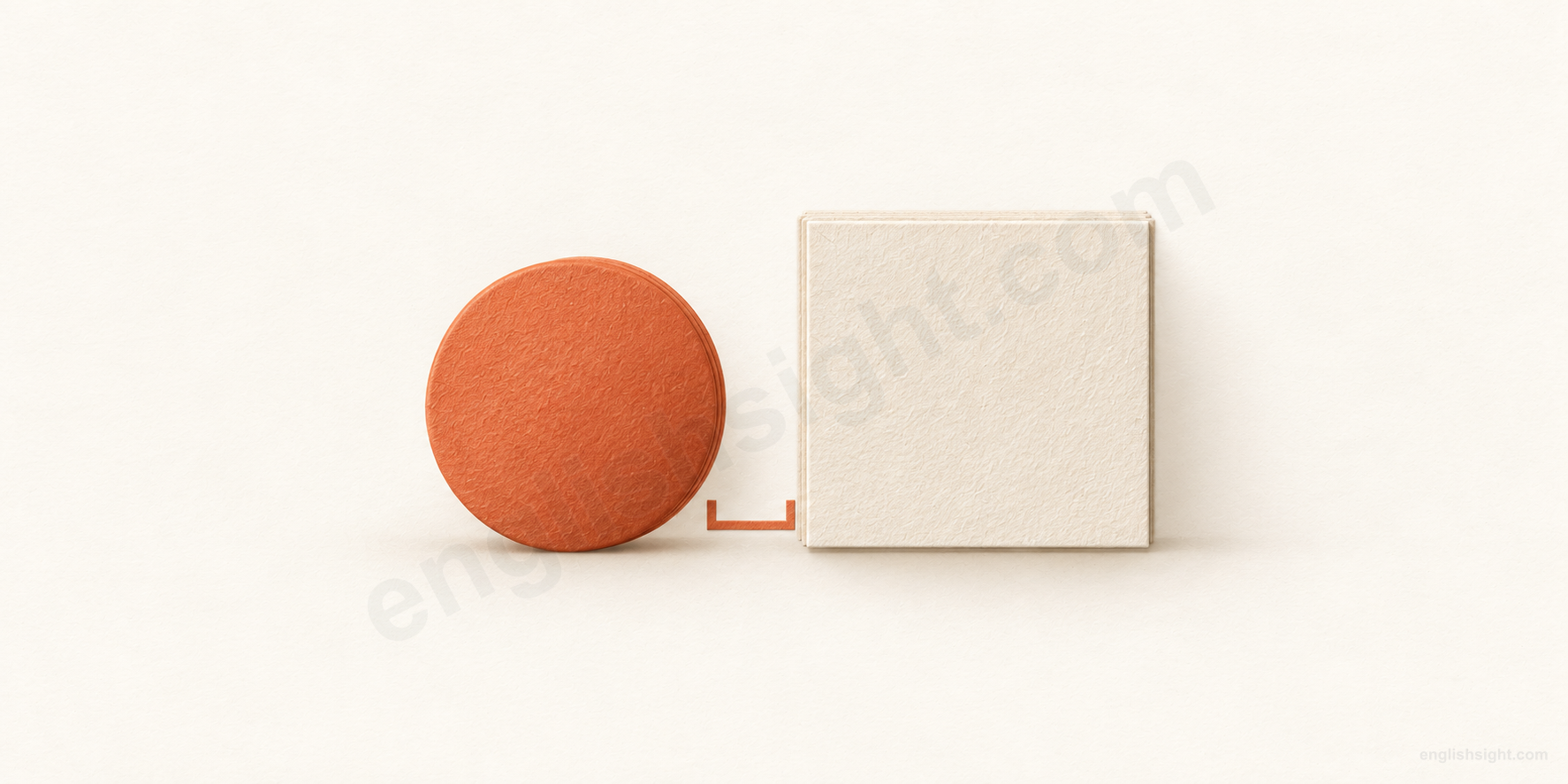
Locate the ball relative to the block.
near
The ball is near the block without touching it.
Notice the small gap between them.
The ball is near the block: a small gap separates them.
Something is near when its distance from a relevant reference point is small in the situation.
The sketch shows a static spatial relation. Time, number, and similarity use other kinds of distance. Near does not require touching, movement, or a goal that will eventually be reached.
Near places something a relatively small distance from a reference point. The reference may be a person, place, time, number, condition, or standard. What counts as small depends on the situation.
Being near is a relation; moving nearer is a change in that relation. Many abstract uses can be linked to a small gap, but fixed expressions still need to be learned as expressions.
01
Locations and relative distance
Identify a reference place, compare distances, or describe coming closer. A short distance need not mean touching.
01
near + place / person; near to + reference
near the station / near me
a short distance from a reference point
Situation / reference
You choose a place to meet.
Meaning in context
The café is a short walk from the station.
Near relates the café’s location to the station; it does not specify an exact distance.
Near can take a noun or pronoun directly: near the station, near our office, near me. The reference can also be here or there: Is there a shop near here?
Near to the entrance is also possible. Near is the simpler usual choice before names: near Tokyo or near Anna. By contrast, close normally needs to before a named reference: close to the station.
Near is broader than next to, which puts things immediately beside each other. For a location without a stated reference, nearby is often convenient: There’s a café nearby. Before a noun, use a nearby café rather than the general learner pattern a near café.
In a sentence
Let’s meet at the café near the station.
Watch the difference Near the station does not necessarily mean next to the station.
Nearest selects by distance; next selects by order.
Nearer is comparative; nearest is superlative. Move nearer (to) the window compares positions. The nearest exit selects the closest exit among the relevant choices.
The next exit is the next one you will encounter in a sequence, such as along a road; it need not be the closest exit in a straight line. Nearest to the door compares distance, while next to the door means immediately beside it.
In a sentence
Which entrance is nearest to the car park?
Watch the difference Use nearer, not more near, for the ordinary comparison.
03
the near side of + area / object
the near side
the side closer to the chosen viewpoint
Situation / reference
You look across a pond.
Meaning in context
You identify the bank on your side.
Near side depends on the observer or other understood reference.
The near side of the pond is closer to where you are looking from; the far side is across it. Here near can naturally appear before side because the phrase contrasts two sides.
This is relative position, not movement. The near side can change when the viewpoint changes. Specialist nearside terms for vehicles or horses follow conventions and should not be inferred from this general scene.
In a sentence
There is a bench on the near side of the pond.
Watch the difference Near side does not universally mean left side.
04
come / get / draw near (to + reference); stay / keep near
come / get / draw near
move into a position a short distance away
Situation / reference
A dog is some distance from the gate.
Meaning in context
It comes closer to the gate.
The verb contributes movement; near describes the resulting proximity.
Come near and get near describe approaching. Stay near and keep near instead maintain proximity. Near can stand without a following noun when the reference is understood: Come nearer so I can hear you.
Draw near is common in narrative descriptions and also applies to approaching times. It is more literary than everyday come closer. These are ordinary verb-plus-distance combinations, not separable particle verbs.
In a sentence
The dog came near enough for me to read its tag.
Watch the difference Coming near something does not say you touched or reached it.
05
will not / would not go near + person / place / thing
won’t go near
refuse to approach, visit, or have contact with something
Situation / reference
A friend suggests using the old lift.
Meaning in context
You insist on avoiding it.
A negative statement about going near can express strong avoidance.
I won’t go near that lift may be a literal refusal to approach it or a stronger way of saying I refuse to use it. Context identifies the avoided activity.
Compare I haven’t been near the office all week, which can emphasize that you have not visited. A negative near expression does not always express fear: annoyance, dislike, or simple absence can be relevant.
In a sentence
After yesterday’s breakdown, I won’t go near that lift.
Watch the difference Won’t expresses refusal here; it is stronger than saying the lift is far away.
02
Time and approaching events
The gap can be a stretch of time. Check whether you are locating an event or describing its approach.
06
near + time; nearer (to) + date / event
near midnight / nearer the day
a short time before or after a reference time
Situation / reference
You remember roughly when the call arrived.
Meaning in context
You locate it close to midnight.
Near a time can mean shortly before or shortly after it.
Near midnight gives an approximate time around midnight. It does not by itself choose which side of midnight. Near the end of the film places something in the final part, using the end as the reference.
We’ll decide nearer the day means we will decide later, when less time remains before the event. Nearer compares the future decision time with now.
In a sentence
The message arrived near midnight.
Watch the difference Near midnight is not a claim that it arrived exactly at midnight.
07
in the near future; in the near term
in the near future
soon, without giving an exact date
Situation / reference
Someone asks about your plans.
Meaning in context
You say a change is expected soon.
The future is treated as a time ahead with a relatively small gap from now.
In the near future is a familiar phrase for soon. Near modifies future; the whole prepositional phrase locates the event. We do not usually say in near future without the.
How soon depends on the activity: a software update and a large construction project have different timescales. In the near term likewise concerns the coming, relatively short period; neither phrase supplies a deadline.
In a sentence
We plan to add evening classes in the near future.
Watch the difference Do not read near future as a fixed number of days.
08
near + object; event + near; be nearing + place / stage / age
near / be nearing
approach a place, stage, amount, or time
Situation / reference
Most of the work is finished.
Meaning in context
The project is approaching its final stage.
As a verb, near describes the gap becoming smaller.
Near has regular forms: nears, neared, nearing. The train neared the tunnel takes an object directly. The deadline neared has no object: the event itself is getting closer in time.
The project is nearing completion describes progress toward being finished. He is nearing sixty describes approaching an age. This verb is rather formal; getting close to is often more conversational.
Compare The station is near, a location, with The train is nearing the station, an approach. With the verb, say nearing the station, without to. It is not normally used in a passive such as The station is being neared.
In a sentence
The renovation is nearing completion.
Watch the difference Nearing completion still leaves work to do; it does not mean completed.
03
Amounts, states, and comparisons
A number, condition, or standard can serve as the reference point. These uses extend proximity beyond physical space.
09
near + number / amount; nearer X than Y
near fifty / nearer fifty than forty
approximately an amount or closer to one number than another
Situation / reference
You estimate the size of the group.
Meaning in context
Your estimate is close to fifty people.
Numbers can be reference points on a scale.
Near fifty can mean a little below or above fifty; it does not have to mean below. Nearly fifty normally means almost fifty, usually just short of that figure.
Nearer fifty than forty compares the two reference numbers. The same comparison works for age, price, temperature, and other quantities. Near supplies closeness; the units and context supply the scale.
In a sentence
The final bill was near fifty pounds.
Watch the difference Near fifty and nearly fifty are not identical claims about the amount.
10
be near (to) + state; come near (to) + -ing
near tears / come near to doing
close to entering a condition or having an experience
Situation / reference
A child is very upset but is not crying.
Meaning in context
You describe the child as almost crying.
The reference point can be a state rather than a location.
Near tears means almost crying. Near death and near to exhaustion similarly place someone close to a condition. Near does not make the state happen.
Come near to losing expresses an outcome that almost occurred. In came near to losing, to is a preposition, so it takes losing rather than lose. Came near losing is also possible. The near-event interpretation belongs to the whole construction.
In a sentence
She was near tears after losing her notebook.
Watch the difference Near to crying uses -ing, not near to cry.
11
the nearest thing to + noun; near(er) (to) + standard
the nearest thing to
the closest available equivalent
Situation / reference
The village has no public hall.
Meaning in context
You identify its closest substitute.
The gap is a difference in role or qualities, not necessarily physical distance.
The nearest thing to a public hall identifies what best fills that role when a true public hall is unavailable. The phrase can describe people, objects, or experiences.
Near also compares qualities more generally: This shade is nearer to the original. The relevant feature must be understood from context; a nearby building is physically close, while the nearest thing to a hall may be elsewhere.
In a sentence
The school gym is the nearest thing we have to a public hall.
Watch the difference The nearest thing to something need not be a genuine example of it.
12
someone’s nearest rival / challenger
nearest rival
the competitor closest in performance or position
Situation / reference
One runner is leading.
Meaning in context
You identify the strongest immediate challenger.
Competitors are compared on a performance scale.
Your nearest rival is the competitor with the smallest relevant gap from you, such as in points, votes, or time. It is not necessarily the person standing physically closest.
Nearest supplies a ranking comparison. Rival supplies the competitive relationship; near does not mean rival on its own.
In a sentence
Our nearest rival finished only two points behind us.
Watch the difference Use the stated competition to interpret the gap, rather than measuring physical distance.
13
round / measure / report + to the nearest + unit / step
to the nearest…
round a measurement to the closest specified unit
Situation / reference
A distance is measured as 63.7 kilometres.
Meaning in context
You report it as 64 kilometres.
Nearest selects the closest allowed value after rounding.
To the nearest kilometre means use whole kilometres and select the closest value. Thus 63.7 kilometres becomes 64 kilometres. To the nearest ten uses multiples of ten instead.
This is a numerical reporting instruction, not an estimate of physical proximity to a place. The unit or step after nearest determines the precision.
In a sentence
Report the distance to the nearest kilometre: 64 kilometres.
Watch the difference Nearest ten and nearest tenth specify very different levels of precision.
04
Almost happening or almost matching
Near before a noun or in a compound often marks an incomplete degree. Established expressions need their own interpretation.
14
near + event / state noun
a near disaster / near silence
almost an event, state, or degree
Situation / reference
The sound becomes extremely quiet.
Meaning in context
You describe a state close to silence.
Before some nouns, near means close to being what the noun names.
Near silence is a state with very little sound; a near disaster is an event that almost became a disaster. The noun determines whether we are describing a degree or a narrowly avoided outcome.
These uses are not the same as a disaster near the station, where near gives a location. A near impossibility means something extremely difficult or unlikely, close to impossible.
In a sentence
We waited in near silence as the results appeared.
Watch the difference A near disaster is usually an almost-disaster; a nearby disaster is a disaster in a nearby place.
Near- can modify an adjective in a compound; nearly is the ordinary free adverb.
A near-perfect performance is almost perfect. A near-fatal injury is an injury that almost caused death. The hyphen helps show the combined modifier before a noun.
Nearly is a more general choice before adjectives and verbs: nearly perfect, nearly finished, nearly fell. Near also means almost in some informal expressions, including pretty near finished in North American English and damned near fell; damned adds strong informal emphasis and can offend. Do not replace every nearly with near.
In a sentence
It was a near-perfect performance, apart from one missed note.
Watch the difference For neutral everyday prose, use I nearly fell rather than treating I near fell as the general pattern.
16
have / be involved in + a near miss; a shot is a near miss
a near miss
a narrowly avoided accident or an attempt that almost hits its target
Situation / reference
A cyclist brakes just before reaching a car.
Meaning in context
A collision is avoided by a small margin.
The established expression describes a small margin; context tells us what was almost achieved or suffered.
In safety contexts, a near miss means a serious accident almost happened. The cyclist and car did not collide; the phrase does not mean a small actual collision.
In sport or aiming, a near miss can mean an attempt that almost hits or succeeds: Her shot hit the post: another near miss. That failure is a different outcome from safely avoiding an accident. Learn both uses with their context.
In a sentence
The cyclist stopped just in time; it was a near miss.
Watch the difference A near miss can be fortunate in safety and disappointing in sport.
17
a near escape; it was a near thing
a near escape / a near thing
an escape or success achieved by a narrow margin
Situation / reference
Your team wins by one point.
Meaning in context
You acknowledge how easily it could have lost.
Some established near expressions describe barely succeeding, rather than almost succeeding.
A near escape is an escape from danger by only a small margin: the escape actually happens. A near thing similarly describes success or safety that could easily have ended badly.
This contrasts with a near disaster, where disaster is generally avoided. The full noun phrase determines the result; near is not a mechanical instruction to negate every following noun.
In a sentence
We won by a single point; it was a near thing.
Watch the difference A near thing does not say that we failed.
05
Family and personal importance
Some expressions describe a family connection or emotional importance. Physical distance does not determine these relationships.
18
near relatives / relations; someone’s nearest and dearest
near relatives / nearest and dearest
close family connections, or the family and friends most important to you
Situation / reference
You plan a small celebration.
Meaning in context
You invite your closest circle.
Relational closeness is independent of where people live.
A near relative or near relation has a close family connection, such as a parent or sibling. The expression concerns family relationship, not geographical distance.
Your nearest and dearest is an informal collective expression for close family and friends. It can include friends who are not relatives. For ordinary friendship, a close friend is more usual than a near friend.
In a sentence
We shared the news with our nearest and dearest first.
Watch the difference A relative who lives far away can still be a near relative.
19
be near to + person’s + heart
near to someone’s heart
personally important or deeply valued
Situation / reference
A cause matters a great deal to you.
Meaning in context
You describe its personal importance.
The heart stands for personal feelings in this established expression.
A project near to your heart is one you care about deeply. Close to your heart and dear to your heart are familiar alternatives.
This is a conventional emotional metaphor. It does not describe the project’s physical location or imply that near alone means love in any construction.
In a sentence
Protecting local wildlife is a cause near to her heart.
Watch the difference Use the possessive: near to her heart, not near to she heart.
06
Useful fixed expressions
Learn the full wording and its purpose: emphasis, approximation, availability, accuracy, or a narrowly missed result.
20
come from near and far; spread near and far
from near and far
from a wide range of places
Situation / reference
Visitors arrive from the town and distant regions.
Meaning in context
You emphasize their wide geographical origins.
The contrasting pair includes both nearby and distant places.
People come from near and far means they come from many places over a wide area. Near and far together provide the broad range; near alone would not mean everywhere.
The pair can also describe reach: News of the festival spread near and far. From is needed when giving origins, but not when describing where news spread.
In a sentence
Visitors came from near and far for the festival.
Watch the difference Near and far is the established order in this expression.
21
nowhere near + noun / adjective; not anywhere near + enough; nowhere near as…as…
nowhere near / not anywhere near
far from a place, level, or condition
Situation / reference
The report still needs several sections.
Meaning in context
You strongly reject the idea that it is finished.
The expression denies closeness by a large margin.
Nowhere near the station can be literal distance. Nowhere near finished is a degree judgment: much more work remains. Not anywhere near gives the same strong denial.
Nowhere near as expensive as the other one means much less expensive. In not anywhere near enough, the amount falls well short. Read the following adjective, comparison, or noun to identify the scale.
In a sentence
The report is nowhere near finished.
Watch the difference In standard English use It isn’t anywhere near finished or It’s nowhere near finished, without combining both negatives.
22
amount + near enough; near enough to + verb
near enough
close enough for the difference not to matter
Situation / reference
A total is slightly different from the rounded amount.
Meaning in context
You accept the rounded amount in conversation.
In the informal approximation, the remaining difference is treated as unimportant.
Ten pounds, near enough presents ten pounds as an adequate approximation. This use is especially British and informal. As near as dammit is a more emphatic informal British alternative; dammit is mild swearing.
Compare physically near enough to touch: there enough means the distance allows the action. The informal amount expression is not claiming exact equality.
In a sentence
It cost twenty pounds, near enough.
Watch the difference An acceptable approximation is not necessarily precise enough for a financial record.
23
as near as + person + can / could + tell / judge / remember
as near as I can tell
as accurately as my information allows
Situation / reference
You have incomplete information about a total.
Meaning in context
You give your best estimate.
The whole expression limits the precision of your claim.
As near as I can tell means according to the best judgment I can make. As near as I can remember similarly limits a statement to your best recollection.
This concerns accuracy, not how close you are standing. Can tell refers to assessing or finding out, rather than simply speaking aloud.
In a sentence
As near as I can tell, we have about forty chairs.
Watch the difference Keep the full comparison as near as; do not shorten it to near I can tell.
24
be near / nearer the mark
near the mark
fairly accurate in an estimate or statement
Situation / reference
Someone guesses a repair cost.
Meaning in context
You say the estimate is close to the actual amount.
The mark is a metaphorical target for accuracy.
A guess near the mark is close to being correct. Nearer the mark compares two judgments and says one is more accurate. Close to the mark is a familiar alternative.
This expression can evaluate a figure or a description. The standard is truth or accuracy, rather than a place you are trying to reach.
In a sentence
Your second estimate is nearer the mark.
Watch the difference Near the mark does not necessarily mean exactly right.
25
be near at hand
near at hand
close by or coming soon
Situation / reference
Help is available nearby.
Meaning in context
You describe it as within easy reach.
The whole phrase can concern distance or time.
Help near at hand is readily available nearby. With an event, such as The deadline is near at hand, the meaning is soon. Close at hand is another familiar form.
Hand contributes the image of reach in this fixed expression, but no literal hand is required. It does not mean holding something in your hand.
In a sentence
Help was near at hand when the car broke down.
Watch the difference Near at hand describes proximity or availability, not actual possession.
26
so near and yet so far
so near and yet so far
a disappointed comment on almost achieving a goal
Situation / reference
A final shot misses and your team loses.
Meaning in context
You express frustration at narrowly missing success.
A small final gap can still separate failure from the desired result.
So near and yet so far comments on an attempt that came very close to success but ultimately failed. The contrast is emotional: the goal seemed reachable, yet remained out of reach.
It need not describe literal travel or a large measured distance. Unlike a near thing, which can describe narrow success, this expression normally laments the missed result.
In a sentence
One missed penalty ended our run: so near and yet so far.
Watch the difference Use it for disappointed near-success, rather than to celebrate a win.
27
joke / remark + be near the knuckle
near the knuckle
close to the limits of acceptable humour or comment
Situation / reference
A joke risks offending the audience.
Meaning in context
You call its wording borderline.
This is a fixed British informal idiom about social acceptability.
A joke or remark near the knuckle approaches what people find indecent or unacceptable. It may involve sexual humour or another sensitive subject; the audience and context affect the judgment.
The meaning belongs to the whole idiom and is not a general meaning of knuckle plus near. There need be no physical action or hand in the situation.
In a sentence
That joke was a little near the knuckle for a family show.
Watch the difference Mark this as British and informal; it does not describe a physical injury.
Find the reference and read the whole expression
Near, nearby, and nearly
Near the school names a reference place. A nearby school and The school is nearby give local proximity without that following reference. Nearly finished means almost finished. Near also means almost in compounds and some informal patterns, but the three words are not freely interchangeable.
Forms and grammar
The usual comparison is near, nearer, nearest. The verb has near, nears, neared, nearing and normally describes approach without a passive. The preposition and adverb do not have verb tense. Come near is not a separable phrasal verb, and near has no general causative pattern.
Scale and outcome
Near does not specify metres, minutes, or a percentage. Near a number can be slightly above or below it. A near miss avoids an accident or narrowly misses a target; a near escape succeeds in escaping. Identify the whole phrase before deciding what happened.
Coverage boundary
This lesson covers selected modern general uses and useful expressions, including marked British and North American forms. It leaves the stingy sense, the short/direct-route sense, specialist horse or vehicle terminology, place names such as the Near East, and technical compounds outside its scope; it is not an exhaustive dictionary inventory.
Choose the meaning that fits
Use the reference point, the construction, and the outcome.
1. You want the entrance with the shortest distance from where you are. Which question states that directly?
2. The total was a little above or below fifty; you do not specify which. Which wording fits?
3. Two cars almost collided, but neither car touched the other. Which account fits?
4. A renovation is approaching its final stage, but some work remains. Which form is correct?
5. Your team wins by one point. You want to say it could easily have lost. Which comment fits?
6. Most of the work is still undone. Which wording strongly rejects the claim that it is ready?
Sources and teaching notes
Modern uses were checked against the dictionary pages below. Explanations and example sentences are original; the small-gap model is a teaching connection, not a claim about every speaker’s mental imagery.
The diagram illustrates proximity; it does not predict every fixed expression.