From your own neck to bottle shapes, close contests, pressure, and personal risk.
The narrower joining part
The narrower joining part
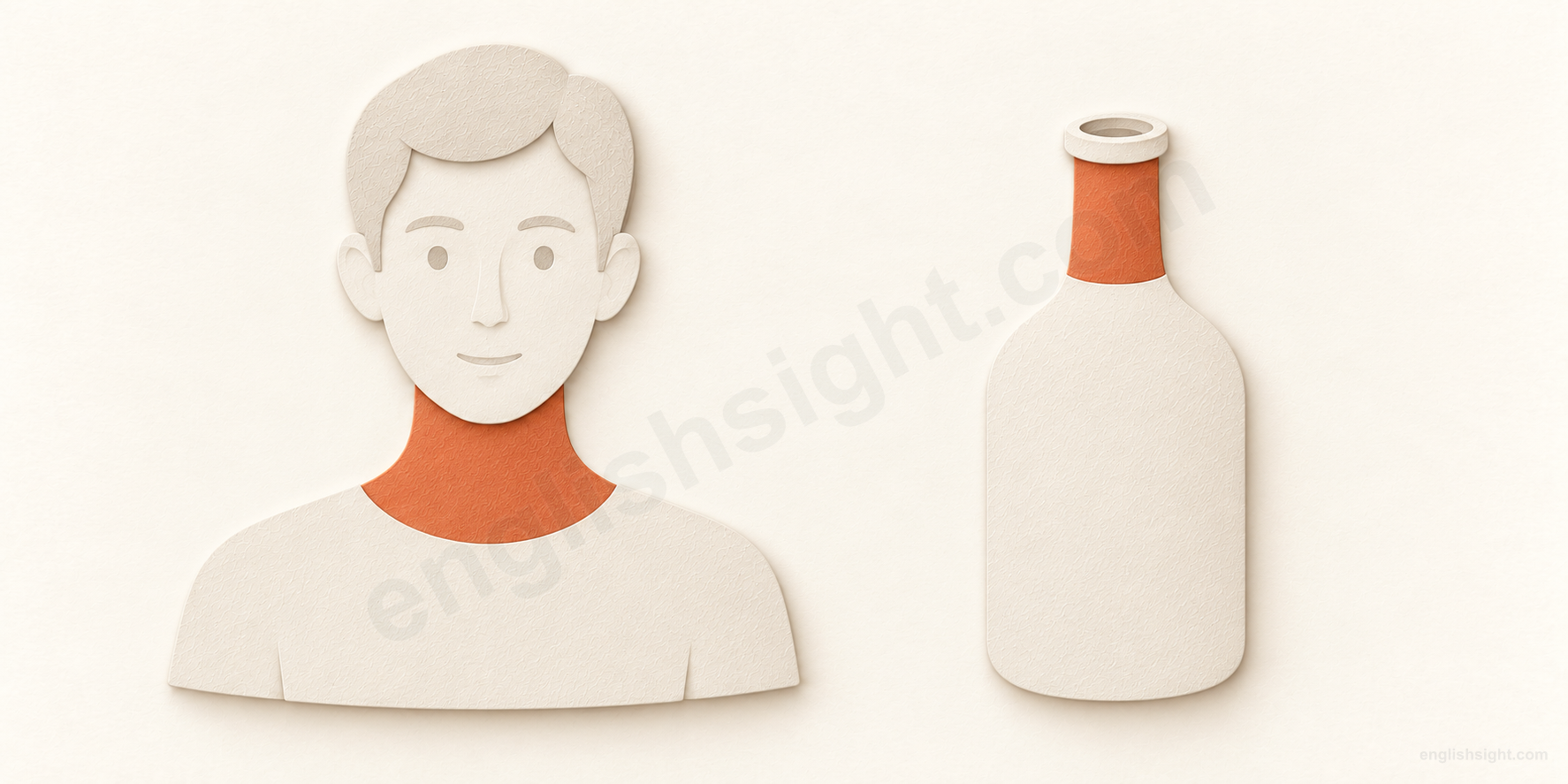
The human neck joins the head to the body.
neck
The bottle's neck is the narrow section below its opening.
Both highlighted parts are narrower than the body below.
A neck joins head and body; a bottle has a similarly narrow neck.
A neck is the part joining the head to the body; by resemblance, neck can name a relatively narrow joining or projecting part of something else.
The body and bottle are shown together to highlight a shape relationship. No change of state is needed. The picture does not explain every idiom or the informal verb meanings.
Your neck joins your head to the rest of your body. Its narrower shape helps explain why bottles and guitars also have necks. Clothing uses the name for the part at this body area.
Other expressions draw on vulnerability, discomfort, or an established comparison. Learn their complete patterns: neck and neck, a pain in the neck, and neck of the woods do different jobs. The visual model supports connections without predicting every idiom.
01
The body, movement, and clothing
Begin with the part between the head and shoulders. Descriptions, actions, and clothing patterns identify what is happening there.
01
possessive + neck; around / round + possessive + neck
your neck / the back of your neck
the part joining the head to the body
Situation / starting point
A scarf lies beside your coat.
Meaning in this context
You put it around the part below your head.
The neck includes more than the internal passage used for swallowing.
Neck is a countable noun: a neck, my neck, and long necks. It names the part joining a human or animal’s head to the body. In ordinary personal descriptions, a possessive identifies whose neck you mean.
Around or round your neck describes a scarf, chain, or arms surrounding it. The back of your neck is also called the nape. By the scruff of the neck means holding the loose skin at the back; it describes a grip, not something worn.
Throat refers to the passage inside this region, and can also name its front. A sore throat especially concerns swallowing or speaking; a stiff neck concerns this larger body region and its movement.
In a sentence
Mira wrapped a soft scarf around her neck.
Watch the difference Do not use neck as the usual word for the internal passage: say My throat hurts when I swallow.
I have a stiff neck and My neck is stiff describe difficulty moving the neck normally. A sore neck emphasizes discomfort instead. A crick in your neck is a familiar expression for a painful stiffness.
In neck pain, neck muscles, or a neck injury, the first noun identifies the body area. It normally stays singular even when the second noun is plural: neck muscles, not necks muscles. These are descriptions, not diagnoses.
In a sentence
I woke up with a stiff neck and could hardly turn my head.
Watch the difference A stiff neck is a physical description; stiff-necked can instead describe an obstinate attitude.
03
crane + possessive + neck + to-infinitive
crane your neck
stretch your neck to see better
Situation / starting point
People in front block the view.
Meaning in this context
You stretch upward to see over them.
Crane supplies the stretching action; neck names the body part.
To crane your neck is to stretch or turn it in an effort to see something. The person trying to see is the subject, and their own neck is the object. A to-infinitive can explain the purpose.
This is a verb plus its ordinary object, not a phrasal verb. Compare turn your head, which describes changing its direction without necessarily stretching to improve the view.
In a sentence
We craned our necks to see the dancers behind the crowd.
Watch the difference With several people, our necks is natural; the expression does not mean the neck becomes permanently longer.
04
the neck of + garment; at the neck; a V-neck / crew neck
the neck of a sweater / a V-neck
the opening or surrounding part at the neck
Situation / starting point
You compare two sweaters.
Meaning in this context
You choose the one with a V-shaped opening.
Here neck names part of the garment rather than the wearer.
The neck of a shirt, dress, or sweater is the part surrounding or fitting at your neck. A shirt open at the neck has its upper part left open. Neck size concerns the fit around this area.
A V-neck has an opening shaped like the letter V; a crew neck is round. These names can also name a garment with that opening: I bought a blue V-neck. Read the clothing context before deciding whether neck means a body part or an opening.
In a sentence
The neck of this sweater is too tight for me.
Watch the difference The neck or neckline is not necessarily a separate collar; a sweater can have a round neck without a shirt-style collar.
05
adjective + -necked + noun
a long-necked bird / a round-necked sweater
describe the kind of neck something has
Situation / starting point
You need a compact description.
Meaning in this context
You combine the description with -necked.
The ending describes a feature, not an action performed on someone.
In compound adjectives, -necked means having the kind of neck named before it. A long-necked bird has a long neck; a round-necked sweater has a round opening at the neck.
This is a word-formation pattern, not the past tense of a verb in these examples. Keep the distinction between The bird has a long neck and It is a long-necked bird.
In a sentence
A long-necked bird stood beside the pond.
Watch the difference Before a noun, write a long-necked bird, not a long neck bird.
02
A similar shape in objects and food
A bottle, an instrument, or a strip of land can have a neck by resemblance. In cooking, the name of the body part can name the meat.
06
the neck of + bottle; bottle’s neck
the neck of a bottle
the narrow part near the opening
Situation / starting point
A bottle has a wide body and narrow top.
Meaning in this context
You identify the narrower section below the mouth.
The shape resembles a body’s narrow neck.
The neck of a bottle is its narrow upper section, below the opening. The noun phrase after of identifies the object whose part you mean. The bottle’s neck is an alternative possessive form.
The resemblance is in shape and position; a bottle has no actual head or anatomy. Neck does not name every opening: the mouth is the opening itself, while the neck is the narrowed section leading to it.
In a sentence
The label was tied around the neck of the bottle.
Watch the difference A bottle neck is the physical part. The separate word bottleneck also has an established meaning of a point that restricts progress.
07
the neck of + guitar / violin
the neck of a guitar
the long narrow part extending from an instrument’s body
Situation / starting point
A guitar has a broad body and a narrow extension.
Meaning in this context
The player presses strings along that extension.
The neck extends from the body and supports the fingerboard.
On a guitar or violin, the neck is the narrow part extending from the main body toward the head. It supports the fingerboard and the strings above it. The player’s fingers work along it.
This shares the narrow-part resemblance with a bottle neck, but it is not a passage for liquid. Shape links these senses; identical function does not.
In a sentence
Her left hand moved along the neck of the guitar.
Watch the difference The neck is not the whole instrument or just its strings.
08
a neck of land
a narrow neck of land
a thin strip of land
Situation / starting point
Two broader land areas meet at a thin strip.
Meaning in this context
A path crosses that narrow section.
The land is narrow relative to the areas beside it.
A neck of land is a narrow strip, often joining broader areas. The phrase describes geography by analogy with a neck’s narrow shape. It can appear in travel writing or a description of a map.
This is different from neck of the woods, the conversational expression for an area. A place can be in your neck of the woods without having any narrow strip of land.
In a sentence
A narrow neck of land connects the island to the coast at low tide.
Watch the difference Neck of land is a physical shape; neck of the woods is an established expression for a region.
09
neck of + animal name; some neck of lamb
neck of lamb
meat from an animal’s neck
Situation / starting point
You read the ingredients for a stew.
Meaning in this context
Neck names a cut of meat.
A body-part name is being used for food.
In cooking, neck can mean meat from an animal’s neck. Neck of lamb identifies the animal it comes from. This is a food use of the anatomical noun, not a new shape.
The meat use is uncountable in phrases such as some neck of lamb. By contrast, an animal has a neck, and several animals have necks. Countability changes with the intended meaning.
In a sentence
The recipe calls for neck of lamb and root vegetables.
Watch the difference Do not assume every use is countable simply because the body-part sense is.
03
Annoyance, pressure, and burdens
These familiar expressions use the neck in established images of discomfort, close attention, or being weighed down. Learn each whole phrase.
10
person / thing + be + a pain in the neck
a pain in the neck
a very annoying person or thing
Situation / starting point
A printer fails repeatedly.
Meaning in this context
You complain about the inconvenience.
The phrase expresses annoyance rather than a bodily symptom.
Calling someone or something a pain in the neck is an informal complaint. A troublesome task, an unreliable object, or an irritating person can be the subject of be.
The entire phrase carries the idiomatic meaning. Compare I have a pain in my neck, which normally describes a physical sensation. An impersonal subject such as this printer makes the figurative reading especially clear.
In a sentence
This printer is a pain in the neck when we are busy.
Watch the difference Calling a person a pain in the neck is critical and can sound rude; it is not a neutral description.
11
breathe down + someone’s + neck
breathe down someone’s neck
watch someone too closely, or pursue them closely
Situation / starting point
A supervisor keeps checking every small step.
Meaning in this context
The worker feels pressured.
The image is intrusive closeness, not literal breathing.
If someone is breathing down your neck, they are watching what you do so closely that it feels uncomfortable or annoying. The watcher is the subject; the possessive identifies the person under pressure.
It often appears in the progressive because it describes continuing interference. Compare helping someone, which does not itself imply unwanted pressure. The negative attitude comes from the established phrase.
The same expression can also mean pursue someone very closely: The police were breathing down the thieves’ necks as they fled through town. Here the police are chasing the thieves and are close behind them; they are not supervising the thieves’ work. The situation distinguishes pursuit from unwanted monitoring.
In a sentence
I find it hard to concentrate with you breathing down my neck.
Watch the difference Down is part of both established uses. The subject may be an intrusive watcher or a close pursuer; neck alone does not express either relation.
12
be up to + possessive + neck + in + noun
be up to your neck in something
have a great deal to deal with or be deeply involved
Situation / starting point
Small tasks have accumulated.
Meaning in this context
You have more work than you can easily handle.
Up to marks an imagined high level; in names what surrounds or involves you.
Be up to your neck in work means having a great deal of work. In debt or in trouble, it can mean being deeply involved in a difficult situation. The expression need not involve anything physically touching the neck.
Use in before what occupies or entangles the person. The same words can be literal in a water description, so the following noun and the situation decide the reading.
In a sentence
I’m up to my neck in paperwork this week.
Watch the difference Say in paperwork, not with paperwork in this fixed pattern.
13
be a millstone around / round + someone’s + neck
a millstone around your neck
a burden that is hard to escape
Situation / starting point
A project has ended but its costs remain.
Meaning in this context
The costs continue to burden you.
The imagined weight represents an unwanted responsibility.
A millstone around or round your neck is a serious problem or responsibility that is difficult to get rid of. The heavy stone is a metaphor; the sentence need not describe physical danger.
More generally, something hanging around your neck can mean a worrying responsibility. Compare a scarf around your neck: the physical or figurative reading depends on the object and context. Around alone does not mean responsibility.
In a sentence
The empty building has become a millstone around the town’s neck.
Watch the difference The subject is the burden; the possessive identifies who must bear it.
14
get it in the neck + for + noun / -ing
get it in the neck
be blamed, scolded, or punished
Situation / starting point
A mistake is discovered.
Meaning in this context
Someone receives an angry response.
The expression concerns receiving criticism or punishment.
Get it in the neck is British informal English for being severely told off or punished. It does not normally describe a physical injury. Context identifies the cause and the person giving the criticism.
It is a fixed expression: it does not need a separate noun after it. From the manager can identify the source of the reprimand. This is not a general rule that in the neck always means blame.
In a sentence
I got it in the neck for leaving the shop unlocked.
Watch the difference Keep it in the phrase; got in the neck is not the standard idiom.
04
Risk, rescue, effort, and anger
The vulnerable neck can stand for a person’s safety or interests. The surrounding words decide whether the risk is physical, social, or only an exaggerated image.
15
stick + possessive + neck + out; stick your neck out for someone
stick your neck out
risk being wrong or criticized by taking a position
Situation / starting point
Others avoid making a prediction.
Meaning in this context
You offer one and accept possible criticism.
Exposing the neck is a teaching image for making yourself vulnerable.
Stick your neck out means say or do something that could expose you to criticism or prove you wrong. It often introduces a prediction, recommendation, or support for another person.
For someone can name the person you support; and say can introduce a claim. The idiom does not require actual bodily danger. Compare crane your neck, which describes a literal effort to see.
In a sentence
I’ll stick my neck out and say the new café will succeed.
Watch the difference Use a possessive that matches the person taking the risk: I stuck my neck out, not I stuck neck out.
16
risk + possessive + neck + (-ing / for + noun)
risk your neck
put yourself in physical danger
Situation / starting point
A shortcut involves a dangerous climb.
Meaning in this context
You decide whether to expose yourself to injury.
Here the neck stands for personal safety or life.
Risk your neck means do something that could get you seriously hurt or killed. Risk supplies the danger relation; your neck stands for your vulnerable self rather than only that one body part.
After risk your neck, an -ing clause can identify the dangerous activity: risk your neck climbing that wall. A for-phrase can name the person or cause you take the risk for. Compare stick your neck out, where embarrassment or criticism may be the main danger.
In a sentence
Don’t risk your neck climbing over that broken fence.
Watch the difference The idiom is stronger than simply saying an activity is inconvenient or difficult.
17
put + possessive + neck + on the line / on the block
put your neck on the line
expose your interests or reputation to serious risk
Situation / starting point
A proposal may damage your career if it fails.
Meaning in this context
You publicly take responsibility for it.
The whole expression concerns accepting personal consequences.
Put your neck on the line means take a risk that could cost you reputation, money, or other important interests. For someone or something can identify what you are backing.
Put your neck on the block is a related expression for risking serious consequences through what you say or do. These phrases share vulnerability with risk your neck but often concern work or reputation rather than physical injury.
In a sentence
Rina put her neck on the line by backing the untested plan.
Watch the difference On the line is an established phrase, not a literal place where the neck must be positioned.
18
save + someone’s + neck; save your own neck
save someone’s neck / save your own neck
rescue someone from serious trouble or protect yourself
Situation / starting point
A colleague faces blame for a missing file.
Meaning in this context
You find the record that clears them.
Neck can stand for the person’s safety or interests.
Save someone’s neck means get them out of a very difficult or dangerous situation. It may involve avoiding punishment or professional trouble, rather than avoiding death.
Save your own neck focuses on self-preservation. Especially when someone abandons others or shifts blame, it can imply selfishness. It does not always have that implication: the context decides whether the criticism is intended.
In a sentence
Finding the original receipt saved my neck at work.
Watch the difference The possessive names the person helped: I saved her neck means she benefited, not I.
19
break + possessive + neck + to-infinitive
break your neck to do something
make an extreme effort, often in a hurry
Situation / starting point
You could rush dangerously to finish.
Meaning in this context
Someone tells you that such effort is unnecessary.
The idiom exaggerates effort; the literal reading concerns injury.
Break your neck to do something is informal exaggeration for trying extremely hard, often by hurrying. You don’t have to break your neck to finish today tells someone not to make such a strenuous effort.
He broke his neck in a fall can instead report a real injury. You’ll break your neck on those stairs may be a warning about getting badly hurt. Read the action and context instead of assuming every occurrence is figurative.
In a sentence
You don’t need to break your neck to get the report done tonight.
Watch the difference The effort reading does not assert an injury; the injury reading should not be reduced to an idiom.
20
could / want to + wring + someone’s + neck
I could wring his neck!
express intense annoyance in an exaggerated way
Situation / starting point
Someone has spoiled your work again.
Meaning in this context
You express how angry you feel.
The forceful image expresses anger in the idiomatic reading.
I could wring his neck is an informal, exaggerated expression of strong annoyance. In that use, it reports an angry feeling rather than a plan to injure someone.
The words also have a literal violent meaning. Even when intended figuratively, saying this directly to someone can sound threatening. A neutral alternative is I’m really angry with him.
In a sentence
When he deleted my draft again, I could have wrung his neck.
Watch the difference The past participle is wrung. Do not assume this forceful expression is appropriate in every conversation.
05
Competition, places, and boldness
Some expressions concern a small lead, an area, or shameless behavior. Their meanings cannot be predicted just from the body part.
21
be neck and neck (with + competitor); a neck-and-neck + noun
neck and neck
level or extremely close in a competition
Situation / starting point
Two teams keep matching each other’s score.
Meaning in this context
Neither has a clear lead.
The racing image extends to other kinds of competition.
Be neck and neck means be level or very close in a race or competition. With names the competitor being compared: our team is neck and neck with theirs.
The expression can describe runners, teams, candidates, or businesses. A neck-and-neck race uses the phrase before a noun, with hyphens. It need not mean the competitors’ physical necks are exactly aligned.
In a sentence
The two candidates are neck and neck in the latest poll.
Watch the difference Compare win by a neck: that describes a small winning margin, not competitors currently level.
22
win / lose + by a neck
win by a neck
win a race by a small distance
Situation / starting point
Two horses reach the finish almost together.
Meaning in this context
One finishes just ahead.
By introduces the margin separating the winner from the next finisher.
Win by a neck describes a very narrow victory, especially in horse racing. Neck is used as a measure of the small distance between the finishers.
The expression reports a result. Neck and neck describes competitors being level or close during a contest. The article a belongs to the margin phrase by a neck.
In a sentence
The favourite won by a neck after a close finish.
Watch the difference Use by a neck, not with a neck, for the winning margin.
23
in + this / that / your + neck of the woods
this / your neck of the woods
a particular area, especially where someone lives
Situation / starting point
A friend is visiting your area.
Meaning in this context
You ask them to come and see you.
This is a conversational name for an area, not an anatomical part.
Neck of the woods is an informal expression for a place or area. This neck of the woods means this area; your neck of the woods means the area associated with you.
The expression does not require actual woods. It can refer to a city neighbourhood. Learn it as a whole: the physical narrow-part model is not enough to predict its modern conversational meaning.
In a sentence
Let me know when you’re next in our neck of the woods.
Watch the difference Keep the plural woods in this expression; in our neck of wood is not the ordinary form.
24
have the (brass) neck + to-infinitive
have the neck / brass neck to do something
act with shameless boldness
Situation / starting point
Someone has damaged your property.
Meaning in this context
They then ask you for another favour.
Neck here names an attitude rather than a narrow shape.
Have the neck to do something expresses disapproval of someone’s audacity. Brass neck is a British informal expression emphasizing confidence combined with a lack of respect or shame.
This is not ordinary praise for courage. I can’t believe he had the neck to ask suggests that the request was unreasonable or disrespectful. Treat this as an established sense, without trying to derive it from anatomy.
In a sentence
He had the brass neck to ask for a refund after breaking the camera himself.
Watch the difference This British informal use is critical; brave is a better choice when you mean respectful praise.
06
Two informal verb uses
Recognize the kissing use and the British swallowing use. Their register and grammar differ from ordinary noun uses.
25
be + necking; neck with + person
be necking
kiss and embrace in a romantic or sexual way
Situation / starting point
Two adults sit close together.
Meaning in this context
They kiss and embrace.
This verb describes an activity, not simply touching someone’s neck.
As a verb, neck can mean kiss and caress romantically or sexually. It often appears as were necking or be necking with someone. Oxford labels this use old-fashioned and informal; kiss or make out may be more familiar choices depending on context.
The usual learner pattern is intransitive: the people are the subject, with an optional with-phrase naming a partner. This established verb meaning cannot be predicted merely by adding a tense ending to the body-part noun.
In a sentence
In the old film, the couple were necking on a park bench.
Watch the difference Necking is not the normal verb for turning, stretching, or washing your neck.
26
neck + drink / object
neck a drink
swallow something, especially a drink, quickly
Situation / starting point
Someone is about to leave.
Meaning in this context
They swallow the remaining drink quickly.
In this British informal verb use, the drink is the direct object.
British informal English uses neck for swallowing something, especially a drink. In neck a drink, the person drinking is the subject and what they swallow is the object.
This differs from the intransitive kissing use. She necked her drink describes drinking; they were necking describes romantic activity. Use drink or drink quickly for a more neutral expression.
In a sentence
She necked the last of her juice and caught the bus.
Watch the difference The form is necked, with no spelling change: neck, necks, necked, necking. This slang use is not equally ordinary in every variety of English.
Read the complete expression
A neck is not always a throat
Neck names the region between head and body. Throat names an internal passage and can also mean the front of the neck. A sore throat and a stiff neck describe different kinds of problem.
Countability and forms
Neck is pronounced /nek/. The body, clothing, and object senses are normally countable: a neck, two necks. Neck as meat is uncountable. The verb forms are neck, necks, necked /nekt/, necking. The -necked in long-necked is an adjective ending, not an action.
The whole phrase carries the figurative meaning
Risk your neck, stick your neck out, and put your neck on the line overlap in vulnerability but differ in their typical risks. Neck and neck describes close competition; by a neck describes a small margin. Do not assign all these meanings to neck alone.
Scope and register
The main noun uses come first. Informal idioms and the two marked verb uses are included for recognition and practical expression. Technical anatomy, engineering constriction, volcanic necks, specialist botany, historical killing senses, and unrelated compounds are not expanded here.
Choose the meaning that fits
Use the whole expression and the situation. A shared word does not make the meanings identical.
1. Swallowing hurts inside your neck. Which is the usual description?
2. Two runners are still level near the end of a race. Which expression fits?
3. Your supervisor watches every step and makes you anxious. What describes that?
4. You make a prediction although others might criticize you if it is wrong. Which phrase fits?
5. A friend says, “Come and see us when you’re in our neck of the woods.” What do they mean?
6. In British informal speech, “He necked his drink” means what?
Sources and teaching notes
The sources below support the meanings, patterns, and register notes. Explanations and examples are original. The visual link is a teaching interpretation of the body-part and shape senses.
The diagram helps connect body shape and object shape; it does not claim that every speaker pictures the word identically.