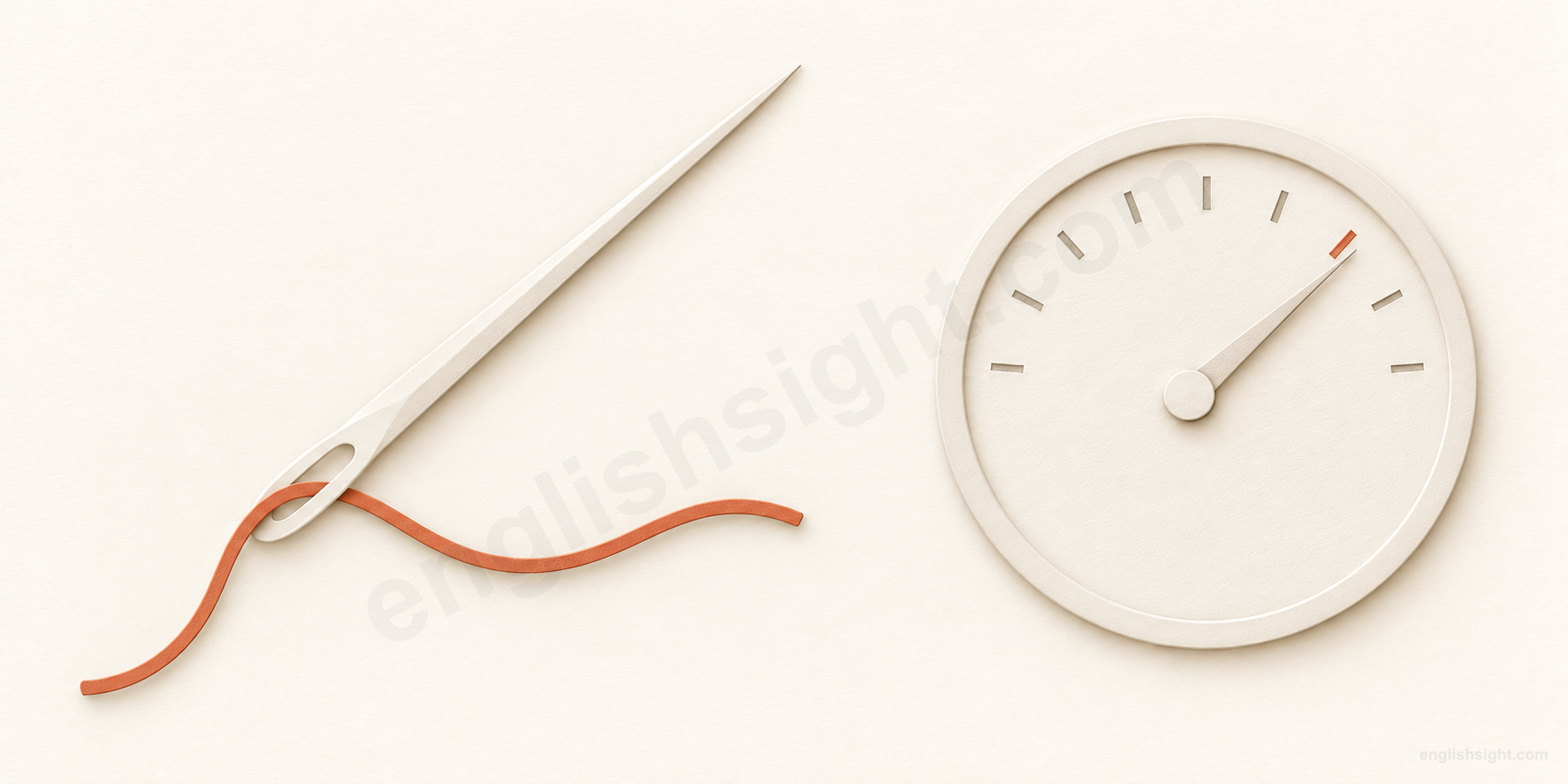
Follow needle from sewing tools to pointers, prickly feelings, and pointed remarks.
A fine tip with a particular job
A fine tip with a particular job
A sewing needle has an eye that holds thread.
needle
A gauge needle points to a reading without carrying thread.
Compare the slender forms and fine tips, then notice their different jobs.
A slender form, different jobs: carrying thread or indicating a reading.
A needle has a slender form and a fine tip; its particular job determines how we understand it.
The sewing example anchors the shape. An eye, a hollow passage, and physical piercing are not features of every kind of needle. The figurative expressions need their own explanations.
Needle most often names a narrow tool or something with a similar shape. The context tells you whether it carries thread, enters a body, points to a reading, or belongs to a tree.
A useful teaching connection is a slender form with a fine tip. Some uses emphasize shape, others a pointer or a prick. Fixed expressions add meanings that the shape alone cannot predict.
01
Tools, pointers, and narrow shapes
Identify the object from its job and context. A sewing needle, a medical needle, and a compass needle share a slender form, but work differently.
01
a needle; a sewing needle; sew with needle and thread
a needle and thread
the tool that carries thread while sewing
Situation
A shirt button has come loose.
What it means here
You use a fine pointed tool to sew it back on.
The eye holds the thread; the point goes through the material.
A hand-sewing needle has a small opening called its eye. The thread goes through that opening, and the needle carries it through cloth to make stitches. A sewing-machine needle has its eye near the point instead.
Needle is usually countable: a needle, two needles, the needle. A pin commonly holds pieces temporarily; a sewing needle carries thread. They are not interchangeable names for every small pointed object.
In a sentence
I found a needle and some blue thread to mend the pocket.
Watch the difference Needle and thread is a familiar tool-and-material pairing; thread is usually uncountable when naming the material.
02
thread + a/the needle; thread a needle with + thread
thread a needle
put thread through a needle’s eye
Situation
The thread and needle are separate.
What it means here
The thread runs through the small opening.
Thread is the action word; needle names the tool being prepared.
To thread a needle is to pass the end of a thread through its eye. You can also say thread the needle with cotton or put the thread through the eye of the needle.
The eye here is an opening, not an organ of sight. Threading prepares the tool; it does not itself mean sewing the cloth.
In a sentence
Could you thread this needle for me? The eye is tiny.
Watch the difference Use thread as the verb for this action, rather than needle the thread.
03
a knitting needle; a pair of knitting needles
knitting needles
long tools for forming loops of yarn
Situation
You have wool and a scarf pattern.
What it means here
Loops of yarn are worked on long pointed rods.
These needles hold and form loops rather than carry thread through an eye.
Knitting needles are larger than sewing needles. They may be metal, plastic, or wood. A familiar arrangement uses two separate needles; circular needles have tips joined by a flexible cable.
The modifier knitting identifies the activity. Do not assume a knitting needle has the eye of a sewing needle. A crochet hook is the usual everyday name for the hooked tool used in crochet, though broader dictionaries also include that tool under needle.
In a sentence
She packed her knitting needles and a ball of wool.
Watch the difference A pair of knitting needles is singular as a phrase headed by pair: This pair is new.
04
a hypodermic / acupuncture needle; insert a needle into + body part
a needle on a syringe
a fine medical instrument that enters the body
Situation
A nurse prepares to take a blood sample.
What it means here
A fine hollow needle provides a passage for blood.
The needle is the narrow part; the syringe is the device attached to it.
A medical needle may deliver liquid or collect a sample. A hypodermic needle is a thin hollow tube. A syringe has a barrel and plunger; needle normally identifies the pointed component, although informal speech may use the word more broadly.
An acupuncture needle is a different kind: it is extremely thin and solid, rather than a hollow injection tube. Needle alone does not specify which procedure is involved. A person who says I’m afraid of needles usually means medical needles and their use.
In a sentence
The nurse attached a new needle to the syringe.
Watch the difference Not every medical needle is hollow, and needle does not always mean the whole syringe or an injection.
05
an inflation needle; a needle for a ball pump
an inflation needle
a narrow hollow attachment for putting air into an object
Situation
A ball needs more air.
What it means here
A pump sends air through a narrow attachment.
This needle carries air through a small opening.
An inflation needle is the slim hollow fitting used with a pump for objects such as sports balls. The noun extends to a tool with a similar narrow form and a passage inside.
The modifier inflation supplies the purpose. This is a name for a piece of equipment, not a special new meaning of the verb inflate.
In a sentence
Do we have an inflation needle for this basketball pump?
Watch the difference A ball-pump needle and a medical needle are different tools despite sharing the noun.
06
the needle on + instrument; the needle of a compass; needle + point / move
the needle on a gauge
a slender pointer that shows a reading or direction
Situation
You look at an instrument.
What it means here
Its narrow moving pointer indicates a value.
Here the tip points to information rather than piercing material.
A needle on a dial can show speed, weight, temperature, or another measurement. A compass needle indicates direction. The surrounding instrument determines what its position means.
The needle points to a mark or value: The needle points to zero. A compass needle can point north without to. A digital display may show numbers without having a needle.
In a sentence
The needle on the pressure gauge stayed near zero.
Watch the difference Do not use needle for every part of a clock or dial: the usual clock terms are hands.
07
a pine needle; pine / fir needles
pine needles
the narrow leaves of a pine or similar tree
Situation
You walk beneath pine trees.
What it means here
Their fallen narrow leaves cover the path.
The name compares the leaf’s shape with a slender needle.
A pine needle is a leaf. Needles is often plural because people describe many of them on a branch or on the ground. One leaf can still be called a needle.
The shape connection is useful, but these are plant parts, not metal tools. Pine needles and sewing needles use the same countable noun in different settings.
In a sentence
Dry pine needles covered the steps outside the cabin.
Watch the difference Usually plural is a usage tendency, not a ban on one needle.
08
the needle on a record player; lower the needle onto + record
the needle on a record player
the small tip that follows a record’s groove
Situation
A record is ready to play.
What it means here
A small stylus touches its groove as it turns.
Here needle names the record player’s contact tip.
In ordinary conversation, the needle of a record player is its stylus: the part that follows the groove. The record is a physical disc, so this use belongs to vinyl and older record-playing equipment.
The needle is not the whole tonearm. This branch is connected with a fine contact tip, not with sewing or injecting. A stylus tip need not be sharp enough to pierce material.
In a sentence
He lifted the needle before the record finished.
Watch the difference Needle does not name the laser in a CD player or a feature of ordinary digital audio.
02
Search, sensation, and careful progress
These whole expressions use different features of a needle. Learn their wording and situation rather than translating each part separately.
09
look / search for a needle in a haystack; be like looking for a needle in a haystack
a needle in a haystack
something extremely difficult to locate
Situation
One tiny item is hidden among countless others.
What it means here
Searching is frustrating because the target is hard to distinguish.
The comparison is about finding a small target in a huge search space.
Looking for a needle in a haystack compares a search with finding one tiny needle among a mass of hay. It can describe files, people, or objects; there need not be any actual hay.
The expression stresses difficulty, not a logical guarantee that success is impossible. You can say Finding the original receipt was like looking for a needle in a haystack.
In a sentence
Finding that photo in these unlabeled boxes is like looking for a needle in a haystack.
Watch the difference Keep the conventional wording needle in a haystack; changing the objects may lose the familiar expression.
10
have / get pins and needles in + body part
have pins and needles
feel tingling or prickling in part of the body
Situation
Your foot has been in an awkward position.
What it means here
You feel a prickly tingling sensation.
The expression names a feeling; no actual pins or needles are present.
Have or get pins and needles describes a tingling, prickly sensation, often in an arm, hand, leg, or foot. Use in to name the affected part: pins and needles in my fingers.
The expression works as an uncountable name for the sensation. It does not mean several pieces of sewing equipment, and the phrase alone does not identify a medical cause.
In a sentence
I got pins and needles in my foot after sitting on it.
Watch the difference Say I have pins and needles in my foot, without a before pins and needles.
11
be on pins and needles + waiting for / to hear…
be on pins and needles
wait with nervous anticipation
Situation
You are waiting for an important answer.
What it means here
You feel too anxious or excited to relax.
On pins and needles describes the person’s emotional state.
Especially in North American English, be on pins and needles means feeling tense or excited while waiting to learn what will happen. The answer may be welcome or unwelcome.
Compare I have pins and needles in my hand, which describes a bodily sensation. On marks a different fixed expression; it is not a freely interchangeable preposition here.
In a sentence
We were on pins and needles waiting to hear whether our offer had been accepted.
Watch the difference Do not interpret be on pins and needles as the ordinary way to report a tingling foot.
12
something + moves the needle; move the needle on + issue / result
move the needle
make a noticeable difference
Situation
A team wants an improvement in results.
What it means here
A change has enough effect to show up.
The image comes from an instrument’s pointer changing position.
In discussions of work, policy, or performance, move the needle means produce an effect large enough to notice. A real gauge is not required. Move the needle on sales identifies the area affected.
The phrase often suggests useful progress, but the basic meaning is noticeable change. We should check the context before assuming the change is good. Didn’t move the needle says the effect was too small to matter in that discussion.
Shift the needle is another recorded variant. The familiar pointer image still concerns a noticeable effect.
In a sentence
The new bus service could move the needle on local traffic congestion.
Watch the difference Trying hard is not enough for this expression; it concerns the effect.
13
thread the needle; thread the needle between + competing demands
thread the needle
manage a difficult task with precision
Situation
A plan must satisfy competing demands.
What it means here
You find a carefully judged way to meet them.
The sewing action supplies a comparison for a delicate challenge.
Figurative thread the needle describes doing something that calls for careful precision, especially when interests or requirements conflict. The full expression supplies this meaning; needle alone does not mean compromise.
In We need to thread the needle between cost and comfort, between names the competing considerations. The literal meaning remains possible when the discussion concerns sewing.
In a sentence
The designer must thread the needle between keeping costs low and making the seats comfortable.
Watch the difference This is a verb–object idiom, not a separable phrasal verb: needle is the object of thread.
14
be + (as) sharp as a needle
as sharp as a needle
quick to notice or understand
Situation
Someone notices a hidden problem immediately.
What it means here
You praise their mental quickness.
Sharp describes intelligence here, with the needle as an emphatic comparison.
A person who is as sharp as a needle is mentally alert and quick to understand. This comparison builds on the figurative adjective sharp, rather than saying the person has a pointed body.
It is praise for perceptiveness in this context. Do not confuse it with sharp words, which can be angry or harsh. The adjective and context supply the interpretation.
In a sentence
Mina is as sharp as a needle; she spotted the error before anyone else.
Watch the difference The comparison does not mean the person is physically dangerous or unkind.
03
Words that irritate and rivalries that sting
The informal verb describes verbal provocation. A related British noun describes tension between opponents.
15
needle + person; needle someone about + topic
needle someone about something
irritate someone with pointed teasing or criticism
Situation
A colleague keeps making personal remarks.
What it means here
The remarks provoke or annoy their target.
The small repeated verbal jabs are compared with pricks.
The informal verb needle takes a person as its object. It commonly describes deliberate, repeated comments aimed at getting a reaction. About introduces the topic: needle someone about their mistake.
It is more pointed than simply ask. It can be teasing between friends, but it can also be unpleasant. The metaphor is a teaching connection; it does not describe physical contact.
In a sentence
Please stop needling me about that missed penalty.
Watch the difference Use an object: They needled him, not They needled to him.
16
needle + person + into + -ing
needle someone into doing something
provoke an action through persistent remarks
Situation
Someone repeatedly challenges another person.
What it means here
The target reacts by doing something.
Into plus an -ing form names the reaction being provoked.
Needle someone into doing something adds a result or intended result to the ordinary irritation meaning. The person after needle is the target, and the -ing phrase names the action.
They tried to needle her into arguing does not say she actually argued. They needled her into arguing presents arguing as the result. Passive wording is possible: She was needled into reacting.
In a sentence
He needled me into making a bet I did not want to make.
Watch the difference Into is a preposition here: into making, not into make or into to make.
17
a bit of needle between + rivals; a needle match; get / have the needle
a bit of needle between rivals
hostile tension between competitors
Situation
Two teams have a long rivalry.
What it means here
There is an edge of hostility when they meet.
The British informal noun describes the tension, not an object.
In British informal English, needle can be uncountable when it means antagonism between competitors. A bit of needle between the teams describes a charged relationship, and a needle match is a contest marked by that rivalry.
Another British informal expression is get or have the needle. In an annoyed response, He got the needle means he became irritated; it can also express dislike or unease depending on context. These are recognition expressions, not neutral international alternatives to angry or rivalry.
In a sentence
There was a bit of needle between the teams after last season’s final.
Watch the difference This emotional noun is uncountable: a bit of needle, unlike a needle for sewing.
Keep the branch and the construction clear
A tool name is not one universal design
A sewing needle has an eye; a medical needle may be hollow or solid; a gauge needle points; a stylus follows a groove. Use the modifier and situation to identify the object.
Forms and countability
The noun is normally countable, with plural needles. British rivalry needle and the sensation pins and needles are uncountable. Verb forms are needle, needles, needled, needling; drop the final e before -ing.
Verb grammar
The ordinary informal verb takes a target: someone needles someone. Continuous and passive forms are possible: They are needling him; He was needled about his accent. Into doing adds a provoked action. This is not a productive family of particle verbs.
Coverage boundary
This lesson covers common object names and useful figurative expressions, with British rivalry usages marked. Specialist senses in construction, crystals, engraving, and valves, rare sewing verbs, historical slang, and named monuments are outside the main lesson. It is a selection of uses, not a frequency ranking or every dictionary sense.
Read the whole expression
Choose the interpretation that fits the situation.
1. You are told to thread a sewing needle. What should happen?
2. “I have pins and needles in my foot.” What is the speaker describing?
3. A small redesign “didn’t move the needle on sales.” What does this mean?
4. Which sentence naturally describes taunts provoking an unwanted argument?
5. “The compass needle turned.” What is needle naming?
Sources and teaching notes
The sources support the uses and patterns below. Explanations and examples are original; the shape-and-tip connection is a teaching aid, not a rule that generates every idiom.
The diagram illustrates a useful connection, not a mental picture shared by every speaker.