Read the whole expression to distinguish a bodily nerve, anxious nerves, and the nerve to act.
Signals and sensitivity
A route for signals
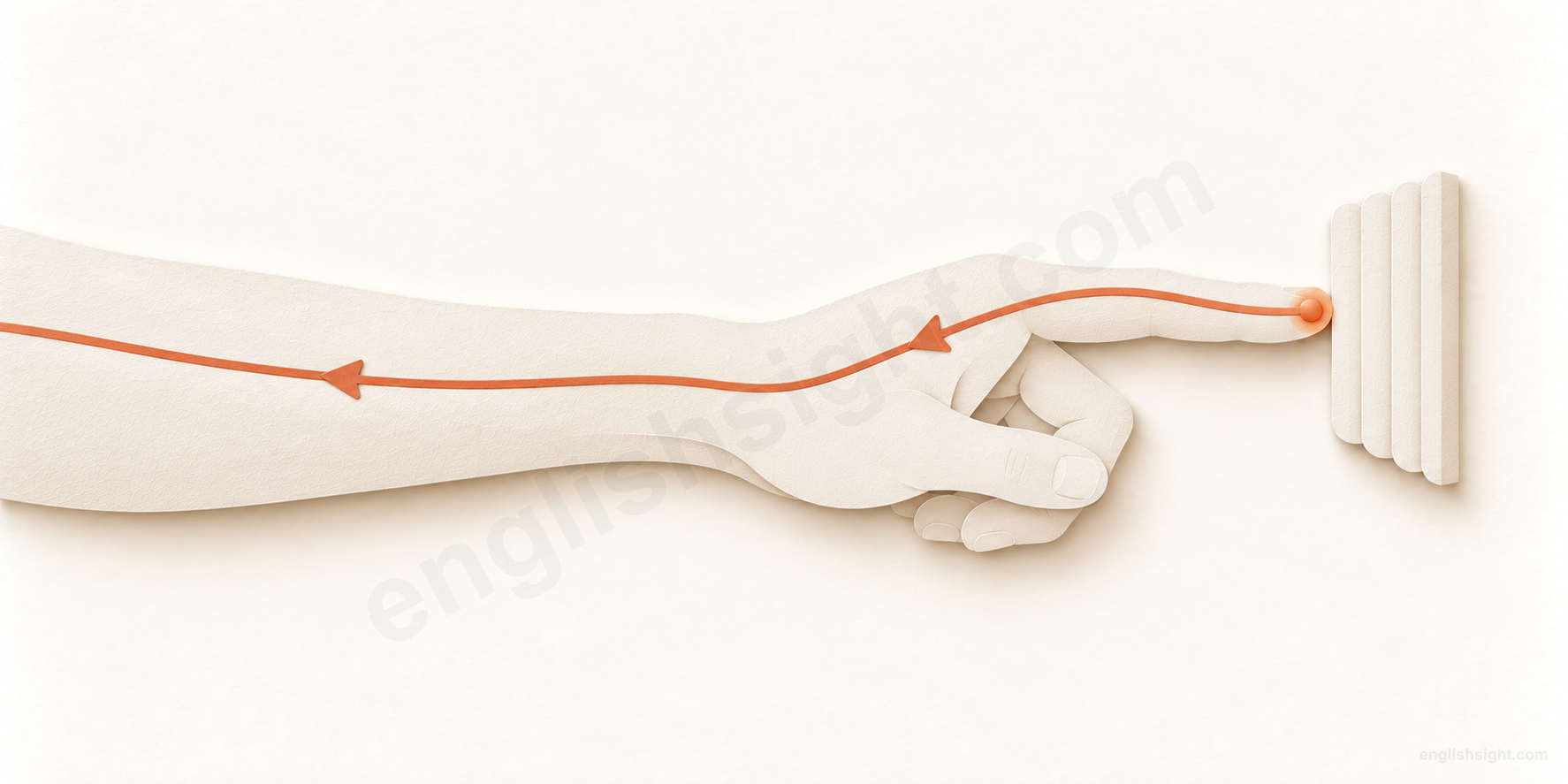
A fingertip touches a ridged surface.
nerve
Touch information travels toward the body's control system, beyond this close-up.
A sensory signal travels inward along the highlighted nerve route.
The highlighted nerve route carries a touch signal inward; the nerve is the carrier, not the sensation itself.
A bodily nerve carries signals involved in sensation and movement between the body’s control system and other body parts.
The sketch shows a simplified sensory route from a fingertip along the arm. Emotional nerves, courage, and cheek are figurative uses; their grammar and established expressions must be learned separately.
A nerve can be a physical structure carrying signals. Nerves can also name anxiety, while nerve can name courage or a kind of boldness that others consider rude. These uses share associations with feeling and responding, but one definition cannot replace them all.
The picture anchors the bodily sense. The figurative families and idioms are explained in their own contexts; the diagram is a learning model, not a claim that every English speaker imagines the same picture.
01
Signals in the body
Start with a physical nerve, then recognize a familiar organizational metaphor. These uses concern connections and control, rather than bravery.
01
a / the + nerve; nerves; nerve + noun
a nerve; nerve damage
a structure that carries signals in the body
Situation / starting point
A finger makes contact with a surface.
Meaning in this context
Sensory information travels along a nerve.
The nerve is the signal-carrying structure, not the feeling itself.
A nerve connects parts of the nervous system with other body parts. Nerves help carry information involved in feeling and movement. This physical noun is countable: a nerve, the optic nerve, several nerves.
In nerve damage, nerve pain, nerve cells, and nerve endings, nerve modifies another noun. The main noun determines the grammar: nerve damage is normally uncountable, while nerve cells is plural. A trapped or pinched nerve is a physical condition, not an expression for being worried.
In a sentence
The doctor checked for nerve damage in his hand.
Watch the difference Do not use blood vessel or muscle as a synonym for nerve. Feeling nervous does not by itself mean you have nerve damage.
02
the nerve centre / center of + organization or activity
nerve centre / nerve center
the place coordinating an organization or activity
Situation / starting point
Several teams need instructions and updates.
Meaning in this context
One room coordinates their work.
The phrase compares organizational coordination with bodily control.
The nerve centre of an operation is where its activities are coordinated and decisions or instructions are sent out. It may be a room, office, or larger location. This is an established metaphor, not a claim that the building contains a literal nerve.
Centre is the British spelling; center is the American spelling. The whole phrase is a countable noun phrase: a nerve centre, the nerve centre of the operation.
In a sentence
This small office is the nerve centre of the rescue operation.
Watch the difference An important building is not necessarily a nerve centre; the phrase highlights coordination or control.
02
Feeling tense or irritated
Plural nerves often describes worry or emotional strain. The surrounding words show whether someone feels anxious, becomes calmer, or finds something annoying.
03
suffer from nerves; exam nerves; an attack of nerves
nerves; exam nerves
feelings of worry before or during a demanding event
Situation / starting point
An interview is about to begin.
Meaning in this context
Worry makes it hard to concentrate.
Plural nerves can name anxiety without identifying individual body structures.
You can suffer from nerves, have exam nerves, or have an attack of nerves. The last phrase presents a spell of anxiety: an is attached to attack, not to nerves. My nerves got the better of me means anxiety interfered with what I was trying to do.
Use plural agreement: My nerves are terrible today. For the personal state, I am nervous is a straightforward alternative. Compare I have the nerve to speak, which concerns courage, with I suffer from nerves before speaking, which concerns anxiety.
In a sentence
Nerves got the better of me during the interview, and I forgot my questions.
Watch the difference For ordinary anxiety, say I am nervous or I suffer from nerves; I am nerve is not standard.
The person becomes calmer; no physical nerves are being repaired.
Calm, settle, soothe, and steady can take someone’s nerves as their object. These expressions describe easing anxiety or restoring composure. A person can do something to calm their own nerves, or an experience can calm someone else’s nerves.
The possessive identifies the person affected: calm my nerves, settle her nerves. This family connects with emotional sensitivity, but the meaning comes from the full collocation rather than a literal change to nerve tissue.
In a sentence
I took a quiet walk to settle my nerves before the talk.
Watch the difference Keep nerves plural here: settle my nerves, not settle my nerve.
05
someone’s nerves are on edge / frayed / shot; live on one’s nerves
nerves on edge; frayed nerves
a tense or emotionally worn-out state
Situation / starting point
A family has spent hours waiting for news.
Meaning in this context
Small disturbances are difficult to tolerate.
These descriptions concern emotional strain and reduced patience.
If your nerves are on edge, you feel tense and easily upset. Frayed nerves suggests that stress has worn down your ability to stay calm. In informal speech, My nerves are shot can similarly mean that you feel emotionally exhausted.
Compare My nerves are on edge with The noise gets on my nerves: the first describes your state; the second names what irritates you. Live on your nerves, especially British English, describes continuing to feel anxious over a period: I was living on my nerves while we waited for the results.
In a sentence
By the end of the long wait, everyone’s nerves were on edge.
Watch the difference Frayed and shot are figurative descriptions here, not diagnoses of damaged nerves.
06
be + a bundle / bag of nerves
a bundle / bag of nerves
a very nervous person
Situation / starting point
Someone is waiting to take a driving test.
Meaning in this context
They feel extremely anxious.
The whole noun phrase describes a person’s emotional state.
I am a bundle of nerves means I am very nervous. A bag of nerves is another informal version. The container image intensifies the feeling; it does not describe how bodily nerves are actually arranged.
Use a before bundle or bag, and retain plural nerves after of. You can describe a temporary state even when the person is usually confident: She was a bundle of nerves before her first lesson.
In a sentence
I was a bundle of nerves before my driving test.
Watch the difference Do not shorten the expression to I am a nerve; the idiom is the whole phrase.
07
something / someone + gets on + possessive + nerves
get on someone’s nerves
annoy or irritate someone
Situation / starting point
A tap keeps dripping while you try to read.
Meaning in this context
You become increasingly irritated.
The thing before get causes irritation to the person named by the possessive.
The dripping gets on my nerves means I find it irritating. The subject can be a sound, a habit, a person, or a situation. Someone does not have to be frightened or anxious for something to get on their nerves.
Learn get on someone’s nerves as an informal idiom. The possessive identifies the irritated person: it gets on my nerves, her nerves, or their nerves. Do not move the words around as if this were a separable particle verb: It gets on them does not preserve this meaning.
In a sentence
That dripping tap is getting on my nerves.
Watch the difference Do not confuse get on my nerves with get nervous: the first names irritation; the second describes becoming anxious.
03
Courage and steadiness under pressure
Uncountable nerve can be the courage to begin or the composure to continue. Several established expressions develop this family; they are learned as whole phrases.
08
have the nerve to + verb; it takes + amount + nerve + to-infinitive
have the nerve to; take nerve
have or require courage to do something
Situation / starting point
You want to challenge an unfair decision.
Meaning in this context
Speaking up requires courage.
Nerve is an amount of courage, not a countable body part.
In this sense nerve is normally uncountable: It takes nerve, a lot of nerve, or enough nerve. Have the nerve to do something identifies the courage needed for a particular action. I don’t have the nerve to ask says I am too afraid or hesitant to ask.
The same have the nerve to pattern can criticize rude boldness. Compare She had the nerve to question an unfair rule with He had the nerve to blame the person he had cheated. The action and the speaker’s attitude determine whether courage or cheek is intended.
In a sentence
I didn’t have the nerve to challenge the decision in front of everyone.
Watch the difference Do not assume have the nerve to is always praise or always criticism; read the situation.
09
get up / work up + the / enough + nerve + to-infinitive
get up / work up the nerve
gradually find enough courage to act
Situation / starting point
You keep putting off a difficult request.
Meaning in this context
You finally feel brave enough to ask.
The whole expression presents courage as something built up before acting.
Get up the nerve and work up the nerve to do something describe overcoming hesitation. Enough nerve can replace the nerve when the amount needed is emphasized. These expressions focus on becoming ready, rather than simply possessing courage.
After years of silence, I finally worked up the nerve to apologize presents a change in willingness or bravery. It does not guarantee that the apology was accepted. Get up here belongs to the larger expression; it does not mean physically stand up.
In a sentence
I finally worked up the nerve to ask for a refund.
Watch the difference The infinitive names the intended action: the nerve to ask, not the nerve of ask.
10
lose + possessive + nerve; a loss / failure of nerve
lose your nerve
become too frightened or uncertain to continue
Situation / starting point
You plan to perform a difficult action.
Meaning in this context
At the last moment, you cannot make yourself do it.
Lose describes a failure of courage or confidence in the situation.
Lose your nerve means that fear or uncertainty overcomes your readiness to act. It can concern a physical challenge, a public performance, or a difficult decision. The possessive changes with the person: lose my nerve, lost her nerve.
This is different from lose your temper, which means become angry, and lose a nerve, which would suggest a bodily structure in an unusual literal context. A loss of nerve or a failure of nerve is a related noun phrase for diminished resolve.
In a sentence
I reached for the microphone, then lost my nerve and sat down.
Watch the difference Keep nerve singular in the usual idiom, even when several people lose their nerve.
11
keep / hold + possessive + nerve
keep / hold your nerve
remain calm and determined under pressure
Situation / starting point
The match is close and the crowd is loud.
Meaning in this context
The player stays composed for the final shot.
The focus is maintaining composure through a difficult moment.
Keep your nerve and hold your nerve describe remaining steady when panic or doubt could affect your decisions. The expression is useful for sport, negotiations, and difficult choices as well as danger.
It does not mean refusing to change your mind regardless of evidence. In a story, They kept their nerve may explain why they completed a task, but the phrase itself does not guarantee success. Compare lose your nerve, where confidence gives way.
In a sentence
Despite the shouting, she held her nerve and took the final shot.
Watch the difference Hold your nerves is not the usual form of this idiom; use hold your nerve.
12
have / need + nerves of steel
nerves of steel
exceptional calmness in a difficult or dangerous situation
Situation / starting point
A rescue worker faces a demanding task.
Meaning in this context
The worker remains remarkably steady.
Steel suggests strength and steadiness; it is not a bodily material.
Someone who has nerves of steel stays calm under intense pressure. This is usually an admiring description. The plural form is part of the established expression, even though ordinary courage is often expressed by uncountable nerve.
You need nerves of steel to do that describes the composure the task requires. It need not mean the person never feels fear; it emphasizes their ability to function steadily. The metaphor cannot be read as a medical statement about their nerves.
In a sentence
You need nerves of steel to land a plane in those conditions.
Watch the difference Use plural nerves in nerves of steel, unlike the usual keep your nerve.
13
a test of nerve; test + possessive + nerve
a test of nerve
a situation that challenges courage or composure
Situation / starting point
A decision must be made while others are watching.
Meaning in this context
The difficulty tests the decision-maker’s resolve.
The challenge is to steadiness or courage, not necessarily a medical test.
A test of nerve is an experience that shows how well someone handles pressure. Similarly, a task can test your nerve. The nature of the test comes from the situation: waiting calmly may require as much nerve as taking action.
Contrast a nerve test in a medical setting, which can refer to examining nerve function. In a test of nerve, the of phrase identifies the quality being challenged. The word order helps distinguish the figurative and technical readings.
Plural nerves can also refer to the ability to cope with pressure: The constant uncertainty tested our nerves. The plural form therefore does not always name anxiety or individual body structures.
In a sentence
Waiting for the last result was a real test of nerve.
Watch the difference A test of nerve does not automatically involve a hospital or damage to a bodily nerve.
14
a war of nerves + between opposing sides
a war of nerves
a contest using psychological pressure to weaken an opponent
Situation / starting point
Two sides refuse to give way in a dispute.
Meaning in this context
Each tries to make the other lose confidence.
The contest is over resolve, even when there is no armed conflict.
A war of nerves is a struggle in which pressure, waiting, threats, or uncertainty are used to unsettle the other side. It can describe negotiations, political disputes, or sporting rivalry.
This is a fixed noun phrase, often used in reporting. It differs from a test of nerve: a test can simply be a demanding situation, whereas a war of nerves involves opposing sides and pressure directed at an opponent.
In a sentence
The talks became a war of nerves, with each side waiting for the other to give way.
Watch the difference War is metaphorical here; the phrase does not by itself report fighting.
15
nerve + reflexive pronoun + to-infinitive / for + noun
nerve yourself to / for
prepare yourself mentally for something difficult
Situation / starting point
You hesitate before delivering unwelcome news.
Meaning in this context
You deliberately prepare to face the conversation.
The verb describes strengthening your own courage before acting.
Nerve can also be a verb: nerve yourself to do something, or nerve yourself for something. The person gathering courage and the reflexive object refer to the same person. She nerved herself to speak is more literary or written in tone than She worked up the nerve to speak.
The forms are nerve, nerves, nerved, nerving. To introduces an infinitive in nerved himself to begin; for is a preposition in nerved himself for the interview. This verb means preparing for a challenge, not making someone nervous.
In a sentence
She nerved herself to tell the team that the project had failed.
Watch the difference Include the reflexive in this usual construction: she nerved herself, not she nerved to speak.
16
strain every nerve + to-infinitive
strain every nerve
make the greatest possible effort
Situation / starting point
A team is trying to finish urgent work.
Meaning in this context
They use all the effort they can.
This established expression concerns effort rather than the count of bodily nerves.
Strain every nerve to do something means try extremely hard. It is emphatic and suits formal or dramatic descriptions better than a casual account of a small task. Strain every sinew is a related expression.
This phrase preserves an older association of nerve with sinew or bodily strength. It should be learned separately rather than derived from the diagram’s modern signal-carrying meaning. The to-infinitive states the goal of the effort.
In a sentence
The crew strained every nerve to finish the repairs before nightfall.
Watch the difference The idiom describes trying hard; it does not state that the effort succeeded or caused a nerve injury.
04
Bold behavior and sensitive subjects
Context can turn nerve into criticism of someone’s behavior. Other idioms describe the strong emotional response produced by a remark or message.
17
have a nerve; have the nerve to + verb; what a nerve!
have a nerve; have the nerve to
show boldness the speaker considers rude or unjustified
Situation / starting point
Someone breaks a promise and then blames you.
Meaning in this context
You criticize their shameless behavior.
The speaker’s disapproval distinguishes cheek from admired courage.
You’ve got a nerve! and What a nerve! express indignation. Have the nerve to do something can similarly criticize an action the speaker thinks the person has no right to perform. Here the speaker is evaluating behavior, not counting anatomical nerves.
Compare He didn’t have the nerve to complain, which often means he lacked courage. In He had the nerve to complain after breaking it himself, the context makes the complaint seem outrageous. Informal expressions such as He has some nerve carry the same critical attitude.
In a sentence
He had the nerve to demand a refund for a ticket he had never bought.
Watch the difference Saying You’ve got a nerve! is confrontational; it is not a neutral compliment.
18
touch / hit / strike + a (raw / sensitive) nerve
touch / hit / strike a raw nerve
raise a subject that causes a strong, often painful emotional reaction
Situation / starting point
Someone feels embarrassed about an earlier failure.
Meaning in this context
A remark brings that feeling back.
The remark reaches an emotionally sensitive subject, without physical contact.
Touch a nerve, hit a nerve, and strike a nerve can describe a remark that upsets or angers someone. Raw or sensitive makes emotional vulnerability especially clear. The subject may be a question, a joke, an article, or a person’s remark.
You need not intend to hurt someone: I seem to have touched a raw nerve can recognize an unexpectedly strong response. The pain-of-touch image is a teaching connection to physical sensitivity; the phrase itself is an established figurative use.
In a sentence
My question about the failed business touched a raw nerve, and he went quiet.
Watch the difference Raw nerve in this figurative setting need not mean that any physical nerve is exposed or injured.
19
strike a nerve + with + person or audience
strike a nerve with someone
connect strongly with someone’s feelings or concerns
Situation / starting point
A writer describes a problem many readers recognize.
Meaning in this context
Readers respond strongly because it matters to them.
A strong response can be recognition or concern, not only hurt or anger.
Strike a nerve with an audience can mean affect them strongly because the message connects with something they care about. Context may show sympathy, recognition, anger, or discomfort. The phrase alone does not settle which emotion is involved.
Compare touched a raw nerve, which highlights a painful sensitivity. In The story struck a nerve with young parents, the with phrase names the affected audience. It does not mean the writer deliberately insulted those parents.
In a sentence
The article about childcare costs struck a nerve with many young parents.
Watch the difference Do not automatically interpret every strike a nerve as offend; check the response described.
Let the pattern decide
Countable, uncountable, and plural
Physical structures are a nerve / nerves. Courage is normally uncountable nerve: enough nerve, a lot of nerve. Anxiety commonly uses plural nerves. Established phrases keep their own forms: a bundle of nerves, nerves of steel, lose your nerve, and What a nerve!
Related words are not interchangeable
In the emotional uses discussed here, nervous is an adjective for being worried or easily worried; nerve is usually a noun. The written reflexive verb nerve yourself means prepare bravely, rather than become anxious. The ordinary noun idioms are not a productive family of phrasal verbs.
Scope and teaching boundaries
The core explanation covers modern body, anxiety, courage, and audacity uses plus the idioms below. Technical nerve classifications, botany and insect-wing veins, the older independent sinew sense, specialist nerve-agent terminology, and detailed medical advice are outside this lesson. Strain every nerve retains an older association and is included as an emphatic expression, not as an everyday model for new phrases.
Read the whole expression
Choose the meaning supported by the situation and the grammar.
1. Before an interview, Mira says, “My nerves are terrible today.” What does she mean?
2. Sam plans to ask a question, but fear stops him at the last moment. Which phrase fits?
3. A repeated clicking sound gets on your nerves. What is happening?
4. Someone cheats you and then has the nerve to call you dishonest. What attitude does this wording convey?
5. An article about high rents strikes a nerve with students, who say it describes their own lives. Which reading fits?
6. Which phrase most clearly names a physical health problem?
Sources and teaching notes
Definitions and usage were checked against the sources below. Explanations, example sentences, and the diagram were written for this lesson; the visual connection is a teaching interpretation.
The signal-path sketch is a teaching aid. Figurative uses have their own patterns and limits.