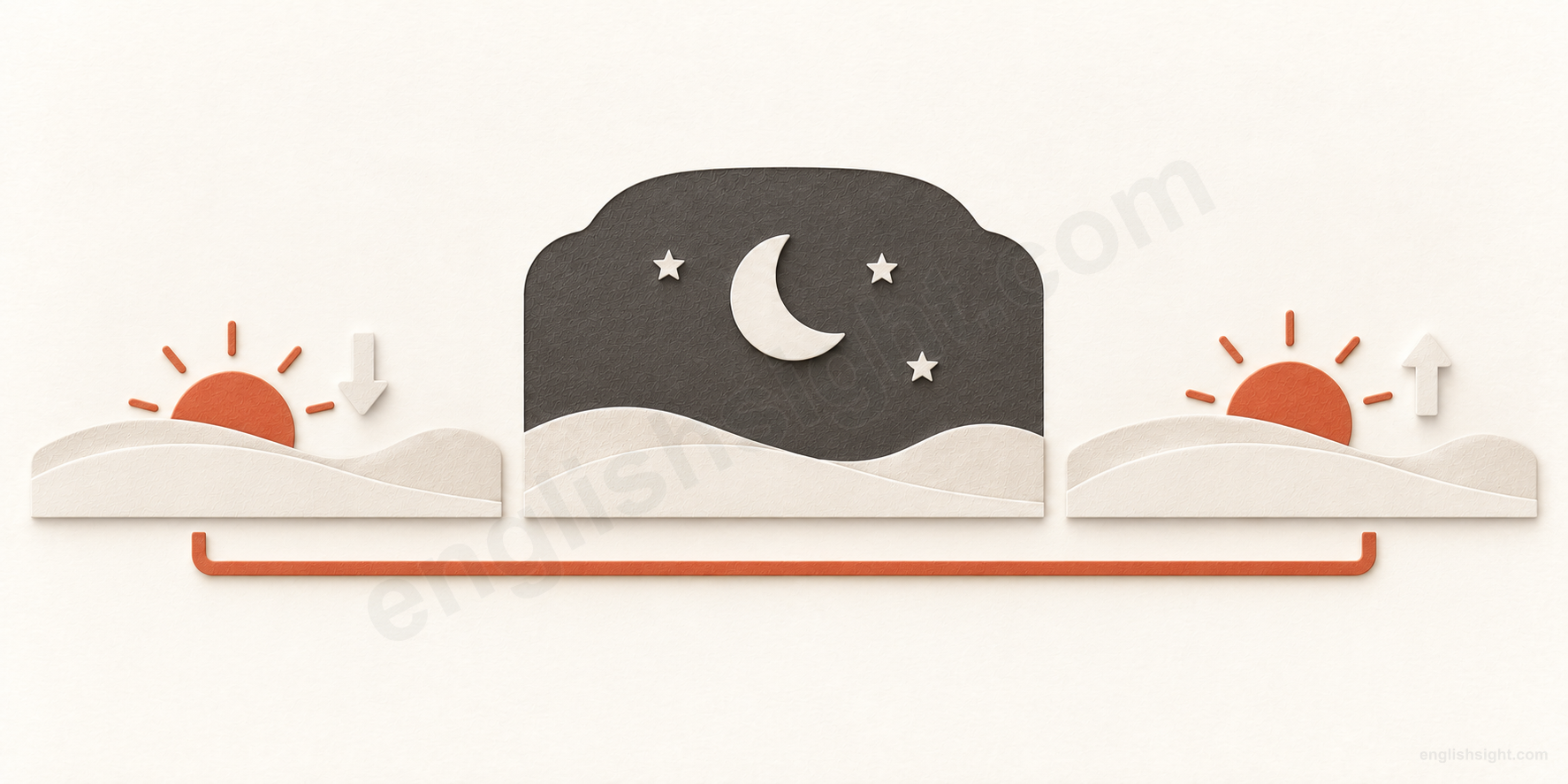
Use night for nighttime, an evening’s experience, and the routines or expressions built around it.
From sunset to the next sunrise
A recurring interval in the daily cycle
Sunset: daylight fades.
night
Sunrise: daylight returns.
The nighttime interval passes between sunset and the next sunrise.
Night runs from sunset to the next sunrise. The moon is only a symbol and need not be visible.
Night is the recurring time after sunset and before sunrise; in everyday plans it can also mean the evening before bed.
Night names a time, not an activity. Sleep, work, travel, and entertainment can happen within it. Fixed expressions add meanings that a picture of darkness alone cannot predict.
Night /naɪt/ usually names the dark part of the daily cycle. English also uses it for an evening’s plans, a period of sleep, or one overnight stay. Start with the time interval, then notice what the verb and the rest of the expression add.
This lesson groups common uses by the choices they help you make. The visual model is a teaching aid; it is not a claim that every English speaker imagines the same scene.
01
Locate a time in the daily cycle
Start with the dark part of the daily cycle, then choose a phrase for a general time, a particular night, or a whole duration.
01
night; a/an + adjective + night; night falls / fell
night; night falls
the dark part of the daily cycle, or its arrival
Situation / reference time
The sun is setting over the fields.
Meaning / use
Daylight fades and the nighttime period begins.
Night names a time; falls describes that time beginning.
Night contrasts with daytime. It is not a fixed clock hour: seasons and places affect when it gets dark. A clear night, a warm night, and a dark night describe conditions during one such period.
Night fell as we reached the farm means it became dark. Nothing physically drops. This is an established way to describe the arrival of night; get dark is an ordinary alternative. You can use night without an article when naming the time generally, but a night when describing one occurrence.
In a sentence
Night fell while we were still walking back to the farm.
Watch the difference Night is not another word for sleep: people can work, travel, or stay awake all night.
02
verb + at night; by day … by night; clock time + at night
at night; by night
during nighttime, often as a regular condition or routine
Situation / reference time
The same street is busy in daylight.
Meaning / use
After dark, it becomes much quieter.
At night places a situation in nighttime without selecting a calendar date.
Use at night for routines or general conditions: I read at night; the roads are quieter at night. By night can make a day/night contrast: an office by day and a music venue by night. At night is the easy everyday choice.
At night is also used after a clock time: ten at night means 10 p.m. Say two in the morning for 2 a.m. The useful contrast with in the night is a tendency, not a rule that at night can only describe repeated events. Late at night means at a late nighttime hour.
At this time of night refers to the particular nighttime hour being discussed, often with surprise or concern that it is late: Why is someone knocking at this time of night? Keep of in this longer expression.
In a sentence
This street is much quieter at night.
Watch the difference Say at night without the. At the night is not the general-time expression.
03
verb + in / during the night; in the middle of the night
in the night; during the night
at some time within a nighttime period
Situation / reference time
You go to bed, and everything is quiet.
Meaning / use
A noise wakes you before morning.
The event occurs within the night; it need not last until morning.
In the night and during the night are natural for something that happens inside a nighttime period, often while people are sleeping. During the night does not itself mean throughout the night: a single brief event can happen during it.
In the middle of the night stresses a very late or inconvenient nighttime hour; it need not identify the exact halfway point. Compare I wake at night, which can describe a habit, with I woke during the night, which reports an event in the night being discussed.
In a sentence
A loud crash woke me during the night.
Watch the difference Keep the in during the night and in the night. All night is the expression for the full duration.
04
on + weekday + night / nights; on the night of + date / event
on Friday night; on the night of…
identify a particular night by day or date
Situation / reference time
There are several possible evenings for the visit.
Meaning / use
You choose the one associated with Friday.
On marks the named occasion, rather than nighttime generally.
Use on with a weekday plus night: on Friday night, on Monday nights. The plural can describe a weekly routine. On the night of 12 June identifies the night by a date or event.
A named night is normally associated with the evening following that day’s daytime hours. For tickets or travel after midnight, check the calendar date: one social night can cross midnight. The phrase alone is not a complete travel schedule.
In a sentence
We are meeting on Friday night, not Saturday night.
Watch the difference Use on Friday night, not at Friday night. In informal American English, Friday night can also appear without on.
05
verb + last night / tomorrow night / every night; tonight
last night; tomorrow night; every night
refer to nights without a preposition
Situation / reference time
You are speaking today.
Meaning / use
You locate an event relative to today, or say it recurs each night.
Last, tomorrow, and every provide the time reference themselves.
Last night normally refers to the night just past; tomorrow night is the night associated with tomorrow. Every night describes a repeated schedule and takes singular night. I cook every night does not mean I cook continuously until morning.
These time phrases do not normally take at, in, or on. Tonight means this evening or the coming/current night. If you need this night in an ordinary plan, tonight is usually the natural choice: Are you free tonight?
In a sentence
I called her last night, and I will call again tomorrow night.
Watch the difference Say last night, not on last night; every night, not every nights.
06
the other night; the night before + event; the following / next night
the other night; the night before
a recent unspecified night, or a night before a reference event
Situation / reference time
You remember a conversation, but do not give its date.
Meaning / use
You place it recently, or before another event in the story.
The other night looks back from now; the night before depends on a reference point.
The other night means one night recently, not necessarily yesterday. It is useful when the exact date is unimportant: We talked the other night.
The night before the interview means the night preceding that interview. In a past narrative, the following night or the next night advances the story by one night. These phrases follow the story’s reference point, which may be far from today.
In a sentence
The other night, Mia told me she had packed the night before her flight.
Watch the difference The other night does not mean tomorrow night, and the night before does not always mean last night.
07
verb + all night (long); all-night + noun
all night; all night long
for the whole nighttime period in context
Situation / reference time
Rain starts before you go to bed.
Meaning / use
It continues until morning.
All makes the night a duration rather than the time of one event.
All night answers how long. Long adds emphasis without changing the basic meaning. It can also be ordinary exaggeration: I was awake all night may express a very poor night rather than a timed medical record.
Compare It rained during the night, which allows a short shower, with It rained all night, which presents continuing rain. Before a noun, all-night is a compound modifier: an all-night café or an all-night journey.
In a sentence
The rain kept us awake all night long.
Watch the difference Use all night, not all the night as the usual everyday duration phrase. An all-night café is not a café for only one particular night.
02
Sleep, stays, and work
Night can name a period you spend somewhere, a unit for booking accommodation, or the time assigned to work. The accompanying verb tells us what happens.
08
stay (for) the night; spend the night + at / in + place; spend the night + -ing
stay the night; spend the night
remain somewhere overnight, or say how that period is used
Situation / reference time
The last bus has left, and your friend offers a room.
Meaning / use
You remain at the house until the next day.
Night is the period; stay names remaining, while spend can introduce a place or activity.
You can stay the night at my place offers overnight accommodation. Spend the night in a hotel tells where that time is spent. Spend the night working tells what fills the time and does not imply sleep.
Spend the night with someone can mean staying in their company, but in some adult contexts it suggests having sex. Staying at a friend’s house is a clearer way to describe accommodation when you want to avoid that implication. Context, rather than night by itself, supplies it.
In a sentence
You can stay the night here and take the first bus tomorrow.
Watch the difference Spend needs an object: spend the night here, not spend here the night in ordinary word order.
09
for + number + nights; amount + a night / per night
three nights; a night; per night
count overnight stays or give a rate for each one
Situation / reference time
You are choosing the length of a hotel booking.
Meaning / use
You reserve three overnight stays and compare their cost.
A recurring period becomes a countable unit.
Night has a regular plural, nights. Hotels often count stays by nights: arrive Monday and leave Thursday morning, and you normally book three nights.
Eighty pounds a night and eighty pounds per night both state a rate for each night. For three nights gives the duration; on three nights says that something happened on three occasions. They answer different questions.
In a sentence
We booked three nights at sixty euros a night.
Watch the difference Say three nights, with plural -s. A three-night stay uses singular night inside the compound modifier.
10
a good night’s sleep; have a good / bad night; a sleepless night
a good night’s sleep; have a bad night
describe how well someone sleeps
Situation / reference time
You are exhausted after several interrupted hours in bed.
Meaning / use
You hope for a full, refreshing period of sleep tonight.
The expression evaluates sleep during the night, rather than the night’s darkness.
A good night’s sleep means enough restful sleep over a night. Night’s has a singular possessive apostrophe: it relates the sleep to that night. The word sleep is the main noun.
In a sleep conversation, I had a bad night means I slept badly; a sleepless night involves little or no sleep. In another context, a bad night could mean an unpleasant shift or evening. The surrounding conversation tells you which experience is being judged.
In a sentence
After a good night’s sleep, I could think clearly again.
Watch the difference Write a night’s sleep, not a nights sleep. Night itself does not guarantee that anyone slept.
11
have / get an early night; have a late night; late-night + noun
have an early night; have a late night
go to bed earlier or later than usual
Situation / reference time
You have an early appointment the next morning.
Meaning / use
You decide to go to bed sooner than you normally do.
Early and late measure bedtime, not the time of sunset.
Have an early night means choose an earlier bedtime. Have a late night means go to bed late, perhaps because of work, travel, or entertainment. Neither expression requires a particular number on the clock.
Compare early in the night, which locates an event in the earlier part of a nighttime period, with an early night, which describes your bedtime. A late-night snack is a snack eaten at a late hour; it does not mean you necessarily go to bed immediately afterward.
In a sentence
I have to leave at six, so I am having an early night.
Watch the difference An early night does not mean it gets dark early, and a late night does not mean you sleep late in the morning.
12
work nights; work / be on the night shift
work nights; work the night shift
regularly work during the nighttime part of the schedule
Situation / reference time
A workplace runs both in daylight and after dark.
Meaning / use
Your working hours are assigned to the nighttime period.
Nights can function as an adverbial time expression.
I work nights means I regularly work at night. Nights here is not something you produce or act on. It tells when you work.
The night shift can mean the scheduled working period or the people who work then. I start the night shift at ten describes the schedule; the night shift has arrived refers to the team. These are meanings of shift in the compound, not extra meanings of night alone.
In a sentence
My sister works nights at the hospital and sleeps during the day.
Watch the difference Work nights describes a routine. Work all night emphasizes one whole night’s duration and does not necessarily describe your regular job.
13
night + noun: night train / flight / sky / nurse
night train; night sky
identify something associated with nighttime
Situation / reference time
You can travel in daylight or after dark.
Meaning / use
You choose the service that runs at night.
Night before a noun classifies that noun by its relation to nighttime.
A night train is a train service running at night; the night sky is the sky seen at night. A night nurse works then. The following noun determines the particular relation.
Learning dictionaries may label these uses as a noun modifier or as adjectival uses. For producing a sentence, keep night before the main noun: a night train. You cannot generally replace a normal adjective after be with night: say The train runs at night.
In a sentence
We took the night train so we could arrive the next morning.
Watch the difference Night usually stays singular before another noun: night trains, not nights trains.
14
be + a night owl; plural night owls
a night owl
a person who likes staying awake late
Situation / reference time
Other people are ready for bed.
Meaning / use
You still enjoy being awake and active.
The owl image is an established comparison for a person’s habit.
Call someone a night owl when they enjoy staying up late. It is informal and describes a preference or usual pattern, not simply one unavoidable late shift.
The person is not literally an owl. Night supplies the time association, while the whole compound supplies the description of a person. An early bird is a familiar contrasting expression for someone who gets up or starts early.
In a sentence
I am a night owl, so I often read after everyone else has gone to bed.
Watch the difference Use a for one person: She is a night owl, not She is night owl.
03
Plans, events, and saying goodbye
In social life, a night often means the evening before bed. Established expressions describe enjoying it, extending it, and bringing it to an end.
15
have / spend + a/an + adjective + night + at home / with friends
a quiet night at home
an evening’s activities or experience before bed
Situation / reference time
You finish work and decide how to relax.
Meaning / use
You spend the evening at home, then go to bed.
Night can cover an evening’s experience, without meaning every hour until sunrise.
In plans and conversation, night overlaps with evening. A lovely night with friends may be dinner and conversation before bed; it need not include the hours when everyone sleeps.
Evening more directly names the part of the day after late afternoon. Night can name either that social period or the later dark/sleeping period. I am free this evening and I am free tonight can therefore fit the same plan, while I woke in the night normally points to a later sleeping period.
In a sentence
After a busy week, we wanted a quiet night at home.
Watch the difference A pleasant night does not necessarily describe sleep; read the activity and context.
16
have / enjoy + a night out; have + a night in; a night on the town
a night out; a night in
an evening of entertainment away from home, or a relaxed evening at home
Situation / reference time
Friends are choosing between going out and staying home.
Meaning / use
They arrange an evening together at a restaurant.
Out and in specify how and where the evening is spent.
A night out is an evening spent enjoying yourself away from home, such as at a restaurant, cinema, or concert. A night in is the ordinary contrasting combination for staying at home for the evening.
Have a night out does not mean sleep outdoors, and it need not last all night. A night on the town emphasizes an evening enjoying the town’s entertainment. British informal a night on the tiles similarly suggests staying out late to enjoy yourself.
In a sentence
We have arranged a night out with friends at a small music venue.
Watch the difference Go out at night only states when you go out; a night out normally suggests entertainment.
17
event / activity + night; opening / first / last night; on + event night
opening night; election night; a quiz night
an evening identified by a particular event
Situation / reference time
A new play is about to begin its run.
Meaning / use
The first public performance takes place that evening.
The event gives the night its identity.
Opening night or the first night is the first evening of a show’s run. Election night is the evening when an election is held or its results are followed. A quiz night is an organized evening with a quiz.
These are a productive event pattern, not many unrelated meanings of night. Say on opening night to locate something on that occasion, but attend a quiz night when the noun phrase is the object of attend. The last night of a show is the final evening, not automatically last night relative to today.
In a sentence
We saw the new play on opening night.
Watch the difference Distinguish last night, meaning yesterday’s night, from the last night of the festival, meaning its final evening.
18
make a night of it
make a night of it
extend an enjoyable activity across the evening
Situation / reference time
You planned only a short visit to an exhibition.
Meaning / use
You add dinner and music, extending the evening.
The whole expression describes deliberately making more of an occasion.
The informal expression Let’s make a night of it invites people to extend an enjoyable plan across the evening. The it refers to the occasion or activity already being discussed. The activity need not take place away from home.
The expression does not literally create darkness. Compare spend the night, which simply says how a nighttime period is used, and call it a night, which brings an activity to an end.
In a sentence
Let’s get dinner after the concert and make a night of it.
Watch the difference Keep of it in this expression. Make it a night is not the same established invitation.
19
dance the night away
dance the night away
spend the evening or night dancing
Situation / reference time
The music starts at a celebration.
Meaning / use
People keep dancing as the evening passes.
Away presents time as passing while an activity fills it.
Dance the night away highlights prolonged, enjoyable dancing. It is an expressive way to say how the evening is spent, not a claim that dancing changes the sky or destroys the night.
The night is the time span in the construction, rather than an ordinary object that is danced. In an informal description, the expression can be enthusiastic exaggeration; it does not promise that every minute until sunrise was spent dancing.
In a sentence
At the wedding, we danced the night away beside the band.
Watch the difference Use the fixed order the night away. Do not treat away as a destination.
20
Good night! / Goodnight! / Night! / Night-night!
Good night!; Night!
say goodbye late in the evening or before sleep
Situation / reference time
You are leaving after a visit, or someone is going to bed.
Meaning / use
You end the interaction with a friendly wish.
The exclamation is a social leave-taking expression.
Good night and goodnight are both spellings of the farewell. Night! is an informal shortened form. Night-night is especially used by or to children.
Use Good evening to greet someone on arrival in the evening. Good night normally closes the interaction or wishes someone well before bed; it is not the usual greeting when you first arrive. Have a good night can wish someone an enjoyable evening or good sleep, depending on what comes next.
In a sentence
“I am going to bed now.” “Good night! See you in the morning.”
Watch the difference Do not normally greet a newly arrived evening guest with Good night; use Good evening or Hello.
21
call it a night; let’s call it a night
call it a night
decide to finish for the evening and go home or go to bed
Situation / reference time
You have been working or socializing late.
Meaning / use
You decide to stop now and leave or rest.
Call it marks a decision to end the current evening’s activity.
Let’s call it a night is a natural way to suggest that an evening is finished. It can end a visit, a game, or late work. You do not have to fall asleep immediately.
The it refers broadly to what you have been doing, not to a phone call. Compare make a night of it, which extends an enjoyable occasion rather than ending it.
In a sentence
We have finished the main repairs; let’s call it a night and go home.
Watch the difference Call someone at night means phone them then. Call it a night is a separate fixed expression.
04
Repetition, contrast, and quiet hours
Some expressions build on the daily cycle; others use the contrast between darkness and daylight. Learn the whole expression and its purpose.
22
verb + night after night
night after night
on many successive nights
Situation / reference time
The same event happens again the next evening.
Meaning / use
It continues to recur over a run of nights.
After repeats the unit, rather than extending one night.
Night after night emphasizes repeated occasions across many nights. It can express persistence, admiration, tiredness, or annoyance, depending on what keeps happening.
Compare all night, which describes the duration of one night. A musician may perform night after night while each performance lasts only one hour. Every night gives a straightforward schedule; night after night makes the repetition more noticeable.
In a sentence
Night after night, the same dog barked beneath our window.
Watch the difference Night after night does not mean uninterrupted activity from one night through the next day.
23
verb + night and day / day and night; morning, noon and night
night and day; day and night
continuously, or very often across both parts of the daily cycle
Situation / reference time
A service is needed whether it is light or dark.
Meaning / use
It remains available around the clock.
The two complementary periods stand for the whole cycle.
Night and day and day and night can mean all the time. A service open day and night is available through both periods. I thought about it night and day can emphasize constant concern without being a literal minute-by-minute account.
Morning, noon and night is another emphatic expression for something happening very often or continually. It names parts of the cycle to suggest the whole, rather than restricting the activity to exactly three moments.
In a sentence
The emergency phone line is open day and night.
Watch the difference With a phrase such as work night and day, read it as emphasis unless the context establishes literal uninterrupted work.
24
be + as different as night and day; as different as day and night
as different as night and day
extremely different from each other
Situation / reference time
You compare two things that share a category.
Meaning / use
Their qualities contrast very strongly.
Night and day are being compared, not added together as a duration.
As different as night and day uses the familiar contrast between darkness and daylight to emphasize a strong difference. It can describe people, experiences, or versions of something.
The grammar separates this from work night and day. Different and as create a comparison; after a verb such as work, night and day can instead tell how continuously the activity occurs. Strong difference does not by itself tell you which thing is better.
In a sentence
The two rooms are as different as night and day: one is silent, and the other is full of music.
Watch the difference Do not translate every night and day as continually. The comparison pattern has a different meaning.
25
in the dead of night; at dead of night (British English)
in the dead of night
in the deep, quiet part of the night
Situation / reference time
Most people are asleep, and the surroundings are still.
Meaning / use
Someone hears or does something at that quiet hour.
Dead intensifies stillness and the sense of a deep nighttime hour.
In the dead of night is an expressive phrase for the quietest part of the night, often very late. It suits a story about an unexpected sound or a secret departure.
British English also uses at dead of night. Dead here is part of a fixed expression; it does not say that anyone has died. In the middle of the night is a more neutral everyday alternative. Neither phrase gives an exact clock time.
In a sentence
In the dead of night, we heard a branch scrape against the roof.
Watch the difference Use in the dead of night as a complete expression; do not infer death from the word dead here.
Choose the whole time expression
Night and evening overlap
An evening plan can be a plan for tonight. A night’s sleep concerns the later sleeping period. Neither night nor evening starts at one fixed clock time in all contexts; use an exact time and date when precision matters.
At, in, on, or no preposition
At night is the usual general-time phrase; in/during the night locates an event within a night; on Friday night selects an occasion. Last night, tomorrow night, every night, and tonight normally need no preposition. These are usage patterns, not a rule that every single event requires in.
Forms, spelling, and grammatical scope
Night is mainly a noun, with plural nights, and it can modify another noun. Informal Night! is an exclamation; work nights uses an adverbial form. There is no ordinary verb family here requiring tense, passive, or causative lessons. Night and knight sound the same, but knight is a different word. Use standard night rather than informal nite in normal writing.
A picture is a starting point
The diagram explains the daily time interval. Make a night of it, call it a night, and the comparison as different as night and day need their own established patterns. They cannot be decoded simply by imagining a dark sky.
Choose the expression that fits
Notice whether you need a date, a duration, a repeated event, or a social expression.
1. You are arranging a meeting for the evening associated with Friday. Which form fits?
2. A short alarm sounded once while you were asleep. Which sentence locates it without saying it lasted until morning?
3. A musician gave a one-hour performance on each of many successive evenings. Which phrase emphasizes that repeated schedule?
4. You have an early train tomorrow and decide to go to bed sooner than usual. What are you having?
5. You want to finish tonight’s work and go home. Which suggestion fits?
6. Two rooms have completely different atmospheres. Which sentence states that contrast?
7. You arrive at an evening gathering and want to greet the host. Which is the usual greeting?
Sources and teaching notes
The source pages below were consulted for meanings and usage. The explanations and example sentences were written for this lesson. The diagram is a teaching model of the time interval, not evidence about a shared mental image.
The diagram supports the time relationship; it does not represent every English speaker’s mental image.