Describe a familiar state, compare a level, and recognize when the baseline changes.
A state fits its reference
A state fits its reference
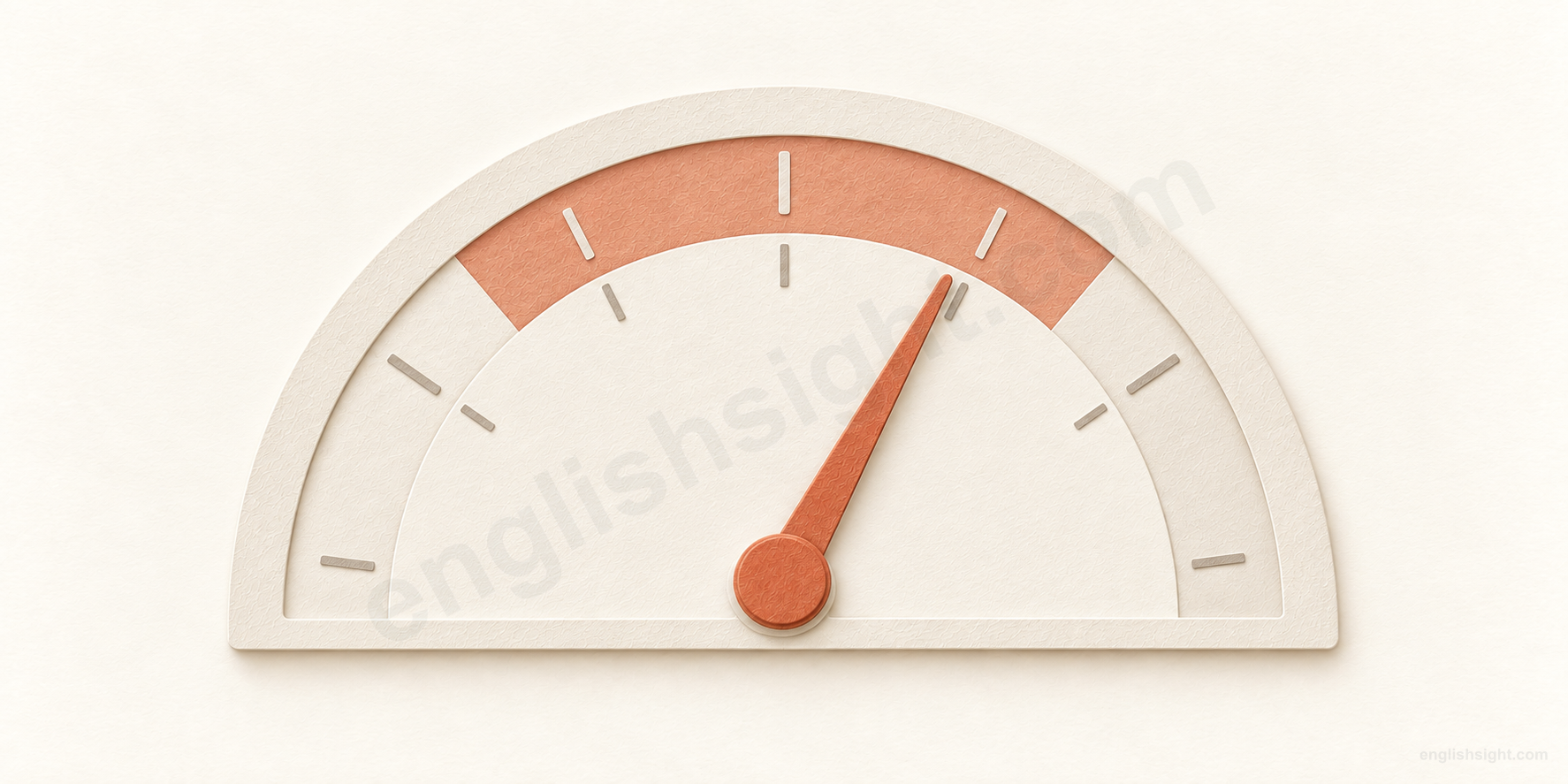
A highlighted band marks the expected range.
normal
The needle indicates a position within the band, away from its exact middle.
Compare the needle’s position with that band.
Normal fits the relevant expectation; it need not be one exact value. The gauge is a teaching model.
Normal describes something as fitting the usual or expected state, pattern, or range in the relevant context.
The diagram uses a range as a teaching metaphor. Many normal situations are not measurements, and the word need not mark a change over time.
Normal connects a situation with what is usual or expected for a particular person, place, time, or kind of thing. Always ask: normal compared with what?
It is mainly an adjective, but it also names a usual state or level in expressions such as back to normal and below normal. This lesson connects those uses without treating every technical meaning as the same idea.
01
What is usual here?
Describe an ordinary routine, identify the relevant person or setting, and talk about familiar reactions and behavior.
01
normal + noun; be / seem + normal
a normal day
a day that follows the familiar pattern
Situation / reference
You know the usual routine at your workplace.
Meaning / result
Today follows that routine without anything unusual.
Normal compares the situation with an expected pattern.
A normal day, a normal life, or normal office hours refers to the pattern people expect in that setting. Normal can come before a noun or after a linking verb: The opening hours are normal again.
Normal need not mean boring, perfect, or identical every time. A normal working day can contain small surprises while still fitting the familiar routine. The context supplies the reference.
In a sentence
On a normal day, I open the shop at nine and leave at six.
Watch the difference Normal does not itself mean morally right or especially good.
02
be normal for + person / place / age / period
normal for this time of year
expected for a particular setting or comparison group
Situation / reference
You are judging the weather in a particular season.
Meaning / result
You compare it with that season rather than every possible day.
For identifies the reference that makes the judgment meaningful.
Something can be normal for one place, season, person, or age and unusual for another. In normal for this time of year, for introduces the relevant comparison, not a purpose.
You can also make a personal baseline explicit: That is normal for me. This means it fits my own usual experience; it does not claim that everyone shares it. For her age similarly limits the comparison to an age group.
In a sentence
Cold mornings are normal for this time of year.
Watch the difference Do not leave out the comparison when it matters: normal here may be unusual somewhere else.
03
it is normal (for + person) to + verb; it is normal that + clause
It is normal to feel nervous.
a reaction is understandable or commonly expected
Situation / reference
A learner worries about speaking to a new group.
Meaning / result
You explain that such nervousness is an expected reaction.
The to-infinitive identifies what is being judged.
In It is normal to feel nervous, it introduces an assessment of feeling nervous. Add for someone when you need to identify who experiences or does the action: It is normal for new speakers to feel nervous.
Perfectly normal and completely normal strengthen the reassurance. Here perfectly means entirely, not flawlessly. A perfectly normal mistake can still need correcting.
Normal describes an expected reaction; the word alone does not establish that every degree of that reaction is harmless. In Is it normal that the screen flashes?, a that-clause presents the observed situation for someone to assess.
In a sentence
It is perfectly normal to feel nervous before your first presentation.
Watch the difference After for, use an object pronoun: normal for me to ask, not normal for I to ask.
04
be / feel / seem + (not) + possessive + normal self; feel like + possessive + normal self
not my normal self
different from my usual mood, energy, or behavior
Situation / reference
Someone knows how you usually behave.
Meaning / result
You explain that today you feel or act differently.
My normal self uses my own usual state as the reference.
I’m not my normal self today can explain why you are quieter, more tired, or less cheerful than usual. It concerns a temporary contrast with your own familiar behavior, rather than a change of identity.
You can say She seems more like her normal self or I feel like my normal self again when the familiar mood or energy returns. Match the possessive: my normal self, his normal self, their normal selves.
In a sentence
I’m not my normal self today; I hardly slept last night.
Watch the difference Not my normal self is a personal comparison, not a label for someone’s overall worth or identity.
02
Conditions, practices, and working states
Say what usually happens, what people regularly do, or whether something is in its expected condition.
05
normal + operation / results / condition; subject + look / sound / be + normal
normal operation / normal results
an expected working condition or finding
Situation / reference
You check whether an object or a result differs from the expected condition.
Meaning / result
You report that it fits the relevant reference.
Normal can evaluate a condition, not just how often an event occurs.
Normal operation describes the way a system is expected to work. Normal results or a normal temperature describe findings that fit the reference used in that context. They do not have to equal one single number.
Compare The engine sounds normal with The engine sounds loud. Normal is an adjective describing the engine’s apparent state. The report says the results are normal likewise describes the results, without saying how the report was written.
Dictionaries also record normal applied to a person’s health, meaning physically or mentally healthy. That broad wording can be imprecise or judgmental in conversation. When a specific fact is meant, name it: the results were normal or she feels well. Do not treat a normal result as a claim about every aspect of a person.
In a sentence
The engineer checked the pump and said its operation was normal.
Watch the difference Normal describes the relevant condition; it does not promise that a system can never fail.
06
under / in normal circumstances, + clause; in the normal course of events / things, + clause
under normal circumstances
if the usual conditions apply
Situation / reference
You know how a process usually works.
Meaning / result
You explain an expectation while allowing for an exceptional situation.
The conditions, rather than the person, are described as normal.
Under normal circumstances and in normal circumstances introduce what usually happens when there are no exceptional conditions. Under normal circumstances, we can deliver tomorrow leaves room for a strike or a breakdown to change that expectation.
In the normal course of events or in the normal course of things focuses on the usual way events develop. In the normal course of events, you will receive a reply next week describes the expected sequence, not a training course.
These phrases do not require would. We close at six under normal circumstances states a usual practice; Under normal circumstances, I would help can contrast that practice with the exceptional situation now.
In a sentence
Under normal circumstances, the repairs take two days, but this part is difficult to find.
Watch the difference Under normal circumstances means with the usual conditions, not underneath a physical object.
07
it is normal practice (for + person) to + verb
normal practice
the procedure people ordinarily follow
Situation / reference
A newcomer does not know a workplace’s routine.
Meaning / result
You explain what staff ordinarily do there.
Practice means an established way of doing things in this expression.
It is normal practice to do something presents an action as the established routine. The reference may be one organization or a wider profession; add a phrase such as in this office to make it clear.
It is normal practice for staff to check the doors names who carries out the action. Practice here is uncountable, so the basic pattern is It is normal practice, without a. Normal practice is a description of custom; a rule or legal requirement needs separate wording.
In a sentence
It is normal practice in this office to save a copy before sending a file.
Watch the difference Normal practice here means usual procedure, not an ordinary exercise session.
03
Keeping, recovering, or changing a baseline
Normal can name a usual state or level. Prepositions then express comparison, continuation, or a return; new can establish a different baseline.
08
be / get / go back to normal; return to normal
back to normal
in the familiar state again after a disruption
Situation / reference
A disruption changes how things usually work.
Meaning / result
The familiar state is restored.
Back and to supply the idea of returning; normal names the state.
Be back to normal describes a restored state. Get back to normal, go back to normal, and return to normal describe the return to it. The normal state itself may be uneventful; the construction adds the recovery story.
Compare The service is normal with The service is back to normal. Only the second explicitly looks back to a period when it was different. In return to normal, to is a preposition followed by the noun normal, not the start of a to-infinitive.
Use normal without the in this fixed expression. You can instead say return to the normal timetable, where the belongs to a noun phrase headed by timetable.
In a sentence
The trains are back to normal after yesterday’s power cut.
Watch the difference Say back to normal, not back to normally or back to the normal when no following noun is intended.
09
above / below / near normal; within the normal range; more / less than normal
above / below normal
higher or lower than the usual level
Situation / reference
You have a reference level for a place, time, or activity.
Meaning / result
You compare the current amount with that reference.
Normal is a noun naming the usual level; the preposition gives the comparison.
Above normal and below normal compare an amount with a usual level; normal is a noun here. Near normal means close to that level, while within the normal range explicitly allows a band of values. In the normal range, normal is an adjective describing range. State the reference when needed: below normal for October.
More than normal and less than normal can compare quantities or degrees too: We used less water than normal. Compare the adjective phrase a higher-than-normal bill, in which the whole comparison modifies bill.
A normal value and an average value can overlap, but they are not automatically identical. Average may name a calculated mean; normal concerns the reference expected in the context.
In a sentence
Rainfall was below normal for October, so the reservoir stayed low.
Watch the difference Below normal does not by itself mean below zero, and above normal does not automatically mean better.
10
continue / carry on / work + as normal; as per normal (informal)
as normal
in the usual way
Situation / reference
An unusual event could interrupt a routine.
Meaning / result
You say that the routine continues in its familiar way.
As normal describes how an activity continues.
Continue as normal, carry on as normal, and work as normal mean to continue in the usual way. Normal here belongs to an established expression; do not use bare normal as a general replacement for normally after every verb.
As per normal is an informal alternative meaning as usual. It can have a conversational or mildly complaining tone: The printer has jammed, as per normal. As normal is a simple choice for routine announcements.
Contrast continue as normal with return to normal. The first describes continuation; the second describes restoration after a change.
In a sentence
The library will stay open as normal while the roof is repaired.
Watch the difference As normal describes the manner or routine. As normal as compares degree: The room looks as normal as ever.
11
be / become + the new normal
the new normal
a formerly unusual situation that is now expected
Situation / reference
A situation used to be exceptional.
Meaning / result
It becomes the pattern people now expect.
New changes the reference itself rather than restoring the old one.
The new normal names a changed baseline: something once unusual has become the expected state. It appears in discussion of work, weather, prices, and other lasting changes.
The phrase does not mean that the change is good or that everyone welcomes it. Compare back to normal, which points toward a familiar earlier state, with the new normal, which treats a changed situation as the current reference.
In a sentence
For our team, working from two different cities has become the new normal.
Watch the difference A one-off surprise is not necessarily a new normal; the phrase presents it as an ongoing expectation.
04
Normal and normally
Choose an adjective for a state and an adverb for how or how often something happens.
You choose whether to describe a state or modify an action.
Meaning / result
You select the adjective or the adverb to fit the sentence.
The -ly form can describe usual frequency or the usual way of doing something.
Use normal to describe a noun or a subject’s state: a normal sound; The machine sounds normal. Use normally to modify an action: The machine normally starts at eight means that it usually starts then.
The machine is running normally means it is running in the expected way now. Normally therefore has both a usually reading and an in-the-usual-way reading; placement and context help distinguish them.
Normal can take perfectly, quite, fairly, more, or less when the context supports the degree: The town feels more normal now means it feels closer to its familiar state. More normal does not necessarily mean more frequent.
In a sentence
The printer normally starts quietly, but today it does not sound normal.
Watch the difference For the ordinary manner meaning, say The printer works normally, not The printer works normal.
Choose the reference and the grammar
Normal, usual, ordinary, typical, and average
These words overlap but answer different questions. My usual seat is the one I often choose; a normal seat fits what is expected of that kind of seat; an ordinary seat is unremarkable. A typical example represents its group. Average can refer to a calculated value. Context can make more than one choice natural.
Common does not automatically mean acceptable
Calling a practice normal may report a social expectation. It does not prove that the practice is fair or desirable. Calling a person not normal can sound like a dismissive judgment; describe the particular behavior or condition when that is what you mean.
Word forms and scope
Normal has no verb tense forms in this lesson and no phrasal-verb family. Normally is the related adverb; normality and normalcy name the state of being normal, and normalize is a separate verb. Technical meanings in geometry, statistics, chemistry, and laboratory science need their own definitions and are not predicted by this diagram.
Find the reference
Choose the expression that fits the situation and grammar.
1. You have always preferred an early lunch, although your friends eat later. Which sentence limits the claim to your own routine?
2. The buses stopped during repairs. They are now following their old timetable again. Which phrase describes the restoration?
3. Rainfall is below normal for June. What does that tell you?
4. The computer usually takes a minute to start. Which sentence states that usual pattern?
5. An arrangement once seemed unusual, but the team now expects it to continue. Which expression fits?
Sources and teaching notes
Dictionary sources support the uses and constructions below. The explanations, examples, and reference-range diagram were created for this lesson; the diagram is a teaching interpretation.
The diagram explains a relationship; it does not claim every speaker imagines the word in the same way.