From breathing and smelling to fronts, discovery, and familiar expressions.
A projecting part that helps us sense
A projecting part used to breathe and smell
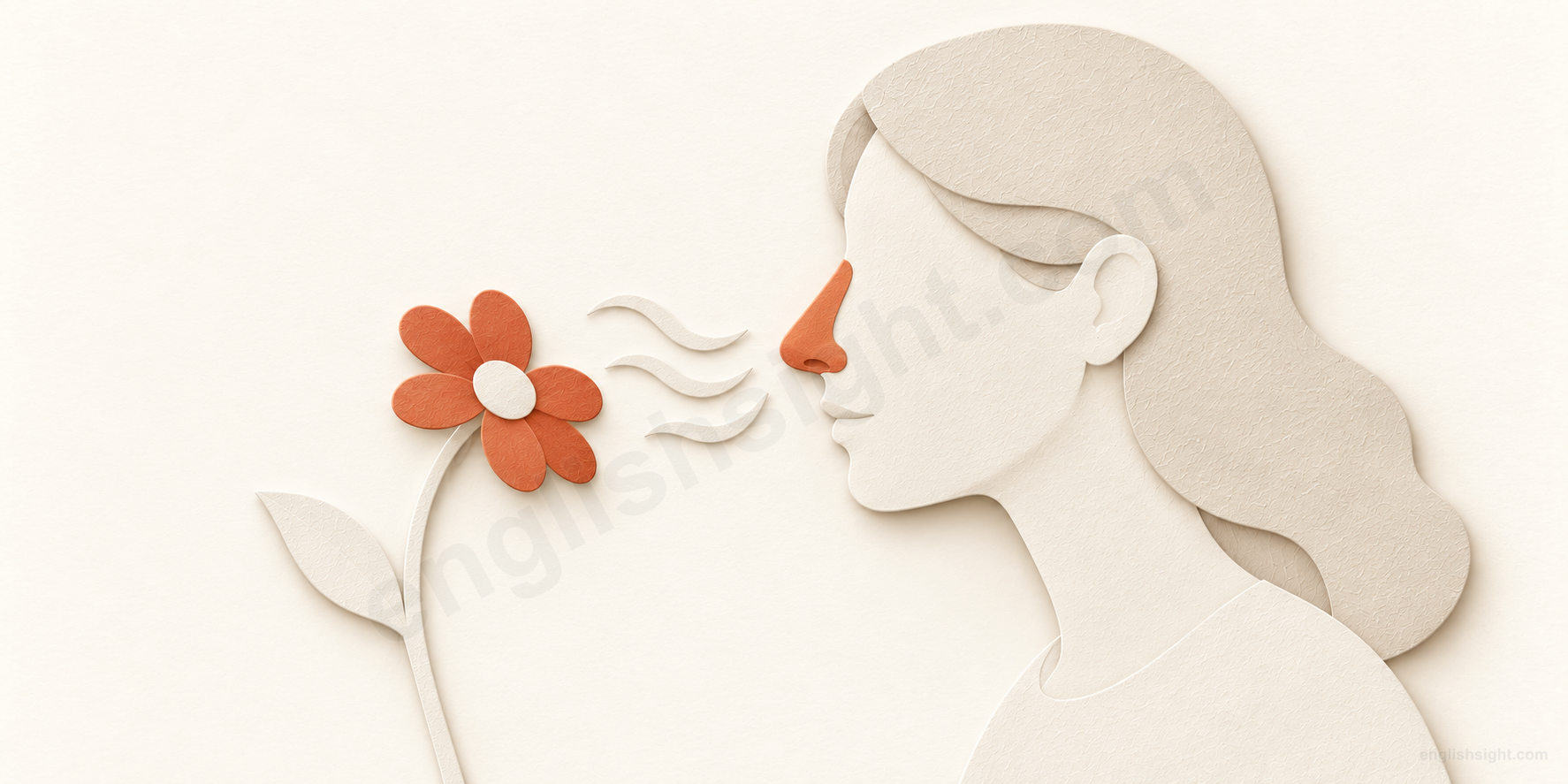
A nearby flower provides a scent source.
nose
The highlighted nose projects from the front of the face.
The person smells the flower with the nose.
The nose projects from the face and helps detect scent. The wavy strips are a teaching symbol for smell.
Nose names the projecting part of the face used for breathing and smelling; front position and scent detection help explain several extensions.
The drawing illustrates the body part and its sensory role. It is a teaching connection, not a single rule that generates every idiom.
Your nose projects from the front of your face and is used for breathing and smelling. These physical facts help connect a vehicle’s nose, an animal nosing a lid aside, and a person with a nose for good opportunities.
Other uses belong to established expressions. Paying through the nose is about an excessive price, not breathing or movement. Learn what the complete expression means and how its grammar works.
01
The body, breathing, and everyday care
Start with the actual body part. Verbs and adjectives tell us what happens to it or what someone does with it.
01
a / possessive + nose; breathe through + possessive + nose
a nose / your nose
the projecting body part used for breathing and smelling
Situation
You describe a face or an animal’s head.
Meaning in context
The listener identifies the body part.
A nose is a body part; a nostril is one of its openings.
Nose is countable: a small nose, two noses. With your own body, a possessive is ordinary: my nose, her nose. The bridge of the nose is the upper firm part where glasses can rest.
You breathe through your nose and can smell with it. Animals have noses too; snout often names a projecting nose-and-mouth area. Nose and knows sound alike, but knows is a form of know.
In compound adjectives, -nosed means having the kind of nose named: a red-nosed clown. This descriptive pattern does not explain separate words such as hard-nosed, which has an established figurative meaning.
In a sentence
My glasses keep sliding down my nose.
Watch the difference Use nose for the whole part, not for each of its two nostrils.
02
have a runny / blocked / stuffy nose; your nose is running
a runny / blocked nose
describe a nose that runs or feels obstructed
Situation
You explain how your cold feels.
Meaning in context
You distinguish flowing mucus from difficulty breathing through the nose.
Runny describes fluid coming out; blocked or stuffy describes obstruction.
I have a runny nose and My nose is running describe mucus flowing from the nose. Running here does not mean moving quickly. A blocked nose is also called a stuffy nose, especially in American English.
These descriptions may occur together. A bleeding nose means blood is coming from it; the event can also be called a nosebleed. The adjective describes a symptom, not the shape of the nose.
In a sentence
I have a blocked nose, so I sound different today.
Watch the difference Say a runny nose, not a running nose, as the usual adjective phrase for this symptom.
03
blow / wipe / pick + possessive + nose
blow / wipe / pick your nose
name different actions involving the nose
Situation
You need a tissue or are discussing a habit.
Meaning in context
The verb identifies the exact action.
Blow, wipe, and pick do different work.
Blow your nose means force air through it, usually into a tissue, to clear mucus. Wipe your nose means remove moisture from its outside with a tissue or cloth.
Pick your nose means use a finger to remove material from inside it. It is usually mentioned as an unwelcome habit. These are ordinary verb-plus-object combinations, not phrasal verbs.
In a sentence
Excuse me—I need to blow my nose.
Watch the difference Blow my nose does not mean blow air onto the outside of my nose.
04
hold / wrinkle + possessive + nose; hold your nose and + verb
hold / wrinkle your nose
react physically to a smell or express reluctance
Situation
A strong smell reaches you.
Meaning in context
You pinch your nose closed or tighten its skin in distaste.
The action may be literal; holding your nose also has a figurative use.
Hold your nose means pinch it shut, often to avoid an unpleasant smell. Wrinkle your nose means make small folds around it, often showing dislike or disgust.
Figuratively, hold your nose and do something means accept something you dislike: I held my nose and supported the compromise. No actual pinching is necessary in that use.
In a sentence
Maya wrinkled her nose at the smell of the old milk.
Watch the difference Holding your nose is different from holding your breath, although both can occur together.
02
Smell, discovery, and a projecting front
The noun can also name a sensory ability, a talent for discovery, or a vehicle’s front. These connections help memory without predicting every expression.
05
have a good / keen nose; a dog with a good nose
a good nose
a strong ability to detect smells
Situation
A dog is searching for a scent.
Meaning in context
It detects smells very effectively.
The organ can stand for the sensory ability.
A dog with a good nose has a good sense of smell. Good evaluates its ability, not whether its nose looks attractive. A keen nose likewise emphasizes sensitivity.
This use connects directly to smelling in the drawing. For a person, a good sense of smell is a clear neutral way to express the same sensory idea.
In a sentence
The rescue dog has a good nose and soon finds the hidden food.
Watch the difference A good nose can describe smell detection; a nose for a bargain is a figurative talent.
06
have a nose for + noun phrase
have a nose for something
be good at finding or recognizing something
Situation
Someone repeatedly finds valuable opportunities.
Meaning in context
Others recognize their talent for spotting them.
For introduces the type of thing the person is good at detecting.
Have a nose for a bargain means recognize good deals easily. News, talent, trouble, and promising opportunities can also be things someone detects in this way.
This is a figurative link to detecting a scent, not a claim about the person’s physical sense of smell. Use a noun phrase after for: a nose for talent, not a nose to talent.
In a sentence
Lena has a nose for bargains at second-hand shops.
Watch the difference Do not replace for with of when naming the talent: a nose for news.
07
the nose of + vehicle; a vehicle’s nose; nose to tail
the nose of a plane
the front or projecting end of a vehicle
Situation
You describe where a part is attached.
Meaning in context
The listener locates it at the vehicle’s front.
Position and projection connect this meaning with a face’s nose.
The nose of an aircraft is its front end. The same word can describe the front of a car or boat, particularly in descriptions of position or movement.
A plane’s nose points upward or downward; that direction need not equal its exact direction of travel. Nose to tail, especially in British traffic reports, describes vehicles moving slowly in a line, very close behind one another.
In a sentence
The plane’s nose pointed toward the terminal.
Watch the difference A vehicle’s nose is not its engine in every design; the word identifies the front part.
08
a wine with a + adjective + nose; the nose of a wine
a wine’s nose
the smell of a wine
Situation
A tasting note describes the wine’s aroma.
Meaning in context
The reader learns what it smells like.
Here nose names the wine’s smell, not the drinker’s body part.
In wine descriptions, nose means the characteristic aroma: a fruity nose or a nose of dark berries. This is tasting vocabulary rather than the usual word for every everyday smell.
The drinker uses a nose to smell; the wine has a nose in the aroma sense. That shift from organ to perceived smell is an established specialized use.
In a sentence
The tasting note describes the wine as having a fruity nose.
Watch the difference Do not routinely replace smell with nose for kitchens, clothes, or other everyday objects.
03
Using a nose, moving carefully, and searching
As a verb, nose can involve an animal’s nose, a vehicle’s front, or a person searching. Read the subject and object to choose the meaning.
09
nose + object; nose + object + open / aside
nose something open
touch, examine, or push with the nose
Situation
A dog approaches a partly closed lid.
Meaning in context
Its nose pushes the lid aside.
The animal’s nose is the instrument of the action.
An animal can nose your hand by touching or rubbing it with its nose. It can also nose a door open or nose a lid aside. The object receives the action; open or aside supplies the resulting state or direction.
Nose around can also describe an animal searching by smell. In The dog nosed the door open, open is a result complement, not evidence that every nose expression is a phrasal verb.
In a sentence
The dog nosed the lid aside and sniffed the box.
Watch the difference Touching with the nose need not push something open; the complement specifies that extra result.
10
vehicle + nose + direction; nose + vehicle + direction; nose its way + direction
nose forward / into a space
move a vehicle slowly and carefully, front first
Situation
A driver sees a small gap in traffic.
Meaning in context
The car moves cautiously into it.
The verb focuses on the front advancing cautiously.
A car can nose forward or nose into traffic. A person can also nose a car into a space. The first pattern has the vehicle as subject; the second names the vehicle as object.
Nose its way through traffic is another pattern for careful progress. A plane can nose up or down, directing its front upward or downward. These directional words add direction rather than a new meaning of discovery.
In a sentence
The driver nosed the van into the narrow parking space.
Watch the difference Nose into the garage with a car concerns movement; nose into someone’s affairs concerns intrusive curiosity.
11
nose around / about (for something); have a nose round
nose around / about
look around, especially for information
Situation
A visitor starts examining drawers and shelves.
Meaning in context
They search through the place, perhaps too curiously.
Around describes searching in an area, not a successful discovery.
Nose around for information describes looking for it, often with an intrusive or overly curious tone. Nose about is a variant, especially in British English. A location can follow: nosing around in the office.
The noun expression have a nose round means have a look around, informally in British English: I’ll have a nose round the market. It can sound casual and curious without necessarily accusing someone of wrongdoing.
In a sentence
Someone has been nosing around in my desk.
Watch the difference Searching is not the same as finding: nose around does not guarantee a result.
12
nose out + object; nose + object + out
nose something out
discover something by searching or detecting it
Situation
A reporter follows small clues.
Meaning in context
The search uncovers missing information.
Out adds the sense of bringing the discovery to light.
Informally, nose out information means discover it through searching, persistence, or curiosity. Animals can also nose something out by smell.
This phrasal verb is separable: nose out the details or nose the details out. A pronoun goes between: nose them out. Contrast nose around, which describes the search rather than its successful result.
In a sentence
After several calls, the reporter nosed out the missing details.
Watch the difference With a pronoun, say nose it out, not nose out it.
13
follow + possessive + nose
follow your nose
use smell, a straight route, or intuition as your guide
Situation
You need a guide to your next move.
Meaning in context
Context tells you whether the guide is scent, direction, or instinct.
This one expression has three readings; the situation decides.
Literally, follow your nose means follow a smell: Follow your nose to the bakery. In directions, Just follow your nose can mean continue straight ahead.
Figuratively, it means trust your own judgment rather than a fixed plan: When choosing the next experiment, I followed my nose. This intuition use connects to detection, but it does not involve an actual smell.
In a sentence
“How do I get to the bridge?” “Just follow your nose along this road.”
Watch the difference Do not assume the phrase always means trust your instinct; route and smell contexts have different readings.
04
Attention, privacy, and what is nearby
These expressions concern involvement and attention. Most keep nose as a noun inside a larger expression.
14
poke / stick your nose into + matter; keep your nose out of + matter
poke / stick your nose into something
interfere in a matter that is not your concern
Situation
Someone asks intrusive questions about a private decision.
Meaning in context
Their involvement is criticized as unwanted.
The intrusive interest belongs to the whole expression.
Poke your nose into someone’s business means involve yourself where you are not wanted. Stick your nose into is a common variant. Keep your nose out of something tells someone not to interfere.
Into marks involvement and out of marks staying uninvolved. These are idioms with nose as a noun. The verb pattern stop nosing into my affairs conveys a similar criticism.
In a sentence
Please keep your nose out of my private messages.
Watch the difference These expressions can sound sharp or rude; please does not make the accusation neutral.
15
(right) under + possessive + nose
under someone’s nose
very close or openly happening nearby, often unnoticed
Situation
You search for something or discover an overlooked activity.
Meaning in context
It turns out to have been close by all along.
Physical nearness contrasts with failed attention or ineffective supervision.
My keys were right under my nose means they were very close although I had missed them. It need not mean literally below my face.
The children copied answers under the teacher’s nose means they did it openly nearby, despite the teacher’s presence. Context may emphasize not noticing, failing to stop it, or bold defiance.
In a sentence
The note was right under my nose beside the keyboard.
Watch the difference Right intensifies nearness; it does not change the expression into a direction instruction.
16
have + possessive + nose in + reading material
have your nose in a book
be absorbed in reading
Situation
Someone concentrates on a book while others talk.
Meaning in context
Their attention stays on the reading.
The physical reading posture stands for focused attention.
Have your nose in a book means be reading with close attention. Book can be replaced by a particular reading source, such as a newspaper or a report.
The phrase need not mean the face actually touches the pages. It can suggest that the reader is ignoring surrounding people or events, though that criticism depends on context.
In a sentence
Even on the train, Karim has his nose in a book.
Watch the difference Having your nose in a book describes reading; poking your nose into someone’s business describes interference.
05
Disapproval, annoyance, and control
The whole expression carries the social judgment. A person’s real nose usually does not move or get hurt.
17
look down your nose at + person / thing; with your nose in the air
look down your nose at someone
treat someone or something as inferior
Situation
Someone dismisses another person’s background.
Meaning in context
Their behavior suggests that they consider themselves superior.
At introduces the target of the contempt.
Look down your nose at someone means show that you think you are better than them. A thing can also be the target: looking down your nose at inexpensive food.
With your nose in the air describes a similarly superior, unfriendly manner. These conventional posture images need not describe a measurable physical angle or a literal difference in height.
In a sentence
He looks down his nose at anyone who did not attend university.
Watch the difference Do not confuse this with physically looking down at something on the floor.
18
turn your nose up at / turn up your nose at + thing
turn your nose up at something
reject something because you consider it inadequate
Situation
Someone is offered a simple meal.
Meaning in context
They refuse it as if it is not good enough.
This expression focuses on rejection rather than merely an opinion.
Turn your nose up at an offer or a meal means refuse it dismissively. Turn up your nose at is also possible. The phrase commonly suggests fussiness or superiority.
Look down your nose at describes contempt; turn your nose up at emphasizes rejecting what is offered. Neither requires an actual movement of the nose.
In a sentence
Don’t turn your nose up at the smaller room; it has a lovely view.
Watch the difference Keep at before the thing rejected: turn your nose up at it.
19
person / thing + get up + possessive + nose
get up someone’s nose
annoy someone
Situation
A colleague keeps interrupting you.
Meaning in context
You find the habit irritating.
The person whose nose is named is the person who feels annoyed.
That gets up my nose means that annoys me. It is informal British English. The subject can be a person, a habit, or a situation.
This is an established idiom. Compare literal Water went up my nose, where water really enters the nose. Do not infer the annoyance meaning from any occurrence of up and nose.
In a sentence
His constant interruptions really get up my nose.
Watch the difference Use the affected person’s possessive: gets up her nose means annoys her.
20
put + possessive + nose out of joint; have your nose out of joint
put someone’s nose out of joint
upset or offend someone, often by taking attention away
Situation
An experienced worker feels overlooked when a newcomer receives praise.
Meaning in context
They feel offended or displaced.
Joint is part of the idiom; no physical injury is implied.
Put someone’s nose out of joint describes upsetting their pride or sense of importance. Being ignored or losing special attention is a typical context.
You can also say Her nose is out of joint to describe the resulting feeling. This is more specific than everyday annoy and should not be read as a medical description.
In a sentence
Praising the new assistant put Daniel’s nose out of joint.
Watch the difference A broken nose is a physical injury; a nose out of joint is normally an offended feeling.
21
rub + possessive + nose in it / in + failure
rub someone’s nose in it
unkindly keep reminding someone of a mistake or failure
Situation
Someone has already admitted a mistake.
Meaning in context
Another person brings it up repeatedly to embarrass them.
The reminder is deliberately unkind, not just useful feedback.
Rub someone’s nose in it means dwell on their failure in a humiliating way. It points back to the mistake or bad result. A noun can name it directly: rub his nose in his failure.
The picture suggested by the idiom is unpleasant, but ordinary figurative use does not mean physical contact. A single helpful correction is not automatically rubbing someone’s nose in it.
In a sentence
I know I lost the tickets; there’s no need to rub my nose in it.
Watch the difference It refers to the failure or mistake; it does not mean a place to put someone’s face.
22
thumb your nose at + target; lead + person + by the nose
thumb your nose at / lead someone by the nose
show defiance or exercise strong control
Situation
People respond to authority in different ways.
Meaning in context
One rejects its authority; another follows another person’s wishes.
The two idioms express different relationships to control.
Thumb your nose at someone or something means show disrespect or defiance: The firm thumbed its nose at the rules. It can also name a rude gesture made with the thumb against the nose.
Lead someone by the nose instead means control them and make them do what you want. In Don’t let them lead you by the nose, the listener is warned against being manipulated. Learn the full expressions separately.
In a sentence
The company thumbed its nose at the new regulations.
Watch the difference Thumb your nose at resists authority; lead someone by the nose describes controlling that person.
06
Money, work, accuracy, and narrow results
Learn these established expressions as complete units. Their meanings cannot reliably be calculated from nose alone.
23
pay through the nose (for + purchase)
pay through the nose
pay an excessively high price
Situation
An urgent purchase leaves you few alternatives.
Meaning in context
You spend much more than you think reasonable.
Through the nose belongs to a fixed money idiom.
Pay through the nose for something means pay far too much for it. The phrase comments negatively on the price; it does not specify a particular sum.
For introduces the purchase: pay through the nose for a ticket. You can omit it when the item is already understood: We paid through the nose.
In a sentence
We paid through the nose for a last-minute hotel room.
Watch the difference This is not a method of payment; do not interpret through literally.
24
keep + possessive + nose clean
keep your nose clean
avoid wrongdoing and trouble
Situation
Someone has a chance to avoid further trouble.
Meaning in context
They behave properly and obey the rules.
Clean refers figuratively to conduct, not physical hygiene.
Keep your nose clean is informal advice to stay out of trouble, especially by avoiding illegal or dishonest activity. It can also occur in less serious everyday advice about behaving properly.
Compare keep your nose out of this, which tells someone not to interfere. Clean concerns conduct; out of concerns involvement. Neither expression instructs someone to wash their face.
In a sentence
He has kept his nose clean since starting his new job.
Watch the difference The usual expression is keep your nose clean, not clean your nose, for this figurative meaning.
25
keep + possessive + nose to the grindstone
keep your nose to the grindstone
continue working hard and steadily
Situation
A difficult deadline requires sustained effort.
Meaning in context
Someone stays focused on the work.
Grindstone is part of a fixed work idiom.
Keep your nose to the grindstone means work hard for a sustained period. It often suggests persistence and limited distraction rather than a quick burst of effort.
This is figurative and informal. The full phrase supplies the work meaning; to does not mean an actual destination for the nose.
In a sentence
She kept her nose to the grindstone until the report was finished.
Watch the difference Do not confuse working hard with keeping your nose clean, which concerns avoiding wrongdoing.
26
time / amount + on the nose; be right on the nose
on the nose: exactly
exactly correct in time, amount, or calculation
Situation
You compare a figure with the actual total.
Meaning in context
They match exactly.
This informal use expresses precision, especially in North American English.
At ten on the nose means at exactly ten. A price or estimate can also be right on the nose: the amount is exactly correct.
The phrase adds precision, not an approximate guess. Contrast the separate critical meaning of too on the nose, which concerns a lack of subtlety rather than accurate timing.
In a sentence
The repair cost two hundred dollars on the nose.
Watch the difference Read the context: on the nose can also criticize something as too obvious.
27
be (too / a bit) on the nose; be as plain as the nose on your face
too on the nose
so direct or obvious that it lacks subtlety
Situation
A story states its message very explicitly.
Meaning in context
A reader finds the treatment heavy-handed.
The criticism is about obviousness, not a wrong calculation.
Dialogue that is too on the nose states the intended idea or emotion too directly. This use occurs particularly in criticism of writing, images, and symbolism.
The simpler phrase as plain as the nose on your face means very obvious. That idiom need not criticize artistic subtlety; it can simply emphasize that something is easy to see or understand.
In a sentence
The final speech was too on the nose; it explained every feeling.
Watch the difference Too on the nose is not a complaint that the speech happened too precisely on time.
28
win / lose by a nose; nose + competitor + out; nose out + competitor; competitor + nose ahead
win by a nose / nose someone out
win or defeat someone by a very small margin
Situation
Two competitors finish almost together.
Meaning in context
One wins only narrowly.
The noun expression and verb expression describe the narrow result.
Win by a nose is especially associated with horse racing, where a tiny distance separates the horses. It can also be used figuratively for a narrow victory.
Informal nose someone out means narrowly beat them: Lee nosed Pat out in the final vote. A passive is possible: Pat was nosed out by Lee. Compare nose out the facts, where the object is information and the meaning is discovery.
Nose ahead means move into a slight lead: Halfway through the race, Kim nosed ahead. Unlike winning by a nose, this does not mean the race is over or that Kim will win. Ahead marks the leading position; out in nose a rival out belongs to the separate defeat expression.
In a sentence
Our candidate nosed her rival out by just two votes.
Watch the difference An information object suggests discovery; a competitor as object suggests narrow defeat.
29
cut off + possessive + nose to spite + possessive + face
cut off your nose to spite your face
harm yourself through an angry attempt to punish someone else
Situation
Someone refuses a useful offer out of resentment.
Meaning in context
Their attempt at revenge leaves them worse off too.
The idiom emphasizes self-defeating anger.
Cut off your nose to spite your face warns that a reaction intended to hurt someone else also harms your own interests. It is an informal fixed saying, not an instruction to injure yourself.
For example, refusing a free trip solely because you dislike the organizer may deprive you of something you want. The whole saying carries this judgment; nose alone does not mean self-sabotage.
In a sentence
Walking home in the rain just to spite the friend who offered a lift would be cutting off your nose to spite your face.
Watch the difference Use this for a self-defeating reaction, not for every ordinary mistake.
30
it’s no skin off + possessive + nose (if + clause)
it’s no skin off my nose
it does not harm or concern me personally
Situation
Someone chooses a plan you do not prefer.
Meaning in context
You say their choice makes no practical difference to you.
The idiom states that you suffer no loss.
It’s no skin off my nose means the matter does not negatively affect me, so I am not bothered by it. It is informal and can sound indifferent or dismissive.
The possessive can change: no skin off her nose means she is unaffected. This is a fixed expression about personal consequences, not an account of an actual injury.
In a sentence
It’s no skin off my nose if they choose another restaurant.
Watch the difference It does not mean nobody else is affected; the claim concerns the person named.
Start with the body, then read the whole phrase
Forms and grammar
The noun plural is noses. Verb forms are nose, noses, nosed, nosing; drop the final e before -ing. The verb can be intransitive or transitive: The boat nosed forward; she nosed the boat forward. Progressive and passive forms are possible when the action or pattern allows them.
Nose is not the ordinary verb for every act of smelling
Say I smell coffee or I sniffed the flowers in everyday contexts. Nose as a verb is more specific: an animal touches or searches, a vehicle moves cautiously, or a person searches for information.
Read the grammar before assigning a label
Blow your nose is a verb with a noun object. Nose something out is a separable phrasal verb. Nose into a space can describe directional movement; poking your nose into someone’s affairs is an idiom about interference.
Scope
This lesson covers useful modern senses and recognizable expressions, not every specialist, historical, slang, or regional use. Nose job and nose ring are separate compound nouns; specialized tool parts, wine-testing occupations, and regional betting slang are not expanded here.
Choose the meaning in context
Use the subject, the object, and the complete expression to decide.
1. “She has a nose for bargains.” What does this tell us?
2. “The boat nosed into the narrow channel.” What happened?
3. “The reporter found the secret.” Which pronoun pattern is natural?
4. You searched for your keys, then found them beside your hand. Which comment fits?
5. A critic says, “The dialogue is too on the nose.” What is the criticism?
6. Someone keeps interfering in your private plans. Which request addresses that?
Sources and teaching notes
The sources below support the senses and constructions. Explanations and example sentences are original; the drawing is a teaching model.
The drawing connects a body part with its sensory role; it does not describe a picture shared by every English speaker.