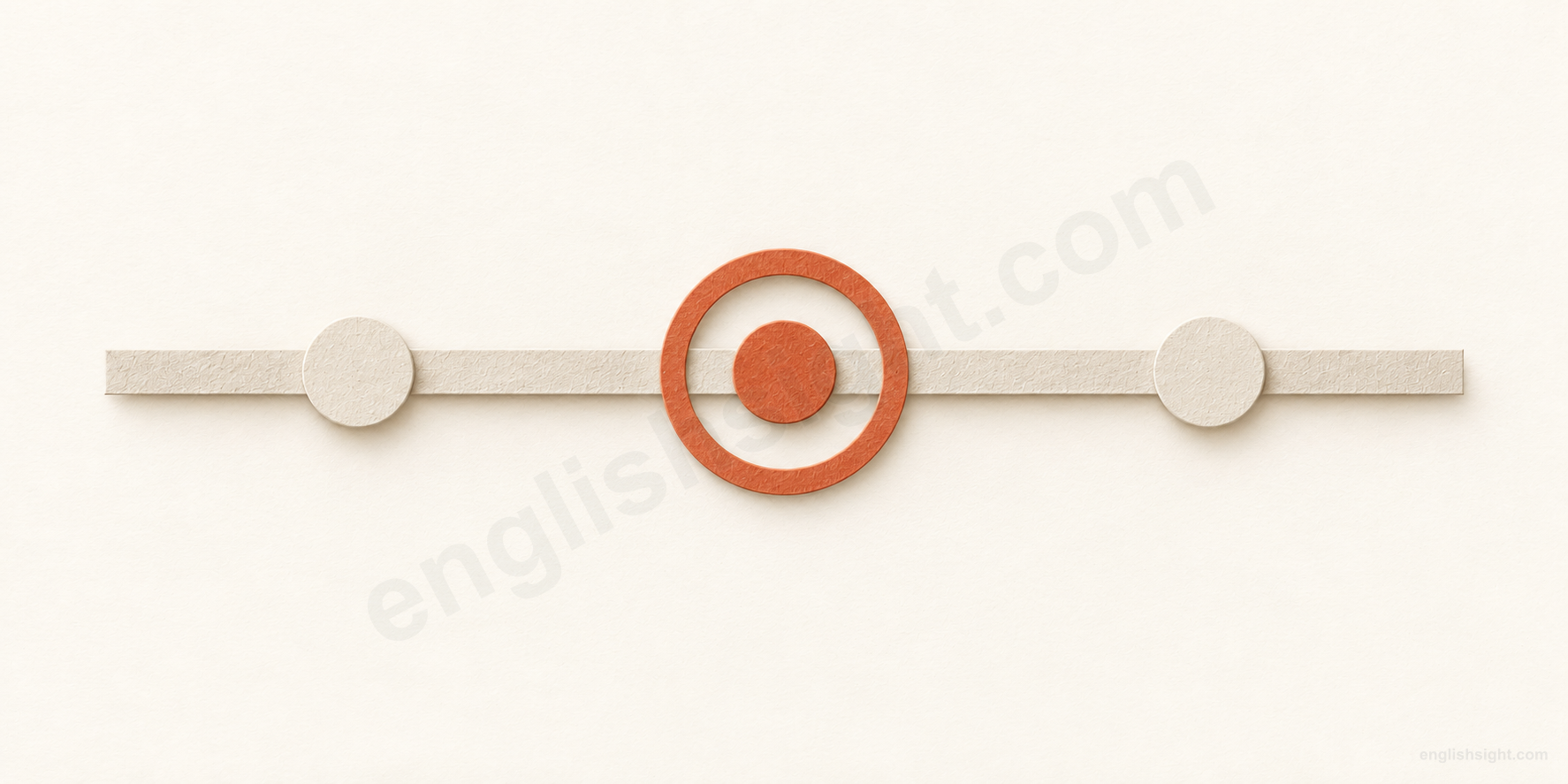
Find the present moment, set its boundaries, and notice how now guides a conversation.
Bring the current point into focus
Bring the current point into focus
The muted left marker represents an earlier time.
now
The muted right marker represents a later time.
The orange center disk and ring bring the current time into focus.
Now highlights the time treated as current, between earlier and later.
Now directs attention to the time treated as current, against earlier and later possibilities.
The highlighted point can stand for a moment or a wider current period. In conversation, now can guide attention to the next relevant step. Fixed expressions still need their own explanations.
Now /naʊ/ usually directs attention to the time treated as current. That can be a single instant or a wider present period; a story can also make an earlier moment feel current within its own viewpoint.
This lesson connects time uses with familiar constructions, then treats conversational signals and fixed expressions in their own terms. A highlighted current point is a teaching model, not a picture that every speaker necessarily sees.
01
The time in focus
Now points to the time treated as current. That may be this instant, a wider present period, or the current point inside a story.
01
clause + now; now + clause; not now
now / not now
at the current time or during the current period
Situation / context
Someone asks where you work.
What the expression conveys
You describe your present situation.
The context sets how wide the present period is.
I work at home now may describe your current working arrangement over many months. I’m answering a call now describes an activity in progress at this moment. Now does not select a tense by itself.
Not now declines or postpones something at the present time; it need not mean never. Nowadays usually concerns life in the present era or a current habit, so it would sound odd in a request to pass something immediately.
In a sentence
I work at home now, but last year I worked in an office.
Watch the difference Use a simple form for a state: I know now is natural; I am knowing now is not the ordinary form.
02
verb + now / right now; clause + right now
do it now / right now
act without delay; emphasize the present moment
Situation / context
A decision cannot wait.
What the expression conveys
You ask for action immediately.
Right strengthens the time focus; the sentence supplies the action.
Send it now asks for action at once. Right now can strengthen that urgency: Send it right now. A direct command may sound forceful, so the relationship and tone matter.
Right now also describes a current situation without issuing an order: I’m on the train right now. Compare I’ll call you now, an immediate intention, with I’m calling you now, an action presented as happening.
In a sentence
Please save the file right now before the battery runs out.
Watch the difference Right now is not always an urgent command: I’m busy right now simply reports a present situation.
03
now + clause; subject + now + verb
now I understand
the present situation after a change
Situation / context
A friend explains the missing step.
What the expression conveys
The problem becomes clear.
Now can contrast an earlier state with the situation that holds after an event.
I understand now often suggests that I did not understand before. The explanation in the context supplies the reason; now itself marks the updated situation.
A reaction such as Now we’ll have to walk presents a consequence of what has happened. It may express frustration, but annoyance comes from the situation and tone rather than from every occurrence of now.
In a sentence
The diagram shows the missing step; now I understand the answer.
Watch the difference Now we’ll have to walk can concern the near future; now need not force the following verb into present tense.
04
present perfect + for + duration + now; it is + duration + now + since + past clause
for two years now
a duration extending to the present
Situation / context
A course began two years ago.
What the expression conveys
The speaker is still taking the course.
For supplies the length; now emphasizes its current endpoint.
We’ve studied together for two years now looks back over an interval ending at the present. The present perfect helps connect that past beginning with the current situation.
It’s three weeks now since we repaired the door is another way to measure elapsed time. Do not confuse a length ending now with a length starting now: two years from now points into the future.
In a sentence
We’ve studied together for two years now.
Watch the difference For two years now does not mean two years later; two years from now does.
05
past-tense clause containing now; now + description, now + description
now in a past story
at the point currently reached in an account
Situation / context
A story moves from the journey to the arrival.
What the expression conveys
The reader views the next scene from that point.
The story can supply a temporary present viewpoint.
In past-tense narration, now can mean at that stage of the story. In The village was now silent, silence belongs to the narrated time, not necessarily the moment of speaking. Then is often the neutral alternative when simply placing an event in the past.
The patterned sequence now X, now Y describes alternation: The light flickered, now bright, now dim. It is more literary than ordinary conversation; it does not place both states at exactly the same instant.
In a sentence
They reached the village at midnight. The streets were now silent.
Watch the difference Do not mechanically change a story’s verbs to present tense because you see now.
06
now + is + noun phrase; between now and + time; duration + from now
now is the time
treat the present as the time or opportunity being discussed
Situation / context
You have been waiting for an opportunity.
What the expression conveys
You identify this moment as suitable.
Now can occupy a noun-like position rather than modify an action.
In Now is the time to ask, now is the subject: this moment is the suitable time. In between now and Friday, now is one endpoint of an interval; Friday is the other.
Dictionaries differ in labels: Collins COBUILD calls subject uses a pronoun, while its general dictionaries include a noun entry. Learn the sentence role without assuming now is a verb or needs an article.
In a sentence
Now is a good time to ask about the timetable.
Watch the difference Say three days from now for three days later; three days now does not express that relation.
02
Looking back, starting here, or waiting
Just, by, until, for, from, and on change the relation to the current time. Learn the whole expression rather than giving every combination the same translation.
07
past-tense event + just now
just now: a moment ago
very shortly before the present
Situation / context
A caller has just ended a call.
What the expression conveys
You report the recent event.
With a completed past event, just now points slightly backward.
The courier called just now places the call a very short time before speaking. The simple past is natural here; the interval need not be measured in exact seconds.
Contrast The courier is here just now, which can mean currently present, especially in British usage. Use the verb and the situation to decide which reading is intended.
In a sentence
Maya called just now and left a message for you.
Watch the difference Do not translate every just now as at this moment; a completed past event normally points to a moment ago.
08
present state + just now
just now: at present
during the present moment or period
Situation / context
Someone asks to speak to you.
What the expression conveys
You explain that you are currently occupied.
A present state can make just now mean at present.
I’m busy just now means I am busy at present; it leaves open whether the situation will change. This reading is particularly familiar in British English.
In informal South African English, just now can instead mean in a little while. That regional future reading is not a safe assumption for an international listener; later or in a few minutes is clearer when arranging a time.
In a sentence
I can’t discuss the plan just now; can we talk after lunch?
Watch the difference For unambiguous international wording, use right now for the current moment and a moment ago for the recent past.
09
by now + clause; should + be + complement + by now; should + have + past participle + by now
by now
at or before this point, often with an expected result
Situation / context
Enough time has passed for a train journey.
What the expression conveys
You expect the travelers to have arrived.
By treats the present as a deadline or checkpoint.
They should be home by now says their arrival is expected to be complete at this point. It is an expectation, not proof that they arrived.
By now, we know the routine describes knowledge already established at the present checkpoint. Compare until now, which looks over the preceding interval rather than mainly checking whether a result has been reached.
In a sentence
The train left at eight, so they should be home by now.
Watch the difference By now does not mean from this moment onward; that is from now on.
10
until / till / up to / up till / up until + now
until now / up to now
over the period ending at the present
Situation / context
A situation held throughout the earlier period.
What the expression conveys
You describe its history and possibly introduce a change.
Until and up to frame an interval with now as its endpoint.
Up to now, we’ve had no complaints reports the record so far. It does not guarantee what will happen next. Up till now and up until now are common alternatives.
Until now often highlights a contrast: Until now, I had no reason to doubt her suggests that a new reason has appeared. Whether the situation actually changes must be read from context.
In a sentence
Up to now, we’ve had no complaints about the new timetable.
Watch the difference Until now is backward-looking; from now on starts at the present and looks forward.
11
clause + for now; for now, + clause
for now / for the moment
temporarily, with a later decision left open
Situation / context
You need a place to put a box.
What the expression conveys
You choose a temporary arrangement.
For now limits how long an arrangement is being accepted.
Leave it here for now means this location is acceptable at present, though we may change it. Plain Leave it here now instead stresses the time of putting it there.
That’s all for now closes a conversation or update without making it final forever. Bye for now similarly treats the farewell as temporary; no exact next meeting time is promised.
In a sentence
Leave the box beside the door for now; we’ll find a shelf later.
Watch the difference For now is temporary duration. Now for introduces what comes next; reversing the words changes the function.
12
from now on + clause; duration + from now
from now on / from now
beginning at the present and continuing forward
Situation / context
A group changes its meeting place.
What the expression conveys
The new arrangement applies to future meetings.
From marks the starting point; on emphasizes continuation.
From now on, we’ll meet downstairs introduces an arrangement that starts now and applies afterward. It can be a rule, promise, or changed habit, not only a prediction.
From now without on also marks a starting point: Count ten minutes from now. In a week from now, the measured interval places something one week later. Compare for now, which presents an arrangement as temporary.
In a sentence
From now on, please put the date on every file.
Watch the difference On belongs after now in this expression: from now on, not from on now.
13
event verb + any minute / moment / day / time + now
any minute / moment / day now
expected very soon, without an exact time
Situation / context
You are waiting for a delivery.
What the expression conveys
You expect its arrival soon.
The whole expression describes an approaching event.
The taxi should arrive any minute now predicts a very near arrival. Any day now uses a wider scale, as when waiting for exam results or a baby’s birth.
Any time now is also possible. Any does not mean that a random distant date is equally likely here; the expression conveys an expectation of nearness, not a guaranteed deadline.
In a sentence
The taxi should arrive any minute now, so keep your bag ready.
Watch the difference Do not use any day now as a precise appointment date.
03
New circumstances and the next conversational step
Now can introduce a reason, organize a conversation, or respond to a difficulty. These uses depend on clauses, context, and tone.
14
now (that) + clause, main clause; main clause + now (that) + clause
now (that)…
because a situation has become true or is now relevant
Situation / context
The rain has stopped.
What the expression conveys
You suggest an activity made possible by that fact.
The now-clause supplies a current reason, not just a time label.
Now that the rain has stopped, we can eat outside presents the changed weather as the reason for the suggestion. That can be omitted: Now the rain has stopped, we can eat outside.
The conjunction takes a clause with its own subject and verb. It differs from now + an independent sentence used simply to date an action. Past narration is possible too: Now that the rain had stopped, they went outside.
In a sentence
Now that the rain has stopped, we can eat outside.
Watch the difference Say now that you are here, not now that your arrival. Do not add because before the same reason clause.
15
now, + clause / imperative; now then, + question
Now, let’s… / now then
get attention, move the conversation on, or prepare a response
Situation / context
A group has finished one discussion.
What the expression conveys
You guide everyone to the next step.
This now organizes attention rather than setting a clock time.
Now, let’s check the total signals a transition in a shared activity. Now then, who needs a copy? can introduce an offer or practical question.
Now, let me think buys a moment to formulate a response. In Now listen carefully or Come on now, now can also strengthen an instruction or appeal. A comma often marks a spoken pause, but tone and context decide the force.
In a sentence
Now, let’s check the total before we send the bill.
Watch the difference Do not assume every sentence beginning with now is about immediate timing; it may manage the conversation.
introduce relevant background or a contrasting point
Situation / context
A listener has heard part of a story.
What the expression conveys
You add a detail needed to understand it.
Now can mark a turn in the explanation itself.
After saying that Lina chose a noisy hotel, a speaker might add Now, Lina usually hates noise. That gives relevant background and creates a contrast; it does not say her dislike began at this instant.
Similarly, Now, I would choose the smaller room can introduce the speaker’s contrasting opinion. The following statement supplies the information or disagreement; now helps position it in the conversation.
In a sentence
Lina booked the room above the café. Now, she usually avoids noisy places.
Watch the difference Read the whole context before interpreting now as a change in someone’s habits.
17
(and) now for + noun phrase
now for…
announce the next subject or activity
Situation / context
The main part of a meal is finished.
What the expression conveys
You announce dessert as the next part.
Now for points the audience toward what comes next.
Now for dessert! is a short announcement, with a noun phrase after for. It can introduce the next item in a presentation, a task, or an enjoyable activity.
Compare Dessert is enough for now: for now makes a temporary judgment. The order now for announces a transition; it is not a verb with a separable particle.
In a sentence
And now for dessert: baked apples with cream.
Watch the difference Use a noun phrase after for: Now for the next question, rather than Now for we ask a question.
18
now what?; what is it now?; what + clause + now?
Now what? / What is it now?
ask for the next step or react to another interruption
Situation / context
A planned route is blocked.
What the expression conveys
You ask what to do next.
The same time word can accompany uncertainty or irritation.
The road is closed. Now what? asks how to proceed in the new situation. It can be a genuine request for a next step rather than a complaint.
When someone repeatedly interrupts, Now what? or What is it now? can instead sound annoyed. What do you want now? may have the same effect. These are informal reactions, and a softer What can I help with? is often better in service situations.
In a sentence
The road is closed, and the other route is flooded. Now what?
Watch the difference Tone and context distinguish a practical next-step question from an irritated response.
04
Established expressions
Some familiar combinations have meanings that need to be learned together. A highlighted present moment alone cannot predict them.
19
(every) now and then / again + clause; clause + (every) now and then / again
(every) now and then / again
occasionally, without a fixed schedule
Situation / context
You usually take the bus.
What the expression conveys
You mention an occasional walk instead.
This is a frequency expression, not two named times.
Now and then and now and again both mean occasionally. Every can strengthen the familiar pattern without making it a regular timetable: every now and then.
The phrase can appear before or after the main clause. Contrast every Friday, which gives a regular day, and from now on, which introduces a continuing future arrangement.
In a sentence
Every now and then, I walk home instead of taking the bus.
Watch the difference Do not interpret then here as one particular later moment; learn now and then as a unit.
Repeated now is an interpersonal response, not a repeated time instruction.
Now, now, we can fix it can reassure someone who is distressed. Now, now, no arguing can mildly disapprove of behavior. Now then can also introduce a gentle warning.
These expressions are especially natural with someone you know or a child. With an adult stranger, the same wording can feel patronizing; a supportive full sentence may be more appropriate.
In a sentence
Now, now, one mistake doesn’t mean you’ve failed.
Watch the difference Do not confuse repeated Now, now with the regional hyphenated word now-now, which has its own time use.
21
(it is) now or never
It’s now or never
this is the last available opportunity
Situation / context
Registration closes in a few minutes.
What the expression conveys
You urge a decision before the chance is lost.
Never makes the contrast about losing the opportunity.
It’s now or never presents the current moment as the final chance to act. It can be a literal deadline or a dramatic way to urge someone to take an opportunity.
The phrase does not prove that no similar chance will ever exist. Its force depends on the situation, so do not treat it as a neutral way to suggest an activity at any convenient time.
In a sentence
Registration closes in five minutes. It’s now or never if you want to join this course.
Watch the difference Now and then means occasionally; now or never presents an urgent either/or choice.
22
now you are talking!
Now you’re talking!
enthusiastically approve of a suggestion
Situation / context
Someone suggests an ordinary activity, then a much better one.
What the expression conveys
You warmly approve the improved suggestion.
The full expression signals approval, not merely speech in progress.
When a friend suggests a picnic by the lake, Now you’re talking! can mean that is a very appealing idea. The phrase is informal and enthusiastic.
The progressive form is part of this familiar response. In a different context, You’re talking now may simply describe someone speaking; the idiomatic response needs a suggestion or similar proposal to approve.
In a sentence
“We could spend the afternoon by the lake.” “Now you’re talking!”
Watch the difference This is not a general correction telling a silent person to speak.
23
the here and now; verb + here and now
the here and now / here and now
the present situation; immediately at this point
Situation / context
You are worrying about distant possibilities.
What the expression conveys
You return attention to the present situation.
Here adds the current situation or place to the present-time focus.
The here and now names present life or current circumstances: focus on the here and now. The article the belongs to that noun phrase, not to ordinary adverbial now.
Without the article, settle it here and now means settle it in the present situation without delay. The phrase can stress immediacy even when the exact physical location is not the main issue.
In a sentence
Let’s focus on the here and now and decide what we can do today.
Watch the difference Do not add the before now in ordinary timing expressions such as Do it now.
24
even now, + clause; subject + be + even now + -ing
even now
despite what has happened; at this very moment
Situation / context
Several repairs have been attempted.
What the expression conveys
The fault still remains.
Even adds surprise or persistence against an expectation.
Even now, the door won’t close suggests that, despite the repairs, the problem remains. The facts about what has happened create the expectation that it should be fixed.
In formal writing, even now can instead emphasize the exact present moment: The engineers are even now testing the bridge. Context distinguishes persistence despite events from this formal timing use.
In a sentence
We’ve replaced the lock twice, but even now the door won’t close.
Watch the difference Even now is not interchangeable with every now and then: one concerns the present, the other occasional frequency.
Keep time, grammar, and tone separate
Now is not a tense instruction
I know now, I’m working now, and Now we’ll have to wait are all natural in suitable contexts. The verb describes the state, activity, or future consequence; now places it in the current situation. In stories, the current viewpoint can be in the past.
Position can change the emphasis
She now works here neutrally highlights a changed situation. Now, let’s begin often marks a conversational transition. Sentence-final now often emphasizes timing. These are useful tendencies, not absolute rules; pauses, stress, and context matter.
Learn the whole combination
By now checks a result at this point; until now looks back over the period ending here; from now on looks forward; for now leaves a temporary arrangement open to change. The prepositions and on contribute these differences.
Scope and word classes
This lesson covers the everyday adverb, now (that) as a conjunction, noun-like time expressions, discourse functions, and selected established idioms. Now does not inflect as a verb and has no passive, causative, or phrasal-verb paradigm. The informal adjective meaning fashionable, abbreviations spelled NOW, and regional now-now are outside the expanded scope.
Choose the meaning in context
Use the whole expression and the situation to decide.
1. You accept a temporary place for a box and may move it later. Which wording fits?
2. Maya called a moment ago and has already hung up. Which report fits?
3. The journey normally takes one hour, and the travelers left two hours ago. You expect them to have arrived. Which fits?
4. The rain has stopped, making an outdoor meal possible. Which sentence gives that current reason?
5. A friend suggests an activity you really like. What does “Now you’re talking!” communicate?
Sources and teaching notes
The linked dictionary entries support the usage inventory. Explanations and examples are original; the time-line model is a teaching interpretation. Dictionary labels and scope differences are recorded in the coverage notes.
The diagram is a memory aid; speakers do not all share a single mental picture.