Separate food and fasteners, then learn the whole expressions used for enthusiasm, reactions, and difficult problems.
The shell and what it encloses
The shell and what it encloses
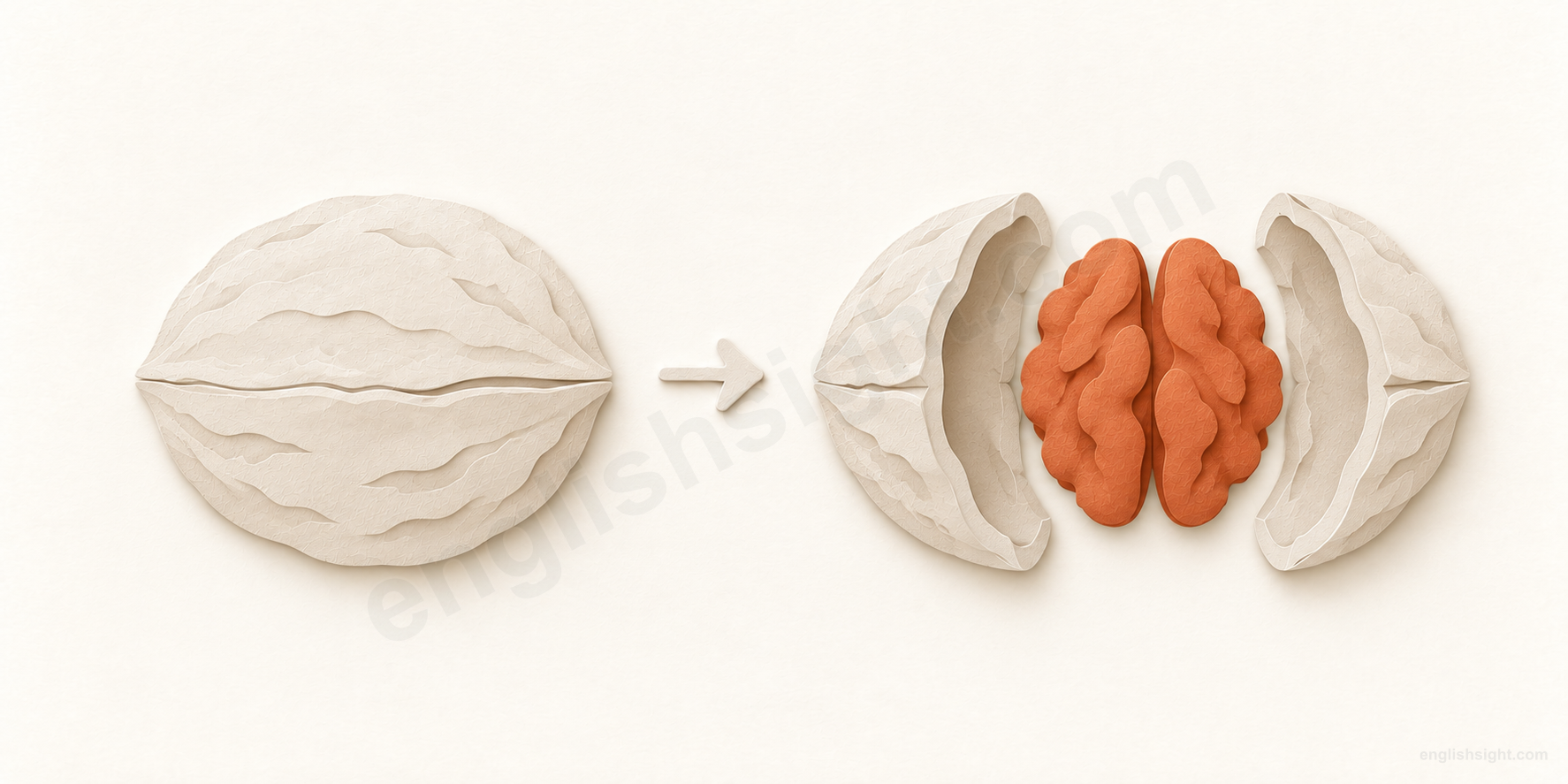
The kernel is hidden inside a hard walnut shell.
nut
The edible kernel is exposed between the shell halves.
The shell is cracked open and its two halves separate.
Cracking the hard shell reveals the kernel. This helps illustrate a hard nut to crack; the other meanings need their own explanations.
A food nut has a hard outer shell around an inner kernel; cracking the shell exposes the kernel.
This object-and-opening model supports the food sense and the metaphor of a hard nut to crack. It does not explain every fastener, enthusiast, or slang use; those branches need their own patterns.
In a food context, a nut can mean the whole thing with its shell or the part we eat. In a toolbox, a nut is a threaded fastener. The surrounding words tell you which branch you need.
The hard shell makes a useful teaching connection with a problem that is hard to crack. Other meanings and idioms need their own explanations; one picture cannot predict them all.
01
Food and useful objects
Begin with the two concrete nouns. Check whether the setting is a kitchen or a piece of equipment.
01
a nut; nuts; nut + noun; allergic to nuts
a nut / nuts
a hard-shelled food item or its edible inner part
Situation
You describe a bowl of snacks.
What is meant
The bowl contains edible nuts, without their shells.
Nut can name the whole item or the kernel used as food.
Use a nut for one item and nuts for more than one. A bowl of nuts need not contain shells: the edible kernels are also called nuts. Roasted nuts and chopped nuts describe preparation.
Everyday food usage includes items such as almonds and peanuts; it is not identical to the strict botanical category. Nut allergy is a noun compound, and allergic to nuts uses to: I am allergic to nuts. These expressions name a condition rather than explain how to manage it.
In a sentence
There are chopped nuts in this cake.
Watch the difference A nut allergy has singular nut before allergy; avoid a nuts allergy.
02
crack a nut; shell nuts; nuts in their shells
crack / shell a nut
open the hard covering or remove it
Situation
A nut still has its shell.
What is meant
You open the shell and take out the kernel.
Crack acts on the covering; shell names removing the covering.
Crack a nut means break its shell open. Shell nuts means remove the shells. A nutcracker is a tool for opening them; cracked does not necessarily mean the kernel has already been removed.
This is the literal opening relationship in the diagram. Crack is the verb and a nut is its object; it is not a phrasal verb. In She shelled the nuts, shell is a verb, while in The shell is hard it is a noun.
In a sentence
We cracked the nuts and took out the kernels.
Watch the difference Do not use peel as an automatic replacement for shell; shell specifies removing a shell.
03
tighten / loosen / undo a nut; screw a nut onto a bolt
tighten a nut
secure a threaded fastener
Situation
A bolt passes through two pieces of a chair.
What is meant
A nut screws onto it to help hold the pieces together.
A nut has an internal thread that fits a bolt.
In repairs, a nut is a small part with a threaded hole. The bolt is the shaft it fits onto; the nut is not the bolt itself. Tighten a nut secures it, while loosen or undo a nut releases it.
A wheel nut or lug nut is used at a wheel; a wing nut has projections that make it easier to turn by hand. Learn this concrete branch separately from the food diagram. Nuts and bolts can name actual hardware before the phrase takes an idiomatic meaning.
In a sentence
Tighten the nut on the end of this bolt.
Watch the difference A washer is a separate ring, usually without the internal screw thread of a nut.
02
Interests and strong reactions
Informal noun and adjective patterns express different things. The article, the final -s, and words such as about and drive matter.
04
a / an + interest + nut
a music / fitness nut
a person intensely interested in something
Situation
A friend spends much of her free time exploring new music.
What is meant
You describe her as an enthusiastic music fan.
The activity before nut tells us what the person loves.
A music nut is a very enthusiastic music fan. The informal countable noun needs an article with a singular person: She is a music nut. Compare two fitness nuts, where the final noun takes the plural.
The activity word makes the enthusiast meaning clear. Saying She is a nut without that context can instead sound insulting. Enthusiast is a more neutral alternative. This use is established vocabulary, not a predictable property of a shell.
In a sentence
My sister is a music nut who goes to concerts every week.
Watch the difference Do not confuse a nut, a noun identifying a person, with nuts, the informal adjective.
05
be nuts about + noun / pronoun / -ing form
be nuts about somebody / something
like or love someone or something very much
Situation
A child talks about dinosaurs all day.
What is meant
You describe a strong interest.
About introduces the person or thing that attracts the enthusiasm.
The adjective nuts expresses intense liking in be nuts about. The object can be an activity, a thing, or a person; with a person it can express romantic attraction. I am nuts about him is different from I think he is nuts.
Keep nuts after the linking verb and keep about before the object. The -s does not indicate several people here. This is an informal description of enthusiasm, not a clinical statement. Nuts for someone is another informal pattern for strong affection: He is nuts for her.
In a sentence
Our youngest is nuts about dinosaurs.
Watch the difference Say She is nuts about music, not She is a nuts about music.
06
be / seem nuts; be nuts to + verb
be nuts
seem foolish, unreasonable, or wildly impractical
Situation
Someone proposes walking home through a dangerous storm.
What is meant
You react to the idea as unreasonable.
The adjective evaluates a person, action, or situation informally.
That is nuts can reject an idea as wildly unreasonable. You must be nuts to… reacts strongly to someone’s proposed action. The adjective normally follows a linking verb; a nuts idea is not the ordinary pattern.
This can sound playful among friends or harsh in disagreement. When directed at someone’s mental health it can be offensive. A more precise response is That sounds unsafe or That plan is unrealistic.
In a sentence
It would be nuts to walk home in this storm.
Watch the difference Nuts about something expresses liking; nuts without about does not automatically do so.
07
go nuts; do + possessive + nut (British informal)
go nuts
react with extreme excitement, anger, or loss of control
Situation
The home team scores in the final seconds.
What is meant
Supporters react with loud excitement.
Go marks a change into an intense reaction; context gives the emotion.
The crowd went nuts can describe an excited celebration. In Dad went nuts when he saw the damage, the context instead suggests anger. Go is a change-of-state verb here, not movement to a place.
Do your nut is a British informal expression specifically for becoming very angry: He did his nut over the bill. Keep the possessive and singular nut in that idiom. Neither expression is a neutral way to describe a medical condition.
In a sentence
The fans went nuts when the last goal went in.
Watch the difference Do not assume go nuts always means anger; the event and tone distinguish it from excitement.
08
cause + drive + person + nuts
drive somebody nuts
make someone extremely irritated or frustrated
Situation
A phone keeps making the same alert sound.
What is meant
The repeated interruption becomes very irritating.
The subject causes the affected person to feel exasperated.
In That noise drives me nuts, that noise is the cause, me is the person affected, and nuts describes the resulting feeling. Drive does not refer to a vehicle. The expression is an informal exaggeration.
Compare I went nuts, which describes my reaction, with The noise drove me nuts, which names a cause. Use an object pronoun: drives me nuts, not drives I nuts. In a formal complaint, explain the actual disruption instead.
In a sentence
The constant notifications are driving me nuts.
Watch the difference Nuts remains after the object: drives her nuts, not drives nuts her.
03
Problems, practical details, and scale
Learn these as established expressions. Some preserve a shell-opening metaphor; others have a separate conventional meaning.
09
the nuts and bolts of + subject / activity
the nuts and bolts of something
the concrete details needed to make something work
Situation
A team has agreed on a broad idea.
What is meant
They now discuss staffing, timing, and costs.
The whole phrase points to practical implementation.
The nuts and bolts of a project are its practical details: who does what, what it costs, and how the work will happen. It does not mean every abstract principle or the most exciting part.
Literal nuts and bolts hold equipment together; the idiom treats practical details as what makes an activity work. Keep the plural nouns and usually the: learn the nuts and bolts of editing. Before a noun, nuts-and-bolts can mean practical, as in a nuts-and-bolts guide.
In a sentence
Let’s discuss the nuts and bolts of running the workshop.
Watch the difference A meeting about nuts and bolts may concern hardware; check whether the object is a physical machine or an activity.
10
problem / person + be + a hard / tough nut to crack
a hard / tough nut to crack
a problem that is difficult to solve or understand
Situation
A fault keeps returning despite several repair attempts.
What is meant
Finding its cause proves difficult.
The resistant shell is a useful metaphor for difficulty.
The whole expression describes a difficult challenge. The nut is the problem and cracking it means solving or understanding it. The phrase does not say the problem is impossible or that a solution has already been found.
A person can also be a hard nut to crack when they are difficult to deal with or persuade. Read what the subject is: a technical fault and a reluctant negotiator present different kinds of difficulty. This connection is a teaching metaphor, not a universal mental picture.
In a sentence
This recurring fault is a tough nut to crack.
Watch the difference Keep a before the singular noun: It is a tough nut to crack, not It is tough nut to crack.
11
person + be + a hard / tough nut
a hard / tough nut
a person difficult to deal with or influence
Situation
A negotiator refuses repeated attempts to change her position.
What is meant
Others find her hard to persuade.
Here the noun phrase evaluates a person’s resistance.
Calling someone a tough nut can mean they are difficult to influence or deal with. Unlike a music nut, this is not describing a hobby. The adjective hard or tough and the situation select the reading.
To crack may be added when the focus is on persuading or understanding the person. Do not interpret the shorter phrase as automatically praising physical strength; it can be critical or admiring depending on context.
In a sentence
The negotiator is a tough nut; she rarely changes her position.
Watch the difference Tough nut and health nut are different established patterns, not interchangeable descriptions.
12
use a sledgehammer to crack a nut
use a sledgehammer to crack a nut
use a much stronger measure than the problem needs
Situation
A tiny administrative error leads to a huge new approval process.
What is meant
The response creates far more work than necessary.
A huge tool applied to a small task illustrates disproportion.
This idiom criticizes excessive force, effort, or a heavy solution. The nut represents a comparatively small problem; the sledgehammer represents a response out of proportion to it.
It need not concern literal violence or an actual tool. Unlike a hard nut to crack, which emphasizes difficulty, this expression emphasizes an oversized response. Learn the whole comparison rather than assigning that meaning to nut alone.
In a sentence
Requiring three approvals for a spelling correction is using a sledgehammer to crack a nut.
Watch the difference The point is excessive means, not simply successful problem solving.
13
from soup to nuts
from soup to nuts
from the beginning through to the end
Situation
A guide covers every stage of preparing an event.
What is meant
It takes the reader through the whole process.
The fixed endpoints stand for a complete sequence.
This North American informal idiom means from beginning to end, often with a sense of complete coverage. It can describe a process, account, or service rather than food.
The food-based image uses the first and last parts of a meal as endpoints. It does not assert that every modern meal follows that sequence. Keep the fixed plural nuts; from soup to a nut is not this idiom.
In a sentence
The guide explains event planning from soup to nuts.
Watch the difference This describes extent or completeness; it is different from the practical-detail focus of nuts and bolts.
04
Regional and slang recognition
Recognize what you may hear, while choosing neutral wording when the setting calls for it.
14
a nut; possessive + nut / nuts; off + possessive + nut; Nuts!
a nut / his nut / his nuts / Nuts!
recognize several slang readings from their grammar and context
Situation
You encounter informal dialogue in a film.
What is meant
You use the whole sentence to identify the intended meaning and tone.
Article, possessive, number, and punctuation help separate the readings.
Calling a person a nut can suggest foolishness or eccentric behavior and can be offensive. In British slang, his nut can mean his head. Off your nut is a British informal way to call someone irrational and can also insult them.
His nuts can refer to his testicles in impolite slang. Standalone Nuts! can dismiss something as nonsense: “You expect me to pay twice? Nuts!” These are recognition items; head, testicles, and That is nonsense are clearer neutral alternatives. The food and fastener meanings depend on a different context.
In a sentence
In that British film, “He hit his nut” means that he hit his head.
Watch the difference His nuts could also mean food or hardware he owns; the possessive alone does not force an anatomical reading.
15
nut + object + out; nut it out
nut something out
work out an answer or calculate something
Situation
A team in Australia is checking a complicated total.
What is meant
They work through the figures to find the answer.
This regional phrasal verb has its own established meaning.
Nut something out is informal Australian and New Zealand English for working something out or finding an answer. It is not the general verb for opening a nut or removing its shell.
The object can occur before out: nut the figures out. With a personal pronoun, put it between the verb and particle: nut it out. Work it out is a more widely understood alternative. This regional use does not make every combination of nut and a small word a phrasal verb.
In a sentence
We need to nut these figures out before the meeting.
Watch the difference Use nut it out, not nut out it. The verb doubles t in nutted and nutting.
Keep the branches and registers distinct
Countable noun versus adjective
The noun is /nʌt/, plural /nʌts/: a nut, two nuts. In nut allergy or nut oil, the first noun normally stays singular. Adjective nuts keeps its -s even with one person: I am nuts about it. These are different grammatical uses.
Food words and technical labels
Everyday food usage is broader than the strict botanical category. A menu is not a botany classification. This is a language lesson, not a guide to deciding which foods are safe for an allergy.
Slang is not a diagnosis
Calling someone a nut, nuts, or off their nut can be insulting, especially about mental health. Describe the actual action or concern instead in respectful or professional communication. Enthusiast uses such as a music nut can be friendly in a suitable context.
Other dictionary branches
British informal nut someone means hit them with your head, not give them food: He threatened to nut the referee. The verb forms are nut, nuts, nutted, nutting. Nut can also mean gather nuts, but collect nuts is clearer for beginners. Music, climbing, printing, and business-cost senses are outside the main lesson.
Read the whole expression
Choose the form or meaning that fits the situation.
1. You are assembling a chair. What does “tighten the nut” ask you to do?
2. One person loves photography. Which sentence uses the adjective correctly?
3. The supporters went nuts after a winning goal. What is the likely meaning?
4. A colleague asks for the nuts and bolts of your plan. What should you explain?
5. A recurring fault is a tough nut to crack. What is being emphasized?
Sources and teaching notes
Dictionary entries and idiom pages support the usages below. The explanations and example sentences are original; the visual connection is a teaching model.
The diagram is a teaching aid, not an image shared by every native speaker.