Follow off from separation to familiar states and expressions.
Notice the missing contact
Notice the missing contact
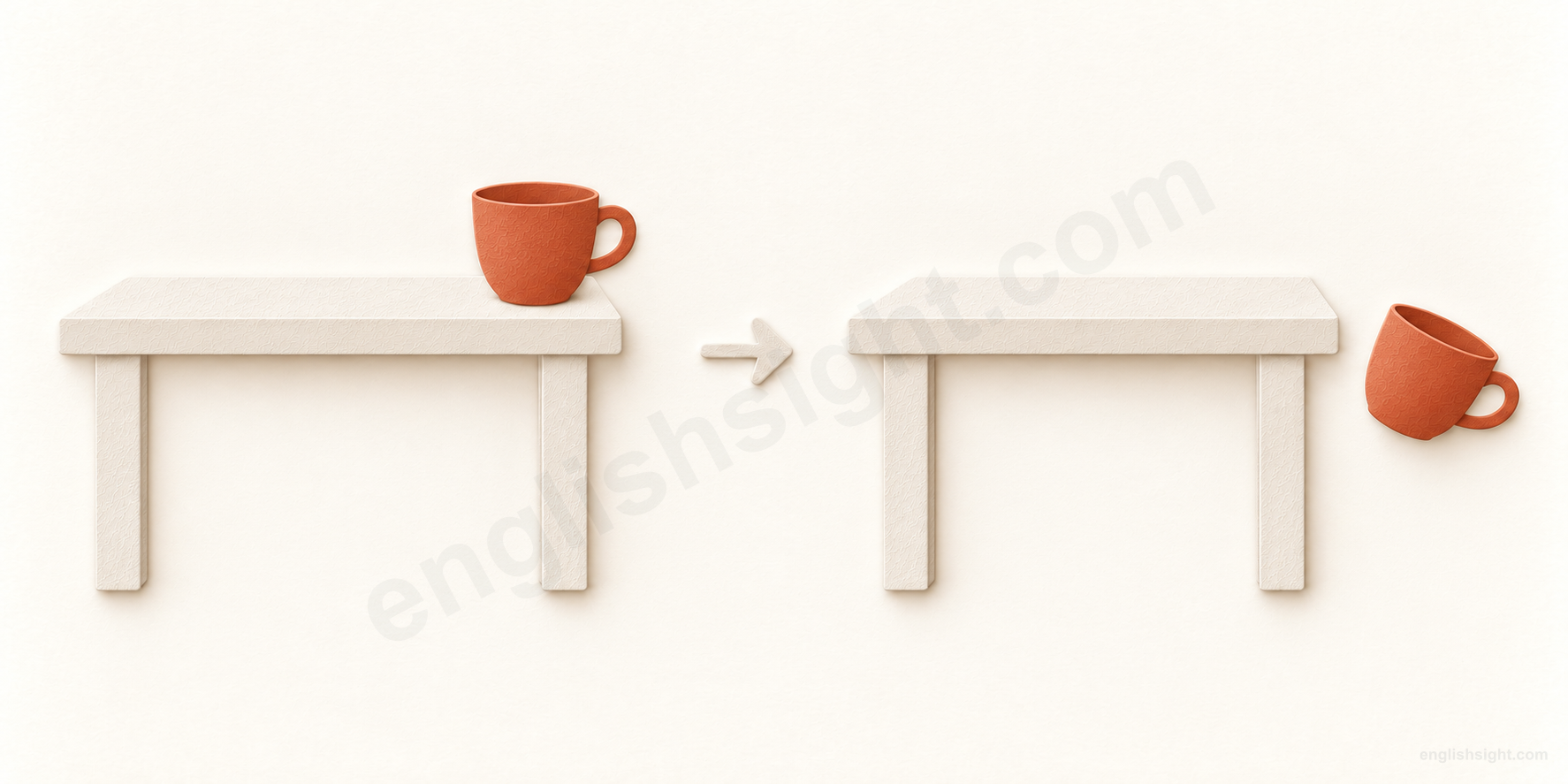
The cup rests on the table.
off
The cup is off the table, with a clear gap.
The cup loses contact with the table.
The cup is off the table: contact with its support is gone.
The same object is first supported, then separated. Ask what contact, activity, or reference is involved in each expression.
The arrow illustrates one physical case. Off the coast is a position; run off batteries is a resource construction. Neither requires this movement.
A useful starting point is a relationship that does not hold: a cup is no longer on a table, a light is not operating, or a worker is not on duty. Off can describe a state as well as a change.
This is a teaching connection, not a picture shared by every speaker. Source and resource uses, and many idioms, need their own learned patterns.
01
Contact, departure, and distance
Start with physical relations. Off can describe separation, departure, or a position away from a reference point.
01
verb + object + off + surface; fall / come off
off the table
no longer on or touching a surface
Starting situation
The cup rests on the table.
Result or relation
It loses contact and falls.
Off marks separation from a support.
Off the table names the starting surface. The button came off describes detachment; wipe mud off your shoes describes removal. Unlike out of, off does not primarily describe leaving an interior.
In a sentence
The cup fell off the table.
Watch the difference A proposal is off the table can instead mean it is no longer being considered.
02
take + clothing + off; take off + clothing
take off your coat
remove something worn
Starting situation
You are wearing a wet coat.
Result or relation
You remove the coat.
The clothing separates from the body.
Take your coat off and take off your coat are both possible. With an unstressed object pronoun, put it between take and off. Off is a separable particle here.
In a sentence
Please take it off before you sit down.
Watch the difference Say take it off, not take off it; put it on expresses the reverse.
03
get / step off + bus / train / bike
get off the bus
leave a vehicle you travel on
Starting situation
You are on the bus.
Result or relation
You leave it at a stop.
The transport convention selects off.
Use get off for buses, trains, planes and bikes; usually get out of for cars and taxis. Without a vehicle noun, We got off is enough when the context supplies it.
In a sentence
We got off the bus outside the museum.
Watch the difference Off the bus does not mean the vehicle has been switched off.
04
be off to + place; set off for + destination
be off / set off
leave or start a journey
Starting situation
You are ready to leave.
Result or relation
Your journey begins.
Off moves attention away from the starting place.
Be off to announces departure; set off starts a journey; drive off tells how someone leaves. Off you go! can give friendly permission to leave. They’re off! can announce a race starting.
In a sentence
We’re off to the market.
Watch the difference Set off an alarm means trigger it; the object changes the construction.
05
off + coast / road / room
off the coast / off Main Street
near a reference point but separate from it
Starting situation
You locate an island relative to the coast.
Result or relation
It lies in the water nearby.
This is a location, not necessarily movement.
A place off Main Street is reached by leaving that street; a bathroom off a bedroom opens from it. Off the coast locates something out from the shore, without saying exactly how far.
In a sentence
There’s a small island just off the coast.
Watch the difference On the coast places it at the shoreline; off the coast places it out in the water.
06
distance / time + off; a long way off
a long way off
at a distance in space or time
Starting situation
You consider today and the exam date.
Result or relation
Two weeks remain between them.
Off measures separation from here or now.
A village five miles off is distant in space; a deadline two days off is distant in time. A long way off can also describe a goal far from achievement.
In a sentence
The exam is still two weeks off.
Watch the difference Off does not mean later than the exam; the interval leads up to it.
02
Inactive, absent, reduced, or no longer usual
A surface is not required. Read what is absent or discontinued, and which subject supplies the meaning.
07
take / have + time + off; be off work / duty
a day off / off duty
be free from work or usual duties
Starting situation
Friday would normally be a workday.
Result or relation
You arrange not to work.
An activity is absent for a period.
A day off is time away from work. Be off sick gives illness as the reason; be off duty means not currently working. Get off work means finish or leave work.
In a sentence
I’m taking Friday off.
Watch the difference Be off work does not by itself say you have lost your job.
08
turn / switch + object + off; be off
turn off / be off
stop a device or supply functioning
Starting situation
The light is on.
Result or relation
You stop it operating.
Off can name an inactive state.
The light is off describes its state; turn it off causes that state. The water is off can mean the supply is disconnected. These uses need no physical movement away.
In a sentence
Please turn it off when you leave.
Watch the difference An alarm goes off means it sounds, not that it becomes silent.
09
event + be off; call + event + off
be off / call off
cancel a planned event
Starting situation
A match is scheduled.
Result or relation
It will not take place as planned.
The plan is no longer active.
The match is off states cancellation. Call it off describes the decision. Put it off instead postpones it. In The match was called off, the event is the subject of a passive construction.
In a sentence
They called off the match because of the storm.
Watch the difference Cancelled and postponed do not promise the same future arrangement.
10
amount / percentage + off + price; take + amount + off
20% off
reduce a price by a stated amount
Starting situation
The boots have a regular price.
Result or relation
The price is reduced by one fifth.
Off marks subtraction from a total.
Twenty per cent off means pay eighty per cent of the original price. Take five dollars off the bill removes that amount. Off may follow the amount without naming the original price again.
In a sentence
These boots are 20% off today.
Watch the difference Twenty per cent off is not a price reduced to twenty per cent.
11
be off + food / medicine / substance
be off sugar
stop or avoid consuming something
Starting situation
Sugar is usually part of your diet.
Result or relation
You avoid it for a month.
A usual activity or substance is excluded.
Off sugar can describe a deliberate restriction. Be off medication says someone is no longer taking it; it does not explain who made that decision. This is a state, not an instruction to stop treatment.
In a sentence
I’m off sugar for a month.
Watch the difference Off does not mean physically away from the sugar bowl.
12
go off + person / thing; be off one’s food
go off / be off your food
lose interest or appetite
Starting situation
You used to enjoy the series.
Result or relation
It no longer appeals to you.
An earlier liking weakens or ends.
In British informal usage, go off someone or something means stop liking them or it. Be off your food means have less appetite, often because you feel unwell; it need not be a chosen diet.
In informal North American English, go off on someone means suddenly become angry with them: He went off on me. The extra on distinguishes this from the British loss-of-liking pattern.
In a sentence
I’ve gone off that TV series.
Watch the difference Put someone off causes dislike or discouragement; go off describes the person’s change.
13
food + be / smell / go off; menu item + be off
the milk is off
be spoiled, or be unavailable on a menu
Starting situation
You check the milk before drinking it.
Result or relation
Its smell suggests it is no longer fresh.
The whole food context selects the meaning.
Especially in British English, food that is off has spoiled; American English usually uses bad or spoiled. In a restaurant, The soup is off can instead mean it is not available.
In a sentence
This milk smells off.
Watch the difference An unavailable dish is not necessarily spoiled; ask about the context.
03
Standards, sources, and circumstances
Some uses compare a standard; others name a resource. These branches cannot all be predicted from one physical arrow.
14
off + course / target / topic
off course / off topic
depart from a route, aim, or subject
Starting situation
The discussion has a main subject.
Result or relation
People move to another subject.
A reference line becomes a comparison.
Off course describes deviation from a route; off target can describe a missed aim or estimate. Off topic or off the subject concerns discussion. Keep off that subject asks people to avoid discussing it.
In a sentence
We’re getting off topic.
Watch the difference Off course has a space; of course means certainly or as expected.
15
be / seem off; be off by + amount; be off with + person; an off day
something is off / an off day
be wrong, below normal, or unfriendly
Starting situation
You compare the totals.
Result or relation
They do not look right.
Off can mark departure from an expected standard.
Figures that are off may be inaccurate. An off day is a day of unusually poor performance. Especially in British informal English, be off with someone means be unfriendly; That’s a bit off criticizes unfair behavior.
The total is off by two states the size of the error; by two alone does not say whether the total is too high or too low.
In a sentence
Something is off in these figures.
Watch the difference Off is vague here; it does not identify the error or diagnose a person.
16
get / buy + object + off + source
get something off someone
obtain something from a source
Starting situation
A neighbour owns the desk.
Result or relation
You buy it from that neighbour.
Off can identify a source in informal speech.
Buy or get something off someone is an informal way to name the source. Get it off a website similarly names where information came from. From is a neutral alternative.
In a sentence
I bought this desk off a neighbour.
Watch the difference Buy someone off instead means pay them to gain improper cooperation.
17
live off + resource; run off + power source
live off / run off
depend on a resource for living or operation
Starting situation
The radio needs power.
Result or relation
Batteries provide it.
This resource meaning is an established branch.
Live off savings means use savings to support yourself; live off rice names a main food. Live off someone can sound critical of dependence. Run off batteries identifies power, not disconnection.
In a sentence
This radio runs off batteries.
Watch the difference Runs off batteries and is switched off say different things about operation.
18
be well / badly off; be better off + -ing / without; be off for + resource
well off / better off / off for
have resources or be in a better situation
Starting situation
You compare the travel options.
Result or relation
The train seems the wiser choice.
Learn the full expression for circumstances.
Well off often means wealthy; badly off means lacking money or resources. Better off can concern any improved situation. Better off taking the train recommends that option; it need not concern money.
How are we off for milk? informally asks how much milk we have. Off for names the resource being assessed, not an absence from it.
In a sentence
We’d be better off taking the train.
Watch the difference Use taking, not to take, directly after better off in this pattern.
04
Read the whole verb combination
Objects and subjects distinguish familiar meanings. Learn the complete pattern instead of giving off one translation everywhere.
19
aircraft / business / person + take off
take off
leave the ground or become successful quickly
Starting situation
Her business starts with few customers.
Result or relation
It grows rapidly.
The complete verb selects a flight or success meaning.
A plane takes off when it begins flight. A business takes off when it gains success rapidly. These are intransitive uses; take your coat off has a different object pattern and meaning.
With a person as subject, take off can also informally mean leave, especially in a hurry: She took off before lunch.
In a sentence
Her repair business took off last year.
Watch the difference Do not add a business as an object: Her business took off.
20
alarm / bomb + go off; set + object + off
go off / set off
sound, explode, or cause a reaction
Starting situation
Smoke reaches the detector.
Result or relation
The alarm begins sounding.
Here off does not mean inactive.
An alarm goes off when it sounds; a bomb goes off when it explodes. Set it off causes the event. Set off laughter starts a reaction. The party went off well instead describes how the event happened.
In a sentence
The smoke set off the alarm.
Watch the difference The lights went off means they stopped working; go off depends on its subject.
21
put + task + off; put + person + off + -ing
put off
postpone, discourage, or distract
Starting situation
You consider joining the club.
Result or relation
The cost makes you decide against it.
The object and following verb choose the meaning.
Put off a meeting postpones it. Put someone off joining discourages them; put someone off their work distracts them. Compare We put off joining: we delayed joining, rather than necessarily rejecting it.
In a sentence
The cost put me off joining the club.
Watch the difference Use joining, not to join, after put someone off in this pattern.
22
drop + person / thing + off; person / quantity + drop off; drop off + call
drop off
deliver, fall asleep, or decrease
Starting situation
You are travelling in a friend’s car.
Result or relation
Your friend leaves you at the station.
Different object patterns carry different meanings.
Drop someone or something off means take and leave them somewhere. Without an object, drop off can mean fall asleep or decrease: I dropped off; Sales dropped off. Context distinguishes these intransitive meanings.
Drop off the call means leave a phone call or online meeting: I need to drop off the call now. Here the call is what you leave, not something you deliver.
In a sentence
Can you drop me off at the station?
Watch the difference Say drop me off; do not read it as asking someone to drop your body.
Finish off a report completes its remaining part. Pay off a loan clears the debt; All that practice paid off means it produced good results. The result meaning has no debt object.
In a sentence
We finally paid off the loan.
Watch the difference Pay someone off can mean bribe them; do not infer the meaning from off alone.
24
effect + wear off; person / thing + cool off
wear off / cool off
gradually disappear or become less intense
Starting situation
The experience feels new and exciting.
Result or relation
The feeling gradually fades.
Off can accompany a reduction toward an end.
An effect wears off when it gradually disappears. Cool off can mean become cooler or less angry. Ease off describes a decrease in pressure or intensity. These changes do not necessarily happen instantly.
In a sentence
The excitement soon wore off.
Watch the difference Wear off is intransitive here; remove a coat with take off.
25
tell + person + off; show off; get off with + penalty
tell off / show off / get off
scold, display proudly, or escape a severe penalty
Starting situation
You shout in class.
Result or relation
The teacher angrily corrects you.
These meanings belong to whole expressions.
Tell someone off means scold them. Show off means try to impress, often disapprovingly; show something off means display it proudly. Get off with a warning means receive only that light penalty.
In a sentence
The teacher told me off for shouting.
Watch the difference Tell me off is different from tell me to get off a bus.
05
Established everyday expressions
The full expression carries its conventional meaning. A memorable picture can help but does not prove the meaning.
26
on and off; off and on
on and off
at intervals rather than continuously
Starting situation
Rain starts during the afternoon.
Result or relation
It stops and starts again.
Alternating states form an established time expression.
Both on and off and off and on describe intermittent activity. An on-off relationship repeatedly ends and begins again. The phrase describes intervals, not necessarily a regular schedule.
In a sentence
It rained on and off all afternoon.
Watch the difference All afternoon does not make the rain continuous when on and off is present.
27
first off, + clause; verb + right off
first off / right off
introduce a first point or act without delay
Starting situation
You begin arranging a meeting.
Result or relation
You name the first matter to settle.
These are fixed expressions for order and timing.
First off informally introduces a first point, especially in British English. Right off means immediately: She answered right off. Neither meaning comes from removing a physical object.
In a sentence
First off, let’s agree on a time.
Watch the difference First off organizes points; right off says there is no delay.
28
say / speak + off the record
off the record
give information without public attribution or official recording
Starting situation
A reporter asks for information.
Result or relation
The speaker gives it on an unofficial basis.
This is a convention about how information is used.
Off the record marks information as unofficial and not for public quotation or attribution. Agree what that means with the listener; saying the phrase alone does not ensure confidentiality. On the record gives the opposite status.
In a sentence
She spoke to the reporter off the record.
Watch the difference This does not simply mean the recording device is switched off.
29
be / let + person + off the hook
off the hook
escape blame, punishment, or a difficult obligation
Starting situation
You are being blamed for missing money.
Result or relation
The receipt clears you.
The hook is an idiomatic image of being caught.
Be off the hook means be free of trouble or responsibility. Let someone off the hook releases them. A landline phone off the hook has its receiver lifted; that literal phone use is different.
In a sentence
Finding the receipt got me off the hook.
Watch the difference Off the hook does not always mean a court has declared someone innocent.
30
speak off the cuff; off the top of one’s head
off the cuff / off the top of my head
speak without preparation or answer from unchecked memory
Starting situation
You are asked for an approximate number.
Result or relation
You answer without checking.
Learn these whole expressions, not literal body movements.
Speak off the cuff means speak without preparing. Off the top of your head means rely on immediate memory or a guess. An off-the-cuff remark uses hyphens before the noun.
In a sentence
Off the top of my head, I’d say about fifty.
Watch the difference An immediate estimate is not a verified figure.
31
on the off chance that + clause; on the off chance of + -ing
on the off chance
try despite a small possibility of success
Starting situation
You think the person is probably out.
Result or relation
You call because they might be home.
The possibility is unlikely, not impossible.
Use on the off chance for an action worth trying despite low expectations. That introduces a clause; of takes a noun or -ing form, as in on the off chance of seeing her.
In a sentence
I called on the off chance that you were home.
Watch the difference By chance describes an accidental event; on the off chance explains a deliberate attempt.
32
buy + object + off the shelf; off-the-shelf + noun
off the shelf
buy a ready-made product
Starting situation
You need software quickly.
Result or relation
You buy an existing package.
The shelf stands for a product already available.
Off the shelf means available as a standard product rather than specially made. Before a noun, write an off-the-shelf solution. It need not refer to an actual shop shelf.
In a sentence
We bought the software off the shelf.
Watch the difference Take a product off the shelves can instead mean withdraw it from sale.
33
be off-limits to + person; keep off + place
off-limits / hands off
be forbidden to enter, touch, or discuss
Starting situation
Visitors can reach a door to the roof.
Result or relation
A rule prohibits entering.
Non-contact can be a rule rather than a change.
Keep off the grass means do not step on it. Off-limits means entry or discussion is forbidden. Hands off! tells someone not to touch or interfere; it can sound forceful.
In a sentence
The roof is off-limits to visitors.
Watch the difference Off the roof describes location or movement; off-limits describes permission.
Grammar, spelling, and limits
Preposition, particle, or adjective
In off the table, off introduces a noun phrase. In turn it off, it is a particle; in the milk smells off, it describes a condition. Dictionaries sometimes label state uses differently. Most uses have no tense or plural; the main verb carries tense.
Pronouns and spelling
Use turn it off, not turn off it. A prepositional object stays after off: off it. Off has /f/; of commonly has /v/. Off of occurs in informal North American English; plain off is a broadly suitable writing choice, rather than treating every off of as impossible.
Scope
This lesson covers common modern senses and representative combinations, without a frequency ranking. Specialist cricket and theatre terms, technical quantities such as 100 off, the slang verb meaning kill, and the full inventory of compound words and verb-plus-off expressions are not expanded.
Choose from the whole context
Use the subject, object, and situation to choose a meaning.
1. You want someone to remove a coat. Which word order is natural?
2. An alarm goes off. What happens?
3. The meeting will happen next week instead of today. Which sentence fits?
4. This radio runs off batteries. What does that tell you?
Sources and teaching notes
Usage was checked against Oxford and Collins. Explanations and examples are original; the diagram is a teaching comparison.
One sketch explains a connection; speakers need not share the same mental picture.