A substance, an application, and familiar expressions.
Choose the right kind of oil, then read what the whole phrase does.
The substance and its application
The liquid and what receives it
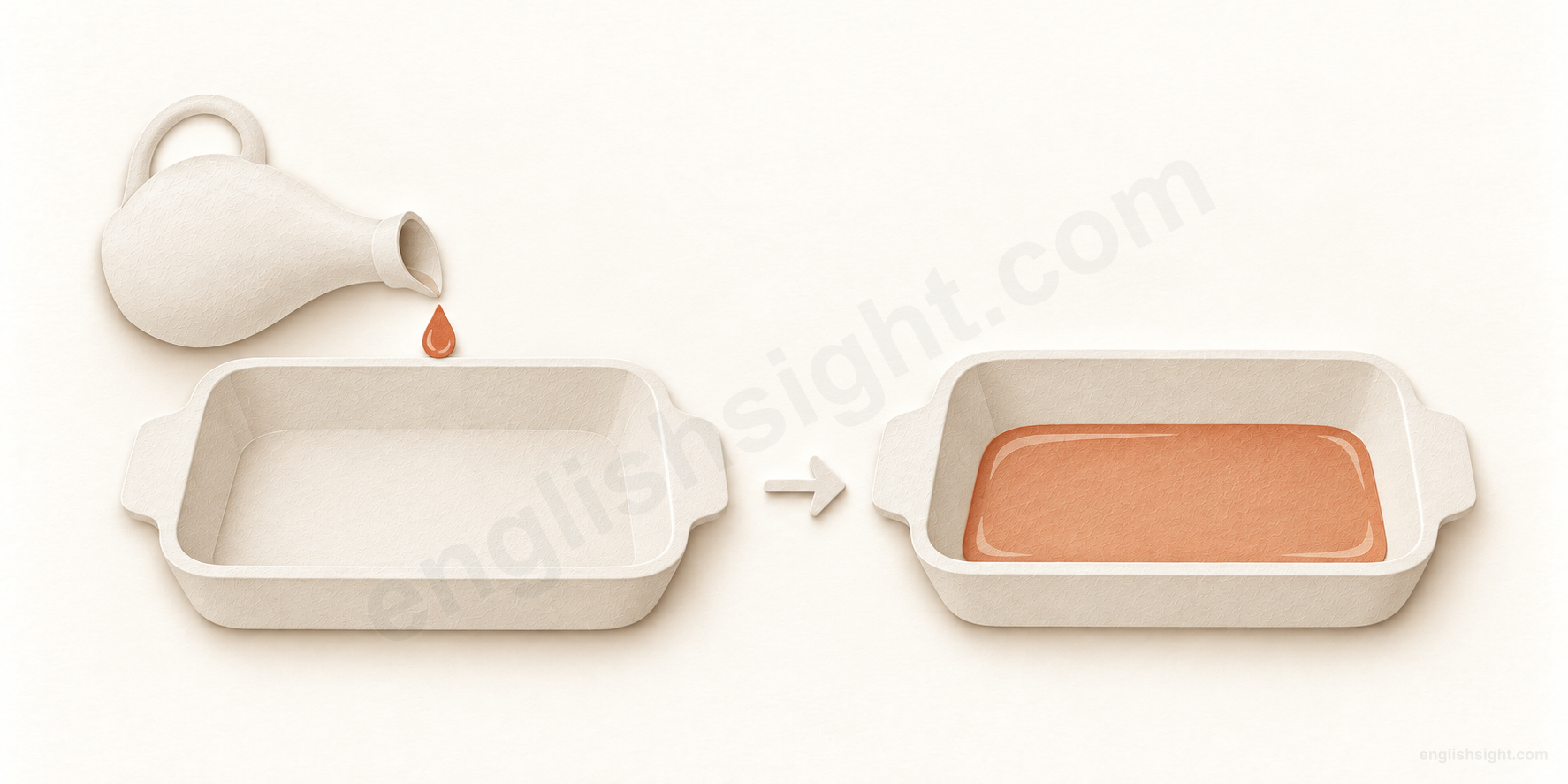
A bare baking dish sits below a tilted oil cruet.
oil
A thin layer of oil coats the base of the same dish.
Apply a little oil to the inside.
Oil is the substance; to oil the dish is to coat it with oil.
Oil names a greasy liquid; as a verb, it means putting oil onto or into something.
The sketch illustrates application: a bare surface receives a thin layer of oil. It does not define every oil by lubrication, nor explain petroleum, art, or all idioms through one physical action.
Oil can belong in a recipe, an engine, a personal-care product, an energy report, or a painting. These are related uses of a substance word, but the actual materials and purposes differ.
As a verb, oil means apply oil to something or supply it with oil. That gives a useful link to expressions about smooth operation; other idioms need to be learned as complete phrases.
01
Which oil do you mean?
Food, engines, heating, personal care, and energy reports give oil different practical references. Name the kind when the context does not make it clear.
01
add / heat + oil; cook / fry something in oil
cooking oil / olive oil
oil used as a food ingredient
Situation or starting point
You are preparing vegetables.
Meaning in context
A little suitable oil goes into the pan.
The context identifies edible oil.
Oil is a noun here. Cooking oil describes its use; olive oil names its source. Other familiar names include vegetable oil, sunflower oil, and sesame oil.
Use oil for frying or as part of a dressing: fry vegetables in oil; dress a salad with oil and vinegar. In marks the cooking medium, while with introduces an ingredient or accompaniment.
This is one branch of the substance meaning. A recipe’s oil does not mean the oil used in a machine.
In a sentence
I added a spoonful of olive oil to the warm pan.
Watch the difference Use a little oil for an amount. A few oil is not the ordinary amount pattern.
02
some / a little oil; a drop / bottle of oil; different oils
some oil / different oils
an amount of a substance versus separate kinds
Situation or starting point
You need an amount for a recipe, or want to compare varieties.
Meaning in context
You measure the substance or count its types.
Oil is usually a mass noun, but oils can identify kinds.
Say some oil, a little oil, a drop of oil, or a bottle of oil when talking about quantity. The unit word is countable: two bottles of oil.
The plural is useful when distinguishing kinds: The shop stocks several cooking oils. A phrase such as a scented oil similarly identifies one kind or preparation.
Oils is not restricted to kinds: in an art context it may refer to paints or paintings. Decide from the surrounding words.
In a sentence
We compared three oils, then bought a bottle of the mildest one.
Watch the difference Three oils normally means three kinds in this context, not automatically three bottles.
03
check / change the oil; the car needs an oil change
engine oil / an oil change
oil that lubricates machinery
Situation or starting point
A car needs routine maintenance.
Meaning in context
Its lubricating oil is checked or replaced.
Engine oil and the fuel used to drive the car have different jobs.
Engine oil helps moving engine parts work smoothly. Check the oil means check its level or condition in a vehicle context; change the oil means replace it.
An oil change is the maintenance job. Oil names the material and change names the event, so an oil change is countable even though this oil is not.
Petrol in British English, or gas / gasoline in American English, names a common vehicle fuel. Do not use engine oil as a general substitute for that fuel word.
In a sentence
The mechanic changed the oil before our long trip.
Watch the difference The noun phrase an oil change does not mean that oil itself has become countable.
Heating oil and fuel oil name oils used for energy. The same broad word can refer to different products according to their purpose.
Heat a house with oil identifies the fuel. An oil lamp burns oil to provide light; oil comes before the main noun and identifies the fuel used by this device.
The noun alone does not specify a product’s grade or suitability. This lesson explains the words, not which fuel to put in particular equipment.
In a sentence
Their old farmhouse is heated with oil.
Watch the difference Oil in an oil lamp is a noun used before another noun; it is not the action verb oil.
05
crude oil; drill for oil; oil + noun; work in oil
crude oil / the oil industry
petroleum and the business built around it
Situation or starting point
A report discusses resources found underground.
Meaning in context
You understand oil as petroleum or the related industry.
Crude oil is the material before refining.
In energy and business reporting, oil often means petroleum. Crude oil names the unrefined material. Drill for oil describes searching for it by drilling; extract oil describes bringing it out.
Oil prices, oil reserves, oil wells, oil rigs, and oil companies are noun combinations. The following noun identifies a price, a resource, a place of extraction, equipment, or a business.
Someone who works in oil works in the petroleum industry. This is an established way to name the business through its main product, not a claim that the person is physically inside liquid.
In a sentence
Maya works in oil, but her sister designs wind turbines.
Watch the difference Crude oil and cooking oil belong to different practical contexts; oil does not make them interchangeable.
06
an oil spill / leak / slick
an oil spill / an oil slick
escaped oil and a patch floating on water
Situation or starting point
Oil escapes from a damaged vessel.
Meaning in context
A floating area of oil spreads across the water.
Spill concerns a release; slick names the floating patch.
An oil spill is an accidental release of oil. Oil is the material; spill is the countable event or quantity released. An oil leak identifies oil escaping through a fault or opening.
An oil slick is an area of floating oil on the sea. A spill may produce a slick, but the two expressions focus on different things.
The visible layer relates to oil’s behavior as a substance. The expression does not mean that every spill happens at sea.
In a sentence
After the tanker accident, an oil slick spread toward the beach.
Watch the difference A spill on a workshop floor is not normally called an oil slick in the sea-pollution sense.
07
bath / hair / baby oil; rub oil into the skin
bath oil / hair oil
an oil preparation for personal care
Situation or starting point
Someone chooses a personal-care product.
Meaning in context
The oil is used on hair, skin, or in a bath.
The product name identifies the intended context.
Bath oil and hair oil name preparations used in personal care. A scented oil emphasizes its smell, while baby oil names a familiar product category.
Rub oil into the skin describes application. Oil remains the substance; rub supplies the action. Into presents the oil as being worked into the skin, rather than simply resting on its surface.
These uses share the substance meaning with cooking and lubrication, but the intended product changes. An oil label alone is not a claim about medical benefits.
In a sentence
The bottle of bath oil had a light floral scent.
Watch the difference Oil in bath oil does not mean the same product as cooking oil.
02
Paint and finished pictures
In art, oil can name a painting material or a finished work. The grammar helps distinguish them.
08
paint / work in oils; oil on canvas
paint in oils / oil on canvas
oil paint as an artistic medium
Situation or starting point
An artist chooses materials.
Meaning in context
The picture is made using oil paint.
In oils identifies the medium; on canvas identifies the support.
An artist who works or paints in oils uses oil paints. In is the preposition used to identify the medium here; the phrase does not describe being surrounded by liquid.
A museum label reading oil on canvas names both material and support. Oil painting can also name the activity: She is learning oil painting.
The substance connects to the paint because oil is part of the painting material. This art use does not refer to petroleum in a fuel tank.
In a sentence
Ravi sketches in pencil but paints his portraits in oils.
Watch the difference In oils names the paints; on canvas tells you what surface carries the painting.
09
an oil / an oil painting; two oils
an oil / two oils
a finished painting made with oil paint
Situation or starting point
A gallery describes finished works.
Meaning in context
You count individual pictures.
The material can name the completed artwork.
In an art context, an oil can mean an oil painting. Two oils therefore means two pictures, rather than two liquids or two tubes of paint.
Compare She works in oils, which identifies paint, with The gallery bought two oils, which identifies finished works. The verb and context select the reading.
Oil painting is a clearer full phrase for a general audience. It is countable for a picture and uncountable for the activity of making such pictures.
In a sentence
The gallery displayed two small oils beside a charcoal drawing.
Watch the difference Do not apply the usual uncountable-liquid rule to oil when it means a finished painting.
03
Put oil on something
The verb turns the substance into an action. The object names what receives the oil; the purpose may be lubrication or coating.
10
oil + object; be oiled; be oiling + object
oil a hinge / oil it
put oil on or into a moving part
Situation or starting point
A hinge squeaks as it moves.
Meaning in context
Oil is applied to the hinge to help it move smoothly.
The verb’s object receives oil.
Oil is now a transitive verb: someone oils something. The hinge is the object receiving oil, not the liquid being poured.
The ordinary forms are oil, oils, oiled, and oiling. We are oiling the hinges describes work in progress; The hinges were oiled yesterday is passive and focuses on the treated parts.
Say oil it when the object is a pronoun. There is no required particle to separate: oil the hinge is already a complete verb-and-object pattern.
In a sentence
I oiled the hinge, and the door stopped squeaking.
Watch the difference Oil the hinge means apply oil to it; change the oil means replace the liquid.
11
lightly oil + object; a lightly oiled + noun
lightly oil a dish
coat a surface with oil
Situation or starting point
You prepare a baking dish.
Meaning in context
A thin layer of oil covers the inside.
Applying oil need not involve moving machinery.
Oil can mean put oil over a surface for a purpose such as preparing cookware or treating a material. The direct object is the dish or surface.
Lightly oil tells you to use a small amount. A lightly oiled dish describes the resulting condition with a past participle.
For cooking, grease a dish is broader: the substance might be butter or another fat. Oil specifically identifies oil as what is applied.
In a sentence
She spooned the mixture into a lightly oiled baking dish.
Watch the difference Pour oil into a dish describes adding liquid; oil the dish focuses on treating its surface.
04
Learn the whole expression
Some expressions borrow oil’s practical associations; others depend on a conventional phrase. Their meanings cannot be predicted from a drop alone.
12
oil the wheels (of something)
oil the wheels
help a process proceed more easily
Situation or starting point
An agreement is slowed by practical difficulties.
Meaning in context
Help removes obstacles to cooperation.
The wheels belong to a metaphor for a process.
Oil the wheels means help something happen with fewer difficulties, especially in business or politics. Clear information or useful introductions can oil the wheels.
The image of lubrication helps you remember the phrase, but no actual wheels are necessary. It describes assistance, not a guarantee that the agreement will happen.
Oxford labels oil the wheels British; grease the wheels is the North American counterpart. Neither expression automatically alleges bribery; that depends on context.
In a sentence
A clear timetable helped oil the wheels of the negotiations.
Watch the difference Do not translate the wheels as literal vehicle parts when the subject is a negotiation.
13
a well-oiled machine; run like a well-oiled machine
a well-oiled machine
a system whose parts work smoothly together
Situation or starting point
A team has practiced its roles.
Meaning in context
Its work is coordinated and efficient.
A machine can serve as a comparison for an organization.
Well-oiled can literally describe properly lubricated equipment. In a team or system description it emphasizes smooth, effective operation.
A team that runs like a well-oiled machine has coordinated parts or people. Like marks a comparison; the people have not literally been coated in oil.
Oil the wheels focuses on helping a process along; well-oiled describes how the system already operates. The two share a lubrication association but have different grammar.
In a sentence
By the second week, the volunteer team was running like a well-oiled machine.
Watch the difference Use oiled in this adjective, not a well-oil machine.
14
burn the midnight oil + working / studying context
burn the midnight oil
work or study until late at night
Situation or starting point
A deadline is approaching.
Meaning in context
Someone stays up late doing the work.
The full phrase expresses late-night effort.
Burn the midnight oil means stay up very late working or studying. It does not require an oil lamp or a clock showing exactly midnight.
Burn changes with the tense: burned the midnight oil or burnt the midnight oil. The word the belongs to the established phrase.
Oil’s connection with lighting makes a useful memory aid, but the modern meaning belongs to the whole idiom. Staying up just to watch a film does not normally express this working sense.
In a sentence
We burned the midnight oil preparing the final presentation.
Watch the difference The idiom is not simply a general synonym for being awake at night.
15
pour oil on troubled water(s)
pour oil on troubled waters
try to calm an argument
Situation or starting point
Two colleagues are arguing.
Meaning in context
Someone intervenes to reduce the tension.
Troubled waters stand for a tense situation.
Pour oil on troubled waters means try to settle an argument. Oxford also records troubled water in the singular.
The person pouring the oil is helping to calm matters, perhaps by speaking tactfully or suggesting a compromise. The phrase describes the attempt; it need not succeed.
This is a fixed calming expression. Do not infer its meaning from what happens when oil is actually spilled into water, and do not confuse it with adding fuel to the fire, which makes a conflict worse.
In a sentence
Leila tried to pour oil on troubled waters by suggesting a short break.
Watch the difference Changing the preposition or replacing troubled waters freely may lose the recognized idiom.
16
two people + be like oil and water
be like oil and water
be very different and not get along
Situation or starting point
Two people have clashing approaches.
Meaning in context
Working together remains difficult.
Oil and water provide a comparison for incompatibility.
People who are like oil and water are very different and do not get along easily. The expression concerns how the two fit together, not one person’s character alone.
The comparison draws on oil and water remaining separate rather than forming one uniform liquid. Treat this as a memory connection, not a rule about all combinations containing oil.
Unlike pour oil on troubled waters, this expression does not describe calming a disagreement. Similar ingredients in an image do not make the idioms synonymous.
In a sentence
The two partners were like oil and water and soon stopped working together.
Watch the difference The phrase usually suggests incompatibility, not merely that two people have different hobbies.
It leads to oil, or figuratively to valuable success.
Read the context to separate discovery from figurative success.
Literally, a drilling team strikes oil when it discovers petroleum underground. Strike does not mean hit a bottle here.
Informally, strike oil can describe becoming rich or successful through a valuable discovery or opportunity. For example: The small publisher struck oil with its first children’s series. No drilling is involved in that sentence.
Strike supplies the discovery or success event. Oil alone does not mean success; learn the combination. The past tense is struck oil.
In a sentence
After months of drilling, the team finally struck oil.
Watch the difference A figurative reading needs a suitable success context; not every useful find is naturally described this way.
18
call something snake oil; a snake oil salesman
snake oil / a snake oil salesman
a supposed remedy or deceptive sales claim
Situation or starting point
Someone promises a miraculous result.
Meaning in context
The claim is rejected as worthless or deceptive.
This is a disapproving expression, not an ingredient list.
Snake oil refers to a supposed medical remedy with no real healing value. The expression signals the speaker’s strong disapproval of the claimed remedy.
It also appears in criticism of deceptive or insincere selling. A snake oil salesman presents such claims; the phrase can be used beyond a literal seller of medicine.
Calling something snake oil makes a judgment about the claim. This language lesson is not evidence that any particular real treatment works or fails.
In a sentence
The review dismissed the supposed miracle tonic as snake oil.
Watch the difference Do not use snake oil as a neutral name for any oil-based product.
19
person + be no oil painting
be no oil painting
be considered unattractive: a British humorous expression
Situation or starting point
Someone comments on a person’s appearance.
Meaning in context
The comment says the person is not good-looking.
Recognition is useful; the personal judgment may offend.
In British English, be no oil painting is a humorous way of saying someone is not attractive to look at. The person is compared with a pleasing picture.
It is often used about oneself: I’m no oil painting, but that passport photo is especially bad. Even when intended as a joke, it can be unkind about another person.
This conventional expression is separate from the neutral art meaning of an oil painting. A real painting described as not an oil painting may simply use another medium.
In a sentence
“I’m no oil painting,” he joked when he saw his passport photo.
Watch the difference Do not assume the idiom is a polite compliment or use it as a neutral description of someone else.
Keep the material, grammar, and idiom distinct
Oil, fat, and grease
Oil usually names a liquid with a greasy feel; fat is a broader food word and also names materials such as butter. Grease may name a thicker lubricant or unwanted fatty material. These words overlap in some contexts but do not identify the same product in every situation.
Read the head noun
Oil prices are prices, an oil change is a maintenance event, and an oil painting can be a picture. In these combinations, oil identifies the material or field; the final noun controls what is being counted.
Verb grammar
The everyday verb is transitive: oil a hinge, oil it. Active progressive and passive forms are natural: She is oiling it; It was oiled. Have the hinges oiled uses the ordinary have + object + past participle construction to arrange treatment. There is no separate productive causative meaning of oil to learn here.
Scope and limits
This selection covers contemporary substance, application, art, and familiar expression uses. It does not teach specialist chemical names, every commercial oil, regional slang such as the good oil, the specialist refueling verb, or a productive family of oil + particle verbs. Oil someone’s palm, a less central bribery expression, is outside the active-use selection.
Choose from the context
Decide whether oil names a material, an action, a picture, or part of an idiom.
1. A recipe needs a small amount of the substance. Which wording fits?
2. The gallery bought two oils. What did it buy?
3. You want to apply lubricating oil to a noisy hinge. Which request fits?
4. Jo worked on a report until very late. Which expression fits?
5. A garage checks the engine oil. What is the relevant job of this oil?
6. Two colleagues are like oil and water. What does this suggest?
Sources and teaching notes
The sources below support the meanings and usage distinctions. The explanations, example sentences, and visual model were written for this lesson. Source checking is recorded separately from independent review.
The diagram is a teaching aid, not an image shared by every native speaker.