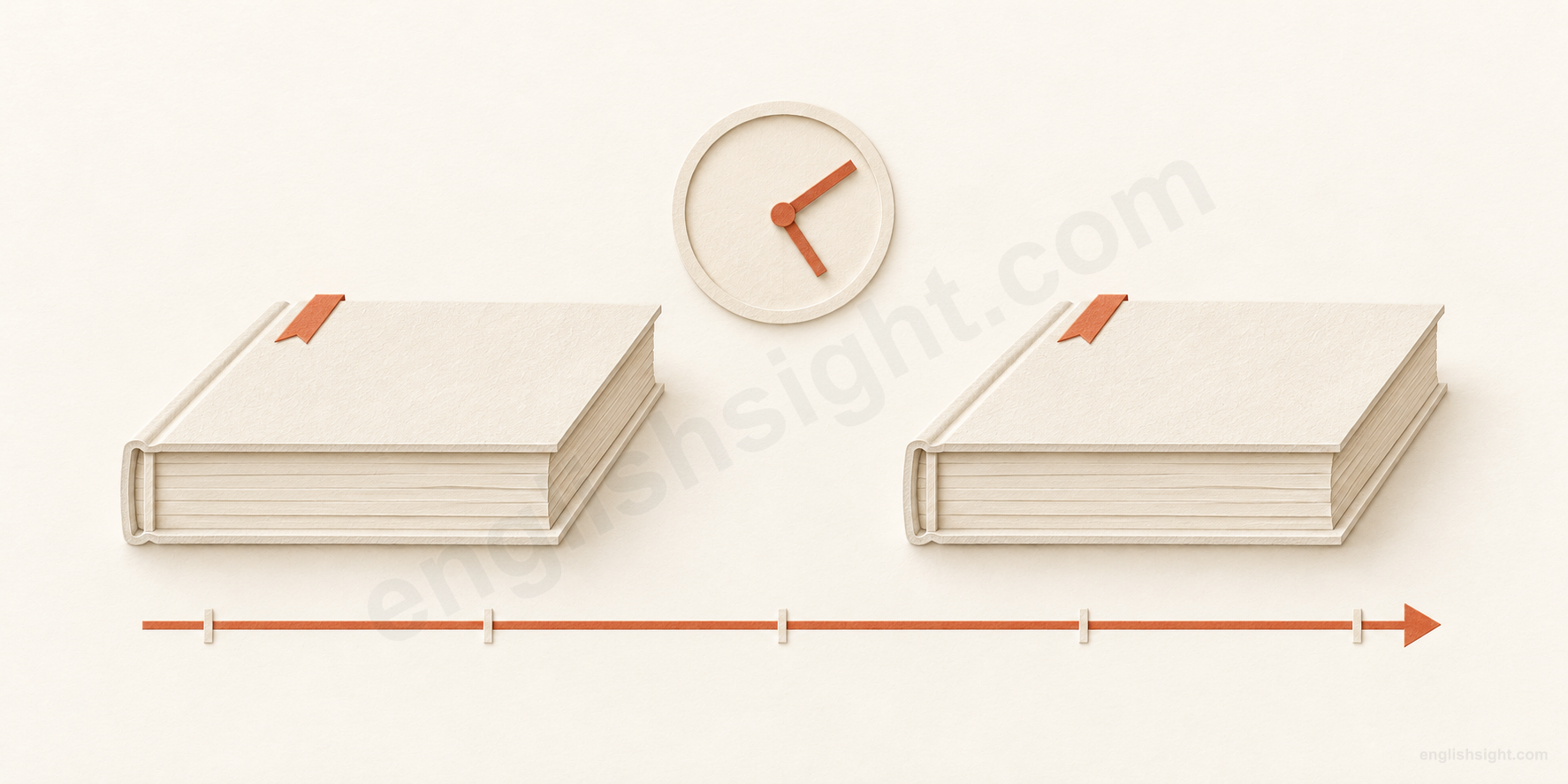
Follow age, earlier versions, long relationships, and familiar expressions through time.
Something already has a history
Something already has a history
The book at an earlier point in its history
old
The same intact book now has a longer history
Time passes; the same book continues to exist.
The same book remains as time passes. A longer history does not require damage.
Old relates someone or something to time: a long or measured existence, or an earlier place relative to the present.
The book illustrates continued existence across time. Wear, former roles, familiarity, and idioms need their own context; a longer history does not automatically mean damage.
Old often asks us to look backward: how long has this existed, or what place did it have before now? The answer can concern a person’s age, a building’s history, or a previous address.
Time is a useful teaching connection, not a formula for every phrase. An old friend may be young; any old notebook need not be old at all. Read the noun and the whole construction.
01
Age, comparison, and sentence patterns
Describe a long life, give an exact age, compare ages, or relate age to an activity. The construction tells you which job old is doing.
01
old + noun; be / look / feel + old; older people
an old person / older people
having lived many years
Starting situation
You are describing people in later life.
Meaning in context
You identify an age group, without stating an exact age.
Old compares a life with what counts as a long life in context.
An old person is contrasted with a young person. The adjective also works after a linking verb: Her dog is very old. There is no single age at which every person or animal becomes old.
When speaking about people, older people or older adults is often more tactful than old people. The old refers collectively to older people, takes plural agreement, and can sound impersonal or offensive; use a people phrase when possible. Young and old alike includes people of every age; it does not name two individual people.
Old age names the later part of life. In a different use, She seems old beyond her years can describe a young person who behaves or thinks with unusual maturity. It need not mean that she looks elderly.
In a sentence
The centre runs a weekly walking group for older people.
Watch the difference Old does not mean ill, helpless, or unable to learn. Avoid using an old to mean one older person.
02
How old + be + subject?; subject + be + number + time unit + old
How old…? / three months old
ask or state the length of a life or existence
Starting situation
A baby was born three months ago.
Meaning in context
You state the baby’s age precisely.
After a measurement, old means aged that much, not advanced in years.
Use be with the measurement: The baby is three months old. Days, weeks, months, and years can all measure age. Objects and institutions have ages too: The bridge is fifty years old.
How old is the baby? asks for age, not how the baby feels. In a short answer, Three months is enough; She is three months old is a complete sentence.
In a sentence
Our kitten is only eight weeks old.
Watch the difference Use is eight weeks old, not has eight weeks or is eight weeks age. This kitten is young despite the word old.
03
a + number-year-old + noun; a + number-year-old; number-year-olds
a ten-year-old / ten-year-olds
put an age before a noun or name an age group
Starting situation
You need a short description of a child’s age.
Meaning in context
The age becomes one compound modifier, or a noun by itself.
The time unit is singular inside an age compound.
A ten-year-old child means a child who is ten years old. Before the noun, join the age words with hyphens and keep year singular. Compare a two-month-old puppy with The puppy is two months old.
The noun can be left out when the person is understood: a ten-year-old. To name several children, put the plural ending on the whole noun: ten-year-olds, not ten-years-old.
In a sentence
The workshop is designed for ten-year-olds.
Watch the difference Write a ten-year-old child, but The child is ten years old. A singular age noun normally needs a determiner: a ten-year-old or my ten-year-old.
04
number + years + older than; the oldest + noun; my elder / eldest + family noun
older than / the oldest
compare ages or dates of origin
Starting situation
Two sisters have different birth dates.
Meaning in context
You state the age difference.
A comparison need not put either person in old age.
Older and oldest are the usual comparative and superlative forms. They work for people, animals, and things: an older computer, the oldest building in the street. Two young children can still be older and younger than each other.
Put a difference before older: two years older than me. Elder and eldest also occur in family descriptions, especially before a noun: my elder sister, their eldest son. Use older, not elder, in the ordinary than comparison.
As old as compares equal ages: This bridge is as old as the station. Here the two things have existed for the same length of time.
In a sentence
My sister is two years older than me.
Watch the difference Say She is older than me, not She is elder than me. Do not combine more with older.
05
get / grow + old; be getting old; feel / look old
get old / grow old
become older over time
Starting situation
Years pass in someone’s life.
Meaning in context
You describe aging as a process.
Get or grow supplies the change; old supplies the resulting description.
She is old describes a state. She is getting old describes a developing change. Grow old is another familiar way to talk about aging, often over a long span of life.
Feel old and look old concern someone’s experience or appearance, rather than proving their actual age. A long day can make you feel old without changing your birth date.
In a sentence
We hope to grow old together in this town.
Watch the difference Old is an adjective here. Getting old is not a passive form, and grow old does not mean become physically larger.
06
old enough + to-infinitive; too old + to-infinitive; too old for + noun
old enough to… / too old to…
relate age to permission or suitability
Starting situation
An activity has an age requirement.
Meaning in context
You judge whether someone has reached or passed a relevant age.
Enough and too set different limits; to names the activity.
Old enough to enter means sufficiently old for entry. Too old to enter means beyond the allowed or suitable age. Neither pattern alone gives the exact rule; the activity and context supply it.
For introduces a role or event: too old for the junior team. At twelve, she is old enough to travel alone gives a judgment about this situation, not a rule for all twelve-year-olds.
In a sentence
At eighteen, Maya is old enough to enter this competition.
Watch the difference Put enough after old: old enough, not enough old. Too old describes an upper limit; it does not mean very old.
02
Things and relationships with a history
Old may describe long existence, wear, an earlier version, or a long relationship. These overlap in life, but they are different claims.
07
an old + object / custom / saying; something + be + old
an old building / an old tradition
existing or continuing from an earlier time
Starting situation
A library has stood for many decades.
Meaning in context
You describe its long history.
The length of the history is separate from present condition.
An old building has existed for a long time. An old tradition or an old saying has been passed down over time; it need not be disappearing or unpopular.
The book in the diagram remains the same object across time. That helps explain old objects, but does not tell you whether a particular old object is damaged, valuable, or still useful.
In a sentence
The library is old, but its roof is in excellent condition.
Watch the difference Old is not automatically obsolete, broken, or antique. Those words make additional claims.
08
old + clothes / shoes / other used object
old shoes / old clothes
showing wear from age or repeated use
Starting situation
You have worn the same shoes on many walks.
Meaning in context
They are now well used.
Context can make old emphasize wear rather than just calendar age.
In I wear old clothes for painting, old often suggests used, worn, or no longer kept for smart occasions. The connection with time is through repeated use.
An old pair of shoes can still be comfortable and usable. Worn-out goes further: it says the item has reached a poor condition through use.
In a sentence
I put on an old shirt before painting the fence.
Watch the difference Old is not the same as dirty. A freshly washed shirt may still be old.
09
possessive / the + old + role, place, version, or system
my old job / the old address
belonging to an earlier arrangement or role
Starting situation
You have moved to a different flat.
Meaning in context
You refer to the address you used before the move.
Old can contrast earlier with current, even when the earlier thing is recent.
My old address means my previous address. It may refer to a flat in a newly built block. My old teacher can mean a former teacher, without saying that the teacher is elderly.
This sense normally goes before the noun. My boss is old describes the boss’s age; my old boss can describe a previous boss. The old system may have been replaced, while the old name may still be used by some people.
In a sentence
The parcel went to my old address, so I had to collect it.
Watch the difference An old car may mean a previous car or an aged car. Add former, previous, or an age if the distinction matters.
10
an old friend of + possessive pronoun; be old friends; old + rival / enemy
an old friend / old friends
having known each other for a long time
Starting situation
Two children became friends several years ago.
Meaning in context
Their friendship now has a history.
Old can measure the relationship, not the person’s age.
An old friend is normally someone you have known for a long time. A friend who is old describes the friend’s age more directly. An old friend of mine is a natural way to introduce a person from your past.
The same time connection appears in old rivals and old enemies: the rivalry or hostility has lasted. It does not imply affection. An old school friend is a friend from your school years.
In a sentence
Lena is an old friend of mine; we met at primary school.
Watch the difference Do not automatically read old friend as former friend. The friendship may still be active.
03
Familiarity, repetition, and attitude
A history can make something familiar, tiresome, or warmly valued. Some informal combinations express attitude rather than literal age.
11
the same old + noun; the old routine; an old problem / habit
the same old story / the old routine
familiar from repeated experience
Starting situation
A familiar problem happens again.
Meaning in context
You recognize an established pattern.
The history belongs to repeated experience, not necessarily to an aged object.
The same old story often expresses frustration at a repeated situation, not a literal storybook. An old problem is a problem that has existed or occurred before.
Old habits and the old routine can be neutral descriptions of established behavior. The same old excuse is more likely to show impatience; same and the context sharpen that attitude.
In a sentence
It is the same old story: the bus is late again.
Watch the difference Old does not by itself mean false. An old excuse is familiar, but whether it is true is a separate question.
12
joke / excuse / repeated behavior + get / be getting + old
That joke is getting old.
becoming tiresome through repetition
Starting situation
Someone repeats the same joke several times.
Meaning in context
You stop finding it amusing.
The person’s reaction changes as the repetition continues.
With a joke, excuse, or repeated behavior as subject, get old can mean become boring or annoying. This informal use is especially associated with American English.
Compare The dog is getting old: an animal subject usually points to aging. The verb get contributes becoming in both cases; the subject and situation select the meaning of old.
In a sentence
That joke is getting old; please tell us a different one.
Watch the difference This does not mean the joke was necessarily invented long ago. A new joke can get old after constant repetition.
13
good old + name / noun; a big old + noun; old + familiar form of address
good old… / a big old…
add warmth, familiarity, or an informal attitude
Starting situation
A reliable friend helps you again.
Meaning in context
You express affectionate appreciation.
Old can color the speaker’s attitude without giving an age.
Good old Nina! can express warm approval of Nina’s dependable help. It need not mean that Nina is elderly. The familiarity belongs to the speaker’s attitude toward her.
In a big old dog, old may describe age, but it can also add an affectionate or amused tone. Expressions such as old chap are informal and can sound dated or socially marked; do not use them as neutral ways to address strangers.
In a sentence
Good old Nina—she remembered to bring a spare key.
Watch the difference Tone and relationship matter. Adding old to a description of a person can sound insulting instead of friendly.
14
any old + noun; not just any old + noun
any old… / not just any old…
say that the particular type or quality does not matter, or emphasize that it does
Starting situation
You only need somewhere to jot down a number.
Meaning in context
You do not require special paper.
This informal combination is about selection, not age.
Any old notebook will do means you are not choosing carefully between notebooks. Even a brand-new notebook can satisfy the request.
Not just any old notebook reverses that casual selection: the speaker wants something special. Old intensifies the indefinite choice; you cannot calculate this meaning from years of existence.
In a sentence
Any old envelope will do; I only need to write down the number.
Watch the difference Do not limit the request to worn or previously used envelopes. The whole expression permits an ordinary choice.
04
Established phrases and everyday idioms
Learn these expressions as combinations. A connection with the past helps, but the full phrase supplies its conventional meaning.
15
in the old days; in the good old days; noun + of old
in the old days / the good old days
refer back to an earlier way of life
Starting situation
You compare today’s habits with life before a change.
Meaning in context
You recall an earlier period.
Good adds a favorable, nostalgic judgment about the past.
In the old days means in an earlier period, before the present situation. It need not refer to ancient history. In the good old days presents that period as better or happier in the speaker’s memory.
The nostalgic judgment is the speaker’s view, not proof that everyone lived better then. Of old, as in the sailors of old, is a more literary way to refer to people or things from long ago.
In a sentence
In the old days, we bought our train tickets at the station.
Watch the difference Do not treat in the old days as exactly the same as yesterday. It normally evokes an earlier period or way of doing things.
16
be an old hand at + noun / -ing
an old hand at…
a person with practiced skill in an activity
Starting situation
Someone has dealt with this kind of problem many times.
Meaning in context
You describe that person as experienced.
The idiom names a skilled person, not an aged body part.
An old hand at something is someone with a lot of experience doing it. Years of practice help explain the phrase, but the person need not be old.
At introduces the field or an -ing activity: an old hand at repairs, an old hand at calming nervous customers. Hand stands for the person in the full expression.
In a sentence
Ask Ravi; he is an old hand at fixing these printers.
Watch the difference Say an old hand at fixing, not an old hand at fix. This expression claims experience, not a particular age.
17
an old flame; an old flame of + possessive pronoun
an old flame
a former romantic partner
Starting situation
You meet someone you once dated.
Meaning in context
You refer to that past romantic relationship.
The whole phrase identifies a person from a romantic past.
An old flame is someone you previously had a romantic relationship with. Flame is figurative; old points to the earlier relationship.
Compare an old friend: that phrase usually emphasizes a long acquaintance, without romance. Calling someone an old flame does not say that they are elderly or that you are dating them now.
In a sentence
At the reunion, she ran into an old flame from university.
Watch the difference Do not use old flame for any childhood friend. The romantic connection is part of the idiom.
18
something + be + old hat
be old hat
be too familiar or outdated to seem interesting
Starting situation
An idea once seemed fresh.
Meaning in context
People now find it unoriginal.
The fixed phrase evaluates familiarity or fashion, not an actual hat.
That idea is old hat says it is no longer fresh, interesting, or up to date. The expression commonly follows be; there is no article before old hat in this pattern.
Compare an old hat, which can be a literal piece of clothing. In the idiom, substituting cap or adding an article loses the ordinary fixed expression.
In a sentence
Animated logos are old hat now; we need a different idea.
Watch the difference Say That idea is old hat, not That idea is an old hat, when you mean unoriginal or dated.
19
something / someone + be + old news
be old news
no longer be new or exciting
Starting situation
A story or trend has already had its moment.
Meaning in context
You no longer regard it as a fresh development.
News here concerns novelty, not only a newspaper’s date.
That is old news can dismiss information as no longer fresh. The phrase also applies more broadly to people, products, or trends that have lost their novelty.
An old news article is an article from an earlier date. Calling a trend old news instead comments on how familiar or unexciting it has become.
In a sentence
That phone design is old news; everyone has seen it already.
Watch the difference News is uncountable in this expression: say old news, not an old news or old newses.
20
Old habits die hard.
Old habits die hard.
long-established behavior can be difficult to change
Starting situation
You decide to stop an automatic routine.
Meaning in context
You catch yourself doing it again.
A long history can make a pattern persist despite a new intention.
This saying explains why people keep doing something familiar or are reluctant to change. Die hard means be difficult to eliminate; no person is literally dying.
It can describe a harmless routine as well as an unwanted habit. It comments on persistence, rather than claiming change is impossible.
In a sentence
I still reach for the light switch in the wrong place—old habits die hard.
Watch the difference Keep the plural habits with die. Do not interpret hard as an adjective describing the habits.
21
You can’t teach an old dog new tricks.
You can’t teach an old dog new tricks.
suggest that someone resists changing familiar ways
Starting situation
Someone prefers an established method.
Meaning in context
You comment on the reluctance to learn a new one.
This is a saying about settled habits, not a rule about learning ability.
The proverb uses an old dog as an image for someone who is used to a particular way of doing things. It can be humorous or self-deprecating, but it can also sound dismissive.
The conventional saying is stronger than Old habits die hard. It suggests that trying to change someone may not work; it does not establish that older people cannot learn.
In a sentence
“I still use my paper diary,” he joked. “You can’t teach an old dog new tricks.”
Watch the difference Do not use the proverb as factual advice about older adults or animal training.
22
be up to + possessive + old tricks
be up to your old tricks
repeat familiar dishonest or troublesome behavior
Starting situation
Someone has been caught cheating before.
Meaning in context
You notice the same behavior again.
Old points to a recurring pattern; up to and tricks supply the disapproving activity.
He is up to his old tricks usually expresses disapproval of repeated dishonest or deceitful behavior. A lighter context can make it a teasing complaint about familiar mischief.
Change the possessive to match the subject: I am up to my old tricks; they are up to their old tricks. This is not a movement phrase about going upward.
In a sentence
The seller is up to his old tricks, adding hidden fees at checkout.
Watch the difference Do not use this as neutral praise for someone practicing a skill. An old hand is the suitable experience expression.
23
a + person / role + of the old school; be of the old school; old-school + noun; be old-school
of the old school / old-school
having traditional qualities or standards
Starting situation
A professional maintains traditional standards.
Meaning in context
You describe a connection with an earlier style of conduct.
School names a tradition or approach, not necessarily a place of education.
A doctor of the old school can be a doctor with traditional standards and ways of working. This expression often conveys approval of qualities the speaker values from the past.
Compare my old school, which normally means the school I used to attend. Of the old school describes an approach or character; it does not tell you where the person studied.
Old-school also works as an informal adjective: old-school methods or He is old-school. It describes a traditional approach; approval or criticism depends on context, and the person or object need not be old.
In a sentence
She is a doctor of the old school, always taking time to listen to her patients.
Watch the difference An earlier style is not automatically worse. Read the context to understand whether the speaker admires it.
24
something / someone + open + old wounds
open old wounds
bring back pain associated with a past experience
Starting situation
An upsetting event is no longer being discussed.
Meaning in context
A new reminder makes the old distress return.
The wound is a metaphor for emotional hurt.
Opening old wounds means reminding people of painful or embarrassing experiences they would rather leave behind. Open describes making that hurt active again.
Old connects the pain with the past, but the whole phrase supplies the emotional metaphor. A discussion can open old wounds without causing any physical injury.
In a sentence
The argument opened old wounds from their difficult separation.
Watch the difference This idiom is about renewed hurt, not simply remembering any event from the past.
25
settle an old score with + someone; settle old scores
settle an old score
take revenge for a past wrong
Starting situation
Someone remembers an earlier wrong.
Meaning in context
They try to retaliate against the person responsible.
Old points back to the grievance; settle a score supplies revenge.
To settle an old score with someone is to take revenge for something that person did earlier. Score is figurative, as if a grievance had been kept on an account.
Settling a disagreement normally means resolving it. Settling an old score instead suggests retaliation; the words around settle change the intended action.
In a sentence
He used the meeting to settle an old score with a former colleague.
Watch the difference Do not use this idiom to promise a peaceful resolution. It implies getting back at someone.
Keep age, history, and attitude separate
The opposite depends on the meaning
For a person’s age, compare old and young. For an object’s date or a version, compare old and new. A previous job is an old job even if you only held it briefly.
Old and old-fashioned
Old concerns age or an earlier connection. Old-fashioned concerns an earlier style, method, or set of values. A newly made dress can be old-fashioned; an old building can have a modern interior.
Adjective grammar
Old is mainly an adjective, with older and oldest as the ordinary comparison forms. Age compounds can function as nouns; the old and of old have special collective or time uses. Get old and grow old contain linking verbs followed by an adjective; there is no old particle-verb family or passive to memorize.
Limits of the time model
The diagram illustrates a time relationship, not movement, deterioration, or a picture shared by all native speakers. Familiar idioms must be learned as combinations. Specialized geological senses, historical language names, and the many separate old- compounds are not developed here.
Read the time relationship
Choose the expression that fits the situation and the intended meaning.
1. A kitten was born eight weeks ago. Which sentence states its age correctly?
2. You are writing a label before the noun child. Which form is correct?
3. Lena is twenty and has been your friend since childhood. What does an old friend normally emphasize here?
4. You moved last week and say, “Someone sent a parcel to my old address.” Which meaning fits?
5. You say Any old envelope will do. Must the envelope be used or worn?
6. Ravi is young but has repaired these printers for years. Which phrase praises his experience?
Sources and teaching notes
The dictionary entries below were read to check meanings and expressions. Explanations and examples are original; the time model is a teaching interpretation, not a dictionary claim about mental pictures.
The diagram illustrates a useful connection; it does not represent a picture shared by every native speaker.