Read on through surfaces, days, channels, states, and familiar expressions.
Contact and continuation
In contact; then connected and continuing
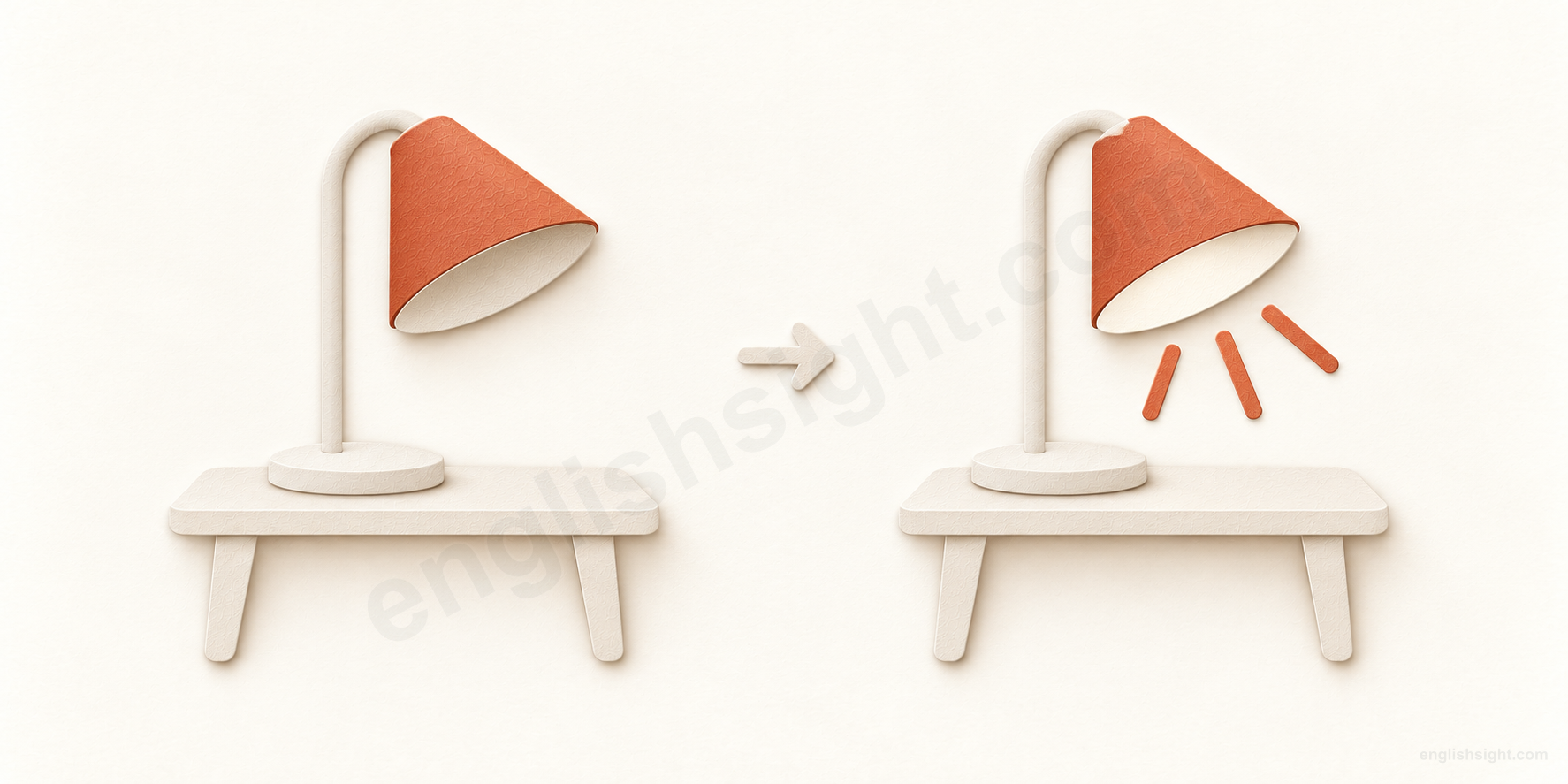
The unlit lamp rests on the table.
on
The lamp is on: it is giving light.
Its base stays in contact with the table as the light comes on.
On the table describes contact and support; the lamp is on describes operation. Other constructions need their own patterns.
A block rests against a supporting line. The line continues into an arrow, suggesting how contact, a working connection, and continuation can be remembered together.
This drawing is a memory aid, not a historical derivation or a picture shared by every English speaker. Dates and fixed idioms still need their own constructions.
A useful starting picture for on is something in contact with a supporting surface. Many abstract uses connect an activity to a basis, channel, or ongoing state, but this is a teaching link, not a rule that predicts every phrase.
On is commonly a preposition with a following complement, and an adverb or particle without one. Some dictionaries also label state uses as adjectives. This lesson organizes uses by communicative function rather than counting dictionary senses.
01
Contact, support, and location
Start with contact, then check the surface, body, place, or vehicle named after on.
01
on + surface; put + object + on / onto + surface
on the table / wall
touching or attached to a surface
Situation / starting point
You locate a stain.
Relationship / result
The stain touches the ceiling.
Contact need not be on an upper horizontal surface.
On connects an object with a surface: a cup on a table, a picture on a wall, writing on a page, or a smile on a face. Put it on the shelf describes an endpoint; onto emphasizes movement toward that endpoint. On top of specifies the upper position. Hit him on the arm names the contact area; cut her hand on glass names what caused the injury.
English example
There is a small stain on the ceiling.
Watch the difference Above means higher than; it does not require contact. On does not always mean above.
02
stand / lie + on + body part; travel on foot
on one foot / on foot
supported by a body part
Situation / starting point
Mia lifts one foot.
Relationship / result
The other foot carries her weight.
On can name the point of bodily support.
Stand on one foot and lie on your back identify the supporting body part. On your hands and knees describes a posture. Travel on foot is a fixed expression for walking, contrasted with by bus. The support picture helps, but the exact wording is conventional.
English example
Mia balanced on one foot beside the door.
Watch the difference Say on foot, not by foot, in the usual travel expression.
03
on + geographical feature / area / side
on the coast / on the left
located along, beside, or within a named area
Situation / starting point
You look for the cottage.
Relationship / result
Its location follows the coastline.
Place expressions use an established way of viewing the location.
With a building or town, on the coast or on a river places it beside that feature. A boat on the river can instead be floating on the water. On an island and on a farm refer to areas; on the left/right gives a side. On a street is especially usual in American English; British English also uses in a street.
English example
Their cottage is on the coast, just north of the port.
Watch the difference Do not use on for every place: in a city and at an address are ordinary choices.
04
be / get on + bus / train / plane / bike; get on
on the bus / get on
aboard or boarding transport
Situation / starting point
The bus is waiting.
Relationship / result
We board it for the journey.
Vehicle type affects the preposition.
On a bus, train, or plane means aboard, usually inside it. On a bike or horse describes riding. Get on describes boarding; get on without a following vehicle uses on as a particle. Ordinary car and taxi passengers are in the car/taxi and get in.
English example
We got on the bus at the station.
Watch the difference By bus describes the travel method; on the bus locates a passenger on a particular bus.
05
put on + noun; put + noun / pronoun + on; have + clothing + on
put on / have on
put clothing into place or be wearing it
Situation / starting point
The jacket is off your body.
Relationship / result
You put it around your body.
The verb distinguishes the action from the wearing state.
Put on describes dressing; have on describes what someone is wearing. Put your jacket on and put on your jacket are both possible. The same contact use appears in sew a button on and The lid is on. These are not claims that every put on expression means dressing.
English example
It is cold, so put your jacket on.
Watch the difference With a pronoun, say put it on, not put on it.
06
have + object + on + person
have something on you
have something with you now
Situation / starting point
You need a pen immediately.
Relationship / result
You ask about what someone is carrying.
Carrying is different from owning or wearing.
Have a pen or money on you asks whether it is available among your belongings now, perhaps in a pocket or bag. You may own a pen but have left it at home. This is a preposition followed by a person, unlike the particle in have a coat on.
English example
Do you have a pen on you?
Watch the difference A pen on you is not necessarily touching your skin; a coat on usually means being worn.
02
Days, timing, and onward movement
Time expressions select days, trigger points, schedules, or a period extending forward.
07
on + day / date / specified part of a day
on Monday / on Friday morning
at a named day or date
Situation / starting point
You schedule a workshop.
Relationship / result
You identify Friday morning.
A specified day selects on.
Use on Monday, on 12 June, on my birthday, and on Friday morning. Compare in the morning and at six. On Mondays marks a repeated weekday. On weekends is usual in American English; at weekends is usual in British English. Ordinary next Monday, last Friday, this morning, and every Tuesday take no on.
English example
The workshop starts on Friday morning.
Watch the difference Say next Monday, not on next Monday, for the ordinary calendar expression.
08
on + event noun / -ing form
on arrival / on arriving
when or immediately after an event
Situation / starting point
We reach the hotel.
Relationship / result
We call home at that point.
The following event is linked to an arrival or other trigger.
On arrival and on arriving mean when or just after arriving, often in written instructions or narratives. On hearing the news links a reaction to hearing it. In an -ing clause without its own subject, the understood doer normally matches the main-clause subject: here we arrive and we call.
English example
On arriving at the hotel, we called home.
Watch the difference On is a preposition here: on arriving, not on arrive or on to arrive.
09
on time; in time for + noun; in time to + verb
on time / in time
at the scheduled time versus early enough
Situation / starting point
The timetable specifies departure.
Relationship / result
The train follows it; we miss it.
Punctuality and meeting a deadline are different.
On time means according to the planned or expected time. In time means before it becomes too late for a purpose. A train can leave on time while a passenger fails to arrive in time. Neither expression is a physical surface relation; learn the complete contrast.
English example
The train left on time, but we were not in time to catch it.
Watch the difference Use in time to catch it; on time alone does not say you caught it.
10
from + time + on; early / later / further + on; and so on
from now on / later on
continuing after a starting point
Situation / starting point
We introduce a new rule now.
Relationship / result
The rule applies afterward.
On extends a time or sequence beyond a point.
From now on starts a continuing period now; from then on starts it at a past point. Later on means at a later stage, and early on means near the beginning. Further on can locate something ahead. And so on continues a list with similar items rather than naming them all.
English example
From now on, we will check every order twice.
Watch the difference From now on concerns the future; since then links a past starting point to a later period.
03
Topics, channels, resources, and targets
On connects information or activity to a particular basis, medium, resource, or target; the surrounding words specify the relationship.
11
noun + on + topic
a book on / advice on
concerning a subject
Situation / starting point
You select reading material.
Relationship / result
Birds are its subject.
The topic is the focus of the information.
A book on birds or advice on saving money introduces the subject. About is often possible; on can sound more focused or specialized, but the distinction is not absolute. In advice on saving, on takes an -ing form. The topic is not a surface the book rests on.
English example
I borrowed a book on urban birds.
Watch the difference Compare a book on the desk: that names location, not subject.
12
on + communication medium / instrument / device
on the phone / on TV / on a computer
using a medium, tool, or channel
Situation / starting point
We need to discuss a design.
Relationship / result
A phone carries the conversation.
On identifies the channel or working platform.
On TV, on the radio, and on the internet locate content in a medium; on a computer and on the piano identify a tool. Files on a disk name storage. On the phone may mean in a call, not physically on top of a handset. British call me on this number gives a contact number.
English example
We discussed the design on the phone.
Watch the difference Use on TV but on the radio; articles belong to each established expression.
13
on + list / menu / agenda / committee / team
on the list / on the committee
included in a record or belonging to a group
Situation / starting point
You check the participants.
Relationship / result
She is listed and is a member.
On can mark inclusion, not physical position.
On a list or menu means included among its entries; on the agenda means scheduled for discussion. On a committee or jury means a member. On the team is especially American; in the team is also usual in British English. On your side means supporting your position.
English example
Her name is on the list, and she is on the committee.
Watch the difference Being on a list does not automatically make someone a committee member; the noun supplies that relation.
14
be based on + noun; depend / rely on + noun / -ing / clause
based on / depend on
taking something as a basis or condition
Situation / starting point
We consider a plan.
Relationship / result
Its success needs enough helpers.
The following information supports or conditions the outcome.
Based on facts identifies a foundation; on their advice identifies a reason for acting. Depend on or rely on names a condition or source of support. On condition that introduces an explicit requirement. These are conventional constructions: on does not mean dependence after every verb.
English example
Our plan depends on having enough volunteers.
Watch the difference Say depend on having, not depend on have; the preposition can also precede what or whether clauses.
15
live / feed / run on + resource
live on / run on
use something as food, income, or power
Situation / starting point
The radio needs energy.
Relationship / result
Two batteries supply it.
A resource sustains life or operation.
Live on a pension names income used for living; live on rice names food. Feed on plants identifies food, and run on batteries identifies a power source. This is a useful abstract support link, while each verb determines the kind of resource.
English example
This little radio runs on two batteries.
Watch the difference Run on batteries says how it is powered; the radio is on says that it is operating now.
16
be on + medicine / medication / diet
on medication / on a diet
following a treatment or eating regime
Situation / starting point
He has a prescribed treatment.
Relationship / result
He is currently taking it.
On describes participation in a continuing regime.
Be on medication or on antibiotics means taking them as a treatment, not standing on them. On a diet means following an eating plan, often for weight control. The expression describes a regime; it does not by itself specify a dose, effectiveness, or medical advice.
English example
He is on medication for his allergies.
Watch the difference On medication does not mean a person is intoxicated. Other drug contexts can have different implications.
17
verb / noun / adjective + on + target
focus on / spend on / an effect on
directing attention, resources, or effects toward something
Situation / starting point
Several questions compete for attention.
Relationship / result
You select the first one.
The preceding word determines what is directed at the target.
Focus on directs attention; spend time or money on allocates resources. An effect on, a tax on, and a ban on identify what is affected. Hard on someone means treating them severely. My phone died on me adds that its failure inconvenienced me. These relations cannot all be translated as a physical surface.
English example
Please focus on the first question.
Watch the difference Learn the whole pattern: discuss a problem has no on, but a discussion on a problem can use it.
18
be on + payer; buy on credit; up / down on + comparison
on me / on credit / up on last year
assign a bill, payment arrangement, or comparison basis
Situation / starting point
We decide who will pay.
Relationship / result
I accept the lunch bill.
These financial expressions have different grammatical roles.
Lunch is on me means I will pay. Buy on credit means pay later under a credit arrangement. Interest on a loan names the sum charged in relation to it. Sales are up on last year compares with last year, especially in British usage. Learn these as distinct financial patterns.
English example
Lunch is on me today.
Watch the difference On me here assigns a cost; have money on me means carrying money.
04
States, activities, and continuation
Learn the whole expression to tell operation, an assigned activity, a temporary state, and continuation apart.
19
be / go + on + activity or duty expression
on holiday / on duty / on a trip
engaged in an activity or assigned work period
Situation / starting point
Rita starts her shift.
Relationship / result
She is working until midnight.
The noun identifies the activity or role.
On holiday or on vacation describes time away; on business describes a work purpose. On duty means currently assigned to work; off duty is the contrast. On strike means taking part in a work stoppage. Go on a trip or a course describes entering an organized activity, not switching on a machine.
English example
Rita is on duty until midnight.
Watch the difference Be on duty does not mean merely having a job; someone employed can be off duty.
20
be + on + fixed state noun
on loan / on hold / on fire
in a named temporary state
Situation / starting point
The repair cannot proceed yet.
Relationship / result
Work is temporarily suspended.
Each complete expression names its own state.
On loan means borrowed temporarily, as with a library book. On hold means waiting or suspended; a caller on hold is waiting to be connected. On fire means burning. On does not itself mean active in all such phrases: on hold is precisely a suspension.
English example
The repairs are on hold until the parts arrive.
Watch the difference Learn the whole expression; being on hold is not the same as holding an object.
21
be / go on sale
on sale
available to buy, or offered at a reduced price
Situation / starting point
Tickets are not yet available.
Relationship / result
Sales begin next Thursday.
Availability and discount are different readings.
Go on sale announces availability for purchase. On sale often means available to buy in British English; in American shopping contexts it commonly means discounted. The context decides. For sale simply says an item is offered for purchase, without promising a price reduction.
English example
Tickets go on sale next Thursday.
Watch the difference Do not assume every ticket that is on sale is cheaper than usual.
22
be on; turn / switch on + noun; turn / switch + pronoun + on
be on / turn on
operating or connected for use
Situation / starting point
You check two appliances.
Relationship / result
The lamp is operating; the heater is not.
On contrasts with off for operation.
Turn or switch on causes operation; be on describes the resulting state; leave it on keeps it that way. A light comes on when it starts shining. Collins also labels some state uses as adjectives, while Oxford treats them as adverbs. The switch label ON is a setting, not a new verb form.
English example
The lamp is on, but the heater is off.
Watch the difference Say turn it on, not turn on it. Operating does not guarantee that a machine works correctly.
23
event + be on; have + something / a lot + on
be on / have a lot on
happening, still planned, or occupying a schedule
Situation / starting point
Rain threatens the picnic.
Relationship / result
You ask whether the plan remains.
Events can be on without being underway yet.
A concert is on may mean happening or scheduled; still on often means not cancelled. What is on tonight? asks about events or programmes. I have a lot on means I am busy with commitments; it differs from I have a coat on. A performer is on when performing. What is going on? asks what is happening.
English example
Is the picnic still on for Saturday?
Watch the difference Still on does not guarantee the event has started. For an appliance, on instead describes operation.
24
go / keep / carry on + -ing; verb + on; go on to + verb; go on with + noun
go on / keep on / walk on
continue an action or proceed forward
Situation / starting point
The speaker pauses.
Relationship / result
She resumes the same activity.
On can carry an action beyond a stopping point.
Go on speaking continues speaking; keep on asking emphasizes persistence. Walk on means continue forward, and send a message on means forward it to another recipient. Go on to explain introduces the next action or stage. These patterns make continuation useful beyond the literal contact picture. Go on with the work uses with before a noun.
English example
She paused for water, then went on speaking.
Watch the difference Go on doing continues an activity; go on to do often introduces a different next activity.
05
Conversation and familiar combinations
Short expressions can encourage, request waiting, complain, or accept a challenge. Tone and construction matter.
25
verb + on and on / on and off; duration + on end; stand + object + on end
on and on / on and off / on end
continuously versus intermittently
Situation / starting point
Rain starts and stops.
Relationship / result
Several dry intervals interrupt it.
A small change in the phrase changes the time pattern.
On and on suggests continuing for a long time, often tediously: The meeting went on and on. On and off, also off and on, means at intervals: It rained on and off. Neither means that a rain switch was being operated. Repetition makes the contrast memorable.
A stated duration + on end emphasizes unbroken time: We talked for hours on end. In Stand the box on end, the same phrase instead means upright on one end, rather than flat; context selects a different reading.
English example
It rained on and off throughout the afternoon.
Watch the difference On and on is continuous; on and off includes breaks.
26
Come on!; subject + come on
Come on!
encourage, hurry, or express disbelief
Situation / starting point
A friend is about to give up.
Relationship / result
You urge another attempt.
Tone and situation select the conversational meaning.
Come on! can encourage effort or urge speed. Oh, come on! can reject an implausible claim, and may sound impatient. Separately, The heating came on means it started operating; The news comes on at nine means it starts. These are meanings of the combination, not of on alone.
English example
Come on, you can solve the last clue!
Watch the difference An encouraging Come on! and a skeptical Oh, come on! need different tone and context.
27
hold on; hold on to + object
hold on / hold on to
wait, or keep a grip
Situation / starting point
We have not located the booking yet.
Relationship / result
You ask the caller to wait.
The presence of a following object helps distinguish meanings.
Hold on asks someone to wait, especially on the phone, or stop before continuing. Hold on to the rail means maintain a grip; here to introduces the object. Hold on can also mean endure a difficult situation. Do not infer a physical grip in every phone conversation.
English example
Hold on a moment; I am looking for your booking.
Watch the difference Hold on to it keeps it in your grip; hold it on keeps it attached or in position.
28
be on about + topic; go / keep on at + person + to-infinitive
be on about / go on at
refer to a topic, or repeatedly pester someone
Situation / starting point
His account is unclear.
Relationship / result
You ask what he means.
Informal British patterns distinguish topic from the person pestered.
What is he on about? asks what he is talking about or means. Keep going on about the cost suggests repetitive, often annoying talk. Go on at someone to do something means repeatedly urge or criticize them. The at phrase names the person receiving the pressure, not the topic.
English example
What is he on about? I cannot follow his story.
Watch the difference These informal patterns can sound critical; use What does he mean? for a more neutral question.
29
you are on; it is not on; be on for + activity
You’re on! / It’s not on.
accept a challenge, reject behavior, or express willingness
Situation / starting point
A friend proposes a bet.
Relationship / result
You accept the challenge.
Fixed conversational expressions require their full context.
You’re on! accepts a bet or challenge. It’s not on says something is unacceptable, especially in informal British English. Are you on for a walk? informally asks willingness to join. These do not share one literal translation, and a person being on TV is a different use.
English example
“Bet you cannot finish first.” “You’re on!”
Watch the difference It’s not on can reject behavior; The game is not on can simply mean it is not happening.
06
Fixed phrases for everyday reasoning
These established phrases express independence, representation, intention, contrast, and a general judgment.
30
on + possessive + own
on your own
alone or without help
Situation / starting point
The shelf needs fixing.
Relationship / result
You do the work without assistance.
Context distinguishes solitude from independent action.
Live on your own means live alone. Repair it on your own means do it without help, even if people are nearby. The possessive changes with the person: on my own, on her own. This idiom does not automatically suggest loneliness or unhappiness.
English example
I repaired the shelf on my own.
Watch the difference Use on my own for me; on your own is not an unchanging phrase for every subject.
31
on behalf of + person / group; on + possessive + behalf
on behalf of
representing another person or group
Situation / starting point
The tenants need a spokesperson.
Relationship / result
You write as their representative.
The whole phrase assigns representation.
On behalf of the tenants means representing them; on their behalf expresses the same relation with a possessive. The person writing need not be one of the tenants. This is an established phrase, not a claim that tenants physically support a letter.
English example
I am writing on behalf of the tenants.
Watch the difference Keep of in on behalf of the tenants, but say on their behalf without of.
32
do + something + on purpose
on purpose
intentionally
Situation / starting point
You choose to leave it open.
Relationship / result
The open window is deliberate.
The phrase marks intention, not an accident.
On purpose means deliberately, contrasting with by accident. It does not state whether the action is helpful or harmful. For a purpose instead names a goal or intended use. The fixed preposition cannot be predicted simply from the contact sketch.
English example
I left the window open on purpose.
Watch the difference In standard English, use on purpose and by accident; do not exchange their prepositions mechanically.
33
on the one hand …; on the other hand …
on the other hand
introduce a contrasting consideration
Situation / starting point
You note a drawback.
Relationship / result
You add an advantage to weigh against it.
The phrase balances two considerations.
On the other hand introduces a contrasting point for a balanced judgment. On the one hand may introduce the first point, but is not required. It is a discourse phrase: no actual hands or surfaces are involved. It should offer a real contrast, not merely the next item in a list.
English example
The room is small; on the other hand, it is very quiet.
Watch the difference On the contrary rejects or reverses a preceding claim; on the other hand adds a contrasting consideration.
34
on the whole, + clause
on the whole
giving a general assessment
Situation / starting point
You consider the whole visit.
Relationship / result
You judge it positively overall.
A general judgment can allow exceptions.
On the whole means in general after considering the situation. A delay can coexist with an overall good visit. Compare as a whole, which treats several parts as one unit, as in judge the project as a whole. Learn both phrases rather than assigning one universal meaning to on.
English example
On the whole, the visit went well, despite the delay.
Watch the difference On the whole does not mean every detail was good or that something lasted the whole time.
35
on the / possessive + way + to + place; on the way home
on the way / on my way
during a journey or already approaching
Situation / starting point
You are traveling home.
Relationship / result
You stop for bread during the journey.
The phrase locates something within an unfolding journey.
On the way home means during the journey home; I am on my way means I am coming or leaving now. On its way can describe an item being delivered. A baby on the way means one is expected. These readings use a journey as a frame, not necessarily a visible road.
English example
I picked up bread on the way home.
Watch the difference Say on the way home without to, but on the way to the station with to.
36
be on hand (to + verb)
on hand
available when needed
Situation / starting point
Visitors may need assistance.
Relationship / result
A technician is available for them.
Availability is different from physically holding something.
On hand means available, often to help: a technician on hand or extra supplies on hand. Compare on your hands, which assigns responsibility: a problem on your hands is yours to deal with. These are established phrases involving hand, not interchangeable literal locations.
English example
A technician will be on hand to help you.
Watch the difference A technician on hand is not a person standing on your hand; the whole phrase gives the meaning.
37
be on board (with + idea); get + person + on board; take + idea + on board
on board / take on board
aboard, participating, or supporting an idea
Situation / starting point
The team considers a plan.
Relationship / result
All members support it.
A boarding expression also has established participation uses.
On board can mean aboard a ship, plane, or train. In project talk, people on board support or join the work. Take advice on board means accept and understand it, not carry it onto a boat. On the board instead means serving on a governing group, or a literal board surface. Be on board describes support; get someone on board means win that person’s support or participation.
English example
The whole team is on board with the new plan.
Watch the difference Keep the article distinction: on board and on the board have different usual readings.
38
put + idea + on paper; look + adjective + on paper
on paper
written down, or judged in theory
Situation / starting point
You read a plan.
Relationship / result
Its practical performance is still unknown.
Written appearance is different from practical evidence.
Put an idea on paper means write it down. Look good or simple on paper means appear so from the description or theory, before proof in practice. It does not assert that the plan must fail, nor require the description to be printed rather than digital.
English example
The plan looks simple on paper, but we have not tested it.
Watch the difference On paper can be literal writing or a theoretical assessment; use the context to choose.
39
question word + on earth + question; nothing on earth
what / how on earth…?
add strong surprise, frustration, or emphasis
Situation / starting point
You cannot explain a surprising success.
Relationship / result
You emphasize your question.
The fixed phrase strengthens the question rather than naming a place.
What, how, why, or where on earth adds surprise, anger, or difficulty imagining an answer. Nothing on earth can strengthen a negative statement: Nothing on earth could change her mind. This emphatic use is distinct from life on Earth, which literally concerns the planet.
English example
How on earth did you find my lost key?
Watch the difference On earth is informal and can sound irritated. A plain How did you…? is more neutral.
40
be on track to + verb / for + noun; get back on track
on track / on the right track
progressing toward the intended result
Situation / starting point
You check progress on repairs.
Relationship / result
Current progress matches the goal.
A path image supports an established progress idiom.
On track means progressing appropriately toward a result; on the right track means thinking or acting in the right direction. On the wrong track signals a mistaken approach. Back on track means progressing correctly again after a setback. The idiom does not require a train or a physical track.
English example
We are on track to finish the repairs by Friday.
Watch the difference Being on track predicts suitable progress; it does not guarantee the final result.
Use the link, then check the construction
Preposition or particle?
On the table has a complement after on. In Put it on, the clothing or device is already named and on is a particle. Separable patterns put object pronouns before on: put it on, switch it on. Depend on it is different: it follows a preposition.
Nouns and verbs contribute meaning
On duty, on fire, and on hold name different states. Go on doing and go on to do select different sequences. Do not call every verb followed by on a separable phrasal verb, or treat all combinations as physical support.
Scope and forms
On has no tense or plural forms; the surrounding verb changes. This selection covers ordinary modern uses, with selected regional notes. It is not an exhaustive idiom dictionary, a frequency ranking, an official Ogden lesson, or a text restricted to the original 850 words.
Choose the relationship that fits
Use the whole sentence and context. Each answer explains the relevant contrast.
1. A clock is attached to a vertical wall. Which sentence fits?
2. You are a passenger inside a taxi. Choose the ordinary expression.
3. You want someone to switch a lamp into operation. Choose the pronoun order.
4. The train departed at its scheduled time, but you reached the platform after departure. What fits?
5. She finishes explaining the rules, then begins demonstrating. Which pattern highlights the next activity?
6. Rain stops several times during the day. Which phrase matches?
7. All your cash is in the wallet you left at home. You still own it. What can you naturally say?
8. Repairs have been paused while parts are ordered. What does on hold mean?
Sources and teaching notes
Dictionary usage was checked in the sources below. Explanations, examples, and the sketch are original; visual connections are teaching interpretations.
One sketch offers a memory aid; it does not describe every speaker’s mental imagery.