Use only to restrict a choice, an amount, a condition, or a claim.
Include this; exclude the relevant alternatives
Include this; exclude the relevant alternatives
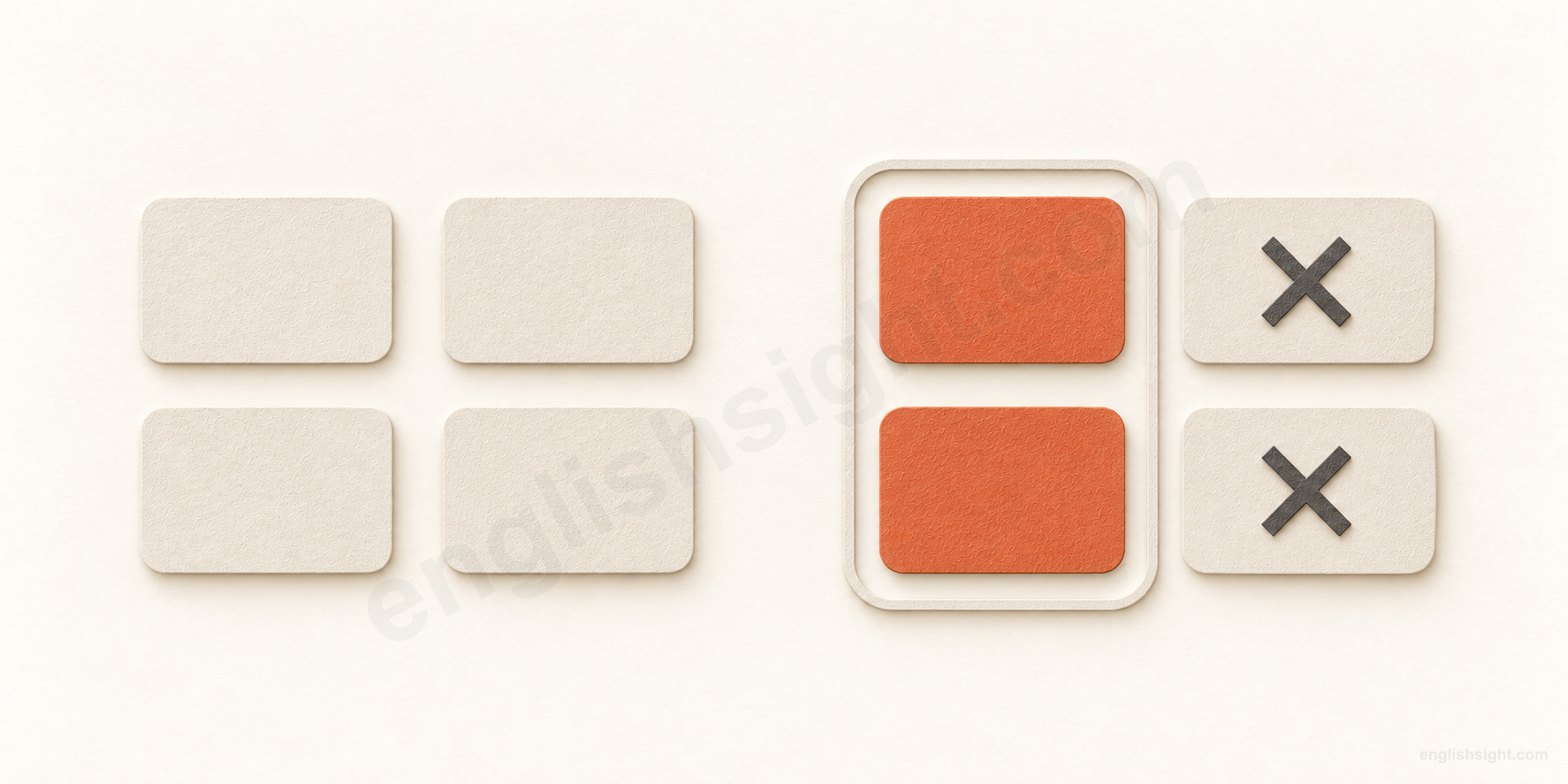
Four relevant alternatives are considered.
only
These two are included; the other two are excluded.
Restrict the claim to the two orange cards.
Only these two: the frame marks the claim’s focus; the crosses exclude the other alternatives.
Only limits a claim to its focus and excludes the relevant alternatives in that context.
This exclusion model helps with ordinary limiting uses. Wishes, unexpected-result infinitives, and intensifiers such as only too also depend on their established constructions.
Only asks us to notice what is included and which relevant alternatives are excluded. Only Ana came concerns people; Ana came only on Monday concerns days. First identify the focus, then decide what the restriction means.
The comparison is local to the situation, not everything in the world. Only can include a group, emphasize a small amount, or appear in established expressions whose meanings need more than a single sketch.
01
Which alternatives are excluded?
Identify the person, thing, action, or group that only limits. The relevant alternatives come from the conversation.
01
the / possessive + only + noun; the only one(s) + identifying detail
the only one / my only chance
identify the sole member or members that fit
Situation / alternatives
Several keys are on the table.
What is included or meant?
Just one key fits this lock.
The restriction concerns keys that fit, not all keys in existence.
The only key that fits identifies a key and rules out other fitting keys in this situation. A following relative clause, infinitive, or phrase can set the comparison: the only person I trust; the only way to enter; the only shop nearby.
Only as an adjective comes before the noun: my only chance, our only options. The only one replaces an understood singular noun; the only ones replaces a plural. Only does not always mean a total of one: our only visitors were two cousins.
I am not the only person who noticed says that I noticed and at least one other person did too. One of the only shops still open informally places a shop among very few remaining choices. If you mean exactly one, use the only shop; if several remain, one of the few shops is a clearer alternative.
In a sentence
This is the only key that fits the back door.
Watch the difference Do not add the after a possessive: my only chance, not my the only chance.
02
be + an only child; possessive + only son / daughter
an only child / an only son
describe a family relationship
Situation / alternatives
Someone asks about your brothers and sisters.
What is included or meant?
You explain that you have none.
An only child has no siblings; an only son may have sisters.
An only child is a child with no brothers or sisters. Use an with this singular countable expression when introducing the description: I am an only child. Only is still before the noun; it does not mean lonely.
Their only son means their single male child and does not rule out daughters. The noun determines the relevant group. Likewise, their only daughter may have brothers. These expressions describe family structure, not anyone’s personality.
In a sentence
Maya is an only child, so she has no brothers or sisters.
Watch the difference An only child and a lonely child describe different things; neither description guarantees the other.
03
the only + person / place / thing + for / to…
the only person for the job
present someone as the uniquely suitable choice
Situation / alternatives
Several people could apply.
What is included or meant?
You strongly recommend one candidate.
The speaker rejects other choices as unsuitable, rather than denying they exist.
In a recommendation, the only person for the job can mean the one person you regard as good enough. This is an evaluation. The sentence need not be a literal count of all possible applicants.
Compare the only applicant, which normally reports how many people applied, with the only person for the job, which can praise suitability. Context tells you whether the exclusion is factual or persuasive.
In a sentence
For a repair this delicate, Priya is the only person for the job.
Watch the difference Do not infer that nobody else is available simply from this emphatic recommendation.
04
only + subject + verb; subject + verb + only + object
Only Leo called / Leo called only Ana
limit the subject or the object
Situation / alternatives
You need to say who called whom.
What is included or meant?
Only singles out the relevant participant.
Changing the focus changes which alternatives are excluded.
Only Leo called excludes other callers. Leo called only Ana excludes other people Leo called in the relevant situation. The first sentence does not tell us how many people Leo called; the second does not say nobody else called Ana.
Keep the focus close to only when precision matters. The same logic works with a group: Only my parents came can include two people. Exclusion applies to alternatives to that group, not to each member within it.
In a sentence
Only Leo called Ana after the meeting.
Watch the difference Only at the start of a subject phrase does not require inversion: Only Leo called, not Only did Leo call.
05
only before a main verb; be + only; auxiliary + only + main verb
I only borrowed it
use context and position to identify the focus
Situation / alternatives
A friend thinks you bought a bicycle.
What is included or meant?
You correct the action: borrowing rather than buying.
A position before the verb can focus an action or a later phrase.
I only borrowed the bicycle can contrast borrowed with bought: borrowing is all I did. In I only borrowed the bicycle for a day, context may instead focus the short duration. Ordinary English often places only before a main verb, after be, or after the first auxiliary: I only borrowed it; it is only a loan; I have only borrowed it.
A rule saying only always modifies the next word is too rigid. Speech stress and context help identify the focus. In writing, reduce ambiguity by moving only next to the intended phrase: I borrowed it for only one day; I borrowed only the bicycle, not the helmet.
In a sentence
I only borrowed the bicycle; I did not buy it.
Watch the difference I only drink tea at work may concern the drink, the place, or the activity. Rephrase when the distinction matters.
06
noun phrase + only; for + person / purpose + only
members only / for your eyes only
restrict access, use, or an audience
Situation / alternatives
A room has an access rule.
What is included or meant?
People outside the named group cannot enter.
Only after a phrase can still exclude alternatives.
Members only is a shortened notice meaning access is restricted to members. The verb is understood from the situation. Cash only restricts payment methods; for information only limits a document’s purpose. Only need not come before the restricted noun phrase.
For your eyes only is a familiar way to say a document is private and should be seen by you alone. It concerns the audience, not a literal rule about which body part to use. Read-only describes a file or medium you can read but cannot change; it is a compound, not a new verb sense of only.
In a sentence
The note is for your eyes only; please do not share it.
Watch the difference Members only is natural on a sign. In a full explanation, supply the missing relation: This room is for members only.
02
Small amounts, modest claims, and time
Only can place a number, description, or time against a larger expectation. Only just has two distinct everyday readings.
07
only + number / a few / a little / once
only two / only a little
present an amount as limited
Situation / alternatives
You expected a large attendance.
What is included or meant?
The actual number is two.
Only highlights the gap between an amount and a larger expectation.
Only two people came gives the number as two while presenting it as small in context. Only a few of the guests came highlights a small part of a larger group. Only a little water uses an uncountable noun; only a few bottles uses a plural countable noun.
Only does not itself make a precise number approximate. Only about twenty is approximate because of about. She is only sixteen can emphasize youth or surprise at an achievement; it is not necessarily a complaint. Only once restricts the number of occasions.
In I have only ever visited once, ever extends the comparison across the relevant time up to now, and only once limits the number of visits. In I only ever drink tea, it can instead emphasize that tea is the sole drink throughout the occasions being discussed. Ever adds the time range; it does not make only mean never.
In a sentence
Only two people came to the workshop, although twelve had booked.
Watch the difference Only two usually states the actual number; at most two gives an upper limit and allows fewer.
08
be + only + description; only + verb
It is only a suggestion / I was only joking
make a smaller or less serious claim
Situation / alternatives
Someone takes your comment as an order.
What is included or meant?
You explain that you were offering an idea.
Only can reduce the importance, force, or seriousness of a description.
It is only a suggestion presents it as a suggestion rather than an instruction. I was only joking contrasts a joke with a serious claim or intention. Here just or merely may express a similar limitation; the speaker is managing how the listener interprets the act.
I am only human appeals to ordinary human limits, often to explain a mistake. This is a familiar expression, not a claim about being the sole human present. Downplaying an act does not make it harmless: I was only joking can sound dismissive when somebody is hurt.
In a sentence
It is only a suggestion; you can choose another date.
Watch the difference Just has many other meanings. Replace only with just only where the intended limiting meaning still fits.
09
only + time expression; only when / after + event
only yesterday / only when…
say something did not happen earlier
Situation / alternatives
You thought a decision had been known for weeks.
What is included or meant?
You learn the news arrived yesterday.
The time is later or more recent than someone might expect.
I only heard yesterday can mean I did not hear before yesterday. Only yesterday I was planning to stay can instead stress how recently that earlier situation was true. Context and tense distinguish the two perspectives.
With an event clause, I understood only when she drew a map places understanding at that point, not earlier. Only after lunch sets a later boundary. Compare I work only on Fridays, which restricts working days rather than describing a delayed discovery.
In a sentence
I only learned about the cancellation yesterday.
Watch the difference Do not translate every only + time phrase as a fixed small duration; ask whether it limits occasions or marks a late point.
10
have / had + only just + past participle; only just + past verb
have only just arrived
emphasize that something happened very recently
Situation / alternatives
A visitor expects you to be settled in.
What is included or meant?
You explain you arrived a moment ago.
Only just can make the interval since an event feel very short.
We have only just arrived says the arrival was very recent. The present perfect relates that event to the present; only just adds the sense that hardly any time has passed. It does not mean we nearly failed to arrive.
The past perfect gives the same relation to a past reference point: We had only just sat down when the phone rang. A simple past is also natural in suitable contexts, especially in American English: I only just got home.
In a sentence
We have only just unpacked, so the room is still a mess.
Watch the difference The verb and context matter: only just arrived commonly means recently; only just caught the bus commonly means barely succeeded.
11
only just + verb / adjective; clause + but only just
only just passed / but only just
say something is true by a very small margin
Situation / alternatives
The passing mark is fifty.
What is included or meant?
You score fifty-one.
The result is on the successful side of a boundary, very close to failure.
I only just passed normally says I passed narrowly. The expression can concern ability, space, money, or time: The box only just fits; I can afford it, but only just. The situation is true, although almost not true.
Only just need not refer to a recent event in this use. She only just passed the exam ten years ago still describes a narrow pass. Contrast nearly passed, which normally says she did not pass.
In a sentence
The suitcase fits under the seat, but only just.
Watch the difference Barely passed means passed; nearly passed normally means failed. Do not reverse the outcome.
03
Conditions, wishes, and adding more
Word order changes the job: only if states a requirement; if only can express a wish; not only adds another truth.
12
main clause + only if / because / when + clause
only if / only because / only when
restrict the circumstances in which something happens
Situation / alternatives
A visitor asks whether entry is possible without a ticket.
What is included or meant?
You say a ticket is necessary.
Only if introduces a necessary condition, not a wish.
You may enter only if you have a ticket rules out entry without a ticket. It does not, by itself, promise that every ticket holder will be admitted: the venue might also be full. Ordinary if introduces a condition that leads to a result; only if insists the result cannot occur without that condition.
Only because gives an exclusive explanation: I stayed only because you asked. Only when can restrict occasions or mark the point at which something finally happens. These meanings come from only limiting a clause introduced by if, because, or when.
In a sentence
You may enter the archive only if you have a reader’s pass.
Watch the difference Only if you have a pass is a condition. If only I had a pass! expresses a wish.
13
only + time / place / condition + auxiliary + subject + main verb
Only then did I understand
front a restriction for emphasis
Situation / alternatives
You give a time or condition special prominence.
What is included or meant?
The main clause uses auxiliary-before-subject order.
Fronted restrictive adverbials trigger inversion in the main clause.
Only then did I understand is a more emphatic, often more formal version of I understood only then. Use did plus the base verb when a simple past clause has no auxiliary. With another auxiliary, move that one: Only after noon can we leave; Only then was I ready.
With Only if you agree can we proceed, the if-clause keeps ordinary subject–verb order. Inversion belongs in the main clause. Only + subject does not trigger it: Only the manager can approve this. The restriction there is part of the subject, not a fronted adverbial.
In a sentence
Only after I checked the receipt did I notice the extra charge.
Watch the difference Use did I notice, not did I noticed. Do not invert inside the after-clause.
14
only have to + verb; have only to + verb
you only have to ask
present an action as enough to achieve something
Situation / alternatives
Someone thinks getting help will be complicated.
What is included or meant?
You say asking is enough.
Only limits the required effort; have to supplies the requirement.
You only have to ask can reassure someone that help is easily available. The following action is presented as sufficient. You have only to ask expresses the same idea in a more formal style.
Compare You only have to submit one form, which limits the requirement, with You must only submit one form, which can prohibit submitting more. You do not have to ask removes the obligation; it does not say asking is the simple route to a result.
In a sentence
To change the delivery date, you only have to call this number.
Watch the difference Only have to does not mean do not have to. A small requirement is still a requirement in the described procedure.
15
if only + past form / past perfect / would + verb
If only I knew!
express a strong wish or regret
Situation / alternatives
You cannot remember a needed name.
What is included or meant?
You wish you knew it now.
If only can stand alone as an exclamation of wishing.
If only I knew her name! uses a past form for an unreal present wish. If only I had saved the file! uses the past perfect to regret an earlier action that did not happen. These are wishes, not ordinary instructions about conditions.
If only the noise would stop! wishes for a change, often with frustration. With be, If only I were there is a careful standard form; was also occurs in ordinary speech. Compare I only wish I could help, where only emphasizes the wish rather than saying it can be fulfilled.
In a sentence
If only I had written down the address before my phone died!
Watch the difference The past form in If only I knew can concern now. Read the tense in this wish construction rather than as a simple past report.
16
main clause + if only to + verb / if only for + noun phrase
if only to… / if only for…
offer at least one sufficient or worthwhile reason
Situation / alternatives
A person doubts whether a visit is worth making.
What is included or meant?
You give a modest reason to go.
This if only gives a reason, rather than expressing an unreal wish.
Visit the exhibition, if only to see the drawings means seeing the drawings is reason enough, even if nothing else attracts you. The speaker concedes that the reason may be limited while still treating it as worthwhile.
For introduces a noun phrase: Go, if only for the view. To introduces an action: Go, if only to take a break. Compare If only I could go!, which is a wish and uses a clause with its own subject.
In a sentence
Come to the reunion, if only to say hello to your old teacher.
Watch the difference This is not only if reversed with the same meaning. It neither imposes a necessary condition nor automatically expresses regret.
17
not only X but (also) Y; not only + auxiliary + subject + verb
not only… but also…
add another true point emphatically
Situation / alternatives
A listener knows the shop sells books.
What is included or meant?
You add that it also sells maps.
Not denies the limitation, not the first fact.
The shop sells not only books but also maps says it sells books and maps. Keep the linked parts grammatically parallel: not only books but also maps; not only writes but also illustrates. Also can be omitted when the addition is clear.
When Not only introduces a whole clause at the front, use inversion: Not only did she write the guide, but she also drew the maps. When it is part of the subject, do not invert: Not only the guide but also the map was missing. Compare Only the guide was missing, which excludes the map.
In a sentence
The app not only saves your notes but also organizes them by date.
Watch the difference Not only does not mean neither. Both linked claims are normally affirmed.
04
Limited action, unexpected results, and exceptions
Read the full construction to distinguish what someone can do, what happened afterward, and a conversational objection.
18
can / could + only + base verb
can only guess / can only hope
present a limited response as all that is possible
Situation / alternatives
The records are missing.
What is included or meant?
You cannot establish the answer and must guess.
Can supplies possibility; only excludes more effective alternatives.
We can only guess tells the listener that reliable knowledge is unavailable. We can only hope similarly presents hope as the remaining response. Only does not change can into a past or negative form; the limitation comes from excluding other actions.
I can only apologize can acknowledge that an apology is all the speaker can offer at that point. Depending on context, it may sound sincere or inadequate. Compare Only I can apologize, which singles out the speaker rather than limiting the action.
In a sentence
Without the original recording, we can only guess what she said.
Watch the difference Can only guess does not assert that the guess is correct. It points to a limit on available knowledge or action.
19
action + will / would + only + negative-result verb phrase
will only make things worse
warn that an action has an unhelpful effect
Situation / alternatives
Someone wants to answer an angry message immediately.
What is included or meant?
You predict more conflict.
Only presents the harmful effect as the result to expect.
Replying now will only make things worse rejects the action as a useful solution. It presents worsening as the relevant outcome, rather than an improvement. The verb phrase supplies the actual harm; only itself does not always mean bad.
Compare It will only take a minute, where only minimizes time and may reassure. You must read the predicate and the situation before assigning a positive or negative tone.
In a sentence
Arguing about the delay will only upset everyone further.
Watch the difference A warning with only is a speaker’s prediction, not a grammatical guarantee about every possible consequence.
20
past event + only to + verb / only to be + past participle
only to find…
introduce an unexpected later result
Situation / alternatives
You travel to collect a reserved item.
What is included or meant?
On arrival you discover it has already been sold.
The infinitive reports what happened next, not the purpose of traveling.
She went back, only to find the shop closed presents the finding as a later, often disappointing surprise. The person who went back is also the person who found it. A passive infinitive works too: He arrived early, only to be told the meeting was cancelled.
Compare She went back to find her bag, where to find gives her purpose. In only to find the shop closed, the discovery is a narrative result. Only need not imply that the person deliberately sought that result.
In a sentence
We drove across town, only to discover that the museum was closed on Tuesdays.
Watch the difference Do not read only to + infinitive as a purpose automatically. Context distinguishes an unfortunate result from a restricted purpose.
21
it is only + fair / right / natural + to-infinitive / that-clause
It is only fair / natural
present a reaction or action as reasonable
Situation / alternatives
A person helped with the work.
What is included or meant?
You say they deserve a share of the credit.
Only can frame something as the reasonable minimum to expect.
It is only fair to thank her presents thanking her as reasonable or deserved. It is only natural to feel nervous similarly treats nervousness as an understandable reaction. The adjective states the judgment; only reinforces its appropriateness.
It was only to be expected says the result was predictable. These expressions do not normally mean a very small amount of fairness or naturalness. They are familiar evaluative combinations, so read the whole phrase.
In a sentence
It is only fair to give Sam credit for the design.
Watch the difference Only fair can mean simply reasonable; it does not mean unfair or barely fair in this construction.
22
clause + comma + only + clause / contrasting phrase
I would come, only…
add an exception, objection, or limiting difference
Situation / alternatives
You would like to accept an invitation.
What is included or meant?
You explain the obstacle.
Conjunction only can work like but or except that in informal conversation.
I would come, only I am working adds the reason the plan cannot happen. It is informal; but I am working is an easy neutral alternative. Only connects a qualification to the previous statement rather than limiting one noun.
It is like the old model, only smaller gives a difference after a comparison. You can also add a warning: Use my bike, only bring it back tonight. In careful formal writing, choose a clearer connector such as but, except that, or provided that to match the relation.
In a sentence
I would stay for dinner, only I have promised to pick up my sister.
Watch the difference Do not confuse this informal connector with Only my sister stayed, where only restricts the subject.
05
Established expressions
These familiar combinations need their own explanations. A simple exclusion sketch cannot predict every meaning.
23
only too + happy / pleased / glad + to-infinitive; know only too well
only too happy / only too well
intensify willingness or awareness
Situation / alternatives
A colleague asks whether helping is inconvenient.
What is included or meant?
You emphasize your willingness.
Only too can intensify a description rather than reduce it.
I am only too happy to help means I am very willing to help. It does not mean I am excessively happy and therefore unable to help. The whole expression carries a positive offer.
I know only too well how delays happen emphasizes strong awareness, often from unwelcome experience. Only too easy or only too likely can stress an unfortunate ease or likelihood. This established intensifier is a limit of the simple exclusion model; learn it with its adjective or adverb.
In a sentence
I would be only too happy to check the figures with you.
Watch the difference Only too happy to help conventionally expresses willingness. Compare too tired to help, where too gives a degree that prevents the action.
24
the only thing is + (that) + clause
The only thing is…
introduce a reservation about a proposal
Situation / alternatives
You like an apartment.
What is included or meant?
You mention a practical concern.
The phrase signals an obstacle after a generally positive response.
The only thing is… is a conversational lead-in to a worry or problem. You can say The only thing is that the rent is high, or leave out that. The speaker presents this as the main reservation, not necessarily a carefully verified count of every possible flaw.
Compare The only thing in the box is a cable, which is a literal restriction on the contents. The conversational pattern is recognizable from its position before a comment about a problem.
In a sentence
The apartment looks ideal. The only thing is that the kitchen is very small.
Watch the difference This informal lead-in often introduces a negative point even when the earlier comment is positive.
25
noun phrase + in name only
in name only
contrast an official label with reality
Situation / alternatives
A person has the title of manager.
What is included or meant?
Someone else makes every decision.
The title applies, but its expected substance is absent.
A manager in name only has the title without the usual authority or function. Only limits the truth of manager to the naming or official description. It does not mean that the person has only one name.
The expression can describe roles, agreements, or relationships: a partnership in name only may lack real cooperation. Explain the missing practical feature in context rather than assuming every named role has exactly the same duties.
In a sentence
After the takeover, Ben remained director in name only; all decisions came from head office.
Watch the difference In name only questions the reality behind a label, not how the label is spelled or pronounced.
26
the one and only + name; possessive + one and only + noun
the one and only
emphasize uniqueness or special status
Situation / alternatives
A host introduces a well-known performer.
What is included or meant?
The introduction gives them special emphasis.
One and only can emphasize a celebrated person or a single opportunity.
The one and only before a name is an emphatic introduction, especially for somebody famous or admired. It gives the person special status; it is not an ordinary test of whether anyone else has the same name.
Our one and only chance emphasizes that we have a single opportunity. Here the noun chance supplies what is counted. The introduction of a performer instead uses the expression to emphasize special status; context distinguishes the two functions.
In a sentence
Tonight’s guest is the one and only Elena Cruz, back with a new show.
Watch the difference This emphatic wording can sound theatrical. An ordinary introduction often needs only the person’s name.
27
only time will tell + whether / if / question-word clause
Only time will tell
say the answer depends on later developments
Situation / alternatives
A new plan has just begun.
What is included or meant?
You cannot yet know whether it will succeed.
Waiting will reveal what present evidence cannot settle.
Only time will tell means the result will become clear later. It can stand alone or introduce a question clause: Only time will tell whether the plan works. Time is personified as something that reveals an answer.
This expression advises patience about an uncertain outcome. It does not give a timetable and does not say every uncertainty will be solved automatically. Only time is the subject, so there is no inversion.
In a sentence
Only time will tell whether the new schedule improves attendance.
Watch the difference Say whether the schedule improves attendance, not whether does the schedule improve attendance; this is an embedded question.
28
be + second only to + comparison + in / for + measure
second only to
rank immediately below one comparison
Situation / alternatives
Several routes are compared by passenger numbers.
What is included or meant?
One route ranks second.
Just one competitor is ahead on the stated measure.
Second only to X puts something below X and above the other relevant competitors. Only excludes additional things ahead of it. State the measure when necessary: in size, in popularity, or in sales.
This is a ranking construction, not an instruction to choose the second item and no others. Compare second to none, which claims something is as good as any competitor rather than second in a ranking.
In a sentence
In passenger numbers, this station is second only to Central.
Watch the difference The ranking applies to the stated comparison group and measure; it need not mean second worldwide in every respect.
29
have eyes only for + person; only have eyes for + person
have eyes only for someone
describe exclusive romantic attention
Situation / alternatives
Someone is surrounded by possible romantic interests.
What is included or meant?
Their attention remains on one person.
The idiom restricts affection, not physical eyesight.
She has eyes only for her partner means her romantic interest is directed toward that person alone. Only have eyes for someone is another common order. The idiom is normally about attraction or love, not an inability to see other people.
Compare for your eyes only, which restricts who may see a document. The same words occur, but the full constructions have different established meanings.
In a sentence
At the dance, Nora had eyes only for her husband.
Watch the difference Do not use this idiom as a neutral way to say somebody is visually watching a colleague work.
Find the focus before choosing a meaning
Only does not always mean one
Only my parents came may include two people. Our only options may include several choices. The focus of only determines the included person, group, amount, or situation; context and stress can identify that focus even when it is not immediately after only.
Exclusion depends on context
Only Ana called normally compares relevant callers for an occasion. It does not claim nobody else ever made a call. The diagram’s boundary is a teaching metaphor for a limited claim, not a physical barrier.
Position, stress, and ambiguity
Only can appear before the verb while focusing something later. Use context and spoken stress to interpret it; move it close to its focus when writing a sentence that could otherwise be read in different ways.
Only, alone, and just
Only Ana came excludes other people who came. Ana came alone describes her lack of company on arrival. Just can replace only in some limiting uses, but just also means exactly, recently, or fairly, so the words are not interchangeable everywhere.
Grammar and coverage boundary
This lesson covers the adjective, focusing adverb, informal conjunction, and selected established expressions. Only is not a verb: tense, passive, causative, and separable phrasal-verb patterns are not applicable. Irish intensifying only and long sayings whose main teaching belongs to another word are not expanded here.
Choose the right restriction
Identify the alternatives, then read the whole construction.
1. Ana and Ben both made calls. Ana called no one except Leo. Which sentence expresses that restriction without claiming that Ben did not also call Leo?
2. A pass is necessary for entry, but the room may still be full. Which sentence states the necessary condition?
3. The required score is fifty. You scored fifty-one. Which sentence says you succeeded by a small margin?
4. Which version correctly emphasizes that you understood after seeing the diagram?
5. You arrived at a concert and unexpectedly learned it had been cancelled. Which sentence presents the discovery as a later surprise?
6. A device both records sound and takes photographs. What does this sentence mean: It not only records sound but also takes photographs?
7. A friend says, “I would be only too happy to help.” What is the usual meaning?
Sources and teaching notes
Usage and constructions were checked against the linked dictionaries. The explanations, situations, examples, and visual model were written for this lesson. The model is a teaching interpretation, not a dictionary definition.
The diagram is a teaching aid, not a claim that every native speaker imagines the same picture.