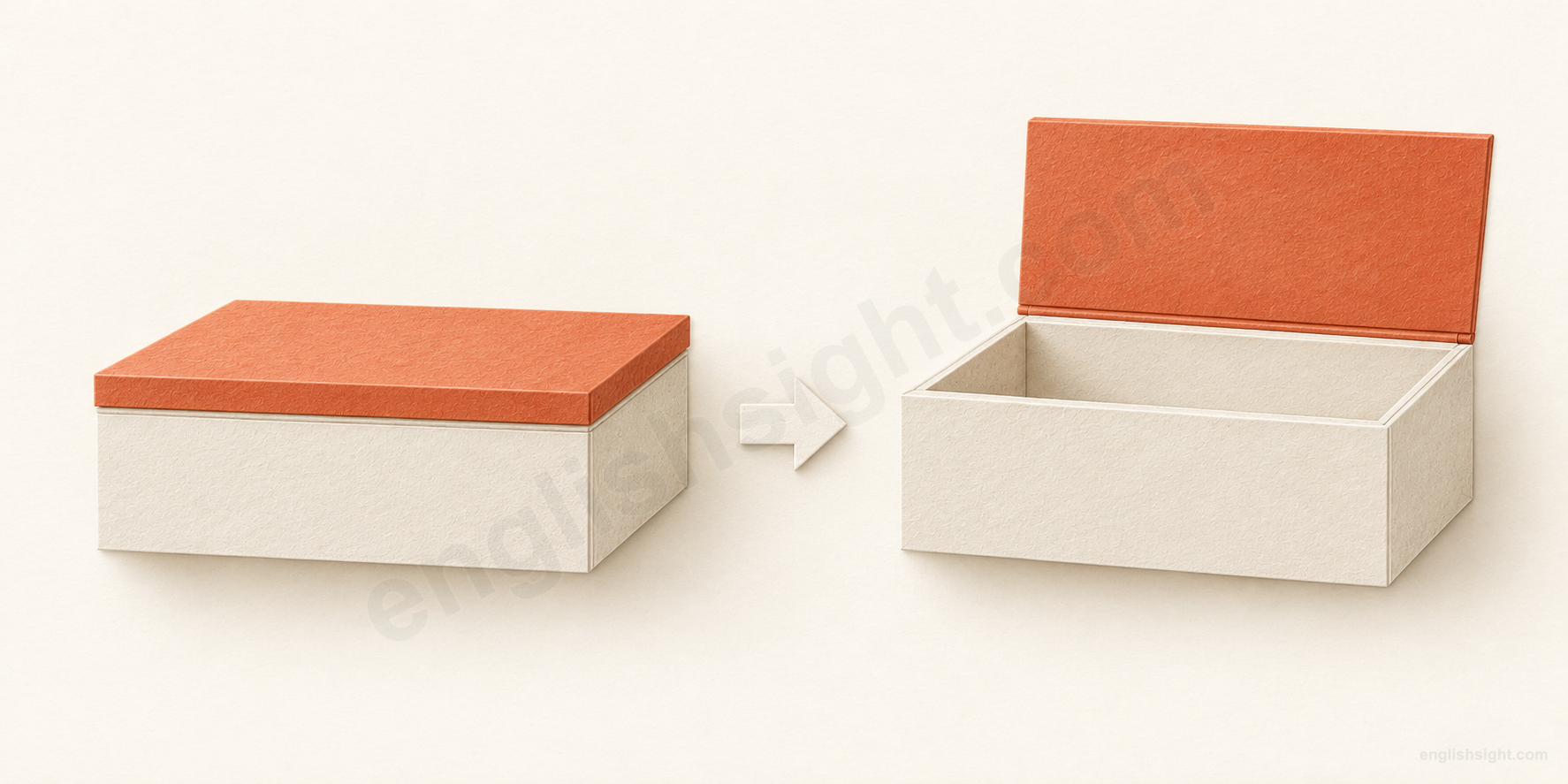
Understand open as a change, a state, a beginning and a way of leaving possibilities available.
From closure to access
From closure to access
Closed: the lid blocks access.
open
Open: the empty interior is accessible.
The lid lifts away from the opening.
Opening makes access possible; nothing has to enter or leave.
Something is not shut or restricted, so its interior, use or possibilities are accessible.
The box models a physical opening. Availability, frankness and unsettled choices extend the connection in different ways; starting an activity and fixed idioms must also be learned in their own constructions.
A closed lid hides an interior and limits access. Open the lid and the interior becomes accessible. As an adjective, open describes that resulting condition; as a verb, open can describe the change that brings it about.
Many figurative uses concern access, exposure or possibilities that have not been closed off. Beginning a meeting or account is an established further branch. The connection is a learning aid, not a rule that generates every use or a claim about a picture shared by all English speakers.
01
Things no longer shut or covered
Doors, containers and folded things become accessible in different physical ways. Distinguish the act of opening from the state open.
01
person + open + door; door + open
open the door / the door opens
move something away from a closed position
Situation before / context
The door covers the entrance.
State, result or intended meaning
The entrance is no longer covered.
The door changes position; a person need not pass through.
In I opened the door, the subject I names the person causing the change, and the door is the object. In The door opened, the door is the subject and no agent is named. The second sentence does not necessarily say the door moved by itself.
The same alternation works with many windows, gates and lids. Unlocking a door only releases its lock; it may still be shut. Opening it changes its position. A road can also open when a blockage is removed; a border can open when crossing becomes permitted.
In a sentence
I opened the gate, but the dog stayed in the garden.
Watch the difference Opening an entrance makes passage possible; it does not assert that anyone goes through.
02
open + container / package / coat
open a box / bottle / envelope
remove a closure to reach what is inside
Situation before / context
A package is sealed.
State, result or intended meaning
Its contents can be reached.
The closure, rather than the whole object, is changed.
An object can be opened by lifting a lid, unscrewing a cap or breaking a seal. The object of open names the container even when only one part moves or is removed.
Open a parcel does not mean empty it. You can open it and leave everything inside. With clothing, open your coat usually means undo its fastenings, rather than take the coat off.
In a sentence
Please open the box without removing the labels.
Watch the difference Open the bottle and pour out the water are separate actions.
03
open + book / umbrella / hand; flower + open
open a book / umbrella / hand
move parts apart or unfold them
Situation before / context
The object is folded or its parts are together.
State, result or intended meaning
Its spread shape is exposed.
An object can open without creating an entrance.
Opening a book separates its covers and pages so you can read inside. Opening an umbrella spreads its canopy. Opening a hand releases a fist or spreads the fingers. The object determines the physical mechanism.
An open book describes its position; an opened book can emphasize that someone has opened it. A flower opens when its petals spread. These uses connect to revealing an interior, but do not all involve removing a lid.
In a sentence
She opened the umbrella before stepping into the rain.
Watch the difference Open an umbrella does not mean switch it on; use turn on for many electrical devices.
04
open + possessive + body part; open wide
open your eyes / mouth / arms
move body parts apart
Situation before / context
Her eyes are shut.
State, result or intended meaning
She lifts her eyelids and can see.
The body part and context determine the action.
Open your eyes normally concerns eyelids; open your mouth concerns lips or jaws. These are ordinary physical uses. A dentist may ask you to open wide, with your mouth understood and wide describing the extent.
Open your arms means spread them, often in preparation for a hug. It does not by itself mean a hug has happened. Figurative open your eyes to a problem concerns awareness and is taught separately.
In a sentence
The dentist asked me to open my mouth a little wider.
Watch the difference Use your eyes with a person: Open your eyes, not usually Open the eyes when giving that person an instruction.
05
be / stay / remain + open; keep / leave + object + open
be / stay / keep / leave open
describe or maintain an unclosed state
Situation before / context
The window is already not shut.
State, result or intended meaning
It remains that way.
Open is an adjective here; no new opening event is required.
The window is open states its present condition. The window was opened reports an opening event, often with an understood or named agent: It was opened by the caretaker. Compare It has been open all morning with It was opened at eight.
Stay or remain open describes continuation. Keep the window open means maintain that state; leave it open means do not close it when you go or finish. The object before open is the thing in that state.
In a sentence
We left the window open while the paint dried.
Watch the difference For a state, say The door is open. The door is opening describes a change in progress.
The first verb supplies the manner or cause; open supplies the resulting state.
Push the door open tells how to cause the change. Pull it open, tear the packet open and force the lid open use different actions with the same result adjective. You can also say push open the door.
The door burst open means it opened suddenly or violently. In The wind blew the door open, the wind causes the result. These are result constructions, not a collection of open phrasal verbs.
In a sentence
A gust of wind blew the kitchen door open.
Watch the difference With a pronoun say Push it open, not Push open it. The verb explains the action, not open alone.
07
open + space / countryside / sea; in the open air
open spaces / in the open air
describe an area without enclosure or a covering
Situation before / context
You leave a narrow built-up street.
State, result or intended meaning
You reach fields with little enclosure.
Open can describe a place without implying it used to be closed.
Open countryside and open spaces suggest a lack of enclosing buildings, trees or other obstacles. The open sea contrasts with sheltered or coastal waters. The relevant lack of enclosure depends on the noun.
In the open air means outdoors. An open container has no covering across its top; an open wound has broken skin rather than intact skin covering it. These are descriptive meanings, not instructions or medical advice.
In a sentence
We ate lunch in the open air beside the lake.
Watch the difference An open space is not necessarily public land or a place you are allowed to enter.
08
door / room / passage + open into / onto + place
open into / onto a room or garden
lead directly to another place
Situation before / context
You describe the layout of a house.
State, result or intended meaning
You identify what lies beyond an opening.
The subject is a door, room or passage; the following place is its destination.
The kitchen opens onto the garden says you can go directly from the kitchen to the garden. A corridor opens into a hall in the same layout sense. It need not describe a door physically moving at that moment.
Into often names an interior space and onto a surface or outside area. Choose them to fit the place, rather than treating either as an object particle you can move after a noun.
In a sentence
The sitting room opens onto a small balcony.
Watch the difference Say opens onto it. You cannot separate onto as in opens it onto to express this layout.
02
Business, activities and services begin
Open also marks a beginning: serving customers, launching a place, starting proceedings or making a service usable.
09
shop + open + at / on; shop + be open + from … to / until …
open at nine / be open until six
start serving customers versus be available during hours
Situation before / context
Customers are waiting before business begins.
State, result or intended meaning
The shop starts serving them at nine.
Opens gives a beginning; is open describes the period of availability.
The shop opens at nine identifies when service starts. It is open from nine to six describes its hours. It opens on Sundays can mean it starts business on those days; it is open on Sundays directly states Sunday availability.
We open the shop at nine names the staff as the cause. A locked staff entrance or closed exterior door does not necessarily tell you whether a business is trading: business availability is the important meaning.
In a sentence
The library opens at ten and is open until seven.
Watch the difference Use open for the state and closed for its usual opposite: The library is closed today.
10
open + business / building; new place + open; be officially opened by + person
open a café / a new museum opens
begin operating for the first time
Situation before / context
A new business has not started trading.
State, result or intended meaning
Its operation begins.
Context distinguishes a launch from routine daily opening.
They opened a café last year normally means they established it and began serving customers. The café opens at seven usually concerns its daily hours. A new café opens tomorrow may announce its first day.
A public building may be officially opened by a guest at a ceremony. That is a passive verb form; it focuses on the event or person inaugurating the place. The ceremony and the first day of operation need not coincide.
In a sentence
A new science museum will open in our town next spring.
Watch the difference Starting a company and opening its doors each morning are distinct senses, resolved by context.
11
open + meeting / talks; meeting / exhibition + open
open a meeting / talks / a show
begin organized proceedings or public performances
Situation before / context
The participants are ready to begin.
State, result or intended meaning
The formal activity starts.
The thing opened is an activity, not a physical container.
A chair can open a meeting or a government can open talks. The meeting or talks can also open without an object. This beginning sense is established with particular activities; it is not a general substitute for start with every verb or noun.
A play or exhibition opens when its public run begins. The exhibition is open until Sunday instead describes when visitors may attend. Open at a price in a market report is a specialized beginning-of-trading use.
In a sentence
The chair opened the meeting by welcoming the new members.
Watch the difference Normally say start cooking, not open cooking. Learn which activities naturally take open.
12
open (an activity) with + noun; open (an activity) by + -ing
open with a joke / open by thanking someone
specify the first part of an activity
Situation before / context
A speaker is about to begin.
State, result or intended meaning
A particular action comes first.
With names initial content; by introduces the action used to begin.
The talk opened with a question identifies its first content. I opened by asking a question identifies my first action. You can also name the activity as an object: I opened the talk with a question.
With takes a noun phrase, while by in this construction takes an -ing form. Neither expression requires a separate particle meaning; they attach information to the ordinary beginning sense.
In a sentence
Mina opened her presentation with a photo of her hometown.
Watch the difference Say opened by showing a photo, not opened by show a photo.
13
open + account + with a provider / at a bank
open an account
establish a service relationship or account
Situation before / context
You do not have an account with this provider.
State, result or intended meaning
An account is set up for your use.
The account begins to exist for you; it is not a lid being moved.
Open a bank account means arrange a new account with the bank. An account with a supplier similarly lets you use their services under that account. The provider is commonly introduced by with; a bank location can follow at.
Opening an existing account page on a screen means accessing it, a separate digital sense. Create an account is also natural for many online services. Log in means enter an existing account using credentials.
In a sentence
I opened an account with a local bank when I moved here.
Watch the difference Open an account does not mean deposit money every time or log in to an existing account.
14
open + file / app / link; open + file + in a program
open a file / app / link
make digital content or a program available for use
Situation before / context
A document is stored but not displayed.
State, result or intended meaning
It is displayed in an application.
The action gives access to content; it does not necessarily create or change it.
Open a file tells a program to display or load it. Open an app launches it or brings it into use. A link can open a web page, often in a new tab; the precise behavior depends on the software.
An open file describes one currently loaded or accessible in a program. Opening, editing, saving and downloading are different operations. Turn on the computer refers to its power, while open a file concerns its content.
In a sentence
Could you open the document in the browser?
Watch the difference A file may already exist when you open it. Use create when you mean make a new file.
03
Access, availability and unsettled possibilities
Ask what is available, who may take part, or what has not been settled. The words after open specify the relationship.
15
be open to + people; an open + meeting / competition
open to the public / open to members
allow a specified group to enter or take part
Situation before / context
You want to know who may attend.
State, result or intended meaning
The stated group is eligible.
To identifies permitted participants, not a promise that everything is free.
An exhibition open to the public admits the public. A class open only to members restricts eligibility to members. Open for visitors or open for business emphasizes availability for that purpose; open to visitors identifies who has access.
An open meeting allows attendance beyond a closed selected group. An Open in a sporting title names a competition with entry rules; it does not promise that any person can enter without qualification. Open access describes access without some usual restrictions, with details depending on context.
In a sentence
The workshop is open to beginners, but booking is required.
Watch the difference Open to everyone does not automatically mean free of charge or available without registration.
16
offer / position + be / remain open; option + be open to + person
the offer is still open / options open to us
be available to accept or use
Situation before / context
You have not accepted an offer.
State, result or intended meaning
You can still choose to accept it.
Availability does not mean the choice has already been taken.
An offer, job or place that is open remains available. A position can be open for applications. Choices open to you are choices you are able to make; the phrase says nothing about which one you prefer.
An open ticket or open return leaves the travel date unfixed within the ticket’s conditions. In a different commercial expression, goods sold on the open market are generally available to buyers rather than offered only within a restricted arrangement.
In a sentence
The offer is still open if you decide to join us.
Watch the difference An open offer can expire later; open does not mean permanently available.
17
keep + communication channels / lines + open; applications + be open
keep lines of communication open
maintain the ability to contact or exchange information
Situation before / context
Two teams need to stay in touch.
State, result or intended meaning
They can continue exchanging messages.
The channel stays usable; no physical door is required.
A phone line that is open can take calls, often during stated hours. Keeping communication channels open means preserving ways to talk and exchange information, especially during difficulty.
Applications, entries or nominations are open when submissions are being accepted. Here open for applications names a purpose or process. Open to applicants names the people who may participate. Neither form means an application will succeed.
In a sentence
Even during the dispute, both teams kept the lines of communication open.
Watch the difference Open lines of communication is a conventional metaphor; it does not require a telephone line.
18
remain an open question; keep / leave + options + open; race + be wide open
an open question / keep your options open
leave a decision or outcome unsettled
Situation before / context
You have several possible plans.
State, result or intended meaning
No final choice has excluded the alternatives.
The future is not yet fixed.
An open question is a matter whose answer has not been settled. The race is wide open means the winner is not yet predictable or decided, not that the runners have a wider track.
Keep your options open means avoid committing too soon so you can still choose later. Leave the date open means do not settle it yet. These uses connect to possibilities that have not been closed off; they do not necessarily imply indecision is bad.
In a sentence
I’m keeping my options open until I hear from all three colleges.
Watch the difference An open question meaning an unsettled matter differs from an open question asked in an interview.
19
be open to + debate / interpretation / negotiation
open to debate / interpretation / negotiation
allow discussion, different readings or bargaining
Situation before / context
A claim, text or price is being considered.
State, result or intended meaning
It can be discussed or understood in more than one way.
The noun after to identifies the process that remains possible.
Open to debate means a matter can be questioned or discussed. Open to interpretation means wording or evidence can reasonably be understood in different ways. Open to negotiation means terms may be discussed and changed by agreement.
The price is not open to negotiation rejects bargaining. A person who is open to suggestions is willing to consider them, whereas a clause open to interpretation permits more than one reading. The same surface grammar has different relations.
In a sentence
The delivery date is fixed, but the price is open to negotiation.
Watch the difference Here to is a preposition: open to negotiating is possible; open to negotiate is not this adjective pattern.
20
subject + be + (wide) open to + criticism / abuse / attack; leave + someone / something + (wide) open to + harm
open to criticism / abuse / attack
be exposed to an unwanted consequence
Situation before / context
A weak rule offers little protection.
State, result or intended meaning
People may exploit it.
Open to can describe vulnerability, without willingness or approval.
A policy open to criticism has features people can criticize. A system open to abuse can be misused. Leave yourself wide open to attack means put yourself in a particularly vulnerable position.
The subject may be a person, idea or system. To names the possible harmful response. This differs from being open to ideas: nobody needs to welcome criticism or abuse for the vulnerability meaning to apply.
In a sentence
Without clear limits, the refund policy is open to abuse.
Watch the difference Open to abuse does not mean wanting abuse. Interpret the complement and the situation together.
04
What people reveal or consider
A person can reveal feelings, consider ideas or make an attitude visible. These meanings do not require a literal opening.
21
be open with + person + about + topic
be open with someone about something
speak without concealing relevant thoughts or facts
Situation before / context
A friend asks why you are worried.
State, result or intended meaning
You tell them honestly.
With names the listener; about names the topic.
Be open with me asks for frankness with the speaker. Be open about the mistake names what is being discussed. You can combine them: Be open with your manager about the delay.
An open person willingly shares thoughts or feelings. Open often suggests frankness and willingness to communicate; it does not necessarily imply rude bluntness, or a duty to tell every private detail to everyone. The noun openness names this quality.
In a sentence
Leo was open with his team about the reasons for the delay.
Watch the difference Open to someone’s ideas means receptive; open with someone means frank in communicating with them.
22
open + feeling / conflict; speak / disagree + openly
open admiration / an open argument
be plainly shown rather than hidden
Situation before / context
A feeling or disagreement could be concealed.
State, result or intended meaning
It is expressed where others can notice it.
Visible or public does not automatically mean friendly or honest.
Open admiration is admiration someone clearly shows. Open hostility is hostility that is no longer disguised. An open argument is not being kept private. The adjective concerns visibility, not whether the feeling is positive.
An open discussion can emphasize frank exchange, while open proceedings can emphasize public access. Read the noun and situation. The adverb openly describes how someone acts: They openly disagreed.
In a sentence
The announcement was greeted with open hostility.
Watch the difference Do not assume an open conflict is an honest discussion; openness can simply mean that others can see it.
23
be open to + noun / -ing; keep an open mind about / on + topic
be open to ideas / keep an open mind
be willing to consider a possibility
Situation before / context
You have a view but have not heard the proposal.
State, result or intended meaning
You are willing to consider it fairly.
Considering an idea is different from already accepting it.
I’m open to suggestions invites others to propose ideas. An open mind is a willingness to hear evidence or alternatives without deciding too early. Keep an open mind about the plan asks for that attitude to continue.
To is a preposition here, so a verb takes -ing: open to trying a different approach. Open your mind to something means become willing to think about it. None of these expressions commits you to agreement.
In a sentence
I’m open to changing the schedule if it helps the team.
Watch the difference Say open to trying it, not open to try it in this receptive-adjective construction.
24
ask + an open / open-ended question
ask an open question
invite an answer beyond a fixed yes or no
Situation before / context
An interviewer wants a fuller response.
State, result or intended meaning
The respondent can explain in their own terms.
The form of the question leaves room for explanation.
An open question, also called an open-ended question, invites a developed response. What helped you learn? gives room for an account; Did you enjoy the class? offers a yes-or-no choice.
This interview use differs from It remains an open question whether the class will continue, where open means unresolved. Both leave room, but one concerns the response format and the other the state of knowledge or decision.
In a sentence
The interviewer asked an open question: “What would you change about the course?”
Watch the difference A question starting with what is not automatically open-ended: What is your age? still asks for a narrow factual answer.
05
Open up, open out and their different meanings
Learn the subject and object with each particle expression. An opportunity, a person and a crack do not open up in the same way.
25
open up + noun; open + noun / pronoun + up; open up!
open up / open it up
open something shut, often with added emphasis
Situation before / context
A door or package is still shut.
State, result or intended meaning
Someone makes it accessible.
Up is a particle; its presence need not add a new dictionary sense.
Open up! can be an urgent command to open a door. Open up the box and open the box up both work with a noun object. With a pronoun, say open it up. Up can make the opening sound more emphatic or thorough, depending on context.
Open up the shop can mean prepare it for daily business; open up a new shop can mean start a business. The object and time expression identify the sense. Up does not invariably mean upward movement.
In a sentence
Could you open it up so we can see what is inside?
Watch the difference Say open it up, not open up it. This separability does not apply to open onto the garden.
26
open + place / field + up to + people; open up + place / field; place + open up
open up an area / market to people
make a place or field accessible to more people
Situation before / context
A region is hard to reach.
State, result or intended meaning
A new connection makes it accessible.
The object is the place or field made accessible; to names those gaining access.
A railway can open up a region to visitors. A change in policy can open up a market to new businesses. The cause is the subject, the accessible place or field is the object, and to introduces the people gaining access.
An economy can also open up, becoming accessible to outside involvement. This may bring benefits or difficulties; the phrase itself does not guarantee a good result or universal access.
In a sentence
The new ferry service opened up the island to day visitors.
Watch the difference Open it up to visitors is possible; do not put a pronoun after up in this transitive pattern.
27
open up + opportunities + for someone; opportunities + open up
open up opportunities / possibilities
create new chances or options
Situation before / context
A person has limited choices.
State, result or intended meaning
New choices become possible.
The object is a possibility created, rather than a destination reached.
A skill, discovery or change can open up opportunities for someone. Opportunities can also open up for someone, with no cause named in the sentence. For identifies the beneficiary.
This shares the availability connection with opening up a market, but the object here is the new chance itself. It says there are possible paths to pursue, not that the person has already succeeded.
In a sentence
Learning to code opened up new career options for Hana.
Watch the difference A possibility opening up is not the same as a guaranteed job offer.
28
person + open up + to someone + about something
open up to someone about something
start sharing thoughts or feelings more freely
Situation before / context
A person has been reluctant to talk.
State, result or intended meaning
They begin speaking about personal feelings.
The person opens up; to identifies the listener and about the subject.
She opened up to me about her worries describes a change toward freer communication. In contrast, She is open with me describes a quality or current relationship without necessarily highlighting a change.
This use is normally intransitive: you encourage a friend to open up, rather than open the friend up to mean make them confide. British English also uses open out to someone in this sense. The container connection is a teaching metaphor, not a claim that feelings are literal objects.
In a sentence
After a few meetings, he opened up to the counselor about school.
Watch the difference Open someone up can have physical or other meanings; it is not the usual equivalent of help someone confide.
29
crack / gap + open up; open up + a lead; a division opens up between + people
a crack / gap / lead opens up
appear or develop into a gap or difference
Situation before / context
A surface or a competition shows little separation.
State, result or intended meaning
A crack or difference develops.
Not every opening is an opportunity or a welcome change.
A crack opens up when a split appears or widens. A wound can open up again when it separates after being closed. These physical uses concern a gap developing.
A runner opens up a lead by getting ahead of competitors; a gap opens up between teams when their positions separate. A division can open up between people who disagree. The same pattern may describe physical distance, a score difference or disagreement.
In a sentence
During the final lap, Ravi opened up a lead of several metres.
Watch the difference Open up a lead describes gaining an advantage; open up to a friend describes communication.
30
open + folded object + out; place + open out into + larger place
open a map out / a path opens out
unfold something or become wider
Situation before / context
A folded map hides much of its surface.
State, result or intended meaning
It spreads out for viewing.
Out highlights extension or widening.
Open the map out means spread it so you can see more of it. With a pronoun, say open it out. A folding table can open out to become larger, and a street can open out into a square.
The intransitive widening use has no object to move: The path opens out. The British personal use open out to someone means become more communicative and belongs with the open up feelings unit. Out does not always indicate movement from inside to outside.
In a sentence
Beyond the trees, the narrow path opened out into a wide clearing.
Watch the difference Open into describes a connection; open out into emphasizes the space becoming wider.
06
Established images in everyday expressions
These expressions have learned meanings of their own. A useful image can connect them, but cannot predict every idiom.
31
open doors for + person; open the door to + noun / -ing; leave the door open for + possibility
open doors / open the door to something
make advancement or a new development possible
Situation before / context
A person or project faces limited opportunities.
State, result or intended meaning
A new route becomes available.
The door is figurative; the outcome can be good or bad.
A qualification can open doors for someone by improving access to jobs or experiences. An agreement can open the door to cooperation. The noun after to names the possible development.
Leave the door open for future talks means preserve that possibility rather than exclude it. These expressions do not say the opportunity will definitely be taken. A policy can also open the door to fraud, so the development need not be desirable.
In a sentence
The training course opened doors for several young designers.
Watch the difference In open the door to working abroad, to is a preposition followed by -ing.
32
welcome / receive + someone or something + with open arms
welcome someone with open arms
welcome someone very warmly
Situation before / context
A visitor arrives or someone offers to help.
State, result or intended meaning
They receive an enthusiastic welcome.
The expression describes the welcome, even without a literal hug.
We welcomed her with open arms means we were very pleased to have her with us. People can also welcome a proposal or assistance with open arms, extending the welcome to something other than a person.
The physical image is arms spread to receive someone, but the idiom does not report a particular body movement. The whole phrase supplies the warm, enthusiastic meaning.
In a sentence
The neighborhood welcomed the new family with open arms.
Watch the difference With open arms does not mean open-minded; a warm welcome and willingness to consider ideas are different.
33
something + open + someone’s eyes + to something
open someone’s eyes to something
make someone realize something they had not understood
Situation before / context
You have overlooked a problem.
State, result or intended meaning
An experience makes you aware of it.
The change concerns understanding, not eyelid position.
An experience can open your eyes to a difficulty, injustice or unexpected pleasure. The cause is the subject; the person’s eyes form the object; to introduces what they come to recognize.
You can open your own eyes to something by beginning to recognize it. Unlike a literal request to open your eyes, this expression concerns a new awareness and often changes a previous view.
In a sentence
The visit opened my eyes to how much work goes into the exhibition.
Watch the difference To here introduces the object of awareness; the phrase need not involve seeing with the eyes.
34
keep + your eyes / ears + open + for something
keep your eyes / ears open
stay alert for something you might notice
Situation before / context
You may encounter something useful.
State, result or intended meaning
You pay attention so you can notice it.
Keep marks continued attentiveness.
Keep your eyes open for a used bike asks someone to watch for one. Keep your ears open for news asks them to listen for useful information. These can describe ordinary attentiveness rather than a deliberate continuous search.
The eyes expression can also be literal when someone is trying not to fall asleep. The for phrase and situation usually make the intended meaning clear. Keep an eye open for something is a related alternative.
In a sentence
Keep your eyes open for a small desk when you visit the second-hand shop.
Watch the difference The idiom means remain alert; it does not require staring continuously.
35
do / enter something + with your eyes open
go into something with your eyes open
act while knowing the possible risks or consequences
Situation before / context
Someone understands a difficult choice.
State, result or intended meaning
They choose with awareness of what may happen.
Awareness is present when the decision is made.
I took the job with my eyes open means I knew its possible difficulties before accepting. This does not guarantee that I predicted every event or made the best choice.
Compare The job opened my eyes to the problem, which describes gaining awareness, and Keep your eyes open for problems, which asks for continued alertness. The grammar identifies when awareness matters.
In a sentence
We began the project with our eyes open, knowing that funding might stop.
Watch the difference With your eyes open is not a claim that every risk was controlled or avoided.
36
open + your heart + to someone
open your heart to someone
share deeply private thoughts or feelings
Situation before / context
Someone has kept an important feeling private.
State, result or intended meaning
They confide it to a listener.
To names the listener or audience receiving the personal disclosure.
Open your heart to someone presents intimate disclosure. It is usually more emotionally intense than simply being open about a schedule change. The listener may be a trusted friend, but people can also open their hearts to a public audience. Pour out your heart is a related expression for expressing deep feelings.
Open up to someone can describe a gradual move toward freer conversation. Open your heart emphasizes the private or heartfelt content. Neither expression means the listener must agree or solve the problem.
In a sentence
She opened her heart to her sister about how lonely she felt.
Watch the difference This is an idiom about confiding, not a literal description of the heart opening.
37
person / life + be + an open book
be an open book
be easy to understand or know about
Situation before / context
A person’s feelings might be difficult to read.
State, result or intended meaning
Their thoughts or life seem readily knowable.
The person is compared to accessible written information.
Calling someone an open book suggests there is little mystery about their thoughts, feelings or life. My life is an open book similarly says there is little being hidden.
This is an idiomatic description, not a guarantee that another person knows every fact. A literal open book is simply a book with its pages spread; the grammatical subject and context distinguish them.
In a sentence
You always know when Sam is excited; he’s an open book.
Watch the difference Do not infer that every open person is completely predictable; the idiom is an expressive comparison.
38
it is an open secret that + clause
an open secret
be widely known despite being treated as secret
Situation before / context
People officially avoid admitting a fact.
State, result or intended meaning
Many people nevertheless know it.
The tension between open and secret is intentional.
An open secret is information many people know even though it is supposedly private or not officially acknowledged. It can concern a workplace decision, relationship or public situation.
The expression does not merely mean a secret someone has just revealed. What matters is the contrast between widespread knowledge and the pretense or expectation of secrecy.
In a sentence
It was an open secret that the company planned to move its office.
Watch the difference Open secret does not mean secret password or information that nobody knows.
39
have / extend + an open invitation + to visit / stay
an open invitation to visit
allow someone to visit without fixing one occasion
Situation before / context
Friends may want to visit in the future.
State, result or intended meaning
They know they are welcome at a suitable time.
Open leaves the occasion unfixed.
An open invitation to stay or visit is an ongoing welcome rather than an invitation tied to one date. It may be addressed to particular people; open does not automatically make every invitation public.
There is also an ordinary access use, an invitation open to all members, meaning all those members are eligible. The ongoing-welcome idiom is distinguished by the context of visiting whenever suitable.
In a sentence
You have an open invitation to stay with us whenever you’re in town.
Watch the difference An open invitation still depends on the context and reasonable arrangements; it is not unlimited permission for anything.
40
be + an open invitation + to undesirable people / to do something
an open invitation to thieves / trouble
make an undesirable action tempting or easy
Situation before / context
A careless arrangement offers little protection.
State, result or intended meaning
Someone may be encouraged to exploit it.
Invitation is figurative, not a genuine welcome.
Leaving valuables in plain view can be an open invitation to thieves. This means the situation makes theft attractive or easy, not that the owner wants to invite thieves.
The expression can also take a to-infinitive describing the encouraged action: an open invitation to cheat. Here to cheat is a verb phrase, whereas to thieves is a prepositional phrase naming people.
In a sentence
Leaving the unlocked bicycles outside was an open invitation to thieves.
Watch the difference This critical use differs from a sincere open invitation to stay with friends.
41
be / sit / sleep + (out) in the open
sleep / sit out in the open
be outdoors without the shelter of a building
Situation before / context
People leave a building or shelter.
State, result or intended meaning
They are outside in an exposed place.
The open is a noun phrase for outdoor, unenclosed space.
In the open or out in the open can describe being outside without a building around you. Out often reinforces the outside or exposed position. The expression can be pleasant or emphasize a lack of shelter, according to the scene.
This is distinct from a secret being out in the open. With people, animals or objects in a physical location, an outdoor or exposed reading may fit; with information, the public-knowledge reading usually fits.
In a sentence
We slept out in the open and watched the stars.
Watch the difference Do not say in open for this expression: retain the article in the open.
42
matter + be out in the open; bring / get + matter + out into the open
bring / get something out into the open
make a hidden matter known or discussable
Situation before / context
A disagreement has been concealed.
State, result or intended meaning
People can acknowledge and discuss it.
The change is from secrecy to public or shared awareness.
A problem is out in the open when the relevant people know about it rather than keep it hidden. Bring it out into the open describes causing that change; get it out in the open often emphasizes finally acknowledging it.
The relevant public may be a family or team, not the whole world. Public knowledge also does not guarantee a solution. Compare an open secret: that expression emphasizes something supposedly secret that people already know.
In a sentence
We need to get our disagreement out in the open before planning the trip.
Watch the difference A hidden issue coming into the open need not be a physical move outdoors.
43
open fire + on + target; guns / shooters + open up
open fire / guns open up
begin shooting
Situation before / context
A report describes an armed incident.
State, result or intended meaning
Shooting starts.
The whole expression means begin shooting; fire has its gunfire meaning.
Open fire is a fixed expression common in news and narrative reports. On introduces the target. It belongs to the beginning branch of open, not the literal idea of uncovering something. In narrative reports, The guns opened up can also mean the guns began firing. This sense of open up is intransitive and differs from opening a door or confiding.
Compare an open fire, a noun phrase describing a fire not enclosed in a stove or similar structure. The presence of an article and the verb pattern separate these meanings.
In a sentence
The report said the soldiers opened fire on an empty vehicle.
Watch the difference Open fire is not the usual way to say light a fire. An open fire is a different noun phrase.
Read the grammar and the whole expression
Forms and pronunciation
Forms are open, opens, opened and opening. The base adjective and verb are both pronounced /ˈəʊpən/ in standard British English and /ˈoʊpən/ in standard American English. Opened ends in /d/, without an extra syllable. The regular -ing form is opening, with one n.
State, action and passive
The gate is open states a condition. The gate is opening describes a change in progress. The gate was opened by a guard is passive. Have the gate opened can arrange for someone to open it; hold the gate open maintains its state. Open itself does not take a person plus to-infinitive to mean persuade that person to act.
Three different open to relations
Open to visitors gives eligibility; open to suggestions gives willingness to consider; open to abuse gives vulnerability. To is a preposition in these adjective constructions and can take a noun or an -ing form. Open to the public does not imply free admission.
Opening, open and openly
Opening can be the -ing verb or a separate noun for a gap, opportunity or beginning; those noun senses are not all senses of open. Openly is the usual adverb for visible or frank conduct. In push the door open, open is a result adjective, not an adverb describing the pushing.
Scope of this lesson
The lesson includes the modern adjective, verb, common particle uses and familiar expressions with the noun phrase the open. Technical phonetics, electrical circuits, specialist trading and sports rules, and the full range of compounds are not expanded. An open relationship is a separate relationship term, not merely a relationship with frank communication.
Choose the intended meaning
Look at the subject, the complement and whether the sentence describes a state or a change.
1. The shop started serving at nine and is still serving now. Which sentence describes its current state?
2. You are willing to consider a new method without promising to use it. Which sentence fits?
3. A rule is open to abuse. What does this mean?
4. A box is shut. Ask someone to open it using open up.
5. A friend starts speaking freely about a worry. Which sentence captures the change?
6. You accepted a difficult job already aware of its risks. Which expression fits?
Sources and teaching notes
The publisher pages below were read to check senses, constructions and idioms. Explanations and examples are original; the central visual connection is a teaching model with stated limits.
The diagram illustrates a useful connection between closure and access; people do not all need to imagine the same picture.