Use orange for a citrus fruit, its flavor and products, or a color between red and yellow.
The fruit and the color
The fruit and the color
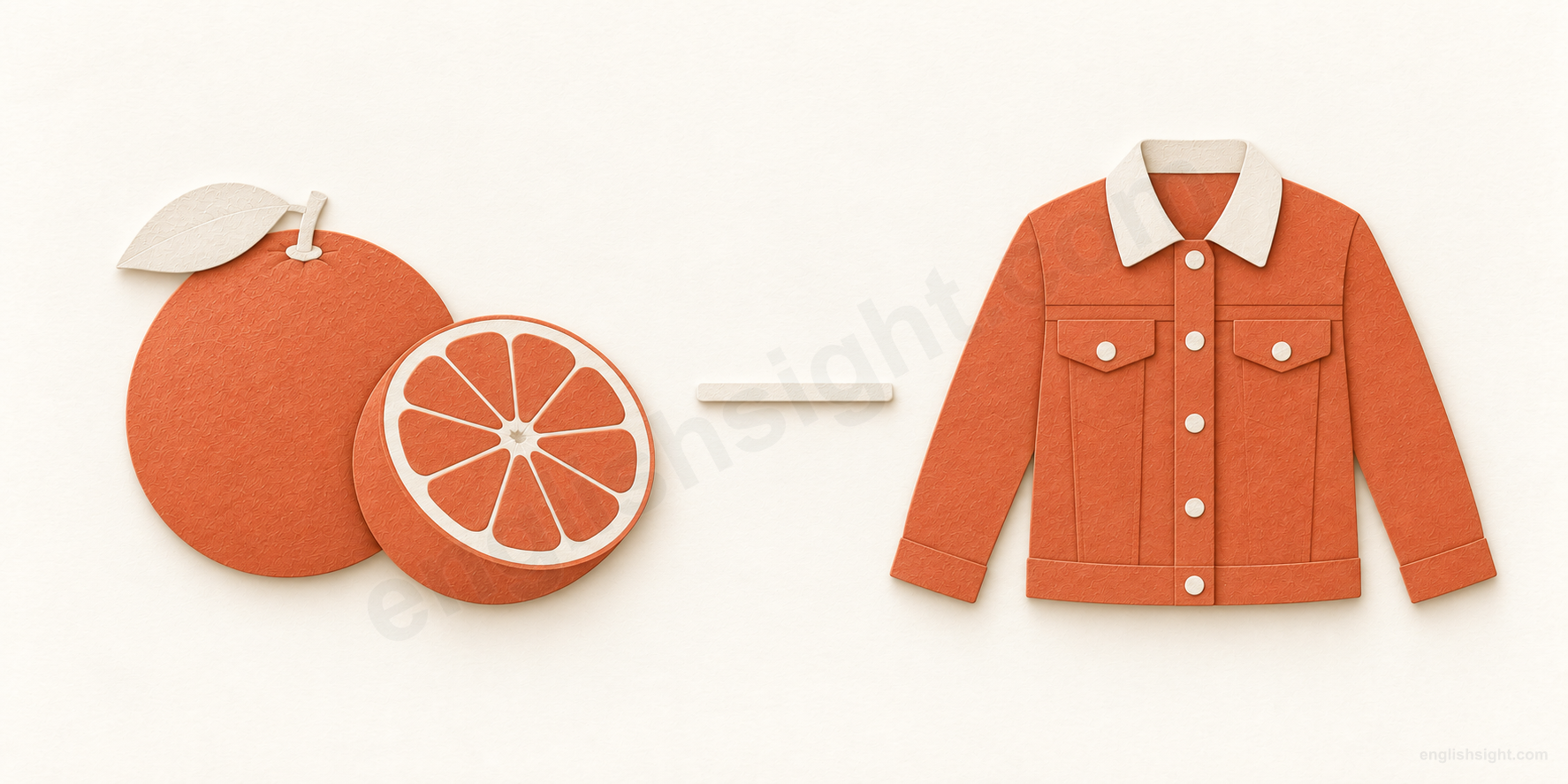
A whole orange and a cut half identify the citrus fruit.
orange
The jacket is orange in color; it is not made from fruit.
The matching color links two established uses of orange.
Orange can name a fruit or describe a color.
Orange names a citrus fruit and also a color between red and yellow; words around it show whether you mean the fruit, something connected with it, or the color.
This is a teaching connection between established uses. A color description does not imply fruit, and fruit-related names do not guarantee an orange appearance.
An orange can be something you peel and eat. Orange can also describe a jacket or name a color. Nearby words and sentence structure tell you which meaning is intended.
The fruit provides a useful link between food and color vocabulary. Regional drink names and the idiom apples and oranges need their own explanations; the picture cannot predict every expression.
01
The fruit, its parts, and its source
Count whole oranges, name pieces and skin, and describe food or trees connected with the fruit. The noun after orange often tells you which relationship matters.
01
an / the / this + orange; number + oranges; like + oranges
an orange / oranges
one citrus fruit or several whole fruits
Situation
You choose fruit for a snack.
What you mean
You take one whole orange.
A whole fruit is countable.
An orange is a round citrus fruit with peel and juicy sections inside. Use an orange for one and oranges for more than one: We bought four oranges. In I like oranges, the plural describes the fruit in general.
Use an because orange begins with a vowel sound. A sweet orange and a sour orange describe taste; orange does not itself guarantee sweetness.
Names on shop labels identify kinds: a blood orange has red flesh, a navel orange has a navel-like mark and no seeds, and a Seville orange is bitter and used for marmalade. These are fruit names, not instructions to interpret each word separately.
In a sentence
I put an orange in my bag for later.
Watch the difference For one unspecified whole fruit, say an orange, not a orange or I packed orange.
02
an orange segment; a slice / wedge of orange; some orange
an orange segment / a slice of orange
a natural section or a cut piece of the fruit
Situation
You prepare the fruit for a salad.
What you mean
You add pieces rather than whole fruits.
Segment names a natural section; slice names a piece cut from the fruit.
An orange segment is one of the sections that separate naturally inside the fruit. A slice of orange is cut with a knife; a wedge of orange is a thicker piece with a narrowing shape. These nouns tell you what kind of piece you mean.
Compare two oranges with two slices of orange: the first counts whole fruits, while the second counts slices. In Add some orange to the salad, orange can describe an amount of fruit flesh without counting whole fruits.
Both orange slices and slices of orange are natural. In orange slices, orange modifies slices and stays singular; the plural ending belongs to slices.
In a sentence
I added three slices of orange to the salad.
Watch the difference Three orange slices means three slices, not necessarily three whole oranges.
03
orange + peel / rind / zest; peel + an orange
orange peel / orange zest
the fruit’s skin, including skin used to flavor food
Situation
You have a whole orange for a cake.
What you mean
You use some of its outer skin.
Orange identifies the fruit; peel or zest identifies the part.
Orange peel and orange rind refer to the fruit’s outer covering. Orange zest is the outer skin used in cooking, often grated to add flavor. These expressions name parts of the fruit, not merely orange-colored material.
Peel an orange means remove its skin: peel is the verb and an orange is its object. In orange peel, peel is a noun. The action comes from peel, not from orange.
Use some orange peel or a strip of orange peel for an amount or piece. Peel can also be countable, especially in North American English, so an orange peel is not automatically an error.
In a sentence
We added a little orange zest to the cake mixture.
Watch the difference Orange zest refers to skin used in cooking; orange juice refers to the liquid.
04
orange + food / drink noun; orange-flavored + noun; a glass of orange juice
orange juice / orange cake
a drink or food connected with oranges as an ingredient or flavor
Situation
You choose something to drink or eat.
What you mean
You identify its fruit source or flavor.
Orange before a food name can identify an ingredient or flavor rather than its visible color.
Orange juice names juice from oranges. Squeeze an orange describes pressing the fruit to release its juice; freshly squeezed orange juice tells you how the drink was prepared.
In orange cake, orange sauce, and orange-flavored sweets, the connection is to the fruit or its flavor. The food need not look orange, and a flavor description alone does not guarantee that it contains real fruit.
Contrast orange juice with orange-colored juice: the first names a kind of juice, while the second describes appearance. Juice is normally uncountable as a substance: some orange juice or a glass of orange juice. At a café, an orange juice can mean one serving.
In a sentence
The café serves orange cake with freshly squeezed orange juice.
Watch the difference Keep orange singular in orange juice and orange cakes; the main noun carries any plural ending.
05
an orange tree; orange blossom; an orange grove
an orange tree / orange blossom
the tree that bears oranges, or its flowers
Situation
You describe a garden where oranges grow.
What you mean
You name the tree, its flowers, or a group of these trees.
The connection is to the fruit-producing plant, not necessarily to the plant’s color.
An orange tree is a tree that bears oranges. Orange blossom refers to its flowers, which are white; the expression does not mean flowers that must be orange in color.
An orange grove is a group of orange trees growing together. In two orange trees, the word trees counts the plants, while orange stays singular as a modifier.
General dictionaries also allow orange itself to name the tree. Orange tree is the clearer everyday choice when a learner needs to distinguish the plant from its fruit.
In a sentence
The orange tree by the gate is covered in white blossom.
Watch the difference Do not infer the color of a flower or tree from the fruit-related modifier orange.
02
A color, a description, or a change
Orange can name a color or describe something with that color. A following noun or a preceding verb supplies the sentence structure.
06
orange + noun; subject + be / look + orange
an orange jacket / The jacket is orange.
describe something as having a color between red and yellow
Situation
You need to identify a jacket by its appearance.
What you mean
You describe its color.
Orange is an adjective before a noun or after a linking verb.
An orange jacket tells you the jacket’s color. The jacket is orange gives the same kind of description after be. No fruit needs to be present.
Adjectives do not take a plural ending: two orange jackets, not two oranges jackets. Bright orange, pale orange, and dark orange make the color description more specific.
Orange can describe flames, a sunset, a sign, or clothing. The relevant link to the fruit is a color association; the sentence does not say that the object is made from oranges.
In a sentence
Her orange jacket is easy to spot in the crowd.
Watch the difference The jacket is an orange identifies it as a fruit; The jacket is orange describes its color.
07
orange as a color noun; in orange; a shade of orange; a deep orange
Orange is my favorite color. / dressed in orange
name the color itself or clothing in that color
Situation
You discuss a color choice or what someone is wearing.
What you mean
You name the color without naming a particular object.
As a color noun, orange is usually uncountable, but shades can be counted.
In Orange is my favorite color, orange is the name of the color. In She was dressed in orange, the phrase means she was wearing orange clothes; it does not mean she was inside a fruit.
Use a shade of orange to discuss a particular version of the color. In design or painting, an orange or several oranges can also mean an orange shade or several different shades. This is a context-dependent countable use, distinct from counting fruits.
Compare an orange wall with a wall painted in a deep orange. In the first, orange directly describes wall; in the second, a deep orange names a shade. The visible result can be the same.
In a sentence
The guide was dressed in orange so we could find her easily.
Watch the difference In a clothing description, in orange describes the color worn; it does not name a fruit.
08
subject + turn / be turning + orange
turn orange
become orange in color
Situation
The leaves have another color.
What you mean
Their color changes to orange.
Turn supplies the change; orange names the resulting color.
The leaves turned orange describes a change of color. Compare The leaves are orange, which only states their current appearance. This is turn followed by an adjective, not a phrasal verb with orange.
The leaves are turning orange describes a change in progress. Orange stays an adjective in both forms; it is not the name of a fruit being produced.
Context matters: turn an orange has a different structure. There an orange is a noun phrase naming the fruit, and turn can mean rotate it. The article changes how you read the sentence.
In a sentence
The leaves along the path are turning orange.
Watch the difference Turn orange describes becoming a color; turn an orange can describe rotating a fruit.
03
Drinks and a familiar comparison
Some uses depend on regional convention or a fixed expression. Learn the whole wording rather than predicting the meaning from the fruit alone.
09
some orange; a glass of orange; orange squash (British English)
some orange / a glass of orange
orange juice or an orange-flavored drink in British usage
Situation
A British host offers drinks.
What you mean
You understand orange as a drink from the context.
A regional drink noun can stand without juice.
In British English, orange can refer to orange juice or a drink made from or flavored like oranges. At a table, Shall I pour you some orange? can be an offer of a drink. It need not mean pieces of fruit.
Orange juice is the clearer wording across varieties of English when you specifically mean juice. Orange squash, in British English, names a sweet concentrated orange drink diluted with water, or the prepared drink; it is not a vegetable dish.
Some orange is ambiguous without a situation: it might be fruit flesh, a drink, or an amount of color in a painting. Pour and a glass of strongly support the drink reading.
In a sentence
“Shall I pour you a glass of orange?” the host asked.
Watch the difference The shorter drink name is regional and does not by itself guarantee pure juice.
10
compare apples and oranges; compare apples with oranges; be apples and oranges
compare apples and oranges
compare things whose differences make the comparison unsuitable
Situation
Someone compares a monthly payment with an annual payment.
What you mean
You point out that the comparison needs a common basis.
The whole expression questions whether two things are comparable.
Compare apples and oranges is a familiar idiom, especially in North American English. It says the things differ in ways that make the proposed comparison misleading or unfair; the discussion need not concern fruit.
You may also hear That’s apples and oranges or You’re comparing apples with oranges. With be, as in The two systems are apples and oranges, the expression can simply emphasize how different the things are. The two kinds of fruit provide a memorable contrast, but these established meanings belong to the whole expression.
Use it to explain the relevant difference, not simply to reject any comparison. A monthly fee and an annual fee can be compared after putting them on the same time basis. The idiom does not prove that different things can never be compared.
In a sentence
Comparing this monthly fee with that annual fee is comparing apples and oranges.
Watch the difference The idiom signals an unsuitable comparison, not a difference in how much someone likes two fruits.
Let the grammar and context guide you
Fruit, flavor, and color are different claims
An orange is a countable fruit; some orange may be fruit flesh or a British drink; orange as a color is usually uncountable. A flavor can be orange even when the food has another color.
Orange is not an everyday action verb
The common modern uses here are nouns, an adjective, and fruit-related modifiers. In peel an orange, squeeze an orange, and turn orange, the verb supplies the action or change. There is no ordinary phrasal-verb family to memorize for orange.
Pronunciation and spelling
Oxford gives British /ˈɒrɪndʒ/ and American /ˈɔːrɪndʒ/; American pronunciations also vary by region. Stress comes at the beginning, and the final sound is /dʒ/. The regular fruit plural is oranges.
Scope and capital letters
This lesson covers everyday fruit, food, plant, color, and drink uses plus a comparison idiom. Capitalized Orange in place names, political or royal names, and Agent Orange requires separate context. Specialist wood, dye, and botanical names are not developed here.
Choose the intended meaning
Look at articles, the main noun, the verb, and the situation.
1. You want to pack one whole fruit. Which sentence fits?
2. Which sentence describes the color of a coat?
3. An orange tree has white blossom. What does orange tell you in orange blossom?
4. Which sentence says that the leaves are changing color?
5. A British host asks, “Shall I pour you some orange?” What is the likely offer?
6. Someone compares a monthly fee directly with an annual fee. What does “You’re comparing apples and oranges” mean?
Sources and teaching notes
The sources below support the meanings and usage distinctions. The explanations and examples are original; the fruit-to-color connection is a teaching aid.
The diagram is a teaching aid, not a picture shared by every native speaker.