From a decorative object to surface detail, formal praise, and musical embellishment.
An addition for beauty
Add decorative interest while keeping the underlying thing
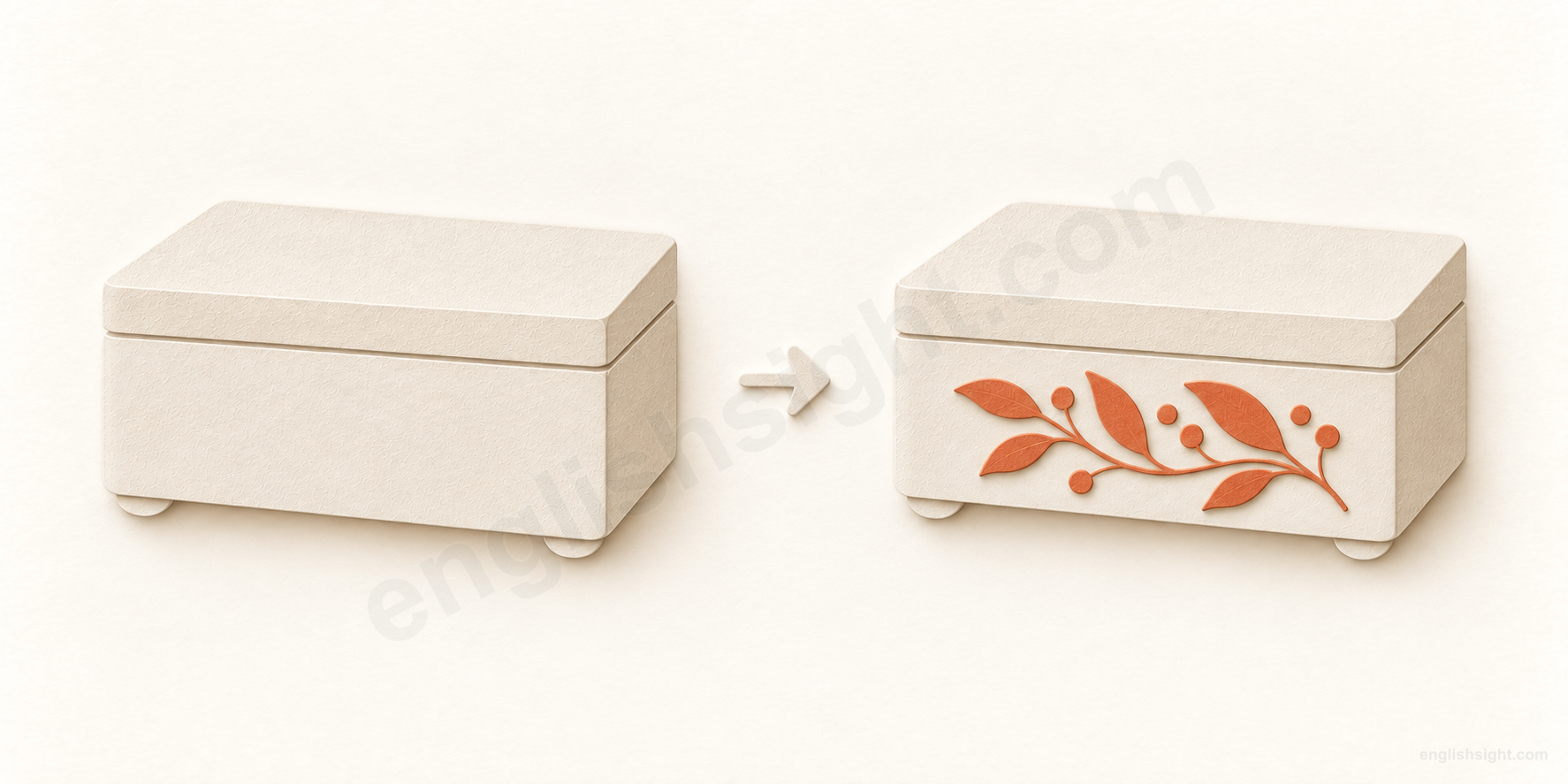
The closed box has a plain front.
ornament
The same box now has a decorative front.
A leaf-and-berry design is added as decoration.
The added motif ornaments the box without changing its underlying structure.
An ornament adds beauty or decorative interest; to ornament something is to supply such decoration.
Decoration may be a separate object or an integrated design. It is not defined by being removable, and a decorative object may also have a practical role. The model does not reduce praise or music to a literal object.
Think of something that adds beauty or decorative interest to a person, place, object, or performance. Ornament can name a separate decorative item, decoration considered as a whole, or the act of decorating.
The before-and-after model connects a plain object with its decorated version. It is a teaching aid, not a claim that all English speakers share one mental picture. Formal praise and musical usage need their own explanations.
01
Objects displayed or worn
An ornament can be one countable object. Its decorative role matters more than its material, price, or size. Compounds identify where it goes or what it is made of.
01
a / an + (material or setting) + ornament; plural ornaments
an ornament / ornaments
an object displayed to make a place attractive
Situation / underlying thing
A shelf or part of a garden has space for something decorative.
Decorative role / result
A figure or other decorative object is displayed there.
Count the individual objects: an ornament, two ornaments.
A small ceramic bird on a shelf can be an ornament. A decorative stone figure outdoors can be a garden ornament. The object is being considered for its appearance, rather than as a tool for a task.
Glass ornament and wooden ornament name materials; garden ornament names a setting. These modifiers do not create separate meanings of ornament. Display, collect, dust, and break fit different things we do with these objects.
Oxford marks the general room-and-garden sense as especially British English. It is still understandable elsewhere; in American English, the Christmas-tree context is particularly familiar. Decoration is a broader word and can also refer to an activity or to an overall arrangement.
In a sentence
We put a small wooden ornament on the empty shelf.
Watch the difference Use an ornament for one countable item. Ornamental is an adjective, so an ornamental alone does not name the object.
02
a Christmas (tree) ornament; hang ornaments on + a tree
a Christmas tree ornament
a decoration hung on a Christmas tree
Situation / underlying thing
A tree is ready to be decorated for the holiday.
Decorative role / result
A decorative object hangs from one of its branches.
The compound names the occasion and usual location of the object.
A Christmas ornament can be a ball, a star, a little figure, or another shape. Christmas tree ornament makes its intended setting explicit. The word ornament alone may be understood this way when people are already discussing a tree.
You hang ornaments on the tree and take them down afterward. On tells us where they are; hang and take down describe the actions. These are not special particle combinations built from the verb ornament.
Both British and North American English use Christmas tree ornaments. In British English, a round hanging decoration is also called a bauble; ornament covers more than that one shape.
In a sentence
Lena hung the star-shaped ornament on a low branch.
Watch the difference Ornament does not always mean a Christmas decoration. The surrounding conversation or the compound supplies that context.
03
a hair ornament; wear + an ornament / ornaments
a hair ornament / personal ornaments
a decorative item worn on the body or in the hair
Situation / underlying thing
Someone chooses an item to wear for its appearance.
Decorative role / result
The item decorates the hair or body.
The same decorative role applies to things people wear.
Hair ornament names something such as a decorative comb, pin, or clip. A clip can hold hair in place and also decorate it, so decorative and practical roles can overlap.
Personal ornaments is a formal way to refer to jewellery and similar items, for example in a museum description. In ordinary conversation, the specific name is often clearer: a necklace, a bracelet, or a hair clip.
The visual model shows decoration added to a box, but the relevant connection here is addition for appearance. It does not mean the wearer is treated as a box or that every ornament must be detachable.
In a sentence
For the wedding, she wore a silver hair ornament shaped like a leaf.
Watch the difference Jewellery is normally uncountable, while ornaments is a countable plural. Say two ornaments or two pieces of jewellery.
02
Decoration and decorative purpose
Uncountable ornament treats decoration as a whole. The phrase for ornament explains why something is present; the verb describes decorating something.
04
uncountable ornament; without / little / rich + ornament
ornament / without ornament
decoration or decorative detail considered as a whole
Situation / underlying thing
You consider the design of a building, object, or surface.
Decorative role / result
You describe its decorative detail, or the absence of that detail.
Here ornament is uncountable, not one item on a shelf.
In design and architectural description, ornament can refer collectively to decorative patterns, carving, and similar details. It need not be a separate object: a carved border can be part of the surface itself.
Without ornament describes a plain design. Rich ornament describes a substantial amount or elaborate style of decoration. These uses are relatively formal; decoration or decorative detail may be easier choices in everyday conversation.
Compare The doorway has three ornaments with The doorway has little ornament. The first counts distinct features; the second considers decoration as a whole. This is a change in how the speaker presents the decoration, not a rule about which material is used.
In a sentence
The doorway is elegant, with almost no ornament around its edges.
Watch the difference Do not add a or an when you mean decoration as a whole. An ornament refers to a distinct item or feature.
05
be / keep something + for ornament; purely / just + for ornament
for ornament / purely for ornament
for appearance rather than a practical purpose
Situation / underlying thing
An object is present, but its role may be unclear.
Decorative role / result
The speaker identifies decoration as its purpose.
For introduces purpose; ornament names decoration without an article.
Something kept for ornament is there to be looked at. A person may keep an old kettle for ornament even though it is no longer used to boil water. This says what role it has now, not that all kettles are decorative objects.
Purely or just strengthens the contrast with practical use. For decoration is a natural alternative. Merely an ornament uses the countable noun to suggest that an item contributes appearance but little else.
Applied to a person, just an ornament can be dismissive: it suggests that the person has been given a visible position without real responsibility. This is a contextual criticism, unlike the admiring formal expression an ornament to something.
In a sentence
The old kettle beside the stove is purely for ornament now.
Watch the difference For ornament gives a purpose. An ornament on the shelf names an object and gives its location; the two patterns have different grammar.
06
ornament + object + (with + decoration); be ornamented with + decoration
ornament something with something
add decorative features to something
Situation / underlying thing
A box, room, or other object has a plainer appearance.
Decorative role / result
Decorative details have been added or are present on it.
The direct object is what receives the decoration; with introduces the decorative material or detail.
The verb ornament is transitive and formal. An artist can ornament a box with a leaf pattern. The box is the object being decorated; the pattern is the addition. With is an ordinary preposition here, not a particle that makes a new phrasal verb.
The passive is especially useful in descriptions: The box is ornamented with leaves. This can describe its finished appearance, without identifying the maker. Richly ornamented means elaborately decorated; it does not say the owner is wealthy.
A decorative feature can also be the subject: A leaf pattern ornaments the lid. That describes what decorates the lid and need not describe a new action. For an everyday activity, decorate is usually the simpler choice. The picture’s two states illustrate the addition, not an improvement in how the box works.
In a sentence
The craft worker ornamented the lid with a simple leaf pattern.
Watch the difference Say ornament the lid with leaves, not ornament leaves to the lid. The usual forms are ornaments, ornamented, and ornamenting.
03
Formal praise and musical detail
Decoration provides a useful connection, but these established extensions need their own contexts. A valued person is not literally an object, and a musical ornament is heard rather than seen.
07
be + an ornament to + a place / group / profession
an ornament to something
a person or thing whose qualities bring distinction to a place or group
Situation / underlying thing
A place or group has a valued member or feature.
Decorative role / result
The speaker praises that member or feature as a source of distinction.
This formal compliment concerns value or credit, not simply outward prettiness.
Calling someone an ornament to a profession praises the good qualities they contribute. The same construction can praise a building that enhances a town. This is an established figurative use, not a claim that the person or building has no practical role.
To introduces the group or place that benefits from the distinction. A credit to is often a more familiar alternative in conversation. The expression sounds formal and can feel old-fashioned when used about a person.
The decorative connection is the idea of enhancing something, but the literal box sketch cannot show professional merit. Keep this sense separate from merely an ornament, which may criticize someone’s lack of a real role.
In a sentence
The tribute described the generous teacher as an ornament to her profession.
Watch the difference An ornament to is normally praise in this sense. Just an ornament can be criticism; do not transfer the tone from one whole expression to the other.
08
a musical ornament; add / play + ornaments
a musical ornament / ornaments
a musical embellishment added to a basic note or melody
Situation / underlying thing
A melody provides the basic musical line.
Decorative role / result
An added musical detail makes a note or phrase more elaborate.
In music, the decorative addition is heard.
Musicians use ornament for an embellishment such as a trill. A trill involves a rapid alternation between two adjacent notes in a scale. The ornament elaborates the musical line rather than naming a physical object on the instrument.
The singular a musical ornament and plural ornaments are used in discussion of performance. The word alone is enough when the musical context is clear. Detailed signs and performance rules belong to music study, not to the everyday object meaning.
This extension shares the idea of decorative addition, but the box drawing is only an analogy. It does not show sound, timing, or how an ornament should be performed.
In a sentence
The pianist added a short trill as an ornament near the end of the melody.
Watch the difference A musical ornament is part of the sound. An ornament on top of a piano is a decorative object in a different sense.
Keep the role, grammar, and register clear
Ornament, decoration, and ornamental
An ornament is a countable item; uncountable ornament is decoration as a whole. Decoration covers a wider range of everyday contexts, while ornamental is an adjective meaning decorative. Use the specific object name when it helps: a necklace or a hair clip.
Noun and verb pronunciation
Both forms have first-syllable stress. In the noun, the last syllable is normally reduced: British /ˈɔːnəmənt/, American /ˈɔːrnəmənt/. The verb commonly has a fuller final vowel, /ˈɔːnəment/ or /ˈɔːrnəment/. Merriam-Webster also marks secondary stress in the American verb’s final syllable.
Verb grammar and scope
The formal verb takes an object, and passive descriptions are especially useful. An ongoing activity is possible: The artist is ornamenting a box. There is no common phrasal-verb family to learn here, and with introduces decoration rather than creating a special verb sense. Historical accessory and specialist church-equipment senses are outside this lesson.
Choose the intended role
Decide whether the sentence counts objects, describes decoration, gives a purpose, or uses a formal extension.
1. You bought two small decorative figures for a shelf. Which sentence counts the items?
2. An old kettle is displayed and never used to boil water. Which phrase explains why it is there?
3. A finished box has a leaf design on its lid. Which formal description fits?
4. A formal tribute calls a teacher an ornament to her profession. What does it mean?
5. A piano teacher asks for fewer ornaments in the melody. What should the student change?
Sources and teaching notes
The linked publisher entries support the meanings and usage notes. Explanations and examples are original. The before-and-after sketch is a teaching model of decorative addition.
This diagram helps explain a connection; it is not a picture shared by every native speaker.