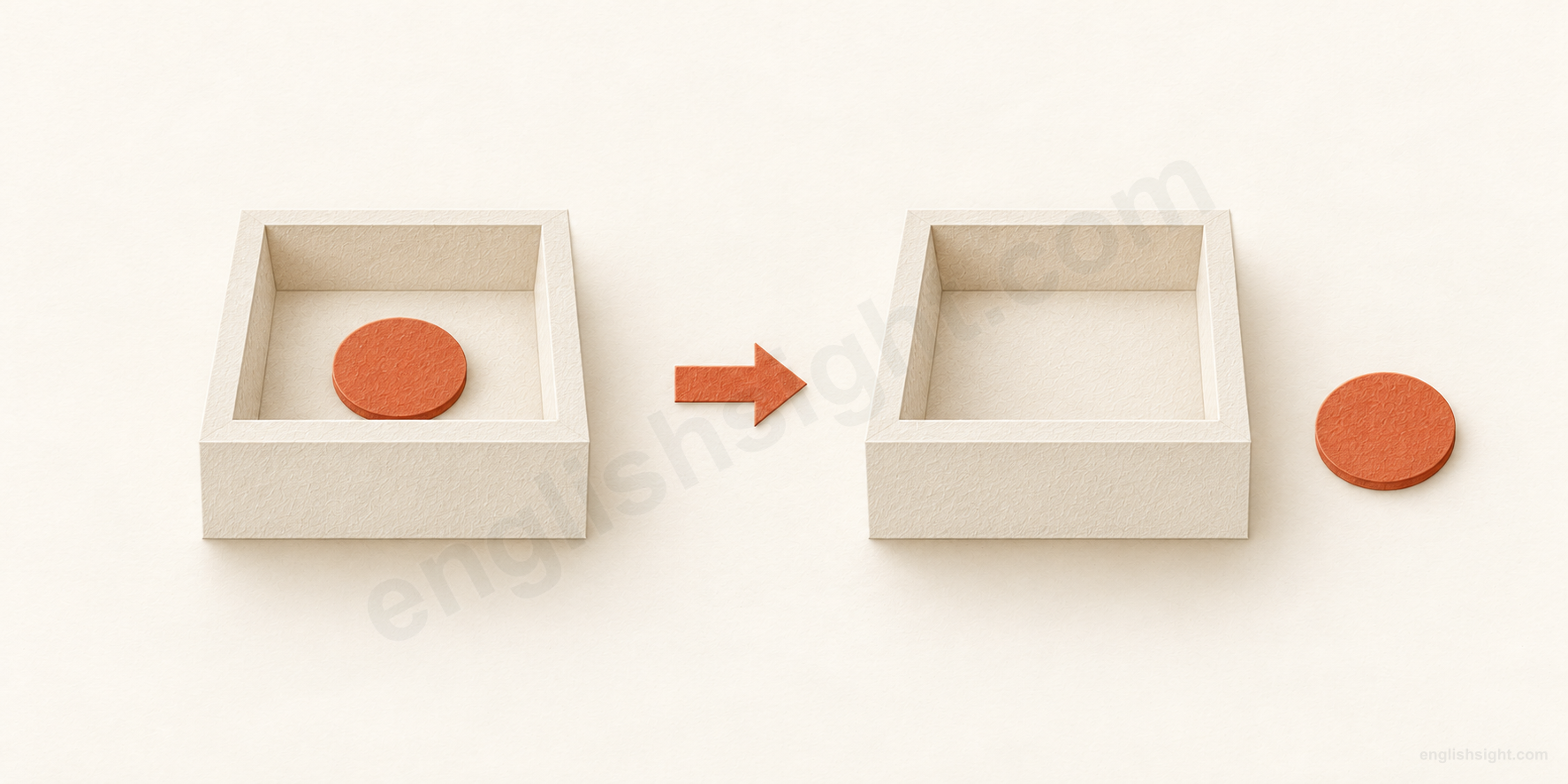
Use out for outside positions, outward changes, and familiar states and combinations.
Beyond the relevant boundary
From inside to beyond the boundary
The orange token is inside the open box.
out
The token is outside, and the box is empty.
The same token moves beyond the box’s boundary.
The same token is first inside, then outside. Out can also describe the outside position without movement.
Out places something outside a containing space or beyond a relevant boundary, or marks a move to that position.
The two states illustrate literal outward movement. A thing can also already be out, and this picture cannot predict every meaning of a verb plus out.
Out /aʊt/ is often an adverb or verb particle; out of connects it to a named place or other reference. It can describe where something is as well as a change: the ball is out, or the ball rolls out.
A useful teaching connection is being outside a containing space or beyond a relevant boundary. Public knowledge, exclusion, and completion offer related ways to organize some uses. Other meanings belong to established expressions and must be learned with their constructions.
Dictionaries organize the grammar differently: Oxford groups many states under its adverb entry; Collins labels several as adjective and adverb uses. The course explains the constructions rather than insisting on one universal label.
01
Outside, away, and beyond an edge
Identify the reference place first. Out can describe a position or movement, and it does not always mean outdoors.
01
verb of movement + out; out of + place; out into + destination
go / come / get out (of a place)
move from inside to outside
Situation / starting point
A ball is inside a container.
Position / result
The ball is beyond the container’s boundary.
Out gives the direction; of names the place left behind.
In The ball rolled out, rolled tells us how it moved and out tells us where it ended relative to the container. Add of the box to name that container; add into the hall to name the destination.
Go out and come out use different viewpoints, as go and come normally do. Out! or Out you go! can order someone to leave and may sound abrupt.
In a sentence
The ball rolled out of the box and into the hall.
Watch the difference Use out of the box, not out from the box as the ordinary way to name its former container.
02
verb + object + out; verb + out + noun; verb + object + out of + place
take / pull / let something out
cause something to leave an inside space
Situation / starting point
The key is in a pouch.
Position / result
You have removed it.
A subject can cause the outward change.
Take the key out and take out the key both work. With a personal pronoun, put it before the particle: take it out. In take it out of the pouch, of the pouch names the source.
Let the dog out allows the dog to leave; it does not necessarily mean carrying it. Get a stain out means remove the mark, not move an intact object. These are related removal uses with different actions.
In a sentence
I pulled the key out of the small pouch.
Watch the difference Do not say take out it. Object-position rules apply to these particle constructions, not to every expression containing out.
03
be out; be out of town; be out on loan
be out / out of town / out on loan
be away from the expected place
Situation / starting point
You call someone’s workplace.
Position / result
The person is away.
Out can describe absence without saying where someone went.
She is out can mean she is away from home or work, even if she is inside another building. Out of town names a wider reference area. An out-of-office reply says someone is unavailable at work.
A library book that is out or out on loan has been borrowed. This contrasts with a book being out meaning published: the context decides whether availability is reduced or increased.
In a sentence
Maya is out of the office, and the book you want is out on loan.
Watch the difference Out does not by itself mean outside in the open air.
04
go out (for dinner); eat out; go out with + person
go out / eat out / go out with someone
spend time away from home, sometimes on a date
Situation / starting point
You want an evening away from home.
Position / result
You choose a restaurant or social event.
Going out can name a social activity rather than just crossing a doorway.
Let’s go out tonight usually proposes social activity. Eat out means have a meal away from home, often in a restaurant. These do not say that the activity happens outdoors.
They are going out together can mean they are in a romantic relationship. I went out with my sister yesterday can simply describe an outing; relationship meaning depends on context.
In a sentence
We went out for dinner, but we ate inside because it was windy.
Watch the difference Go out with someone can mean date them; do not assume every one-time outing implies romance.
05
out + here / there / in + place / at sea; the tide is / goes out
out here / out there / out at sea
locate something outside or away from a reference point
Situation / starting point
The speaker compares this place with another.
Position / result
Out locates something away from the relevant inside or centre.
Here and there locate; out adds an outside or away perspective.
It is cold out describes conditions outdoors. Out here may mean outside near the speaker; out there may point to a more distant area. Out in the country and out at sea depend on the speaker’s reference point.
The tide is out describes low water; the tide is going out describes water retreating from shore. These are established coastal uses, not instructions to go outdoors.
In a sentence
There are fishing boats out at sea, and the tide is going out.
Watch the difference Distinguish a position, the tide is out, from a process, the tide is going out.
Objects are close together, or part of an object is hidden.
Position / result
They occupy more space, or a part projects beyond an edge.
Out can describe extension without complete departure.
The searchers spread out means they separated to cover more ground. You can spread your things out to use a larger surface. Nobody needs to leave a building.
A pencil sticking out of a pocket is only partly beyond its edge. Stick your tongue out is a caused extension. Do not require every part of the object to end outside.
In a sentence
A pencil was sticking out of her pocket.
Watch the difference Stick out may describe a continuing position; it need not describe a fresh movement.
02
Visible, audible, or publicly known
Something can emerge into view, hearing, or public knowledge. Several familiar combinations have more specific meanings.
07
be out; come out (sun, stars, flowers)
the sun / flowers are out
become visible or fully open
Situation / starting point
Clouds hide the sun, or petals are closed.
Position / result
The sun can be seen, or the petals are open.
An outward appearance may be a visible state rather than travel.
The sun came out says it appeared from behind clouds. The sun is out describes the resulting visibility. Flowers coming out are opening; the roses are out means they are in bloom.
The flower use is conventional: out does not mean the plant has left its pot. The subject tells us which kind of appearance is intended.
In a sentence
The sun came out just as we reached the garden, where the roses were already out.
Watch the difference Do not interpret flowers are out as flowers being absent.
08
publication + be / come out; put out + publication; messages + go out
be out / come out / put out a release
be available to the public
Situation / starting point
A recording is being prepared.
Position / result
Listeners can obtain it.
Publication makes material publicly available.
Her album is out describes availability; her album comes out on Friday gives its release date. Come out has no direct object in this use.
A publisher can put out a report, and invitations can go out when they are sent. These uses concern circulation. They do not mean the report, recording, or invitation has physically stepped outside.
In a sentence
Our first recording comes out on Friday.
Watch the difference A book is out can also mean it is on loan from a library; check the context.
09
secret / truth / news + be / come / get out; Out with it!
the secret is out / news gets out
become known beyond those who kept it private
Situation / starting point
Only two people know the plan.
Position / result
Other people learn about it.
Information can move from private to public knowledge.
The secret is out reports that it is no longer secret. It does not identify who revealed it. The truth came out likewise focuses on the discovery; word got out suggests information spread.
Out with it! presses someone to say what they are holding back. This is an informal, potentially impatient demand, not a neutral question.
In a sentence
The secret was out before we could announce the surprise.
Watch the difference The diagram’s boundary is a memory aid here; knowledge is not literally a container.
10
come out (to + person); be out; out + person (as + description)
come out / be out / out someone
disclose an identity, or expose someone else’s private information
Situation / starting point
A person has not shared this aspect of identity with everyone.
Position / result
It becomes known to particular people or to the public.
The person’s own disclosure differs from someone else exposing them.
Come out commonly means tell others about one’s sexual orientation or gender identity. Be out describes being open about it, sometimes only to particular people: she is out to her friends.
The transitive verb out someone means reveal such private information, often against their wishes. Out someone as a fraud is a broader exposure use. Forms are outs, outed, outing; a person can be outed. These meanings belong to established usage, not a general rule that out means tell.
In a sentence
She came out to her friends, but asked them not to out her at work.
Watch the difference Coming out is the person’s disclosure; outing them shifts agency to someone else.
11
read + object + out; read out loud; shout out; speak out (against + noun)
read out / shout out / speak out
make words audible or express an opinion openly
Situation / starting point
Words are written or an opinion is unspoken.
Position / result
Others can hear or learn them.
The kind of communication comes from the whole expression.
Read the number out means say it so that others hear it. Out loud similarly contrasts with silent reading; it need not mean shouting.
Shout out adds loud calling, while speak out means express an opinion publicly, often against something. A quiet person can speak out in an interview. Do not give every communication expression the same volume.
In a sentence
Please read the reference number out slowly.
Watch the difference Read it out has a pronoun before the particle; not read out it.
12
stand out (from / against + background); pick + object + out
stand out / pick out
be noticeable, or identify one thing among others
Situation / starting point
There is a group or background.
Position / result
One member attracts attention or is identified.
Stand out describes prominence; pick out involves someone selecting or recognizing.
A bright coat stands out against a dark wall because it is easy to notice. A strong candidate can stand out as the best without being visually bright.
Pick someone out in a photograph means recognize them among others. Pick out a gift instead means choose one. The object and context distinguish recognition from selection.
In a sentence
I could pick her out in the crowd because her yellow coat stood out.
Watch the difference Say pick her out, not pick out her, when her is the object pronoun.
03
No longer active, included, or correct
The thing being described determines the reading: a flame, a player, a plan, and an estimate are different kinds of subject.
13
light / fire + be / go out; put + object + out; turn + lights + out
the light goes out / put the fire out
stop shining or burning; cause that result
Situation / starting point
A light shines or a flame burns.
Position / result
It no longer shines or burns.
Go out is the change; put out makes something stop burning.
The candle went out has the candle as subject and gives no agent. I put the candle out names someone who extinguished it. The fire was put out is a passive form.
Turn out the lights means switch them off. Put out a fire does not tell us whether water, a cover, or another method was used; out gives the resulting state in this conventional family.
In a sentence
A gust put the candle out, and the room went dark.
Watch the difference Put it out is correct; put out it is not. Go out does not take the flame as a direct object.
14
be out; be knocked out (for + duration)
be out / be knocked out
be unconscious
Situation / starting point
Someone is conscious before a blow.
Position / result
They temporarily lose consciousness.
With a person, out may name a loss of consciousness.
He was out for a minute can mean he was unconscious, if the surrounding story concerns a fall or a blow. Be knocked out makes the cause more explicit.
The same short sentence He is out can instead mean he is away or eliminated from a game. The subject alone is insufficient; the surrounding situation matters. This is a separate conventional state, not literal movement outside the body.
In a sentence
After the fall, he was out for a few seconds.
Watch the difference Out cold is informal emphasis for unconsciousness; do not use it to mean someone is outdoors in cold weather.
15
player / team + be / go out; ball + be / land out
the player / ball is out
be eliminated, dismissed, or beyond a playing boundary
Situation / starting point
A game has rules for participation and lines.
Position / result
A player cannot continue in that role, or a ball lands beyond the line.
A player being out differs from a ball landing out.
In an elimination game, you are out when the rules end your participation. In baseball or cricket, out has a specific role within that sport and does not necessarily mean leaving the ground.
In tennis, the ball is out if it lands beyond the permitted boundary. In each case, the relevant rules define the limit; a general outside picture does not teach the whole sport.
In a sentence
The ball landed out, so the point went to the other player.
Watch the difference Being out in a game does not always mean being physically outside the playing area.
16
option / activity / style + be out; be out of date
that plan is out / that style is out
be unacceptable, impossible, or no longer fashionable
Situation / starting point
You consider a plan or a style.
Position / result
It is rejected or no longer current.
Out can remove something from the available or fashionable choices.
A trip is out this week can mean it is impossible because of time or money. That behavior is out can mean it is forbidden. The reason needs context.
That style is out judges fashion rather than permission. Out of date can describe information or equipment that is no longer current. These are conventional evaluations; they need not involve a physical boundary.
In a sentence
A taxi is out; we have only enough money for the bus.
Watch the difference A style being out does not mean it is prohibited.
17
estimate + be out by + amount; person + be out + amount of money
be out by an amount / be out money
differ from the correct amount, or have lost money
Situation / starting point
An estimate is compared with the real cost.
Position / result
The difference is measured.
Out by measures an error; out an amount can report a loss.
The estimate was out by twenty pounds means it differed from the correct amount by that much. The phrase alone does not say whether it was too high or too low.
In mainly American usage, I am out twenty dollars means I have lost or spent that money without the expected return. This is different from I am out of money, which says none remains.
In a sentence
My estimate was out by twenty pounds: I expected eighty, but it cost a hundred.
Watch the difference Out twenty dollars is a loss; out of dollars describes having none of that currency left.
18
before + period + be out; hear + person + out
before the day is out / hear someone out
reach the end of a period or listen to completion
Situation / starting point
Time remains, or someone has more to say.
Position / result
The period ends, or the speaker finishes.
Out can mark an endpoint rather than departure.
Before the day is out means before the day ends. School is out can mean classes have ended, not that the school building has moved.
Hear me out asks you to listen until I finish. It does not ask you to agree. This completion use is useful as a connection to an endpoint, but the full expression must still be learned.
In a sentence
Hear me out before you decide whether the idea will work.
Watch the difference Put a personal pronoun before out: hear me out, not hear out me.
19
workers + be / stay out; come out on strike
be out / come out on strike
stop working as industrial action
Situation / starting point
Workers are doing their normal jobs.
Position / result
They withhold their work in a dispute.
Out can describe strike action, especially in British usage.
The workers are out can mean they are on strike when the context is a labor dispute. Come out on strike marks the start; stay out means continue striking.
This does not say they have lost their jobs. Compare out of work, which means unemployed. The strike meaning is established usage, not the ordinary absence reading in a phone call.
In a sentence
The drivers came out on strike over the new timetable.
Watch the difference Out on strike and out of work describe different employment situations.
20
person + be tired out / worn out; activity + tire + person + out; object + be worn out
be tired out / worn out
be very tired, or be unusable after heavy use
Situation / starting point
Work uses a person’s energy, or repeated use damages an object.
Position / result
The person is exhausted, or the object no longer serves its purpose.
Out can accompany exhaustion, but the complete expression selects the state.
I am tired out and I am worn out can both mean I am very tired. A long journey tired me out names the cause; with a pronoun say tired me out, not tired out me. This does not mean the person is unconscious or has gone outdoors.
These shoes are worn out means use has damaged them so much that they are no longer useful. A person who is worn out may simply need rest; the object reading does not automatically apply to people. Compare worn-out shoes, with a hyphen before the noun.
In a sentence
The long journey tired me out, so I went straight to bed.
Watch the difference Tired out means exhausted; tired of something means bored or annoyed by it.
04
What follows out of?
A place, supply, condition, source, motive, or total gives out of a different job. Learn the whole construction.
21
be / run out of + supply; supply / time / document + run out
be out of / run out of something
have none left, or reach that state
Situation / starting point
There is a limited supply.
Position / result
No more remains, or the supply is nearly gone.
Be out of is a state; run out of is a change.
We are out of rice says none is left. We ran out of rice tells how the supply reached zero. We are running out of rice usually warns that little remains, rather than saying it has all gone already.
Rice is running out makes the supply the subject. Time is running out similarly approaches a deadline; a visa or lease can run out when its validity ends. These uses do not describe running as a physical activity.
A shop can be out of stock of an item, and the item can be out of stock: it is not currently available to buy there. This does not mean the product is broken; out of order would describe that different condition.
The concert is sold out means no tickets remain available. The shop is sold out of that model means it has none left to sell. Sold out identifies a sales result; out of stock simply reports current unavailability and need not explain its cause.
In a sentence
We are running out of rice, so I will buy another bag today.
Watch the difference Do not say We ran out rice for this meaning; keep of before the supply.
22
be / move / keep + out of + reach / sight / range / trouble
out of reach / sight / range
be beyond an accessible or perceptible limit
Situation / starting point
There is a limit to what someone can reach, see, or detect.
Position / result
The thing lies beyond that limit.
The following noun identifies the relevant range.
Out of reach means too far away to touch or obtain. Out of sight means no longer visible; out of earshot means too far away to hear. A thing can be visible but still out of reach.
Keep out of the rain means avoid exposure to it, perhaps by sheltering indoors. Keep out of trouble similarly avoids involvement in a bad situation. The relevant boundary can be physical or situational.
In a sentence
The shelf was in sight, but the box on it was out of reach.
Watch the difference Use out of reach, not out of the reach, in the ordinary fixed phrase without a following possessor.
23
be / get + out of order / control / date
out of order / control / date
lack a normal working, managed, or current state
Situation / starting point
Something is expected to work, be controlled, or be current.
Position / result
It fails the relevant condition.
These established phrases depend on the noun after of.
The lift is out of order means it does not work. Pages out of order are in the wrong sequence. That remark was out of order informally criticizes unacceptable behavior.
Costs out of control are no longer being effectively limited; information out of date is no longer current. These are not interchangeable conditions. Out-of-date information uses hyphens before the noun, while the information is out of date normally does not.
You are out of luck means the result or opportunity you wanted is unavailable: You are out of luck; the last ticket has gone. This conventional phrase does not mean luck is literally a supply that has reached zero.
In a sentence
The lift is out of order, and the repair notice is out of date.
Watch the difference Out of order is not the ordinary phrase for an item a shop has sold out of.
24
drink / pay + out of + source; get + benefit + out of + activity
out of a bottle / out of savings / get something out of something
identify a source or obtain a benefit
Situation / starting point
A container, fund, person, or activity supplies something.
Position / result
Something is drawn from that source.
Out of can name where something comes from without emphasizing a journey.
Drink out of a bottle names the container used for drinking. Pay out of savings names the fund supplying the money. These source uses go beyond simply standing outside.
Get advice out of someone means obtain it, sometimes with effort. Get a lot out of a course means gain benefits from it. In the latter, a lot is what is gained, not the name of the course.
In a sentence
I got a lot out of the course, and paid for it out of my savings.
Watch the difference Compare get out of the course: without an object after get, this can mean avoid or leave it.
25
make + object + out of + material; be made out of + material
make something out of a material
construct something using a material
Situation / starting point
You have an old sheet of fabric.
Position / result
You use it to make a new object.
Out of names the starting material.
Make a bag out of an old shirt presents the shirt as material for a new thing. It does not say the finished bag moved outside the shirt.
Made of often simply identifies composition; made out of often draws attention to what was used, especially a surprising or reused material. Both can be natural for many objects; this is not an absolute rule about whether a material remains recognizable.
In a sentence
She made a shopping bag out of an old shirt.
Watch the difference Do not treat made out of as a guarantee that the material was recycled; that comes from the example’s context.
26
clause + out of + motive noun
out of curiosity / kindness / fear
give the feeling or motive behind an action
Situation / starting point
A feeling or motive prompts an action.
Position / result
Someone acts because of it.
Out of can identify a motive, not a place left.
I asked out of curiosity explains why I asked: I wanted to know. Out of kindness and out of fear similarly give motives.
This pattern is not a general replacement for because of. The train was late because of snow is natural; out of snow would instead suggest material in a suitable context, not the cause of the delay.
In a sentence
I opened the old box out of curiosity.
Watch the difference The noun after of matters: curiosity supplies a motive, while wood commonly supplies a material.
27
number + out of + total
three out of five
select or count members within a total
Situation / starting point
A group contains five items.
Position / result
Three meet a condition.
Out of names the whole set against which a number is measured.
Three out of five answers were correct means three in a total of five. It can give a score, a survey proportion, or a count within a group.
Nine out of ten is not a comparison of nine with an unrelated ten. Five is the total in the example; it is not a container from which three things must physically leave.
In a sentence
Three out of five answers were correct.
Watch the difference Out of five gives the total, not five additional answers.
28
be out to + verb; be out for + noun
be out to do / be out for something
actively try to achieve an aim
Situation / starting point
Someone has a goal.
Position / result
Their actions pursue it.
This fixed pattern concerns intention, not a destination.
He is out to win means he is determined or trying to win. She is out for revenge names the thing she wants. The wording often emphasizes someone’s purpose, sometimes critically, but the purpose need not be bad.
To introduces a verb in out to win. For introduces a noun in out for revenge. Compare out for lunch: that can simply explain someone’s absence, without implying a determined campaign.
In a sentence
Our team is out to prove that the new design works.
Watch the difference Do not use out to + noun for this goal pattern.
29
be / get out of breath
be out of breath
be breathless, often after exertion
Situation / starting point
You run up a long flight of stairs.
Position / result
You are breathing hard.
The fixed phrase describes breathlessness, not an empty container.
Out of breath commonly describes being breathless after physical effort. I was out of breath after running for the bus gives the cause separately.
This does not mean the person has literally used up all air or stopped breathing. It is an established bodily-state phrase, unlike out of rice, which can describe a completely empty supply.
In a sentence
I was out of breath after running up the stairs.
Watch the difference Keep breath as a noun here; breathe is the verb and does not fit after out of.
30
be / look / feel out of place (in / at + situation)
be / feel out of place
be in the wrong position or seem unsuitable in a situation
Situation / starting point
An object has an expected position, or a situation has social expectations.
Position / result
It is misplaced, or someone feels they do not fit.
Out of place can concern physical arrangement or social suitability.
A book out of place is not where it belongs. A formal coat can look out of place at an informal picnic because it does not suit the occasion.
I felt out of place describes discomfort or a sense of not fitting in. It does not prove that others deliberately excluded you. Compare I felt left out, which focuses on not being included.
In a sentence
I felt out of place in my formal suit at the beach picnic.
Watch the difference Out of place does not necessarily mean someone has physically left a place.
05
Finding answers and reaching an outcome
Out often accompanies a result or completion. The verb still decides whether we discover, calculate, arrange, or exercise.
31
find out + question word / that-clause; find out about + topic; find + person + out
find out
learn information or discover wrongdoing
Situation / starting point
You do not know the departure time.
Position / result
You obtain the information.
The whole expression means discover, not locate an object outside.
Find out when the bus leaves and find out that the shop has closed take clauses. Find out about a subject asks for information about it. Contrast find my keys, which locates a missing object.
Find someone out means discover their dishonesty. In She was found out, the passive focuses on exposure. Find it out is possible when it refers to information, but do not insert an object into find out about it.
In a sentence
Can you find out whether the museum is open on Monday?
Watch the difference Use ordinary clause order: find out when it opens, not find out when does it open.
32
work + object + out; work out + question clause; amount + work out at / to + total
work out an answer / a plan
calculate, understand, or devise something
Situation / starting point
There is a problem or an unplanned task.
Position / result
Thinking produces an answer or plan.
Work contributes the effort; the full expression names solving or planning.
Work out the total means calculate it. Work out why a device failed means understand the cause. Work out a plan means develop its details; these are related results of thinking.
Work it out places a pronoun before out. The total works out at ten pounds each makes the amount the outcome of a calculation; especially in American English, works out to is also used.
In a sentence
We worked out that sharing a taxi would cost six pounds each.
Watch the difference Work out a problem does not mean exercise the problem.
33
person + work out (at + gym / for + duration)
work out
exercise the body
Situation / starting point
You plan a fitness session.
Position / result
You exercise.
The fitness meaning is a separate established use.
I work out twice a week normally means I do physical exercise. There is no object to solve, and no implication that the exercise happens outside.
Compare I work outside, which locates your work outdoors. A workout is the related one-word noun; work out is written as two words when it is the verb.
In a sentence
I work out at the gym before breakfast.
Watch the difference Do not infer outdoors from out in this expression.
34
situation + work out (well / badly); work out for + person
things work out
develop successfully or satisfactorily
Situation / starting point
An arrangement has an uncertain future.
Position / result
It succeeds or fails to be satisfactory.
The subject is a situation, not someone calculating.
I hope it works out expresses hope that a plan or relationship develops well. It did not work out says it failed to be satisfactory; it does not necessarily mean machinery broke.
Things worked out well explicitly gives a good result. Compare work it out, with a person doing the solving. Adding an object changes the construction and the role of the subject.
In a sentence
The flat-sharing arrangement did not work out, so I moved.
Watch the difference It works out and I work it out assign different roles to it.
35
subject + turn out to be + description; it turns out that + clause; turn out well
turn out to be / it turns out that
discover how things really are, or describe an outcome
Situation / starting point
You have an expectation.
Position / result
The facts or final result become clear.
Turn out often introduces a result that differs from expectations.
The key turned out to be in my coat reports a discovered fact. It turns out that the shop is closed uses an introductory it and a that-clause. The key does not need to rotate.
The cake turned out well evaluates the result of making it. Unlike work out well, turn out well can describe how a finished product looks or tastes without suggesting a whole arrangement succeeded.
In a sentence
The empty-looking house turned out to be a small museum.
Watch the difference Use turned out to be, not turned out being, in this discovery pattern.
36
people + turn out (for + event); producer + turn out + product
turn out for an event / turn out products
attend an event, or produce things
Situation / starting point
An event or production process is planned.
Position / result
People attend, or finished products are made.
Object structure separates attendance from production.
People turned out for the concert means they came to attend. The related noun turnout refers to how many attended or voted.
The bakery turns out a hundred loaves a day means it produces them. Here the bakery is the producer and loaves is a direct object. This is a different use from discovering how something turned out.
In a sentence
Hundreds turned out for the concert despite the rain.
Watch the difference A crowd turning out is attendance; a factory turning out goods is production.
37
sort + object + out; sort out + noun; sort yourself out
sort out
organize things or resolve a problem
Situation / starting point
Papers are mixed up, or a problem is unsettled.
Position / result
They become organized, or the problem is dealt with.
The desired result depends on the object.
Sort out the receipts can mean separate and arrange them. Sort out a booking problem means resolve it; it need not mean divide the problem into piles.
Sort yourself out can mean organize your affairs or regain composure. Sort someone out can also sound like a warning about punishment in British usage, so it is not always a neutral promise to help.
In a sentence
I will sort the receipts out and then sort out the missing booking.
Watch the difference With a pronoun, say sort it out. The object determines whether organizing or resolving is intended.
06
Everyday combinations with verbs
These expressions handle distribution, exclusion, services, warnings, and relationships. Their meanings and object positions need individual attention.
38
hand / give + object + out (to + recipients)
hand out / give out
distribute things to several people
Situation / starting point
One person holds a supply.
Position / result
Members of a group receive items.
Out accompanies distribution from a supply across recipients.
Hand out the maps and give out the maps both mean distribute them. With a pronoun, say hand them out or give them out. Add to visitors to name the recipients.
Advice and punishments can also be handed out. The full expression need not involve a literal hand-to-hand movement. Contrast give out heat, where heat is emitted rather than allocated among recipients.
In a sentence
The guide handed the maps out to the visitors.
Watch the difference Do not say handed out them.
39
source + give out + heat / light; supply / machine + give out
give out heat / give out
emit something, or become exhausted or stop working
Situation / starting point
A source produces energy, or a supply supports an activity.
Position / result
Energy is emitted, or the support fails.
Give out has distinct readings with and without an object.
The heater gives out heat means it emits heat. The heater gave out, with no object, can instead mean it stopped working. Their food gave out means the supply was exhausted.
These established meanings cannot be replaced with one translation for give. The object and subject are clues: emitted heat differs from exhausted food.
In a sentence
The heater gave out just when we needed it most.
Watch the difference Gave out heat describes output; gave out with no object can describe failure.
40
leave + object + out (of + whole); feel / be left out
leave out / feel left out
omit something or exclude someone
Situation / starting point
A list or activity could include someone or something.
Position / result
It does not include them or it.
Out marks non-inclusion; leave names the omission.
Leave out the address means omit it from the text. The omission can be deliberate or accidental. Leave me out of the argument asks not to be involved.
Someone who feels left out feels excluded from a group or activity. They may be in the same room as everyone else: exclusion is social, not necessarily spatial.
In a sentence
I felt left out when everyone else was invited.
Watch the difference Leave it out means omit it; leave it outside gives its physical location.
41
rule + object + out (as + description); be ruled out
rule out
exclude a possibility or make participation impossible
Situation / starting point
An explanation or candidate is being considered.
Position / result
It is excluded or prevented.
Rule out concerns a set of possibilities, not drawing a line outside.
Rule out a cause means decide it cannot explain the situation. We cannot rule it out means it is still possible; it does not mean it is likely.
Conditions can also rule someone out by making them unsuitable or unable to participate. The plan was ruled out is a common passive form.
In a sentence
We cannot rule out a typing error until we check the original file.
Watch the difference Cannot rule out does not confirm the explanation.
42
put + person + out; be / seem put out
put someone out / be put out
inconvenience someone, or be annoyed or offended
Situation / starting point
A request disrupts someone’s plans.
Position / result
It causes extra trouble or an offended reaction.
A person as object permits several established readings of put out.
I do not want to put you out means I do not want to cause you trouble or extra work. She seemed put out instead describes annoyance or offense.
In a medical context, put someone out can also mean make them unconscious: The anaesthetic put him out. Neither inconvenience nor annoyance is intended there. Compare put the candle out, where the object permits an extinguishing reading. The full combination, object and situation carry the meaning.
In a sentence
Would collecting me from the station put you out?
Watch the difference Be put out can describe being offended even without practical inconvenience; in a medical context it can instead refer to being made unconscious.
43
take + person + out for + meal; take out + loan / policy; take + food + out
take someone out / take out a loan
invite someone on an outing, or arrange a service
Situation / starting point
You plan an outing or a financial arrangement.
Position / result
You host the outing or obtain the arrangement.
Take out has conventional meanings beyond physical removal.
Take someone out for lunch means go with them on an outing you have invited them to. The invitation does not automatically mean a romantic relationship.
Take out a loan or insurance policy means arrange and obtain it. In North American usage, take food out means buy prepared food to eat elsewhere; British English commonly uses take away. These are distinct senses, not a rule that any service can follow take out.
In a sentence
We took out insurance before taking our parents out for dinner.
Watch the difference Compare take the key out: that is physical removal, not arranging a service.
44
fill out + form; fill + object + out
fill out a form
complete a form with information
Situation / starting point
A form has spaces requesting details.
Position / result
The requested information is entered.
The full expression names completion, not removal of the form’s contents.
Fill out an application means supply the required information. Fill in a form is also common, especially in British English. Fill it out places the object pronoun before out.
Compare fill out with no object when a person becomes fuller or rounder in shape. The form-completion reading depends on the object; out does not independently mean write.
In a sentence
Please fill the form out and sign at the bottom.
Watch the difference Fill it out, not fill out it; do not confuse this with emptying the form.
45
fire / fight + break out; person + break out of + confinement
break out / break out of
start suddenly, or escape confinement
Situation / starting point
An unpleasant event has not started, or someone is confined.
Position / result
The event starts, or the person escapes.
Different subjects select different readings.
A fire or fight breaks out when it starts suddenly. This is not something physically breaking into pieces.
Prisoners break out of a prison when they escape. Break out of a routine extends the escape idea to a restrictive pattern of life. Keep the start-of-an-event and escape meanings separate.
In a sentence
A fight broke out near the exit.
Watch the difference A fire broke out means it started; the fire was put out means it was extinguished.
46
object + fall out; person + fall out with + person (over + issue)
fall out / fall out with someone
come loose and drop, or quarrel and stop being friendly
Situation / starting point
A tooth is loose, or friends have a dispute.
Position / result
The tooth drops out, or the friendship is damaged.
The relationship use is established and needs with before the person.
My tooth fell out describes a loose object leaving its place. Her hair is falling out similarly describes loss of hair.
They fell out over money means they argued and became unfriendly. She fell out with her friend names the other person with with, not as a direct object. This does not mean either person physically fell.
In a sentence
They fell out over who should pay the bill.
Watch the difference Do not say She fell her friend out for the quarrel meaning.
47
Look out!; look out of + window
Look out!
warn someone of danger
Situation / starting point
Someone may not have noticed a danger.
Position / result
You urge immediate care.
The warning is a whole expression, not an instruction to gaze outdoors.
Look out! means be careful, usually because danger is near. Watch out! is a similar warning. The warning can be useful even when looking through a window is irrelevant.
Compare Look out of the window, which gives a direction for looking. In that sentence, of the window identifies the opening; it is not the same construction as the standalone warning.
In a sentence
Look out! That shelf is falling!
Watch the difference Do not interpret the standalone warning as a request to look outside.
48
get out of + duty / -ing; get out of the habit of + -ing
get out of doing something
avoid a duty, or stop a habit
Situation / starting point
A person is expected to do something.
Position / result
They avoid it.
Of is a preposition, so the following action takes an -ing form.
Get out of washing up means avoid having to wash the dishes. I cannot get out of it now means I cannot avoid the commitment. This is different from getting out of a room.
Get out of the habit of doing something means stop that habit. Compare get something out of an activity, where an object names the benefit gained. Object position separates avoiding a task from benefiting from it.
In a sentence
He offered to cook so he could get out of washing up.
Watch the difference Use get out of doing, not get out of to do.
07
Familiar phrases and noun uses
These established expressions are useful as complete units. An outside picture alone will not explain their full meaning.
49
be out and about; be in and out of + place
out and about / in and out
be active away from home, or move repeatedly between places
Situation / starting point
Someone has been staying home, or keeps making visits.
Position / result
They are active outside home, or repeatedly come and go.
The paired words form established expressions.
Out and about means active and moving around away from home, sometimes after illness. It need not mean continually outdoors; visiting shops can count.
In and out of the office describes repeated coming and going. A single exit does not normally justify the repeated-activity reading. Learn the pair as a unit rather than translating each word independently.
In a sentence
After a quiet week at home, she was out and about again.
Watch the difference About in out and about does not mean approximately.
50
be / feel out of it; idea / design + be out there
be out of it / be out there
feel excluded or mentally unaware; be unconventional
Situation / starting point
A person is disconnected from the situation, or an idea is unusual.
Position / result
The phrase gives a social or mental judgment.
These informal expressions need context and cannot be read only as locations.
I felt out of it at the party can mean I felt excluded. He seemed out of it can mean he was not properly aware of events, for example because of drugs or exhaustion. Context distinguishes exclusion from impaired awareness.
That design is really out there informally means very unusual or unconventional. Compare the boxes are out there, which can simply locate boxes outside. Tone and subject matter help decide.
In a sentence
I was so tired that I felt completely out of it during the meeting.
Watch the difference Out of it is informal and can suggest intoxication; avoid using it as a precise description without context.
51
event / contact + happen / arrive + out of the blue
out of the blue
happen unexpectedly
Situation / starting point
No one is expecting contact or an event.
Position / result
It happens as a surprise.
The whole idiom expresses unexpectedness.
An old friend calling out of the blue calls without any warning or expectation. The phrase can describe welcome or unwelcome surprises.
This is not a productive color pattern: changing blue to another color does not preserve the meaning. The spatial model can help you remember something appearing, but does not establish the idiom’s meaning by itself.
In a sentence
An old school friend called me out of the blue.
Watch the difference Keep the whole phrase, including the.
52
object + be inside out; turn + object + inside out; know + object + inside out
inside out / know something inside out
have the inner side facing outward, or know thoroughly
Situation / starting point
Clothing has an inside, or a subject has many details.
Position / result
The inside faces outward, or someone knows all the details.
The physical phrase has a separate established knowledge use.
A shirt worn inside out has its inner surface showing. Turn a pocket inside out means reverse it so that its inside faces outward; this differs from upside down.
Know a system inside out means know it extremely well, including its details. No physical turning is involved. It is an emphatic claim about knowledge, not a test score.
In a sentence
He knows the booking system inside out.
Watch the difference Inside out concerns inner and outer surfaces; upside down concerns top and bottom.
53
give + person + an out; the ins and outs of + topic
an out / the ins and outs
a way to avoid a commitment; the detailed workings
Situation / starting point
Someone needs an escape option or must learn a complicated process.
Position / result
They find a way to withdraw or learn the details.
Out also functions as a noun in limited familiar expressions.
The noun an out means a way to avoid a difficult situation or obligation. The option to cancel gave us an out presents cancellation as that escape route.
The ins and outs of a process are its detailed workings, often the complicated parts. The plural pair does not mean physical entrances and exits in this idiom. These noun uses have their own constructions; ordinary directional out does not take an article.
In a sentence
Before taking the job, I wanted to learn the ins and outs of the booking system.
Watch the difference Say the ins and outs, with both nouns plural, for detailed workings.
54
activity / proposal + be out of the question
out of the question
be completely impossible or unacceptable
Situation / starting point
Someone considers a possible action.
Position / result
The speaker firmly excludes it.
This whole phrase strongly rejects an option.
An extra week off is out of the question can mean the request cannot be accepted. It may express a practical impossibility or a firm refusal.
The question is not necessarily a literal sentence ending in a question mark. Learn the entire phrase, including the. Compared with I am not sure, it closes down the possibility much more strongly.
In a sentence
An extra week away is out of the question during our busiest month.
Watch the difference Keep the in out of the question.
55
situation + get out of hand; reject / dismiss + object + out of hand
get out of hand / reject out of hand
become uncontrolled, or reject without considering
Situation / starting point
A situation grows difficult, or someone receives a proposal.
Position / result
Control is lost, or the proposal is dismissed immediately.
The surrounding verb selects two different established readings.
The argument got out of hand means people could no longer control it effectively. This is close to out of control.
She rejected the idea out of hand instead means she dismissed it without properly considering it. It does not say the idea had become uncontrollable. The same phrase has different roles with get and reject.
In a sentence
Please hear me out rather than dismissing the idea out of hand.
Watch the difference Rejecting something out of hand does not mean physically throwing it from your hand.
56
go all out to + verb; go all out for + goal; an all-out + noun
go all out / an all-out effort
use all available effort or resources
Situation / starting point
A team has a demanding goal.
Position / result
It commits its full effort.
All out expresses intensity and commitment.
Go all out to finish means make the greatest effort to finish. Go all out for a prize names the goal with a noun after for.
An all-out effort uses the related adjective before a noun. This is different from all the players are out, where all counts players and out describes their game status.
In a sentence
The team went all out to finish the repairs before the guests arrived.
Watch the difference Go all out does not mean everyone must leave the building.
Read the subject and the construction
An outside position need not mean outdoors
Someone out of the office may be inside a café. A pencil can stick out while partly inside a pocket. The reference boundary comes from context.
Out, outside, and out of
Out often stands alone: She went out. Out of names the place left: She went out of the room. Outside the room describes a location or destination without necessarily describing departure from its interior. Out the door and out the window occur especially in American English and informal usage; out of the room is a safe general pattern.
Particle position is specific to the expression
Take it out, fill it out, leave it out, and work it out place a personal-pronoun object before the particle. Run out of it keeps the pronoun after of. Come out and things work out have no such direct object. Do not apply one separability rule to every combination.
States, changes, causes, and passive forms
The light is out describes a state; it went out describes a change; she put it out names a cause; it was put out is passive. Out itself does not acquire tense in these patterns: the verb does. The separate verb out has outs, outed, outing and can be passive.
Coverage and limits
This lesson selects ordinary modern uses and representative verb combinations, not every phrasal verb, sporting rule, or regional idiom. The prefix out- in outperform is a separate word-building pattern. Historical social debuts, specialist printing senses, and radio procedure are not developed here.
Choose the meaning from the construction
Check the subject, the object, and the words after out.
1. Maya is out of the office. Which conclusion is justified?
2. There is a little rice left, but it will soon be gone. Which warning fits?
3. You want someone to complete a form. Which order is correct?
4. The candle went out. What does the sentence itself tell you?
5. Which sentence says you gained benefits from a course?
6. We worked out the total. What did we do?
7. Three out of five answers were correct. How many answers were there in total?
8. We cannot rule out a typing error. What remains true?
Sources and teaching notes
Usage was checked against the publisher pages listed below. The explanations and examples are original teaching material; the visual connection is a teaching model.
The diagram is a teaching aid; English speakers do not all share one mental picture.