Recognize the cooking chamber, follow kitchen instructions, and understand related names and expressions.
An enclosed space for heating
An enclosed space for heating
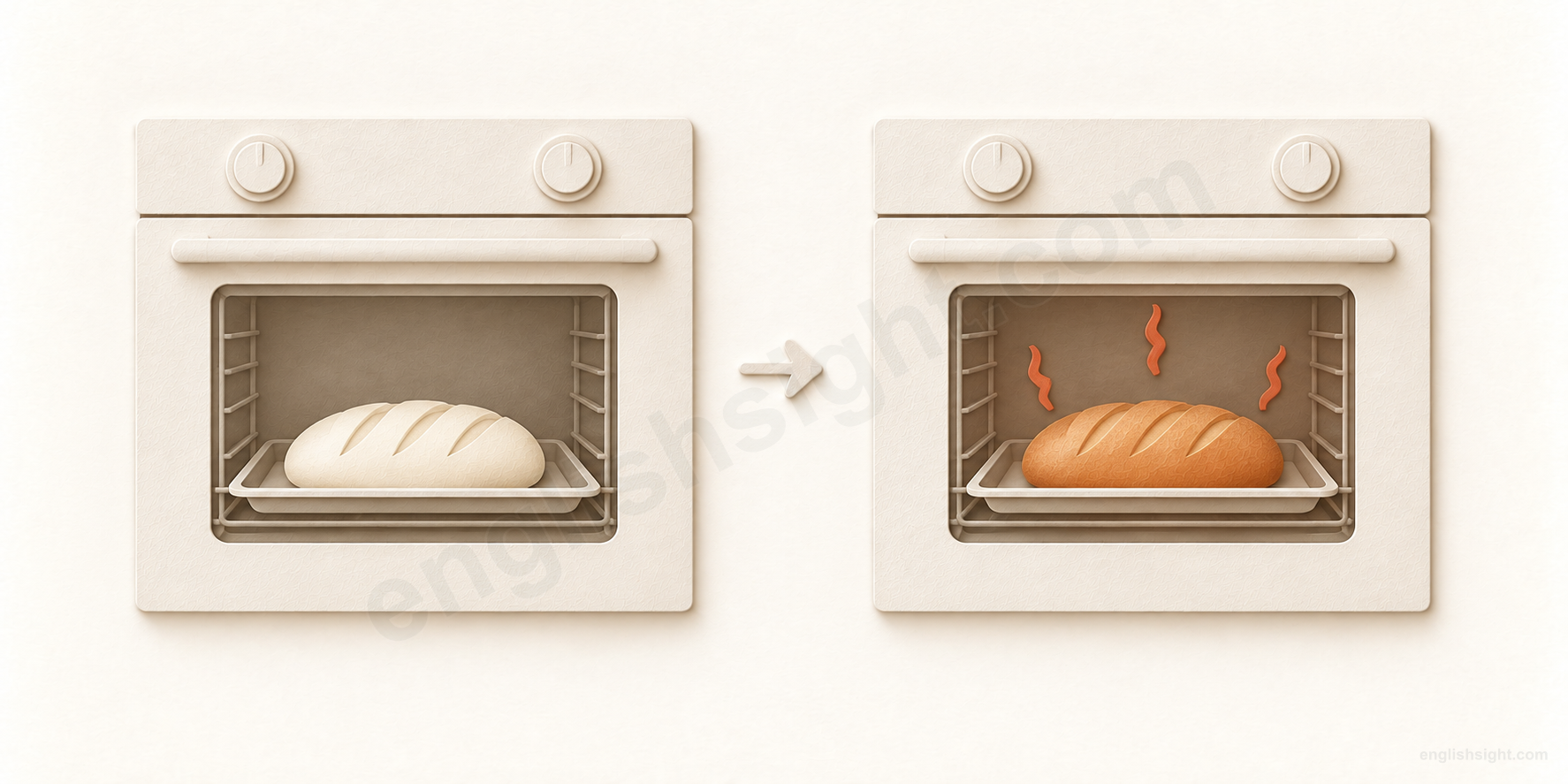
A pale unbaked loaf sits inside the oven.
oven
The baked loaf remains inside the same oven.
Heat acts on the food within the enclosed chamber.
The oven encloses the food; heat cooks it inside.
An oven provides an enclosed space where heat cooks, warms, or dries what is inside.
The sketch shows an ordinary cooking oven. The noun still applies when it is off; microwave ovens use a different heating mechanism. The pregnancy idiom must be learned as a whole.
Think of food inside a chamber where heat acts on it. Oven usually names that cooking space or the appliance containing it; the surrounding words explain its type and use.
This lesson separates the noun from cooking verbs, kitchen compounds, and figurative expressions. The sketch is a teaching model, not a claim that every English speaker imagines the same picture.
01
Recognize the appliance
Start with the enclosed cooking space, then distinguish the whole cooking appliance and different kinds of oven.
01
an / the + oven; number + ovens
an oven / two ovens
an enclosed space used to cook or heat food
Starting situation
You need equipment for cooking a loaf.
Meaning in context
The loaf can cook inside a heated chamber.
The defining feature is the enclosed cooking space.
An oven is the compartment or appliance in which food is heated. It may be built into a larger cooker or be a separate appliance. Bread inside the chamber in the sketch illustrates this use.
Oven is countable: an oven, the oven, two ovens. Say an oven because the word begins with a vowel sound. The first vowel is /ʌ/, as in cup; the plural is ovens.
The name does not mean it is heating at this moment: a cold oven and a broken oven are still ovens.
In a sentence
Our new kitchen has two ovens.
Watch the difference Use a determiner with an ordinary singular noun phrase: We need an oven, not We need oven.
02
food + in the oven; pan + on the stove
in the oven / on the stove
distinguish a cooking chamber from a cooking surface or whole appliance
Starting situation
A loaf cooks inside while a saucepan sits on a burner.
Meaning in context
You name the two cooking locations accurately.
Inside the oven and on the stove describe different relations.
In the oven locates food inside the chamber. On the stove commonly locates a pan on the cooking surface above the burners or rings. On top of the oven, by contrast, can mean the exterior top surface.
Stove can name the whole cooking appliance, including an oven and rings on top. British English also uses cooker for that appliance; North American English also uses range. Oven focuses on the enclosed compartment, so the words are not interchangeable in every instruction.
In a sentence
The bread is in the oven, and the soup is on the stove.
Watch the difference Do not change in to on if you mean food inside the oven.
03
gas / electric / wood-fired / fan / convection / toaster + oven
a gas / electric / fan oven
specify the power source or heating arrangement
Starting situation
A recipe or appliance description identifies an oven type.
Meaning in context
You know which kind of equipment is meant.
The modifier adds information; oven still names the cooking chamber.
Gas oven and electric oven identify the energy source. Wood-fired oven identifies one heated by burning wood. These are noun phrases, not separate actions performed by oven.
A fan oven has a fan that circulates hot air. Convection oven is the North American term given for this type in Oxford; fan oven is its British counterpart. Fan describes air circulation, not a different meaning of the noun oven.
A toaster oven is a small electric oven for toasting bread and baking small amounts of other food. It commonly sits on a kitchen counter. The full name distinguishes it from a full-sized oven and from a toaster used just for toast.
In a sentence
The recipe gives a separate temperature for a fan oven.
Watch the difference Conventional and convection are different words; a conventional oven is not automatically a fan oven.
04
in the microwave (oven); a microwave oven
a microwave oven / a microwave
a cooking appliance that uses microwaves to heat food
Starting situation
You want to name the appliance used to reheat lunch.
Meaning in context
Microwave identifies the relevant kind of oven.
The full compound names a particular heating technology.
A microwave oven heats food using electromagnetic waves. In ordinary conversation, the appliance is usually just a microwave: My lunch is in the microwave.
Although microwave oven contains oven, an instruction to use the oven often means a conventional oven in contrast with the microwave. Read the full instruction rather than assuming the two names always refer to the same equipment. The enclosed-space model remains useful, but hot air is not the heating mechanism of every oven.
In a sentence
We reheated the rice in the microwave oven.
Watch the difference The noun microwave can also name an electromagnetic wave; in this kitchen sentence it names the appliance.
02
Follow a recipe and use an oven
The noun names the equipment. Verbs supply the action, and prepositions show where the food is or where it moves.
05
put + food / tray + in(to) the oven; be in the oven; take + object + out of the oven
put it in / take it out of the oven
place food inside, locate it there, or remove it
Starting situation
A tray is outside the oven.
Meaning in context
After cooking inside, it is removed again.
The verbs and prepositions specify movement or location.
Put the tray in the oven describes placing it inside. Put it into the oven also makes that movement explicit. The tray is in the oven simply describes its location.
Take the tray out of the oven reverses the movement. Remove it from the oven is another common instruction. In, into, out of, and from do not create new senses of oven; they organize the relation between food and chamber.
In a sentence
The rolls are in the oven; take them out of the oven when the timer rings.
Watch the difference Keep of in out of the oven. The pronoun them refers to the rolls, not to the oven.
06
preheat / set the oven to + temperature; turn the oven on / off; turn it on / off
preheat / turn on / turn off the oven
prepare the oven and control its operation
Starting situation
You have prepared food but the oven has not warmed up.
Meaning in context
The oven reaches the required temperature before cooking starts.
Turning on starts heating; preheating prepares the chamber in advance.
Turn on the oven starts its operation; turn off the oven stops it. Preheat the oven means heat it before putting in the food. A preheated oven is one that has already been heated for use.
Set the oven to 180°C specifies a target temperature; bake at 180°C gives the cooking temperature. In a recipe, a moderate or hot oven describes a temperature range rather than a different appliance.
The verbs take oven as their object: preheat it, turn it on, turn it off. With a pronoun, say turn it on, not turn on it. These particle-verb patterns belong to turn, not to oven.
In a sentence
Preheat the oven to 180°C before you put the cake inside.
Watch the difference Use to for the target of preheating and at for the cooking temperature: preheat to 180°C; bake at 180°C.
07
bake / roast / heat + food + in the oven; food + be baked in an oven
bake / roast / heat something in the oven
name what happens to food inside
Starting situation
Food is ready to be cooked or warmed.
Meaning in context
The chosen verb tells you what the heat does.
Oven names the place; bake, roast, and heat name actions.
Bake bread or a cake and roast chicken or vegetables are familiar combinations. Both can happen in an oven. The choice depends on the food and cooking method, not just on whether an oven is used.
You can say We bake bread in the oven or The bread is baking in the oven. In Bread is baked in an oven, the passive verb is baked; oven remains a noun after in.
Heat or warm food in the oven does not necessarily mean cook it from raw. Bread fresh from the oven has just come out after baking. Oven-baked before a food name describes how it was cooked, as in oven-baked potatoes.
In a sentence
We bake the bread in the oven and roast the peppers beside it.
Watch the difference For everyday instructions, use bake, roast, or cook in the oven. Do not build a verb family such as oven up from the noun.
03
Read kitchen labels and equipment names
In compounds, oven connects another word with oven use. The full expression tells you whether it names a glove, a suitable dish, prepared food, or a particular pot.
08
an oven glove / mitt; a pair of oven gloves / mitts
an oven glove / an oven mitt
a thick glove for handling hot oven dishes
Starting situation
A hot dish is ready to be moved.
Meaning in context
The cook uses a protective glove to hold it.
The final noun glove or mitt names the object.
An oven glove, also called an oven mitt, is made for holding hot dishes. Oven specifies its purpose; it is not a kind of oven.
The plural goes on the final noun: oven gloves or oven mitts, not ovens gloves. Compare an oven door, an oven rack, and an oven tray: each final noun names a part or object associated with the oven.
In a sentence
I used an oven mitt to lift the hot dish.
Watch the difference Oven glove is the hand covering; an ovenproof dish is the container. They have different jobs.
09
ovenproof + dish / pan; container + be ovenproof
an ovenproof dish
a dish suitable for use at oven temperatures
Starting situation
You are choosing a container for food that will be heated.
Meaning in context
The label tells you it is suitable for oven use.
The adjective describes the container’s suitability.
Ovenproof describes a dish, pan, or similar item that can be used in a hot oven. It can stand before a noun or after be: an ovenproof dish; This dish is ovenproof.
The word answers Can this container go in the oven? It does not mean that food is ready to eat. Contrast oven-ready, which describes prepared food, and oven-baked, which describes a cooking method.
In a sentence
Transfer the vegetables to an ovenproof dish.
Watch the difference Ovenproof is normally written as one word. It describes the dish, not whether the meal is cooked.
10
oven-ready + food noun
an oven-ready meal
food prepared so that it can go straight into the oven for cooking
Starting situation
The food has been prepared for the customer.
Meaning in context
The customer can now cook it in the oven.
Ready refers to the next cooking step, not necessarily to eating.
Oven-ready usually appears before a food noun. An oven-ready chicken has been prepared for cooking; the phrase does not by itself say the chicken is already cooked.
Ready to eat points to eating, while oven-ready points to putting food into the oven. The suffix-like second part ready supplies this readiness relation; oven tells you what the food is prepared for.
In a sentence
We bought an oven-ready chicken for dinner.
Watch the difference Do not interpret oven-ready as ready to eat. Keep the hyphen in the usual adjective before a noun.
11
a Dutch oven; cook + food + in a Dutch oven
a Dutch oven
a heavy cooking pot with a closely fitting lid
Starting situation
A recipe asks you to choose a heavy covered pot.
Meaning in context
You identify the cookware meant by the compound name.
In modern recipes, this whole expression can name a pot.
A Dutch oven commonly means a heavy pot with a tight lid, often made of cast iron. It can be used on a stovetop or in an oven. You must learn the compound: it need not mean an oven made in the Netherlands.
This is a useful boundary for the chamber model. The pot encloses food, but a modern kitchen Dutch oven is cookware, not the large appliance illustrated in the sketch. Older roasting devices also have this name, but they are not developed here.
In a sentence
She cooked the stew in a Dutch oven.
Watch the difference Capitalize Dutch. Dutch oven is a compound equipment name, not a transparent description of nationality.
04
Recognize comparisons and an idiom
Heat makes a familiar comparison possible. A separate humorous idiom has an established meaning that you must learn as a whole.
12
place + be like an oven; place + be an oven; it + be like an oven + in here
like an oven / be an oven
describe a place as uncomfortably hot
Starting situation
A closed room has become very hot.
Meaning in context
You compare its heat with an oven’s heat.
The comparison transfers heat to a place that is not cooking equipment.
It is like an oven in here uses an explicit comparison. The room is an oven makes the same kind of point more directly: the room feels extremely hot.
This is expressive description, not a report that the room contains cooking equipment or that its temperature equals a particular oven setting. The enclosed, hot chamber in the diagram offers a memory link.
In a sentence
By midday, the upstairs room was like an oven.
Watch the difference The phrase emphasizes heat. It does not mean the room has become a kitchen.
13
person + have / has a bun in the oven
have a bun in the oven
be pregnant, in an informal humorous expression
Starting situation
Someone is talking playfully about expecting a baby.
Meaning in context
The listener recognizes a pregnancy idiom.
The meaning belongs to the complete idiom.
Have a bun in the oven is an informal, humorous way to say be pregnant. The bun is a playful image for a developing baby; the phrase is not about literal baking in this use.
Learn the whole expression rather than treating oven alone as a word for pregnancy. It may sound too personal or jokey in some conversations; expecting a baby or pregnant is clearer neutral wording.
In a sentence
“I’ve got a bun in the oven,” Maya said, smiling at her sister.
Watch the difference Without a clear pregnancy context, a bun in an oven can still be literal. Use the idiom’s tone deliberately.
Keep the object, action, and full expression distinct
Noun grammar and pronunciation
Oven is normally a countable noun: an oven, the oven, ovens. Its first vowel is /ʌ/, not the vowel in open. The noun has no tense, passive voice, or productive particle-verb family.
The verb supplies the action
Preheat the oven, bake in the oven, and remove from the oven describe different actions involving the same equipment. Collins also records oven as a transitive verb meaning cook in an oven; this lesson recommends the ordinary beginner wording cook or bake in the oven rather than expanding that dictionary verb into invented patterns.
Compounds have different heads
An oven mitt is a glove, an ovenproof dish is a container, and oven-ready food is prepared for cooking. A Dutch oven can be a covered pot. Read the whole expression instead of expecting every phrase containing oven to name the same appliance.
Coverage boundary
The everyday cooking noun and practical related expressions are the focus. Ovens used for industrial drying or heat treatment retain the heated-chamber idea, but their technical varieties are outside this lesson. The diagram does not mechanically explain every idiom.
Choose what the whole expression means
Use the situation, the final noun, and the preposition to choose.
1. The cake is inside the cooking chamber. Which sentence says that?
2. A chicken is sold as oven-ready. What does that tell you?
3. You need the oven hot before the cake goes in. Which instruction states this?
4. A recipe asks for a Dutch oven. In a modern kitchen recipe, what is likely needed?
5. Maya says she has a bun in the oven, then tells her sister when the baby is due. What does the idiom mean?
Sources and teaching notes
The linked dictionary entries were read to check meanings, forms, collocations, and the idiom. Explanations and examples are original; the chamber sketch is a teaching model.
The diagram offers a way to understand the relation; it does not represent a picture shared by every native speaker.