Follow the relationship, then read the whole expression.
Find the reference and the path
Find the reference and the path
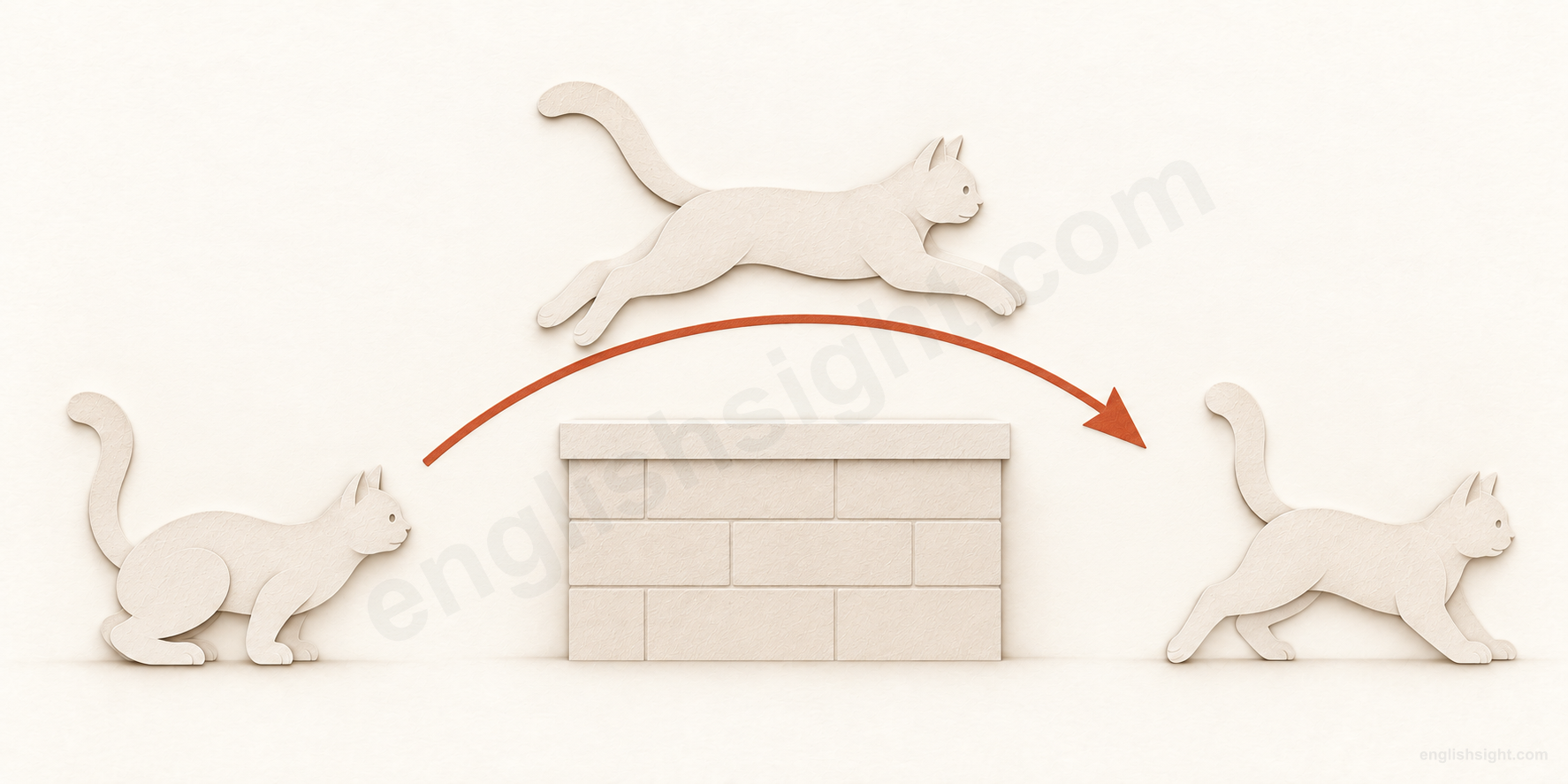
The cat crouches on this side of a low wall.
over
It lands beyond the wall on the right.
It jumps above the wall, following a path to the other side.
The wall is the reference: the cat passes above it and reaches the other side.
An object sits above a block; a curved path passes above it and reaches the other side. Height and crossing are related, but neither requires covering.
The block can remind us of a boundary or limit. This is a memory comparison, not proof that all meanings develop from one physical picture.
Over can locate a lamp, cover a body, cross a wall, exceed a limit, or describe a finished event. Ask what serves as the reference and what the surrounding words add.
The sketch connects height and crossing as a teaching aid. Other branches and fixed expressions need their own explanations; no shared mental picture is claimed for every English speaker.
01
Height, covering, and crossing
Identify the reference object, surface, or boundary. The verb tells you whether anything moves.
01
over + noun phrase
over the table
higher than a reference point
Situation / reference
The table is below.
Relationship / result
The lamp is above it.
Position does not require movement.
Over can place something higher, often directly above a reference. Lean over the desk puts your upper body above it; look over someone’s shoulder describes a line of sight.
English example
A lamp hangs over the kitchen table.
Watch the difference Above is a broader height comparison; over need not mean touching.
02
put / spread + object + over + noun
a blanket over someone
cover a person or surface
Situation / reference
The dog is uncovered.
Relationship / result
A blanket covers it.
A layer extends across something.
Unlike a lamp above a table, a covering can touch. A coat over a shirt is an outer layer; a towel over a chair may hang across its top.
English example
I put a blanket over the sleeping dog.
Watch the difference Above does not normally express this covering relationship.
03
movement verb + over + obstacle
jump over a wall
cross to the other side
Situation / reference
The cat is on this side.
Relationship / result
It lands on the other side.
A path passes above an obstacle.
The verb supplies jumping, climbing, or stepping; over relates the path to the obstacle. A bridge over a river spans it without moving.
English example
The cat jumped over the low wall.
Watch the difference Across suits crossing an area; over highlights passing above an obstacle.
04
move / look + over + area
over the grass / a view over…
extend or move across an area
Situation / reference
A stretch of grass lies ahead.
Relationship / result
Our route crosses it.
Not every path is airborne.
Over can describe movement on a surface. A view over the lake extends across what you see. Looking over the edge directs your gaze beyond it; falling over a cliff adds downward movement.
English example
We walked over the grass toward the lake.
Watch the difference Use the verb and context to distinguish walking, seeing, and falling.
05
over here / there; over + boundary
over there / over the road
locate something across or away
Situation / reference
You are on this side.
Relationship / result
The bakery is opposite.
A location can be static.
Over the road means on the opposite side, especially in British English. Over there points to a place away from the speaker; over here directs attention toward the speaker.
English example
The bakery is just over the road.
Watch the difference Over there does not mean above there.
06
come over (to…); have + person + over
come over / have someone over
visit or travel to a place
Situation / reference
You are elsewhere.
Relationship / result
You visit our place.
Over can mark movement between places.
Come over often invites a visit to the speaker’s home. We’re having friends over means hosting them. Sleep over means spend the night at someone else’s home, not sleep too long.
English example
Would you like to come over after dinner?
Watch the difference Use oversleep, not sleep over, for sleeping later than intended.
07
fall over; trip over + obstacle
fall over / trip over
lose balance or fall from an upright position
Situation / reference
A cable blocks your step.
Relationship / result
You end up on the ground.
Over can mark a fallen position.
Trip over names the obstacle that catches your foot; you may stumble without falling. Fall over describes losing an upright position; knock something over makes it fall: I knocked the cup over.
English example
I tripped over a cable and fell over.
Watch the difference A pronoun goes inside the separable pattern: knock it over.
08
turn / roll over; turn + object + over
turn something over
expose the other side
Situation / reference
One face is visible.
Relationship / result
The reverse face is visible.
A rotation changes which side faces up.
Turn over can be intransitive, as when a sleeper changes position, or transitive, as with a card. Turn it over places a pronoun before over.
English example
Turn the card over to read the answer.
Watch the difference Turn over does not always mean rotate through a full circle.
09
all over + place; the world over
all over / the world over
throughout an area
Situation / reference
Sand is in many places.
Relationship / result
The floor is widely covered.
All extends the spatial range.
All over means in or on many or all parts, not necessarily every square centimetre. The world over is a fixed alternative meaning throughout the world.
English example
There is sand all over the floor.
Watch the difference It’s all over means finished in another context; read what follows.
02
Amounts, limits, time, and channels
A number, period, meal, or communication medium gives over a different job. Read the noun and the complete pattern.
10
over + number; number + and over
over twenty / twenty and over
exceed an amount or include a lower age limit
Situation / reference
There is a numerical threshold.
Relationship / result
A value lies above or at it.
Word order changes inclusion.
Over sixty-five excludes exactly sixty-five; sixty-five and over includes it. Well over emphasizes a large excess; just over a small one. Over also works with prices, distances, and durations.
English example
Tickets are free for children aged five and under; adults aged sixty-five and over pay half price.
Watch the difference Over does not itself mean too many or too old.
11
be / go / run over + limit; run over
over budget / run over
exceed a planned limit
Situation / reference
The allotted time ends.
Relationship / result
The meeting continues.
A limit replaces a physical boundary.
Over budget means spending exceeds the allowance. A meeting can run over without an object; by ten minutes measures the excess. Carrying this idea to a number does not automatically imply disapproval.
English example
The meeting ran over by ten minutes.
Watch the difference Over by ten minutes gives the excess, not the total duration.
12
over + period; stay over
over the years / over the weekend
within or across a period
Situation / reference
Ten years form a span.
Relationship / result
Changes occur within that span.
Time is treated as an extent.
Over the years often describes accumulated change. Over the weekend places an event within that period, not necessarily throughout it. Stay over can mean remain overnight or until later.
English example
The village has changed over the last ten years.
Watch the difference Compare over ten years: more than ten years, unless a surrounding pattern gives a span.
13
talk about / discuss + topic + over + meal
over coffee / dinner
while sharing a meal or drink
Situation / reference
We sit down with coffee.
Relationship / result
We discuss the trip meanwhile.
The meal supplies the occasion.
Over coffee means during the time spent drinking coffee together. It does not describe a position above a cup. The activity named after over supplies the conversational setting.
English example
We discussed the trip over coffee.
Watch the difference Discuss takes its topic directly: discuss the trip, not discuss over the trip.
14
communicate over + medium; hear + object + over + noise
over the phone / over the noise
use a channel or rise above competing sound
Situation / reference
The call contains loud noise.
Relationship / result
Her voice is hard to hear.
Read whether the noun names a medium or interference.
Over the phone or radio names a means of communication. Hear someone over the noise instead means hear their voice despite louder competing sound. Both are established uses, not literal movement above equipment.
English example
I could barely hear her over the noise on the call.
Watch the difference Say over the phone; on the phone is also common, with context-dependent meanings.
03
Finished, recovered, remaining, or repeated
Some uses look beyond an endpoint; others revisit an activity or examine its contents. Learn the construction with the meaning.
15
be over; get + object + over with
be over / get it over with
be finished or finish an unwelcome task
Situation / reference
The exam is taking place.
Relationship / result
It has ended.
An endpoint has been passed.
Be over describes a finished event. Get it over with means complete something necessary but unpleasant. Oxford labels finished over an adverb; Collins also uses adjective for its position after be.
English example
The exam is over, and everyone can relax.
Watch the difference Use The exam is over, not an over exam, for this meaning.
16
get over + illness / difficulty / person; be over + illness; can’t get over + noun / how-clause
get over / be over / can’t get over
recover, overcome a difficulty, or express continuing surprise
Situation / reference
The flu affects you.
Relationship / result
You return to normal health.
The difficult phase is behind you.
Get over describes recovery; be over describes the resulting state. With a problem it can mean overcome it. Get over a person concerns emotional recovery; blunt Get over it! can sound unsympathetic.
Informal can’t get over can also express continuing surprise: I can’t get over how quiet the city is today. Here the speaker is amazed, not recovering from an illness. The negative construction and context identify this meaning.
English example
It took me a week to get over the flu.
Watch the difference Keep the object after over: get over it, not get it over, for recovery.
17
have + noun + left over; be left over from…
left over
remain after use
Situation / reference
We prepared more than we ate.
Relationship / result
Some rice remains.
A remainder survives an earlier activity.
Left over describes unused food, time, or money. It need not be waste. The related adjective is usually one word before a noun: leftover rice; the noun leftovers often means remaining food.
English example
We have some rice left over from lunch.
Watch the difference Write left over after the noun here; distinguish the adjective leftover.
18
start over; do + object + over; over and over (again)
all over again / over and over
restart or repeat
Situation / reference
The earlier work is lost.
Relationship / result
You begin from the start.
A completed path is traversed again.
All over again emphasizes starting again from the beginning. Over and over means repeatedly; twice over means twice. Do it over meaning redo it and start over are especially associated with North American English.
English example
The file disappeared, so I had to start all over again.
Watch the difference Be over means finished; do it over means repeat. The whole pattern matters.
19
go over + object; look + object + over
go over / look something over
review or inspect information
Situation / reference
The instructions are available.
Relationship / result
We check or study them.
Attention travels through material.
Go over can mean check or study again. Look something over means inspect it, often fairly quickly. Read it over reviews text; run over your notes can mean review them quickly.
English example
Let’s go over the instructions before we begin.
Watch the difference Say go over them, but look them over: these patterns place pronouns differently.
20
think + object + over; talk + object + over + with + person
think / talk something over
consider carefully before deciding
Situation / reference
A decision is still open.
Relationship / result
We discuss the options.
Over suggests consideration across the issue.
Think it over means consider a matter carefully. Talk it over adds discussion with another person. The topic is the object; with introduces your discussion partner. Turning an idea over in your mind is another reflection expression.
English example
I need to talk it over with my partner.
Watch the difference Use talk it over with her, not talk over her, to express joint consideration.
04
Authority, issues, choices, and transfers
These abstract relationships use familiar spatial comparisons, but the nouns and verbs determine the actual relationship.
21
control / authority over + noun; watch over + person
control over / watch over
exercise authority or protective supervision
Situation / reference
Someone can make decisions.
Relationship / result
Their influence affects a domain.
Abstract hierarchy differs from physical height.
Control or authority over names what someone can direct. Watch over someone means protect or care for them, not simply watch from above. The noun or verb supplies the kind of relationship.
English example
Parents have some control over what young children watch.
Watch the difference Control is not always total; over alone does not express ownership.
22
argue / worry over + issue; argument over + issue
argue / worry over
identify a disputed or worrying issue
Situation / reference
A payment question arises.
Relationship / result
People disagree about it.
Over marks the issue at stake.
An argument over money names the subject or cause of disagreement. Worry over a result names what causes concern. About often works too; neither use means the disagreement or worry has ended.
English example
They argued over who should pay for the repair.
Watch the difference Be over a problem and worry over a problem express different relationships.
23
choose / prefer + A + over + B
choose one thing over another
give one option preference
Situation / reference
Two travel options are available.
Relationship / result
The train is selected.
One option ranks above another.
Over introduces the option not selected. Choose A over B compares alternatives, not a route above B. Prefer A to B is another standard comparison pattern.
English example
She chose the train over the plane.
Watch the difference Keep the selected option first; prefer A than B is not the standard pattern.
24
hand + object + over + to + person; over to + person
hand something over / over to you
transfer possession, responsibility, or a turn
Situation / reference
You hold the keys.
Relationship / result
Maya receives them.
Something passes to a new holder.
Hand over can transfer objects or responsibility. Over to you passes the speaking turn or task to someone else. Radio Over signals that a reply is invited; it is a communication convention.
English example
Please hand the keys over to Maya.
Watch the difference A pronoun goes before the particle: hand them over to Maya.
25
take over (from + person); take + object + over
take over
assume control or replace someone
Situation / reference
You are responsible now.
Relationship / result
Nina becomes responsible.
The role moves to a new holder.
Take over can stand alone or take an object: take the project over. A company may be taken over by another company. Negative feelings taking over means they become dominant.
English example
Nina will take over from me next week.
Watch the difference From names the previous holder; it does not name the task.
26
win + person + over (to + idea)
win someone over
gain someone’s support
Situation / reference
You are doubtful.
Relationship / result
You become supportive.
An opinion changes sides.
Win someone over means persuade them to approve or support you. The change may be gradual. It does not mean defeat them in a contest; that would usually be beat them.
English example
Her clear explanation won me over.
Watch the difference Use won me over, not won over me.
05
Common verb combinations in context
Small changes in the verb or complement can change the meaning completely. These examples distinguish familiar combinations.
27
run + person + over; pull over; move over
run over / pull over / move over
distinguish road movement and accidents
Situation / reference
An ambulance approaches.
Relationship / result
The driver moves to the side.
The verb changes the whole event.
Pull over moves a vehicle to the roadside; police can pull a driver over. Move over asks for sideways space. Run someone over means hit and drive over them; someone can be run over.
English example
The driver pulled over to let the ambulance pass.
Watch the difference With a person, run over describes a vehicle collision; with a time limit, it means exceed the allowance.
28
liquid / container + boil / run over
boil over / run over
flow past a container’s edge
Situation / reference
The soup is heating.
Relationship / result
It spills over the rim.
The edge is a physical limit.
Boil over combines boiling with spilling; run over can describe overflowing without boiling. Figuratively, anger or tension can boil over: Anger boiled over during the meeting. The emotional sense is conventional.
English example
The soup boiled over while I answered the door.
Watch the difference Boil over is usually intransitive: the soup boiled over, not boiled over it.
29
water surface + freeze over
freeze over
become covered with ice
Situation / reference
The surface is liquid.
Relationship / result
An ice layer covers it.
The covering branch appears as a result.
Freeze over concerns ice spreading across a surface. It does not necessarily say the entire depth is solid. Related cover-over patterns express a surface layer; their precise meanings depend on the verb.
English example
The pond froze over during the night.
Watch the difference Frozen over does not by itself establish that ice is safe to walk on.
30
go over + well / badly + with + audience
go over well
receive a particular reaction
Situation / reference
A timetable is proposed.
Relationship / result
The staff respond positively.
Reception is an established meaning.
Especially in North American English, go over well means be received favourably. Compare go over the timetable, which means review it. The presence of an object versus a reaction phrase helps choose the meaning.
English example
The new timetable went over well with the staff.
Watch the difference Well describes the reception; it does not mean reviewing carefully here.
31
feeling + come over + person; person + come over + adjective
come over someone / come over dizzy
be affected by a feeling
Situation / reference
You are waiting anxiously.
Relationship / result
Calm suddenly affects you.
The feeling is imagined as spreading over you.
A feeling comes over a person; What came over you? asks why you behaved unusually. British informal I came over dizzy means I suddenly felt dizzy. These differ from come over for a visit.
English example
A strange calm came over me before the interview.
Watch the difference For the feeling pattern say calm came over me, not calm came me over.
06
Established expressions
Learn these phrases as units. A spatial memory image cannot reliably generate their meanings.
32
be / go over + possessive + head; be in over + possessive + head
over someone’s head / in over your head
exceed understanding, bypass authority, or exceed ability
Situation / reference
The details are complicated.
Relationship / result
You do not understand them.
Head idioms need separate contexts.
Over my head can mean beyond my understanding. Go over my head to my boss means bypass me for higher authority. In over my head means involved in something too difficult to manage.
English example
The technical details went over my head.
Watch the difference In over my head concerns coping with a situation, not merely failing to understand words.
33
be over the moon (about + noun)
over the moon
feel extremely pleased
Situation / reference
Good news arrives.
Relationship / result
You feel delighted.
This is a fixed informal idiom.
Over the moon expresses great happiness, especially in British informal usage. The image of going beyond the moon can help memory, but the meaning belongs to the complete phrase.
English example
We were over the moon about the good news.
Watch the difference Keep the: over the moon. It does not mean an event has ended.
34
be / go over the top
over the top
be excessive or exaggerated
Situation / reference
The mistake is minor.
Relationship / result
The response is disproportionate.
An imagined limit marks reasonable behaviour.
Informal over the top judges something as excessive, sometimes disapprovingly. An over-the-top reaction uses hyphens before a noun. Literal over the top of the wall instead describes a physical relation.
English example
His reaction to a small mistake was over the top.
Watch the difference Do not confuse over the top with over the moon: excess and happiness differ.
35
buy + medicine + over the counter
over the counter
purchase medicine without a prescription
Situation / reference
You ask about a medicine.
Relationship / result
You ask whether a prescription is needed.
The whole phrase names a purchasing condition.
Over the counter means without a prescription when discussing medicine. Before a noun use over-the-counter medicine. The phrase also has a separate financial meaning; physical position above a shop counter does not explain both.
English example
Can you buy this medicine over the counter?
Watch the difference This describes prescription status, not whether a medicine suits a particular person.
36
over and above + noun
over and above
be additional to something
Situation / reference
A price is already stated.
Relationship / result
Delivery adds a further cost.
Addition differs from a simple comparison.
Over and above introduces an extra amount or consideration beyond what was already included. The full phrase means in addition to; it can be used with non-numerical matters too.
English example
Delivery costs ten euros over and above the price shown.
Watch the difference Compare over ten euros, which simply means more than ten euros.
Grammar and the limits of the model
Preposition, adverb, and particle
Over the wall has a complement; come over can stand without one. Particle verbs have different object patterns: turn it over, go over it. A passive belongs to the full verb construction, as in was run over; over itself does not conjugate.
Related forms and specialist uses
The prefix over- often means excessive, as in overcook, but not every word beginning over has that meaning. In cricket, an over is a noun for a set of six legal deliveries; overs is its plural. The fraction three over four means 3/4. These uses do not share the lesson’s crossing picture.
Coverage boundary
This is a selection of common uses, not a frequency ranking or a complete phrasal-verb dictionary. Regional, literary, sexual, and detailed business senses are not expanded. A familiar verb plus over can have additional meanings; check the whole expression.
Choose the intended relationship
Use context and word order, not just a translation of over.
1. A discount starts on your sixty-fifth birthday. Which wording includes that exact age?
2. You have recovered from a shock. Which pattern fits?
3. You want to check the instructions together. Which sentence fits?
4. The work must be done again. Which sentence expresses repetition?
5. You move your car to the roadside to let an ambulance pass. What did you do?
Sources and teaching notes
Usage was checked against Oxford and Collins. Explanations and examples are original; the diagram is a teaching interpretation.
The diagram is a memory aid, not a universal mental picture.