Find a page, browse pages, and recognize the expressions that go beyond paper.
A readable unit in a larger whole
A readable unit in a larger whole
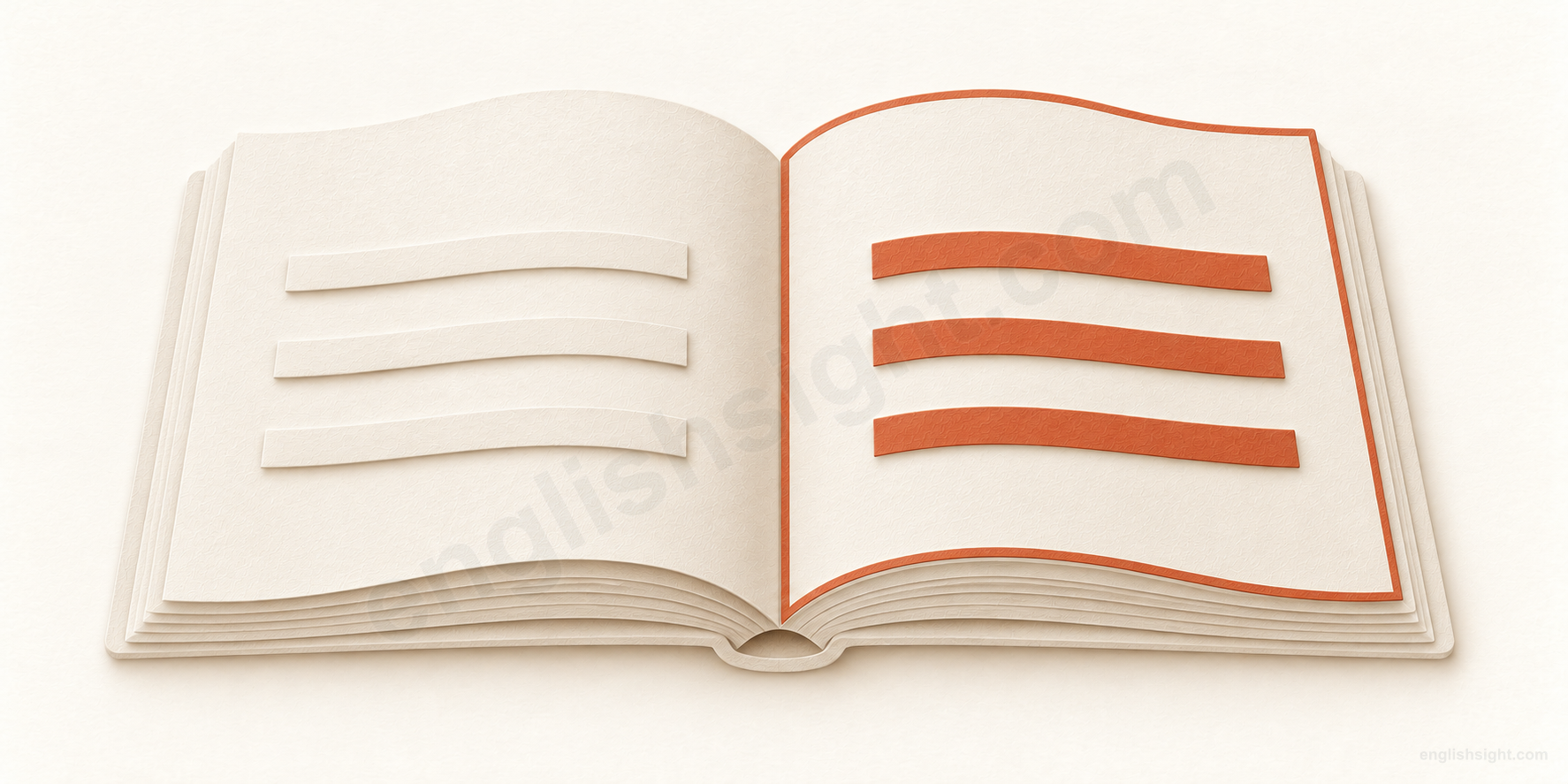
An open book presents two facing reading surfaces.
page
One page is identified within the intact book.
The orange border singles out the right-hand surface.
The outlined side is one page; the facing side is another.
A page presents one readable surface or organized unit of content within a book, document, or online setting.
The picture models the paper sense: the highlighted right-hand surface is one page, and the facing surface is another. Online pages extend the organizing idea. The attendant and contact meanings belong to a separate branch.
An open book presents two facing reading surfaces. Page lets you name, count, or find one of those units. The same organizing idea helps explain a web page and several reading-based metaphors.
Page also names an attendant and the act of calling someone by an announcement or pager. That separate word family needs its own explanation. The diagram is a teaching aid, not a claim about every native speaker’s mental picture.
01
Paper, reading, and finding a place
Begin with the countable reading surface. Notice how numbers, prepositions, and other nouns identify its place or contents.
01
a / the + page; a blank / new page
a page / a blank page
a side used for reading or writing
Situation
You open a notebook.
What is meant
One visible side is available for your notes.
A page is a countable reading surface; a sheet is the physical piece of paper.
A notebook leaf has two sides. When you count numbered reading surfaces, each side is a page. In everyday speech, a torn-out page can also mean the whole leaf. Context decides whether the speaker means a side or the piece of paper.
Blank describes a page with nothing written or printed on it. Start a new page asks for fresh writing space. The diagram highlights one facing page of an open book; it does not define every use of page.
In a sentence
I left a blank page for your notes.
Watch the difference A blank page has no writing; a blank sheet is a piece of paper. Neither expression means that every page in the book is empty.
02
on page + number; turn to page + number; turn the page
on page 18 / turn to page 18
locate content or move to a numbered place
Situation
A reader needs the diagram in a book.
What is meant
The number tells the reader where to look.
On locates content; to marks the destination when you turn.
Use on page 18 for information at that location. Turn to page 18 tells someone to find it. Open your book at page 18 is also natural. When page is followed by its identifying number, no the is needed: page 18, not the page 18.
Turn the page means move the leaf to reveal the next reading surface. The next, previous, opposite, or facing page identifies a page by its relation to another. Over the page can mean on the next page, especially in British English.
In a sentence
The diagram is on page 18; turn to that page now.
Watch the difference Keep the prepositions tied to the action: the answer is on page 18, but you turn to page 18.
03
on the front / back page; the sports / title page(s); in the pages of + publication
the front page / the sports pages
a publication location and the content placed there
Situation
A newspaper assigns space to different kinds of news.
What is meant
The page name tells you its position or subject.
A page can stand for the writing and pictures occupying it.
The front page is the first newspaper page, often carrying prominent news. The back page is at the other end. The sports pages identify a content section that may occupy several physical pages. A title page gives a book’s title and related publication information.
An article on the front page has that specific location. A story in the pages of a magazine appears somewhere within the publication. The printed page can refer more generally to published writing, rather than one particular sheet. These are noun phrases, not phrasal verbs.
In a sentence
Our school team was on the front page of the local paper.
Watch the difference Front-page news uses a hyphen when front-page modifies news; on the front page keeps the ordinary noun phrase.
04
number + pages; a + number-page + noun; page after page; per page
ten pages / a ten-page report
measure a text or a quantity of reading
Situation
A teacher sets a reading task.
What is meant
The page count tells you how much to read.
Pages is plural after a number; page stays singular inside a number modifier.
Ten pages describes a quantity. A ten-page report describes a report with that length; the number and singular page work together before the noun. Pages of notes describes an amount of written material, not a new kind of paper.
Page after page emphasizes a long succession: She checked page after page of figures. Per page gives a rate for each page, as in a printing charge. These patterns measure or emphasize the reading units; they do not add a separate dictionary sense for each number.
In a sentence
Please read ten pages of the twenty-page report.
Watch the difference Write a twenty-page report, not a twenty-pages report. Page count and sheet count can differ when both sides are printed.
02
Pages on a screen
The reading unit also works online. A page is one part of a site; it need not fit on one screen.
05
a web / profile page; open / load / refresh + the page; on this page
a web page / refresh the page
a document or information unit viewed online
Situation
You follow a link to opening times.
What is meant
One page of the museum’s site displays them.
A web page is an addressable information unit, not necessarily one screenful.
A website can contain many web pages. One long page may require scrolling; reaching the bottom of the screen does not necessarily take you to a different page. A profile page or a company’s social media page is a particular online location for information about that person or organization.
Open, visit, load, and refresh describe different actions: refresh requests the page again. Write on this page for content located there. The connection with paper is organization into readable units; there need not be a physical leaf.
In a sentence
Refresh the page to see the new opening times.
Watch the difference A page and a website are not generally interchangeable: one site can have many pages.
06
the home page of + website; a browser’s home page
the home page
a site’s main starting page or a chosen browser starting page
Situation
You want the main menu of a museum’s website.
What is meant
Its home page offers links to other parts.
Home identifies a starting point within the online page system.
A website’s home page is its main entry page, usually linking to other parts of the site. Return to the home page means go back to that starting location. A browser home page can instead be the page chosen as the browser’s starting destination.
The context distinguishes the site’s main page from the user’s chosen starting page. Your browser home page can be a particular search service; it does not have to be the home page of the website you are currently visiting.
In a sentence
The museum’s home page has a link to ticket prices.
Watch the difference Home page names a page’s function. It does not mean every page containing a Home button.
03
Browse a document or contact a person
Page through concerns reading. Page a person concerns contacting someone and belongs to a different word history.
07
page through + book / report / pronoun
page through a book
browse by turning pages
Situation
You have a catalogue but no exact page number.
What is meant
You look through it to find a suitable item.
The document follows through; you move across its pages.
Page through a book, report, or magazine means look through its pages, usually fairly quickly rather than reading every word. Oxford marks this phrasal verb North American English; leaf through is a useful alternative.
Through expresses movement across the document’s sequence. Keep the document after through, including a pronoun: page through it. This is different from turn to page 18, which names one target location.
In a sentence
I paged through the catalogue looking for a small desk.
Watch the difference Say page through it, not page it through. The object here is a document, not a person being contacted.
08
page + person; person + be paged; have + person + paged
page someone / be paged
call for a person over a public announcement system
Situation
A traveler is somewhere inside the airport.
What is meant
Staff announce the traveler’s name to make contact.
The object is the person staff are trying to reach.
To page someone at an airport, hotel, or similar place is to call their name over an announcement system so they can receive a message or report somewhere. The passive focuses on the person: She was paged at the airport.
Have someone paged means arrange for staff to make the announcement. It is the ordinary have + object + past participle arrangement, not an extra meaning of page. This contact verb belongs with the attendant word family, not with paper surfaces.
In a sentence
We asked airport staff to page our missing colleague.
Watch the difference Paging tries to reach someone; it does not guarantee they heard the call or arrived.
09
page + person; receive / get a page
page the doctor
send someone an alert through a pager
Situation
A hospital needs the doctor on duty.
What is meant
A pager alert asks the doctor to respond.
The person is contacted electronically rather than over a loudspeaker.
Page a doctor can mean send a message to the doctor’s pager. The setting identifies the channel: no public announcement is required. A pager is the device; page is the verb describing the contact.
Merriam-Webster also records a page as an individual paging message or alert: I got a page. That countable noun belongs to this contact branch. Page is not a general substitute for every kind of text message, email, or telephone call.
In a sentence
The nurse paged the doctor on duty.
Watch the difference Read the setting before choosing the meaning: paging through a medical report is browsing, not contacting its author.
04
Shared plans, fresh starts, and examples
These established expressions use reading as a model for understanding, progress, or imitation. Learn the complete phrase.
10
be on the same page (about + topic); get + people + on the same page
be on the same page
share an understanding or agree about what to do
Situation
Team members have different ideas about the plan.
What is meant
They discuss it until their aims are aligned.
The whole idiom concerns agreement, not matching book positions.
When people are on the same page, they understand or agree on the relevant plan, goal, or approach. Be describes that shared position; get everyone on the same page describes bringing people into agreement.
The reading image is useful: people working from the same place can coordinate. But the idiom does not require a book or identical opinions on every subject. On the same page about the deadline restricts the agreement to that issue.
In a sentence
Before we book anything, let’s make sure we’re on the same page about the budget.
Watch the difference Use on in the idiom. Being in the same book is not the usual expression for this agreement.
11
turn the page; turn the page on + past problem / period
turn the page on something
leave a difficult period behind and make a fresh start
Situation
A team has had a series of disagreements.
What is meant
It decides to work together differently.
Turning onward is a metaphor for moving beyond a difficult period.
Literal turn the page reveals the next reading surface. Figurative turn the page means begin a new, more positive phase after trouble. On can introduce the past issue or period: turn the page on the argument.
The phrase expresses a fresh start in attitude or action. It does not claim that the past has been erased or that every consequence has disappeared. The figurative meaning belongs to the expression as a whole.
In a sentence
After months of arguments, the team is ready to turn the page.
Watch the difference In a reading lesson, turn the page may be completely literal. Use context to recognize the fresh-start idiom.
12
take / borrow a page from + person / someone’s book / playbook; take a page / leaf out of someone’s book
take a page from someone’s book
use another person’s approach as an example
Situation
Your sister has a useful way to plan meals.
What is meant
You decide to use the same method.
Borrowing a page represents borrowing an approach, not removing paper.
Take a page from someone’s book means follow their example in some respect. Collins records take or borrow a page from as US usage; a page from someone’s playbook is another familiar form when the focus is a method or strategy.
The person or organization after from supplies the model. The imitation may be approving, critical, or neutral depending on the example. It does not necessarily mean copying their words or agreeing with everything they do.
Take a page out of someone’s book and take a leaf out of someone’s book are variants of the same imitation idiom. Here leaf means a book leaf, not a leaf from a tree. The variant does not create a new meaning of page.
In a sentence
I took a page from my sister’s book and planned our meals for the whole week.
Watch the difference Keep the full expression and its model: take a page from someone’s book or take a page out of someone’s book. Take a page on its own will normally sound like a literal action unless the context supplies the idiom.
13
a + adjective + page in / of + history
a page in history
an event or period treated as part of a larger historical story
Situation
A writer describes an important turning point.
What is meant
It is presented as one part of a country’s history.
The reading unit becomes a metaphorical unit in a larger record.
A page in history, or a page of history, can mean an important event or period rather than a literal printed surface. Dictionaries label this use literary. A new page in a city’s history suggests a new stage in its story.
The surrounding words show the evaluation: a dark page and a proud page describe very different events. Page itself does not mean progress or success. In the pages of a history book, by contrast, may refer to actual written material.
In a sentence
The agreement opened a new page in the town’s history.
Watch the difference This literary metaphor is more elevated than ordinary a new stage. Not every mention of history makes page figurative.
05
Recognize the other noun and a useful compound
A page can also be an attendant. A page-turner is a different compound naming an exciting book.
14
a page; a congressional page; a wedding page / pageboy
a page / a pageboy
a young attendant or an institutional messenger
Situation
A visitor reads about a messenger working in a legislature.
What is meant
The job title is page.
This person noun is separate from the paper-page family.
A page can be a young attendant or messenger. In US political contexts, a congressional page assists with messages and similar tasks. Historical texts use page for a boy serving a knight while training, or attending a person of high rank.
At a wedding, page or pageboy can describe a boy attending the bride; pageboy is the usual British term. The hotel-attendant use is old-fashioned. These meanings help with recognition; they are not names for an ordinary page of a book, and the diagram does not model them.
In a sentence
The senator handed the note to a page.
Watch the difference Congressional and wedding roles depend on context. Do not use page as a general name for any child or any worker.
15
a page-turner; the book is a real page-turner
a page-turner
a book so exciting that you want to keep reading
Situation
A novel keeps you awake late at night.
What is meant
You recommend it as an absorbing read.
The compound names the book that motivates continued page-turning.
A page-turner is an informal name for a very exciting book. The imagined effect is that the reader keeps turning pages to discover what happens next. It is a countable noun: a page-turner, two page-turners.
In a book recommendation, this compound evaluates the book and the reading experience rather than naming a person who turns pages. It does not necessarily say the book is difficult, long, or a literary masterpiece.
In a sentence
That mystery is a real page-turner; I finished it in one evening.
Watch the difference Keep the hyphen in the noun page-turner. Ordinary turn the page is a verb phrase with a different grammar.
Use the context and the full expression
Page, sheet, and leaf
Page often counts readable sides; sheet and leaf name physical pieces. Everyday page can also name a whole leaf. For a printing order, state whether you mean printed sides or sheets.
Noun and verb forms
The pronunciation is /peɪdʒ/. The plural noun and third-person verb are pages /ˈpeɪdʒɪz/; the past and past participle are paged /peɪdʒd/, and the -ing form is paging. Paging can describe an action in progress: They are paging the passenger now.
Separate word families and scope
The reading-surface family and the attendant/contact family have different word histories. The picture does not derive one from the other. Technical memory pages, specialist printing type, and page meaning number the pages are outside the practical focus here.
Choose the intended meaning
Use the object, preposition, and situation to distinguish the branches.
1. A learner asks where the answer is printed. Which reply names its location?
2. You print on both sides of five sheets, with one numbered page on each side. How many printed pages do you have?
3. You quickly look through a catalogue without reading every word. Which sentence fits?
4. Hospital staff page the doctor using a pager. What are they doing?
5. Before starting a project, your colleague asks whether you are on the same page about the goal. What does she want to check?
6. After a difficult year, a team wants to turn the page. What does it mean?
Sources and teaching notes
Dictionary entries were used to check meanings, constructions, labels, and boundaries. The explanations, examples, and visual teaching model were written for this lesson.
The diagram is a teaching model; it does not represent a picture shared by every native speaker.