From bodily pain and emotional hurt to annoyance, careful effort, and fixed expressions.
Someone experiences hurt
Someone experiences hurt
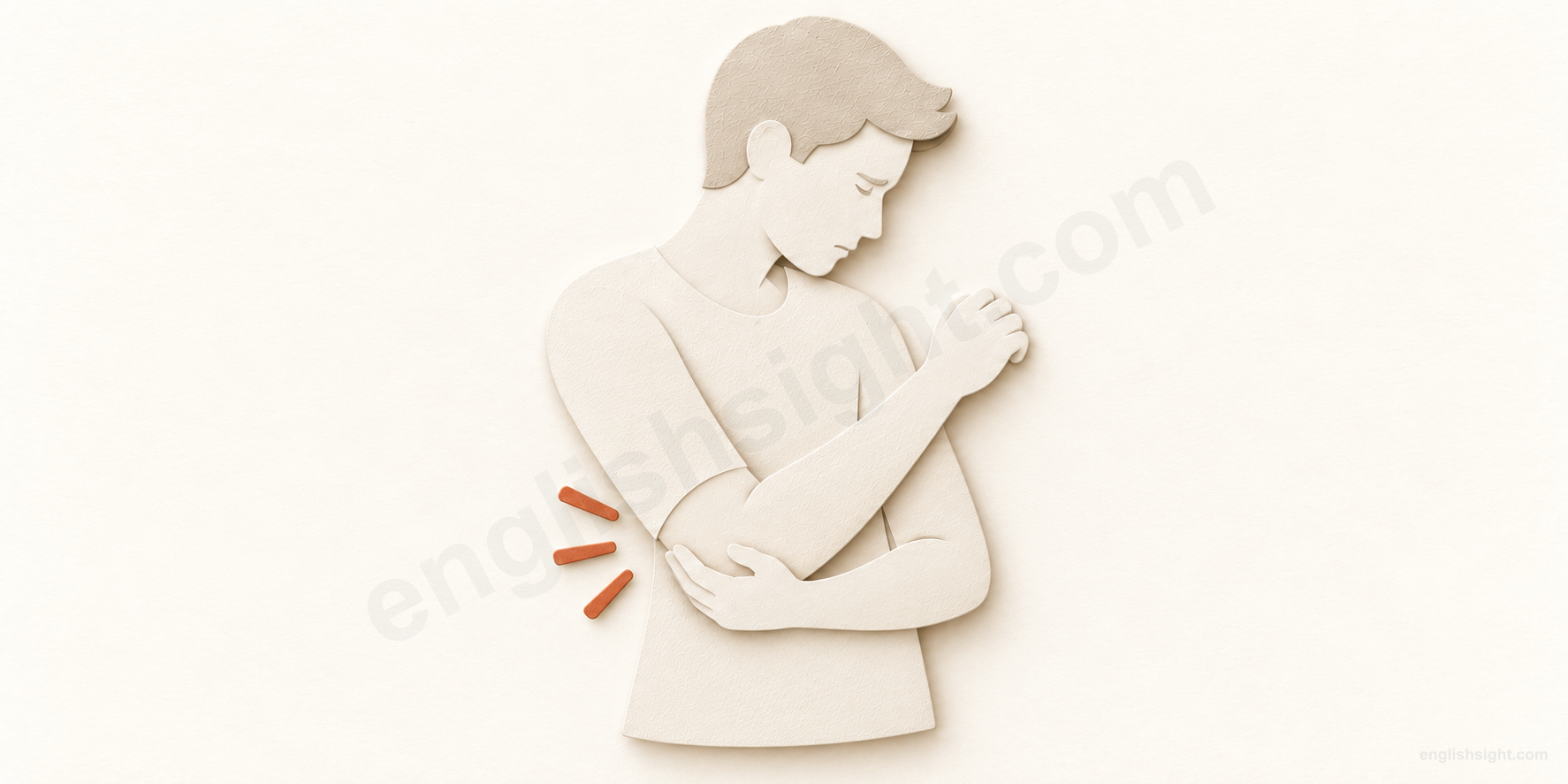
A person feels discomfort in a bent arm.
pain
The felt hurt is located at the elbow.
The other hand supports the hurting elbow.
Pain is the hurt someone feels, not the event that caused it.
Pain names hurt as it is experienced, in the body or in emotional life.
The diagram shows a bodily instance: a person supports a hurting elbow. It does not explain the cause, imply that all pain involves visible injury, or illustrate the separate effort and penalty expressions.
Pain names hurting as an experience. It can be felt in the body or in emotional life; it is not simply another word for the injury or event that causes it.
Learn the constructions as well as the connection. In pain describes suffering, a pain can describe a nuisance, and pains in take pains means careful effort. These are established uses, not meanings that a picture can predict automatically.
01
Describe what hurts
Pain can name suffering in general or a particular sensation. Describe its location, quality, and change without confusing the feeling with its cause.
01
be in (a lot of) pain; feel / experience / suffer pain
be in pain / feel pain
experience physical hurting
Situation / intention
Someone is uncomfortable after an injury.
Meaning in context
You describe the suffering they feel.
Pain names the experience; in pain describes the person’s condition.
Pain is usually uncountable when we mean physical suffering generally: feel pain, experience pain, suffer pain, or be in pain. In a lot of pain describes a large amount of suffering. It does not identify a separate injury.
Compare My wrist hurts with I have pain in my wrist. Hurt is a verb in the first sentence; pain is a noun in the second. Pain can be mild or severe, and the word alone does not tell us the cause.
In a sentence
He was in pain, but he could still describe what had happened.
Watch the difference Say I am in pain or I have pain, not I am pain.
02
have / feel a pain in + body part; body-part noun + pain / pains
a pain in my knee / chest pains
identify a particular pain or repeated sensations
Situation / intention
You need to say where you hurt.
Meaning in context
You name the affected area and the sensation.
Countable pain singles out an instance or kind of hurting.
A pain in my knee picks out a particular sensation; knee pain names the problem more generally. Pains can refer to repeated or distinct sensations, as in chest pains. In + body part gives the location, not the cause.
Aches and pains is a familiar phrase for assorted bodily discomforts. Labour pains (US spelling labor pains) refers to pains during childbirth. These physical plurals differ from take pains, where pains means care or effort.
In a sentence
I felt a pain in my left knee when I stood up.
Watch the difference Use my knee or the knee in a complete phrase; a pain does not necessarily mean a separate injury.
03
a sharp / dull / burning pain; mild / severe / chronic pain
a sharp pain / a dull ache
describe the quality and intensity of discomfort
Situation / intention
You are asked what the discomfort feels like.
Meaning in context
You describe the sensation more precisely.
Sharp and dull describe the feeling; severe describes its intensity.
A sharp pain can feel sudden or piercing; a dull pain is less sharp. Ache commonly suggests an ongoing hurting feeling. Pain is the broader noun: it can be sharp, dull, burning, mild, or severe.
Chronic pain describes pain that persists over time, while severe pain describes intensity. Neither adjective can simply replace the other. These words help describe an experience; they are not a diagnosis.
In a sentence
At first there was a sharp pain; later it became a dull ache.
Watch the difference Do not teach pain as always sharp or ache as always mild.
04
cause somebody pain; inflict pain on somebody; ease / relieve pain
cause pain / ease the pain
describe the arrival or reduction of suffering
Situation / intention
A movement hurts, and resting changes the feeling.
Meaning in context
You explain what increases or reduces the pain.
The verb supplies the change; pain names what is felt.
Cause pain names something that makes someone hurt; give someone pain can also describe causing it. Inflict pain on someone emphasizes causing suffering to that person or animal. Ease or relieve pain describes making it less intense; it does not necessarily mean removing its cause.
Pain relief names the reduction of pain, and pain management names ways of dealing with it. In The pain has gone, the feeling has stopped; The pain has eased says it has become less strong.
In a sentence
Bending my wrist caused pain, but resting it eased the pain.
Watch the difference Use relieve pain, not release pain, for making a hurting sensation less intense.
02
Emotional hurt and causing distress
Pain also describes emotional suffering. As a verb, pain puts the upsetting thing before the person affected; this use is more formal than hurt.
05
the pain of + noun / -ing; cause somebody pain; spare somebody the pain of + -ing
the pain of losing someone
describe emotional suffering
Situation / intention
A person has lost someone important.
Meaning in context
You speak about the distress of that loss.
Of introduces the painful experience, not a body location.
Pain can name emotional hurt without a physical injury. The pain of separation and the pain of losing a friend identify what the suffering concerns. After of, use a noun or an -ing form.
Cause someone pain and spare someone the pain of doing something also work emotionally. For example, I wanted to spare her the pain of hearing the story again means I wanted to avoid making her relive that distress. Pain is usually uncountable here, though a phrase such as the joys and pains of life groups different difficult experiences. Pain and suffering is a familiar pairing for distress; in general use it need not refer to a legal claim.
In a sentence
She wrote about the pain of losing her closest friend.
Watch the difference Do not assume emotional pain is imaginary or that of losing means a pain located in a body part.
06
pain + person; it pains + person + to-infinitive / that-clause
It pains me to admit it.
say that something makes a person emotionally distressed
Situation / intention
You recognize an unwelcome truth.
Meaning in context
You express how upsetting it is to acknowledge.
The upsetting fact or action causes distress to the object person.
As a verb, pain can mean make someone unhappy: His silence pained her. It pains me to admit it uses introductory it, puts the affected person in the object position, and names the upsetting action with to admit.
It pained her that nobody remembered uses a that-clause instead. This verb is formal and normally non-progressive in these emotional uses: it pains me, rather than it is paining me. Everyday conversation often uses it hurts me or it upsets me.
In a sentence
It pains me to admit that I forgot her birthday.
Watch the difference Me is the person affected; the speaker is not performing a physical action called pain.
07
be (deeply) pained by + noun
be pained by something
describe someone’s distressed reaction
Situation / intention
A person hears an unfair accusation.
Meaning in context
You describe how deeply it affected them.
The affected person becomes the subject in this passive pattern.
She was pained by the accusation corresponds to The accusation pained her. By names the cause of the distress; deeply strengthens the reaction. This is a natural passive use of the formal emotional verb.
Painful describes something that causes pain or is difficult to bear: a painful memory. Pained describes the affected reaction, as in a pained expression. I am painful is not the normal way to report that you are hurting.
In a sentence
He was deeply pained by her unfair accusation.
Watch the difference For bodily discomfort, I am in pain is clearer than I am pained.
03
Annoyance and difficulties
A pain can be a troublesome person or task. Other established combinations describe difficulties in development or a problem someone wants to solve.
08
somebody / something is a (real) pain; it / something is a pain to + verb; -ing + is a pain
be a pain
complain that a person or task is annoying
Situation / intention
A task requires repeated unnecessary steps.
Meaning in context
You express irritation about dealing with it.
A pain names the troublesome thing, not its suffering.
Informally, a pain is someone or something that annoys you. It’s a pain to carry all these bags and Carrying all these bags is a pain describe an inconvenient task, not necessarily physical hurting. Something is a pain to do also describes a troublesome task: These labels are a pain to remove.
Compare She is in pain, meaning she is suffering, with She is a pain, meaning the speaker finds her annoying. The second can sound unkind. Such a pain and a real pain intensify the complaint.
In a sentence
It’s a pain to enter the same details three times.
Watch the difference Keep the article in the annoyance sense: It is a pain.
09
somebody / something is a pain in the neck
a pain in the neck
describe an especially annoying person or thing
Situation / intention
A printer repeatedly jams during simple jobs.
Meaning in context
You complain about the trouble it causes.
The body-part phrase is idiomatic when it describes a nuisance.
A pain in the neck extends be a pain. It can describe a person, object, or situation that causes annoyance. No actual neck pain is required.
I have a pain in my neck normally reports a bodily sensation. This printer is a pain in the neck complains about the printer. Variants with ass (especially US) or arse (especially UK) are vulgar; butt is also informal and potentially impolite. Neck is the safer everyday version.
In a sentence
This printer is a pain in the neck; it jams every few pages.
Watch the difference Read the subject and situation before deciding whether the phrase is literal.
10
experience / have growing pains
growing pains
describe difficulties connected with development
Situation / intention
A new team is learning how to work together.
Meaning in context
You describe its early difficulties as part of development.
The established plural links growth with uncomfortable adjustment.
Growing pains can name bodily pains experienced by some children as they grow, or the emotional worries of growing up. In a family conversation, Her growing pains may therefore need context to show which is intended.
A business or organization can also experience growing pains: early problems while it begins operating or develops. Our new team is having growing pains suggests an adjustment stage, rather than pain felt by a physical body. Calling a problem a growing pain presents it as developmental; it does not prove that it will disappear.
In a sentence
The new company is experiencing growing pains as it builds its support team.
Watch the difference Keep the plural in the established expression; do not assume it refers only to children’s legs.
The team names that difficulty as a target for improvement.
Pain is metaphorical here: the problem causes frustration.
A pain point is a particular problem or difficulty, especially one discussed by a business as something it could solve for customers. It is useful when deciding what a product or service should improve.
Point picks out the specific problem. It does not mean a body location in this business expression. In ordinary conversation, problem or difficulty may be clearer than the business term.
In a sentence
The long checkout form is a major pain point for customers.
Watch the difference Do not use pain point as a general replacement for the physical pain in someone’s body.
04
Care and effort: plural pains
In these expressions, pains means trouble taken over a task. Keep the complete pattern: physical suffering is not required.
12
take (great) pains to + verb; take (great) pains with / over + noun
take pains to / take pains with
make a careful effort to do something well
Situation / intention
A writer checks a delicate message carefully.
Meaning in context
The wording receives deliberate care.
Plural pains means the trouble taken, not the suffering felt.
Take pains to do something means make a careful effort to do it. Take great pains with or over something focuses on the task or product receiving that care: She took great pains over the wording.
The infinitive identifies the aim of the effort; with or over introduces the thing attended to. These expressions need not involve injury, unhappiness, or a successful result. They are somewhat more formal than take care to.
In a sentence
I took pains to explain the rules without blaming anyone.
Watch the difference Keep pains plural in this effort expression; take pain is not the same pattern.
13
go to great pains to + verb
go to great pains to
emphasize the amount of effort spent
Situation / intention
A group wants every guest to feel included.
Meaning in context
They devote considerable effort to suitable arrangements.
Go to great pains stresses going to considerable trouble.
Go to great pains to do something emphasizes an extensive or careful effort. The subject is the person or group making that effort; the to-infinitive gives its purpose.
It shares the effort meaning of take pains, but the whole go to great pains pattern is learned together. Go does not describe traveling into a place called pain. Went to great pains and has gone to great pains describe the effort in different time frames.
In a sentence
The hosts went to great pains to make every guest feel welcome.
Watch the difference Use go to great pains to make, not go great pains for make.
14
be at (great) pains to + verb
be at pains to
make a particularly careful or eager effort
Situation / intention
A manager worries that people may misunderstand a change.
Meaning in context
She carefully stresses what the change means.
Be at pains often highlights an effort to clarify or reassure.
Be at pains to do something describes taking particular trouble to do it correctly. It often appears with explain, point out, stress, or reassure when someone wants to avoid doubt or a difficult situation.
Compare The manager was in pain, a report of suffering, with The manager was at pains to explain, a report of deliberate effort. The second says nothing about her physical health. At is part of the established phrase.
In a sentence
The manager was at pains to explain that no jobs would be lost.
Watch the difference At pains to explain does not mean finding explanation physically painful.
15
get / receive something for + possessive + pains
for your pains
describe what you get in return for effort
Situation / intention
You spend time helping but receive an unpleasant response.
Meaning in context
You comment ironically on the reward for your effort.
The possessive identifies whose effort received that return.
For your pains means in return for the trouble you took. It is especially British and often ironic: the response is disappointing or unfair after the effort made.
Change the possessive with the person: for my pains, for her pains, for their pains. Pains here is effort, not physical sensations. The surrounding sentence names the result; the phrase does not specifically mean money or compensation for an injury.
In a sentence
I spent an hour helping him and got a complaint for my pains.
Watch the difference Do not interpret this as payment for medical pain; it comments on the return for effort.
05
Effort and threatened consequences
These fixed expressions need their own interpretation and register. They are not instructions for how pain should be treated.
16
No pain, no gain.
no pain, no gain
say that achievement requires effort or hardship
Situation / intention
A difficult learning task requires sustained effort.
Meaning in context
Someone encourages persistence with a familiar saying.
The saying associates a desired result with demanding effort.
No pain, no gain is a saying used to suggest that achieving something requires effort, discomfort, or sacrifice. Gain means the benefit or improvement; pain stands for the difficulty endured.
In a study context it can be an exaggerated encouragement to work hard. It is not a rule that all useful activity must physically hurt, nor proof that suffering guarantees success. The whole saying carries the message.
In a sentence
“Another page of practice?” “No pain, no gain!”
Watch the difference Treat it as a saying about effort, not an instruction to ignore bodily pain.
17
on / under pain of + punishment noun
on / under pain of
state a threatened punishment for disobedience
Situation / intention
A formal order specifies a rule and a penalty.
Meaning in context
Breaking the rule risks the stated punishment.
Here pain preserves a punishment meaning in a fixed formal phrase.
On pain of a fine means with a fine threatened if the instruction is disobeyed. Under pain of has the same formal function. The words after of name the threatened consequence, such as a fine or imprisonment.
This use is found in formal, legal, or historical descriptions and is unlike everyday be in pain. The phrase does not mean that the person currently feels physical pain. Learn it as a separate established branch rather than predicting its meaning from the body diagram.
In a sentence
The notice ordered visitors to stay outside the barrier on pain of a fine.
Watch the difference Do not replace on with in: in pain describes suffering, not a threatened penalty.
Keep the feeling, grammar, and idiom apart
Pain, hurt, painful, and sore
Pain is commonly a noun: I have pain in my shoulder. Hurt is often the everyday verb: My shoulder hurts. Painful describes what causes or involves pain: a painful movement. Sore describes an uncomfortable body part: My shoulder is sore. These sentence frames are more useful than treating the words as interchangeable.
Countability follows the meaning
Pain can be uncountable suffering, a pain can be a particular sensation or a nuisance, and pains can be physical sensations or effort in fixed expressions. Emotional pain is usually uncountable, but pains can group difficult experiences, as in the joys and pains of life.
Verb forms and scope
The verb forms are pain, pains, pained, pained, with paining as the -ing form. The formal emotional verb is normally non-progressive. Bodily uses such as My knee pains me exist but sound old-fashioned in many contexts; My knee hurts is the neutral everyday choice. Pain is not a productive family of particle verbs; take pains and be at pains are fixed constructions involving the noun.
A teaching connection with boundaries
The bodily picture anchors the idea of felt hurt. Emotional suffering is a related use; nuisance, effort, and threatened punishment need their own conventional patterns. This model is a learning aid, not a claim about an image shared by every native speaker.
Choose by meaning and construction
Read who is suffering, who causes trouble, and whether pains means effort.
1. Lena’s injured ankle is hurting. Which sentence reports her condition?
2. Sam checked each name carefully to avoid mistakes. Which sentence describes that effort?
3. Admitting your mistake makes you upset. Which formal sentence expresses that?
4. You helped for an hour and received only criticism. What does for my pains mean here?
5. Which sentence reports a sensation in a body part rather than a nuisance?
Sources and teaching notes
The dictionary pages below support the uses and constructions. Explanations and examples are original; the diagram is a teaching interpretation.
The diagram is a teaching aid, not an image shared by every native speaker.