Follow paint from a coloured material to covering, picture-making, and the impressions words create.
Apply colour; change what is seen
Apply colour; change what is seen
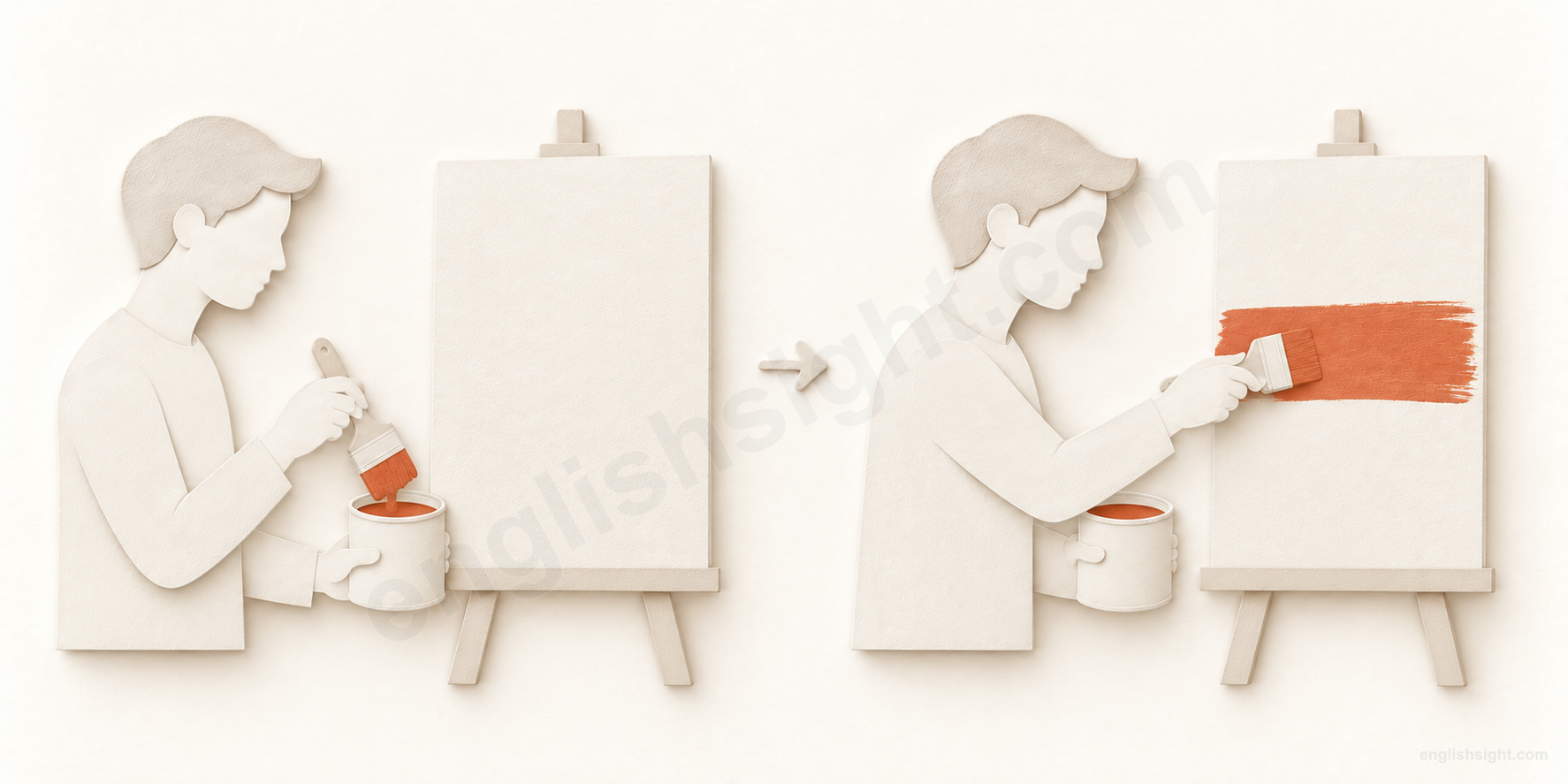
The board is blank, and the painter loads a brush with paint.
paint
A broad orange band is now visible on the surface.
The painter spreads the coloured material onto the board.
Paint becomes a visible layer on a surface; it can also form images. Verbal portrayals and fixed idioms need their own contexts.
Apply coloured material to a surface, changing its appearance or making an image.
This model connects the material, coating, and picture-making uses. A verbal portrayal creates an impression instead of a physical layer. Fixed idioms must be learned as expressions.
When you paint, you usually apply coloured material to a surface. Sometimes the goal is a new covering; sometimes it is an image or a mark. The object of the verb helps you tell which task is meant.
From there, paint can describe a picture created with words. Several established idioms need their own explanations. The visual model is a learning aid, not a claim that every English speaker imagines the same scene.
01
Paint as a material
Ask whether paint means a substance, its dried layer, or an artist’s supplies. These noun uses explain everyday shopping and decorating language.
01
some / a little / a tin of + paint
some paint / a tin of paint
the material used for colouring or covering a surface
Situation / starting point
You need enough material to repaint a shelf.
Result / intended meaning
You buy a container of suitable paint.
Paint names the material; a container word lets you count quantities.
Paint is normally a mass noun here: some paint, not much paint, and a little paint. Say a tin, can, pot, or tube of paint when you mean one container. The choice of container depends on the product and local usage.
Red paint identifies its colour; wall paint identifies a use. Gloss and matt paint describe finishes, while water-based paint describes a type of formulation. A material name alone does not tell you whether it is suitable for a particular job.
In a sentence
Is one tin of paint enough for this shelf?
Watch the difference For a quantity of the substance, use some paint or a tin of paint, not a paint.
02
wet / peeling paint; a coat / lick of paint; a paint job
wet paint / a coat of paint
paint on a surface, wet or dry
Situation / starting point
A newly decorated bench is still wet.
Result / intended meaning
Later, its paint forms a dry layer.
The same noun can refer to material already on an object.
A Wet paint sign warns that the coating is not yet dry. Later the paint may chip or peel: it is the dried layer that comes away. Paint does not mean only liquid still inside a tin.
A coat of paint is one applied layer; two coats are two applications. A fresh coat of paint can make something look renewed. A lick of paint, especially in British English, suggests a quick or small repainting job. A paint job is the work or its finish, not necessarily an artist’s picture.
In a sentence
The bench needs another coat of paint.
Watch the difference Count coats, not pieces of paint, when talking about applied layers.
03
paints; oil / acrylic paints; a box of paints
a box of paints
an artist’s paint colours or types of paint
Situation / starting point
A child has several colours in a box.
Result / intended meaning
The child chooses colours for a picture.
Plural paints can name the separate colours or types of paint an artist uses.
An artist’s paints may come in tubes or blocks. Compare I need more blue paint, which treats blue paint as a substance, with I packed my paints, which refers to the paint colours as a collection. Different types of paint can also be called paints. Paints does not include brushes or every other art supply.
Keep the material separate from the finished artwork: I bought paint for the lesson, but I bought a painting for the wall. A painting is a picture made with paint; painting without a or a plural ending can name the activity.
In a sentence
Maya packed her paints and a clean brush.
Watch the difference A paint is not the ordinary word for one finished picture; use a painting.
02
Changing a surface
The object can name what receives the paint. Other words specify the material, the resulting colour, or who arranges the work.
04
paint + surface; paint + surface + with + material / tool
paint a wall
apply paint to the object or surface named
Situation / starting point
The hallway walls need a new covering.
Result / intended meaning
Someone applies paint to the walls.
The wall is what receives the paint, not a picture being created.
In paint the wall, wall names the surface you work on. Paint the wall with washable paint names the material after with; paint it with a roller names a tool. The rest of the sentence tells you which role the with phrase has.
I’m painting the hallway describes work in progress. Are you painting today? leaves the object unspoken because the task is understood. Painting here may be decorating rather than making artwork; context supplies that distinction.
In a sentence
We’re painting the hallway with a roller.
Watch the difference Do not assume that every use of paint without an object means making art.
05
paint + object + colour adjective
paint the door blue
make an object a particular colour by painting it
Situation / starting point
The door has its old colour.
Result / intended meaning
Painting gives the door a blue finish.
The colour adjective describes the result for the object.
In paint the door blue, blue is a complement describing how the door is to look after the work. Compare paint the door with blue paint: that names the material explicitly. Both can describe the same project.
Paint a blue door has a different grammatical shape: blue is inside the noun phrase and identifies the door. In context, it could mean repainting an already blue door or making a picture of one. Paint the door blue makes the intended resulting colour clear.
In a sentence
Let’s paint the inside of the door blue.
Watch the difference Use paint it blue for the result; paint blue it is not the standard order.
06
be + painted; be being painted; have + object + painted
be painted / have something painted
focus on the painted object or arrange for someone to paint it
Situation / starting point
The shop owner hires a decorator.
Result / intended meaning
The shop front receives a new coat.
Passive voice focuses on the object; have adds an arrangement by someone.
The shop was painted last week reports completed work without identifying the painter. The shop is being painted now puts the passive action in progress. In a freshly painted shop, painted describes the result of that work.
We had the shop painted usually means we arranged for another person to do the work. We painted the shop normally presents us as the people doing it. Have is responsible for the arrangement meaning; it is not a special separate sense of paint.
In a sentence
We had the shop front painted before opening day.
Watch the difference Have the door painted is not the same construction as have painted the door, which is a perfect verb form.
07
paint + nails / lips; paint + nails + colour
paint your nails
apply coloured cosmetics to nails or lips
Situation / starting point
Your nails have no coloured polish on them.
Result / intended meaning
You apply a coloured coating.
The body part receives the colour rather than becoming the subject of a picture.
Paint your nails is an everyday way to talk about applying nail polish. You can add a resulting colour: paint your nails silver. Paint her lips also occurs for putting on coloured lip cosmetics, though put on lipstick is another direct way to describe that action.
Compare paint a portrait of her: that makes an image of the person. Paint her nails describes putting colour on the actual nails. The object and context identify the intended action.
In a sentence
She painted her nails silver for the party.
Watch the difference Do not replace dye your hair with paint your hair when you mean ordinary hair colouring.
03
Making pictures and marks
An object can instead name the subject represented or the image created. Read the surrounding words to distinguish a painted house from a picture of a house.
08
paint + subject / picture / portrait; paint a picture of + subject
paint a picture of / paint someone
make a painted image of a subject
Situation / starting point
A dog sits beside the window.
Result / intended meaning
An artist makes a picture showing the dog.
The subject represented need not receive any paint itself.
Paint a dog can mean make a picture of a dog, not put paint on the animal. Paint a picture of a dog makes the relationship explicit. In paint a portrait, the object names the artwork; in paint my sister, it names the person represented.
This explains why paint a house can be ambiguous without context: decorate the real house or create its image. Compare paint the house white with paint a picture of the house. Draw often focuses on making lines, for example with a pencil; paint normally involves using paint rather than simply any way of making an image.
In a sentence
Omar painted a picture of the dog beside the window.
Watch the difference Painting a person in the art sense does not mean putting colour on that person’s skin.
09
paint + design / words / lines + on + surface
paint a star on the box
create a design or message on a named surface
Situation / starting point
The box has no identifying mark.
Result / intended meaning
A painted star appears on it.
The first noun is the mark created; on introduces the surface receiving it.
In paint a star on the box, star is the image made and box is its location. In paint the box, box is the surface being covered. This difference follows from the construction, not from two unrelated definitions of paint.
The same pattern works for names, numbers, lines, and messages: paint a number on the gate or paint lines on the road. The words after on tell you where the marks go. They are not a detachable particle that creates a new idiom.
In a sentence
We painted a small star on each box.
Watch the difference Paint the box with stars describes its decoration; paint stars on the box directly identifies the marks you create.
10
paint in + medium; paint on + support; paint without an object
paint in oils / on canvas
identify the artistic medium or support
Situation / starting point
Someone asks about an artist’s method.
Result / intended meaning
You say which materials and surface she uses.
In can name the medium, while on can name the support.
She paints in oils tells you the medium: oil paints. She paints on canvas tells you the support. Both phrases can occur together. Without an object, she paints often describes her artistic activity or ability.
The same preposition can have other roles: painted in blue gives a colour rather than a medium. Read the noun following it. These are ordinary prepositional phrases, not separate phrasal verbs paint in and paint on in these examples.
In a sentence
She paints in oils on small pieces of canvas.
Watch the difference Oils here means oil paints; it does not mean cooking oil.
04
Covering something already there
Over directs attention to a new covering; out directs attention to making an existing mark disappear from view.
11
paint over + noun / pronoun
paint over something
put a new layer of paint over something already there
Situation / starting point
An old design is visible on a wall.
Result / intended meaning
New paint covers the design.
Over relates the new layer to what lies underneath it.
Paint over the old design means apply paint on top of it. The focus is on covering what is already there. It does not mean scraping off the old material first; the new paint can conceal it while it remains underneath.
Use paint over it when the previous design is already understood. Contrast paint the wall, which names the surface without necessarily highlighting an older design or mark. Oxford lists paint over as a phrasal verb; the learner pattern here keeps over before its object.
In a sentence
They painted over the old logo when the café changed owners.
Watch the difference Painting over it adds a covering layer; it does not mean stripping the old paint off.
12
paint + object + out; paint out + noun; paint it out
paint something out
hide an existing mark by painting over it
Situation / starting point
An old name is still visible on a sign.
Result / intended meaning
Paint conceals the name so it can no longer be read.
Out highlights the disappearance from view of a particular part.
Paint out the name and paint the name out describe covering the name so that it is no longer visible. With a pronoun, place it between the verb and particle: paint it out. A passive is also natural: the old name was painted out.
Paint out and paint over can describe the same action. Out foregrounds eliminating a visible element; over foregrounds adding a covering layer. Out does not mean that paint physically carries the letters away, and it is not the ordinary verb for deleting typed text.
In a sentence
The sign had the wrong date, so we painted it out.
Watch the difference Use paint it out, not paint out it.
05
Building an impression with words
Paint can describe how a report, speaker, or image presents someone or something. These uses concern representation, not a physical coating.
13
paint a + descriptive adjective + picture of + situation
paint a vivid / grim / rosy picture of
describe a situation so that it creates a particular impression
Situation / starting point
A report gives details about school life.
Result / intended meaning
Readers form a strong impression of that life.
Picture can be an impression formed through words, not a physical artwork.
The report paints a vivid picture means its description is clear and easy to imagine. Grim makes the impression very unpleasant; rosy makes it optimistic. These adjectives evaluate the picture being presented, not the colour of printed ink.
Paint a picture of can introduce a spoken description as well as a written one. The picture is the representation, and of introduces its subject. An optimistic or gloomy description can still be accurate; paint alone does not establish whether it is fair.
In a sentence
Her letters paint a vivid picture of life at the school.
Watch the difference Vivid means strikingly clear, not necessarily positive; grim and rosy express different evaluations.
14
paint + person / thing + as + description; paint + person + in a good / bad light
paint someone as / in a bad light
present a person or thing in a particular way
Situation / starting point
An article selects details about a manager.
Result / intended meaning
Readers are encouraged to see the manager as unreasonable.
The complement supplies the role or evaluation in the portrayal.
Paint someone as a villain assigns a role in a description. Paint someone in a bad light makes them seem blameworthy or unattractive; in a good light gives a favourable impression. Neither expression requires literal paint or lighting.
The article paints him as careless presents the article’s portrayal, not automatic agreement by the speaker. A passive is possible too: he was painted as the person responsible. As introduces how he is represented, not a job that he necessarily holds.
In a sentence
The article paints the manager as the only person to blame.
Watch the difference Do not treat a portrayal as proof: paint her as dishonest does not by itself establish that she is dishonest.
15
paint + subject + with a broad brush
paint something with a broad brush
describe generally while leaving out details
Situation / starting point
A short overview covers a complex industry.
Result / intended meaning
The audience receives a general outline.
A broad brush is a metaphor for a description with little fine detail.
Paint something with a broad brush concerns how much detail a description includes. A wide paintbrush covers an area quickly without making tiny marks; that image helps explain the expression but is a teaching comparison, not a rule for generating new idioms.
A broad overview may be useful at the start of a talk, but it can also overlook important differences. The expression does not automatically mean the description is false or that everyone described deserves the same judgment.
In a sentence
The introduction paints the industry with a broad brush; later chapters examine individual firms.
Watch the difference This concerns generality and detail; it does not mean using unusually colourful language.
06
Established expressions
Learn these expressions as wholes. Their ordinary meanings cannot be predicted by replacing one word with a literal translation.
16
paint + reflexive pronoun + into a corner
paint yourself into a corner
create a difficult situation that leaves you few choices
Situation / starting point
You promise a deadline without checking the workload.
Result / intended meaning
Your own promise leaves little room to change the plan.
The subject’s earlier actions help create the restriction.
The idiom suggests someone painting a floor until there is no clear way out without crossing fresh paint. In ordinary use, the restriction may come from a promise, decision, or public position rather than any physical room.
The reflexive pronoun changes with the subject: I painted myself into a corner; they painted themselves into a corner. The expression emphasizes a difficult position created by one’s own actions, not simply being unlucky or literally standing in a corner.
In a sentence
By promising delivery on Monday, I painted myself into a corner.
Watch the difference Keep the reflexive pronoun when using this form: I painted myself into a corner.
17
paint the town red
paint the town red
go out and celebrate enthusiastically
Situation / starting point
A group wants to celebrate finishing a project.
Result / intended meaning
They go out for a lively evening together.
The whole informal idiom expresses celebration rather than a decorating job.
Paint the town red commonly describes going out to enjoy yourself, often visiting bars or clubs. It can be used as an enthusiastic suggestion after good news or an achievement. The phrase is informal.
Town and red belong to the established expression. Changing red to another colour does not preserve the ordinary idiom, and the expression does not report actual damage to a town.
In a sentence
After the final show, the band went out to paint the town red.
Watch the difference Use the fixed wording for the idiom; paint the town blue is not its standard equivalent.
18
be + like watching paint dry
like watching paint dry
extremely boring to watch or experience
Situation / starting point
A long presentation feels uneventful.
Result / intended meaning
A listener compares it to watching a slow, dull process.
The speaker evaluates the experience as boring, not just slow.
Watching paint dry provides a familiar image of something with little visible action. Saying an event is like watching paint dry strongly criticizes how uninteresting it feels. It need not literally take a long time.
This is an informal, often humorous exaggeration. It can sound dismissive about another person’s work. Compare the literal We’re waiting for the paint to dry, which gives a practical reason for waiting and need not express boredom.
In a sentence
That three-hour slideshow was like watching paint dry.
Watch the difference Do not interpret this idiom as praise for patience or a statement about actual decorating.
Read the object and the whole expression
Forms and pronunciation
Paint is pronounced /peɪnt/. Verb forms are paint, paints, painted, painted, painting; painted ends in /ɪd/. Ongoing work can use the progressive, and transitive uses can form passives. Paint is also a noun; painting can name an activity or, countably, a finished artwork.
A surface and a subject are different roles
Paint the house white identifies a real surface and its resulting colour. Paint a picture of the house identifies a represented subject. Context can resolve paint the house on its own; the verb does not force the same relationship in every sentence.
Particles, prepositions, and other verbs
Paint out is separable: paint it out. The covering pattern paint over something keeps over before its object here. With a roller, on canvas, and in oils supply tool, support, and medium; they are not all new phrasal verbs. Draw, dye, and paint overlap in the broad idea of making or changing colour, but their usual materials and constructions differ.
Scope of this lesson
This selection covers modern everyday noun and verb uses and familiar expressions, not a frequency ranking or every technical use. The basketball term the paint, the horse term paint, specialist brush-applied treatments, and older noun uses for make-up are outside the main lesson.
Choose what paint means here
Check whether the sentence concerns material, a surface, a represented subject, or an established expression.
1. You need one container of wall-colouring material. Which request fits?
2. An artist creates an image of your dog without putting colour on the animal. Which sentence makes that clear?
3. You hired a decorator to work on your door. Which sentence expresses that arrangement?
4. You refer to an incorrect date already mentioned and want to conceal it with paint. Which form fits?
5. A report paints a rosy picture of the business. What does that tell you?
6. A promise you made now leaves you almost no choice. Which expression captures your role in the problem?
Sources and teaching notes
The sources below support the usage inventory. Explanations and examples are original; connections drawn by the visual model are teaching interpretations rather than dictionary claims about everyone’s mental imagery.
The diagram explains a useful connection; individual speakers do not all share one mental picture.