Use paper for sheets, useful objects, written work, and the gap between a record and reality.
From a sheet to a record
From a sheet to a record
A blank sheet of paper
paper
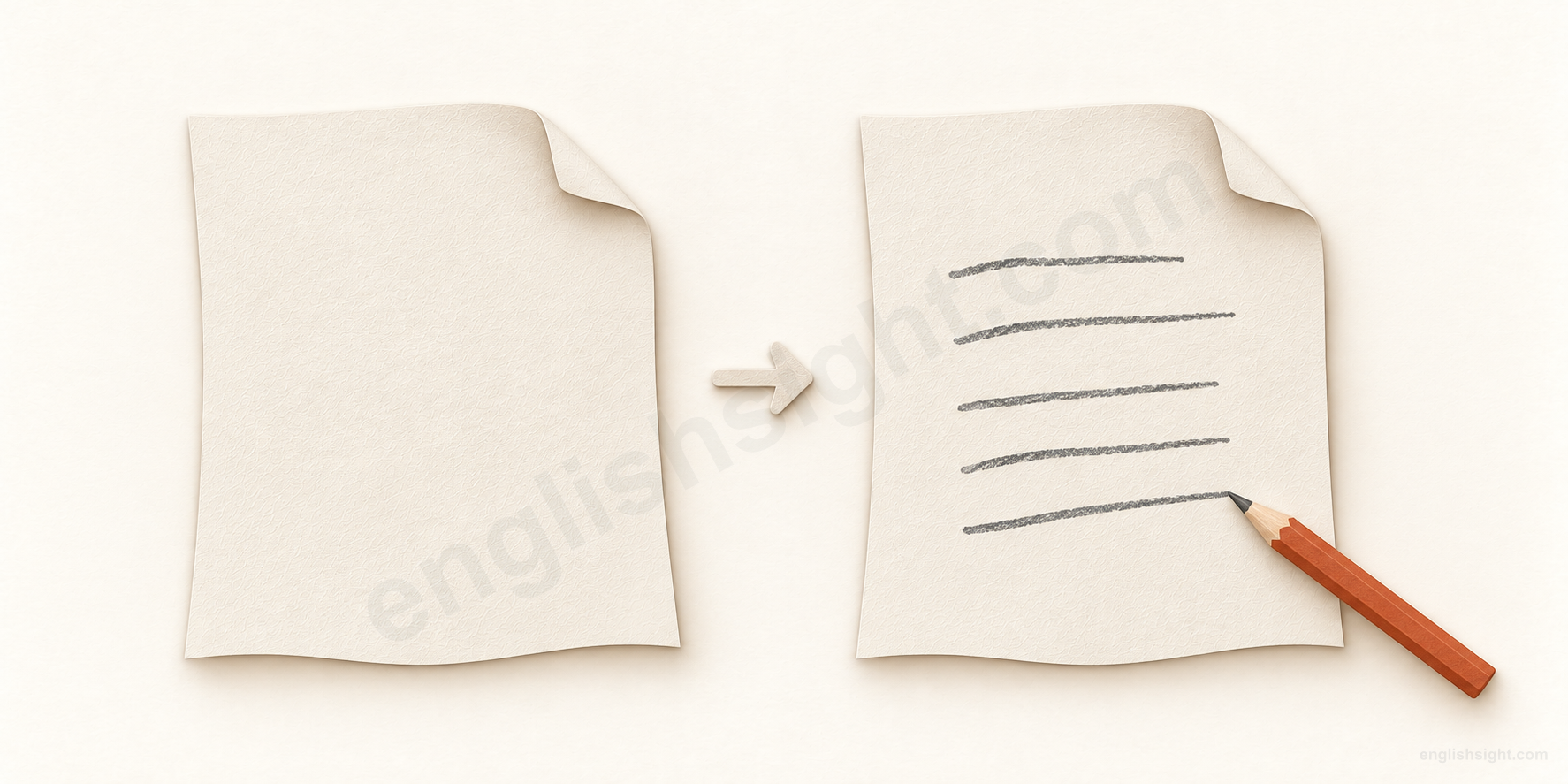
The sheet now carries information.
Writing adds a record to the same material.
The material stays paper; what it carries changes.
Paper is a thin, flexible material that can carry writing or form a covering. Many uses shift attention from the material to the information recorded on it.
The sketch shows the writing branch. Paper does not itself mean write, and it need not have anything written on it. Wrapping and wallpaper belong to the covering branch; idioms need their own explanations.
Picture a thin sheet that can be written on, printed on, folded, or used to cover something. Paper first names the material. In another familiar branch, it names what is recorded or published: a newspaper, an article, or important documents.
These are useful connections for learning, not a claim that every English speaker sees the same picture. Some combinations have established meanings of their own. The grammar and the situation matter as much as the picture.
01
The material and things made from it
Start with the substance, then choose how to count it, name its purpose, or contrast a printed copy with a screen.
01
some / any / much + paper; paper + singular verb
some paper
the thin material itself
Situation / starting point
You need a surface for a quick drawing.
What paper refers to
You ask for the material, without counting sheets.
Paper is uncountable when you mean the substance.
Paper names the material used for writing, printing, wrapping, and other purposes. In this meaning, some paper and a little paper work like some water and a little water.
Ask Have we got any paper? or How much paper do we need? White paper describes its colour; recycled paper describes how it was produced. Neither phrase tells you how many sheets there are.
The sketch starts with a sheet, but the noun can refer to paper in a whole roll or stack too. Material does not have to mean an unused, flat sheet.
In a sentence
There is some recycled paper in the bottom drawer.
Watch the difference For ordinary blank writing material, ask for some paper, not a paper.
02
a / two + sheet(s), piece(s), slip(s), scrap(s) + of paper
a sheet / piece of paper
count separate portions of the material
Situation / starting point
Each person needs one blank sheet.
What paper refers to
You specify a number of sheets, not a number of papers.
The countable word before of supplies the unit.
A sheet of paper is a separate flat sheet; a piece of paper is less exact about its shape or size. A slip is a small piece, often used for a short note, and a scrap is a small leftover piece.
Compare I need two sheets of paper with I read two papers. The first counts sheets; the second normally counts texts such as newspapers or academic articles. A sheet can have writing on both sides: two pages or sides need not mean two sheets.
In a sentence
Give each pair of students three sheets of paper.
Watch the difference Use three sheets of paper for three blank sheets; three papers may suggest three separate texts.
03
purpose + paper; a / two + paper + countable object(s); some paper money
wrapping paper / a paper bag
name a paper type or an object made from paper
Situation / starting point
You choose material for a present and a bag to carry it.
What paper refers to
One phrase names a type of paper; the other names an object.
The final noun determines what you are naming and counting.
Wrapping paper is paper for covering presents. Toilet paper is soft paper for cleaning yourself after using the toilet. Both are normally uncountable: buy a roll of wrapping paper or two rolls of toilet paper.
In a paper bag, paper cup, or paper plate, paper tells you the material. Count the bags, cups, or plates: two paper bags. The paper sheet has been shaped into a useful object; it does not have to carry writing.
Printer paper and writing paper name intended uses. Tissue paper is thin paper used, for example, to protect something in a parcel; a tissue for your nose is a countable object. The names do not make every paper product interchangeable.
A paper towel can be a separate sheet for drying your hands: take two paper towels. In North American usage, paper towel can also name the roll material used for cleaning spills; British names include kitchen paper and kitchen roll. In contrast, a paper clip is usually wire or plastic: paper names what the clip holds, not what it is made from.
Paper money names money in notes, contrasted with coins. It is normally uncountable: some paper money, or two notes, not two paper moneys. Keep the complete compound in view rather than assuming paper alone has changed its grammar.
In a sentence
I bought a roll of wrapping paper and two paper bags for the presents.
Watch the difference Paper usually stays singular in compounds: paper cups and paper clips. It can identify a material or a purpose; a paper clip is not usually made of paper.
04
write / put / get + something + (down) on paper; a paper copy of something
on paper / a paper copy
in a physical written or printed form
Situation / starting point
You have a list in your head or a file on a screen.
What paper refers to
The information appears on a physical sheet.
Here on paper names the medium, without judging whether an idea works.
Put something down on paper means write it down. A paper copy is a physical copy, contrasted with an electronic one. In the sketch, the marks make information available on a sheet; paper itself is still the material.
Compare Write the address on paper with Read the address in the paper. On paper can name a writing surface or medium; in the paper usually locates information in a newspaper. On a piece of paper identifies a particular physical piece.
In a sentence
Please bring a paper copy of the map in case your phone stops working.
Watch the difference A paper copy is a copy on paper; it is not automatically a newspaper or an academic paper.
02
News, documents, and work you read
The material can give its name to a particular text or publication. Context and grammar tell you what kind of paper someone means.
05
a / the + local, daily, morning + paper; in the paper(s)
read the paper / in the papers
a newspaper, or newspapers collectively
Situation / starting point
You want to know what happened in town.
What paper refers to
You read a news publication or refer to its reporting.
A paper is countable when it means a newspaper.
The local paper is the newspaper serving an area. Buy a paper refers to a copy; read the paper refers to the publication or its contents. The papers can mean several newspapers or newspaper reporting generally.
Say an article in the paper to locate a story in the publication. The paper can also stand for the organization: The paper has hired a new editor. That is an organization acting, not a physical sheet taking action.
This meaning names a publication, so reading a paper online is possible. The word does not guarantee that you are holding a printed copy.
In a sentence
Our school garden was featured in the local paper last week.
Watch the difference A news story is normally in the paper; on paper often means written down or judged in theory.
06
someone’s papers; a pile / stack of papers; sort through papers
sort through your papers
written materials and personal records
Situation / starting point
Letters, notes, and records are mixed together.
What paper refers to
You organize the written materials you want to keep.
Plural papers often means a collection of documents, not blank material.
Your papers can be letters, notes, drafts, or other written records. A pile of papers can contain different kinds of documents; it need not be a stack of academic articles.
The material-to-information connection helps here: attention shifts to what the sheets record. Whose papers? and what situation? matter. An author’s papers in an archive may be manuscripts and correspondence; papers on a scientist’s reading list may be research articles.
In a sentence
We found her old travel notes among the papers in the desk.
Watch the difference Do not automatically translate every plural papers as newspapers; look for the kind of records involved.
official documents recording identity, permission, or an arrangement
Situation / starting point
Someone needs proof of identity or a completed formal record.
What paper refers to
The relevant documents are shown, signed, or filed.
The situation identifies which official documents papers refers to.
Identity papers and travel papers establish who a person is or their right to travel. Adoption papers and divorce papers record particular legal processes. Show, sign, and file describe different actions with those documents.
Papers is grammatically plural: Your papers are ready. The word alone does not identify one required form, and it does not always mean a passport. Name the actual document when precision matters: Bring your passport.
In a sentence
Keep your travel papers together in a folder you can reach easily.
Watch the difference Travel papers are documents connected with travel, not simply blank paper you take on a trip.
08
write / publish / cite a paper on + topic; present / give a paper at + event
a research paper on something
an academic article presenting work on a subject
Situation / starting point
Researchers have findings or an argument to explain.
What paper refers to
A written academic work presents them to readers or a conference audience.
One paper counts a whole work, even if it has many pages.
Write, submit, publish, read, and cite a paper describe different stages of academic work. A paper on sleep is about sleep; a paper in a journal appears in that publication. The topic and the place of publication have different prepositions.
Present, give, or deliver a paper can mean explain the work in a conference talk. Give a paper in that setting does not necessarily mean hand someone a printed document. The text may also be read as a digital file.
In a sentence
The team published a paper on how street lighting affects birds.
Watch the difference A twenty-page paper is one academic work, not twenty papers.
09
write / hand in / submit a (term) paper on + topic; a paper for + course
write / hand in a paper
a student’s written assignment
Situation / starting point
A course requires a developed written response.
What paper refers to
The student submits a complete piece of work.
This use is especially associated with North American education.
A student paper is a written assignment, often an essay or report. It may discuss existing ideas without reporting new research. A term paper is a substantial assignment for a course, especially in American education.
A paper on local history names its topic. A paper for a history class identifies the course. Hand in or submit the paper means deliver the work for assessment, including through an online system.
In a sentence
I have to hand in a paper on local history by Friday.
Watch the difference In British contexts, essay or assignment may be clearer; an exam paper is a different school use.
10
set / take / sit / do / mark an exam paper
an exam paper
a set of examination questions or a student’s written answers
Situation / starting point
An examination needs questions and responses.
What paper refers to
Students complete the questions, and teachers assess the answers.
This exam use is especially British English.
The maths paper can mean the exam or a particular part of it. The question paper contains the questions; exam papers waiting to be marked may be the students’ completed answers. Nearby verbs help identify the meaning.
A teacher sets a paper by preparing its questions and marks papers by assessing answers. A student takes, sits, or does a paper. These are education collocations; the noun does not describe the action of writing in general.
In a sentence
The teacher spent the afternoon marking the science papers.
Watch the difference Taking a paper in an exam context can mean taking an exam; it need not mean removing a sheet.
11
a discussion / consultation / government paper on + issue; a White Paper
a discussion paper / a White Paper
a written report or set of proposals for consideration
Situation / starting point
An organization needs to explain an issue or proposed action.
What paper refers to
A report gives readers information and proposals to discuss.
Paper names a whole report, not its colour or number of sheets.
A discussion paper or consultation paper sets out an issue or proposals for people to consider. A government paper on transport can be a report about transport policy. The modifier tells you the document’s purpose.
In UK government usage, a White Paper explains government plans before proposed legislation. This established title does not just mean a sheet of white paper. Treat named document types as vocabulary with their own conventions.
In a sentence
The council released a discussion paper on safer routes to school.
Watch the difference The document’s title and purpose matter; an ordinary white sheet is not a government White Paper.
03
Writing and the gap between records and reality
A written record can preserve an idea without making it work. These expressions distinguish writing something down from proving or carrying it out.
12
look / seem + adjective + on paper; exist / be + only on paper
look good on paper
seem good from a plan or description, without proof in practice
Situation / starting point
You can assess a proposal from its stated details.
What paper refers to
You distinguish that assessment from what happens when it is tried.
On paper can limit a claim to theory, records, or a plan.
If a timetable looks good on paper, its written arrangement seems promising. That leaves open whether real journeys will run smoothly. It is a contrast between a description and experience, not a claim that writing makes the plan bad.
The project exists only on paper means it is still a plan rather than something carried out. Compare I put the timetable on paper, which simply describes writing it down. Read the whole sentence to choose between the two meanings.
In a sentence
The timetable works on paper, but one late bus could disrupt the whole route.
Watch the difference On paper does not always mean false; it signals that practical results have not established the claim.
13
paper + qualifications / profits / losses / promises
paper qualifications / paper profits
status or value recorded without necessarily being realized in practice
Situation / starting point
Certificates or accounts show a kind of achievement or value.
What paper refers to
You ask what that record amounts to in practical terms.
Paper before a noun can contrast a record with practical ability or realized value.
Paper qualifications are formally recorded qualifications, especially when contrasted with practical experience or skill. The phrase can sound dismissive; it does not establish that the certificates are forged.
Paper profits are gains shown by current values or accounts but not yet realized, for example because an asset has not been sold. Paper losses work similarly. Unlike a paper bag, these expressions do not describe an object’s material.
Calling commitments paper promises suggests that they are recorded in words but may not lead to effective action. The criticism concerns whether people will act on them, not whether the words are printed on real paper.
In a sentence
The manager valued practical experience more than paper qualifications.
Watch the difference Paper profits need not mean fraudulent profits; the point is that the recorded gain has not been realized.
14
put pen to paper; before / when someone puts pen to paper
put pen to paper
write, or make a start on writing
Situation / starting point
You have an idea but have not begun the written work.
What paper refers to
You begin turning it into words.
This expression highlights starting to write.
Put pen to paper brings the writing action into focus, rather than buying materials or handing in finished work. It is a familiar, somewhat vivid way to talk about writing.
The expression can refer broadly to creating written words; the actual tool need not be the point. If the task specifically requires handwriting, say write it by hand. The diagram illustrates the physical starting point without setting a rule about tools.
In a sentence
Before you put pen to paper, decide who your letter is for.
Watch the difference Putting pen to paper does not mean that the text has been completed or sent.
15
an agreement / guarantee + be not worth the paper it is written / printed on
not worth the paper it is written on
a written promise or document has no effective value
Situation / starting point
A document appears to promise protection or action.
What paper refers to
You strongly reject its practical value or reliability.
This is a critical idiom about the promise, not the price of a sheet.
Use this expression about an agreement, guarantee, or similar document that will not deliver what it promises. Written or official-looking words alone do not make the undertaking dependable.
It is a strong judgment, often involving an intention not to honour the promise or a lack of effective protection. Written and printed both occur in the expression. A document that is merely hard to read is not necessarily worthless in this sense.
In a sentence
If the seller refuses every repair, that guarantee is not worth the paper it is written on.
Watch the difference This is emphatic criticism, not a neutral way to say that a document is inexpensive.
04
Evidence, apparent power, and dismissal
Learn these established combinations as expressions. Their meanings are more specific than the ordinary material meaning of paper.
16
leave / keep / follow a paper trail; a paper trail of + records
leave / follow a paper trail
leave or trace written evidence of activities
Situation / starting point
Actions have produced records at different times.
What paper refers to
Someone can use those records to reconstruct what happened.
Trail means a traceable sequence of evidence, not paper lying on a path.
A paper trail connects records to activities: receipts may show purchases, and dated messages may show who agreed to a change. Leave a paper trail focuses on creating evidence; follow a paper trail focuses on investigating it. Oxford labels this expression informal.
The records matter as evidence, rather than as the material in the sketch. The trail is a connection that someone can trace through the records, not a physical path. It does not by itself say that the activities were criminal.
In a sentence
Keep the receipts so there is a paper trail of every payment.
Watch the difference A pile of unrelated sheets is not automatically a paper trail; the records need to trace an activity.
17
be / become / prove to be a paper tiger
a paper tiger
someone or something that looks powerful but lacks real power
Situation / starting point
An organization appears able to enforce its demands.
What paper refers to
Its actual ability is much weaker than its appearance suggests.
The whole idiom expresses a contrast between apparent and effective power.
A tiger suggests strength or danger, while a paper version cannot provide that strength. This is a useful memory link for the established idiom, not a rule for inventing similar meanings with every animal.
The phrase is critical and often occurs in political or organizational discussion. Calling a group a paper tiger questions its effective power; calling it small or inexperienced alone does not make the same point.
In a sentence
Without any power to enforce its decisions, the new board could become a paper tiger.
Watch the difference Paper tiger is an idiom about weak effective power, not an ordinary name for every fragile person.
18
give + someone + their walking papers; get one’s walking papers
give someone their walking papers
dismiss someone from a job
Situation / starting point
A person is employed by an organization.
What paper refers to
They receive notice that the employment is ending.
Walking papers is an informal North American expression.
Walking papers refers to a dismissal notice. Give someone their walking papers means tell them they are dismissed; get your walking papers means receive that notice. Learn the plural expression as a unit.
The connection is to an official notice that ends an arrangement, not to documents needed for a walk or trip. For a neutral description, say the person was dismissed or lost their job.
In a sentence
After the investigation, the firm gave the manager his walking papers.
Watch the difference Walking papers means a dismissal notice; travel papers means documents connected with travel.
05
Covering a surface or hiding a problem
As a verb, paper can describe decorating a wall. Paper over also has a familiar figurative use for a problem that remains underneath a surface improvement.
19
paper + wall / room; be papering; be papered
paper a room / wall
cover the walls with wallpaper
Situation / starting point
A room has walls ready for decoration.
What paper refers to
Wallpaper covers the wall surfaces.
The object is the wall, or the room whose walls are being decorated.
As a verb, paper commonly describes putting up wallpaper. Paper the bedroom means decorate its walls, rather than fill it with loose sheets. The noun paper can also mean wallpaper: The paper is peeling near the window.
The verb has regular forms: paper, papers, papered, papering. Active, progressive, and passive patterns work naturally: We are papering the room; The walls were papered last year. This covering branch uses the material’s function, not the writing branch in the sketch.
In a sentence
We papered the hallway with a simple striped wallpaper.
Watch the difference Paper the room normally concerns its walls; it does not mean write an account of the room.
20
paper over + mark / patch; paper over it
paper over a mark
cover a surface problem with wallpaper
Situation / starting point
A wall has a visible mark or damaged patch.
What paper refers to
Wallpaper covers the patch so that it is out of sight.
Over adds the relation of a covering above something already there.
Paper a wall tells you that wallpaper is applied. Paper over a mark tells you what is hidden beneath it. This literal meaning supplies a useful comparison for the figurative use in the next entry.
The covering does not itself tell you whether the underlying cause has been repaired. Keep the object after over in the model pattern: paper over it. That pattern also works for the figurative problem meaning.
In a sentence
The previous tenant had papered over a dark stain beside the window.
Watch the difference Covering a stain with wallpaper is not the same action as removing the stain’s cause.
21
paper over + problem / differences / the cracks; be papered over
paper over the cracks / differences
hide a problem or smooth it over without properly resolving it
Situation / starting point
People have an unresolved problem or disagreement.
What paper refers to
A surface improvement makes it less visible, while the underlying issue remains.
This is a figurative use of a covering, not a full repair.
Paper over the cracks is an established expression for making a situation appear better without dealing adequately with its weaknesses. Cracks can be weaknesses in a team or plan; there need not be a physical wall.
Paper over differences or a disagreement likewise suggests concealing or temporarily smoothing them over. It is usually critical. Passive wording is possible: The differences were papered over. The meaning comes from the whole expression, not from paper alone.
In a sentence
A friendly photograph will not paper over the differences between the two groups.
Watch the difference Resolving a disagreement deals with it; papering over it leaves the problem insufficiently addressed.
Let the grammar identify the kind of paper
Material and counted texts
For ordinary material, use paper with a singular verb and count sheets or pieces. A paper or several papers often counts newspapers, articles, assignments, or exams. Some technical contexts count kinds of paper; that is different from asking for blank sheets.
A text is not one sheet
A paper can be one work with many pages, and it may be digital. Papers can be someone’s documents rather than publications. Read modifiers and verbs together: travel papers, publish a paper, mark papers, and read the morning paper.
Prepositions change the relation
Write on paper, read a story in the paper, and write a paper on a topic describe different relations. In a paper about research can mean inside that academic text. Do not turn one preposition into a rule for every meaning.
Records do not guarantee results
On paper can mean simply written down, or it can contrast a plan with practice. Paper qualifications, a paper tiger, and paper over the cracks make different judgments. None licenses a general rule that paper always means false or weak.
Scope and variety
This lesson covers modern everyday material and document meanings, common education uses, and selected established expressions. It labels regional and informal uses. Technical finance, theatre slang, rare verb meanings, and every possible paper compound are not expanded.
Choose the use that fits
Use the situation, countability, and full expression to decide what paper means.
1. You want two blank sheets for a drawing. Which request is clearest?
2. You learned about the new swimming pool from a newspaper. Which sentence fits?
3. A plan’s calculations look promising, but nobody has tried it. What does “It works on paper” mean?
4. A scientist will “give a paper at the conference.” What is the likely activity?
5. A team announces agreement but leaves its central dispute unresolved. Which phrase fits?
6. At a border, an official asks to see your papers. What are they asking for?
Sources and teaching notes
Usage was checked against the publisher pages below. The explanations and examples are original teaching material. The sheet-to-record connection is a teaching model; it does not predict every idiom.
The diagram illustrates one useful connection between material and information.