Connect lines, comparisons, and work happening alongside other work.
Alongside, with a corresponding course
Alongside, with a corresponding course
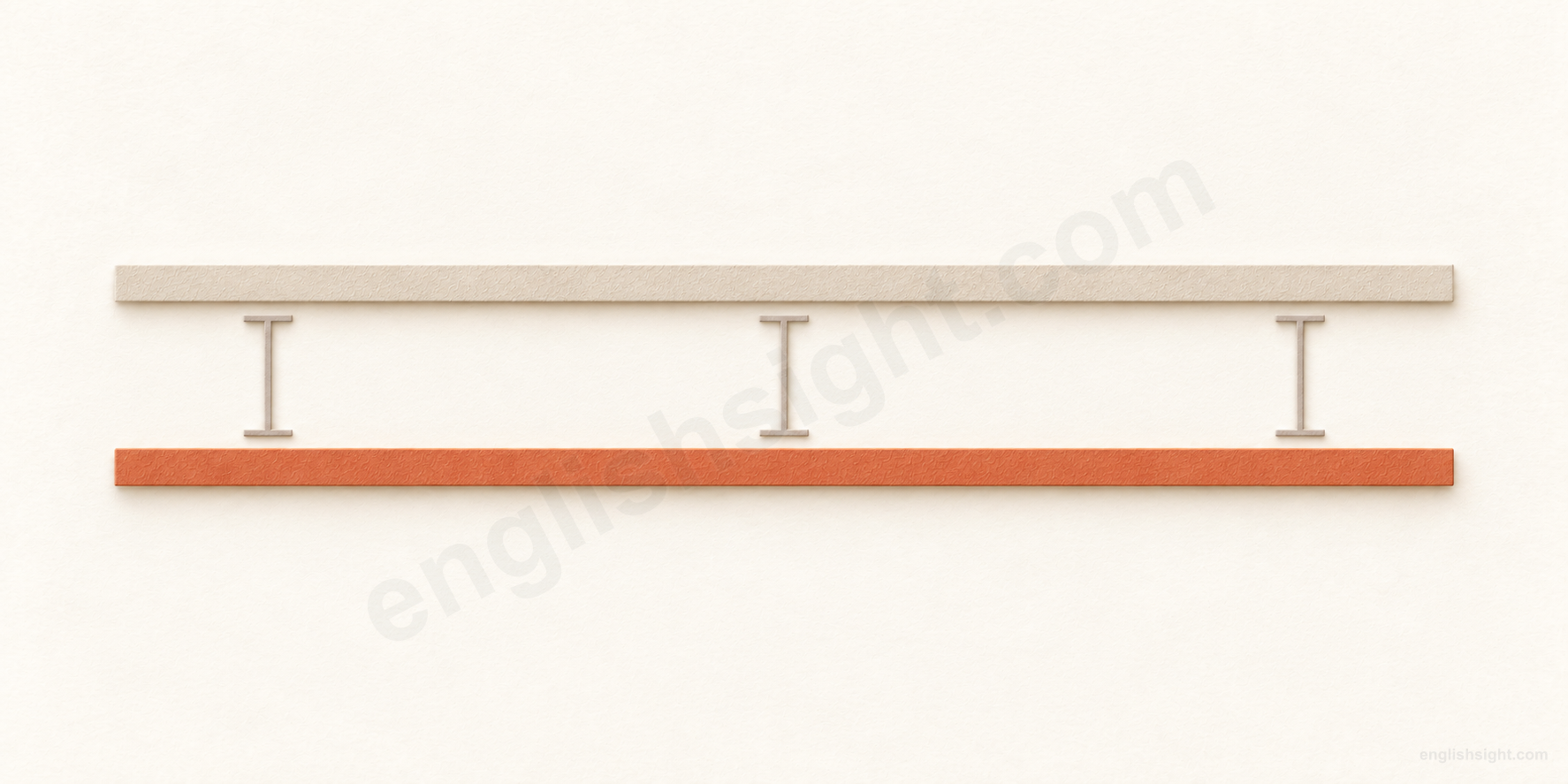
A straight upper strip
parallel
The lower strip runs alongside at a constant distance.
Compare the direction and gap along the strips.
The strips model spatial parallelism. Figurative uses compare patterns or timing, not necessarily a physical gap.
Parallel relates separate things whose direction, development, or timing corresponds; in the literal straight-line case, the gap stays constant.
The sketch illustrates the spatial foundation. Similarity and simultaneity are different extensions: neither promises identical things, an equal physical gap, or the same outcome.
Two lines can keep the same direction and gap. Two lives can follow comparable courses. Two tasks can go ahead at the same time. Parallel connects these ideas, but each context tells you what matches.
Start with the exact spatial relationship, then learn the established patterns for comparisons and simultaneous activity. The connections are teaching aids, not a claim that every speaker imagines one identical picture.
01
Lines, routes, and parking
Start with a spatial relationship: two things extend alongside each other without getting closer or farther apart. Real roads may only approximately fit the exact geometric relation.
01
parallel + plural noun; be / run parallel to / with + noun
parallel lines; parallel to / with
extend in the same direction with an unchanging separation
Situation
You compare two straight lines on a flat page.
What the relationship tells us
Their separation is the same along their length.
Parallel describes a relationship, not just being nearby.
In plane geometry, distinct parallel straight lines never cross even if extended. Two short marks that do not touch are not necessarily parallel: they might point toward an eventual meeting.
Use parallel before a noun, as in parallel edges, or after be, as in The edges are parallel. To and with can introduce the other item: parallel to the wall and parallel with the wall are both established.
After run or move, parallel can describe direction: The path runs parallel to the fence. It is not necessary to add -ly. Roughly, almost, and nearly signal that a real arrangement is only approximate.
The parallel bars in gymnastics are a pair of supported bars used for exercises. This is a named piece of equipment, with parallel describing their arrangement.
In a sentence
Keep the two strips parallel to each other.
Watch the difference Nearby means close; it does not guarantee matching direction or equal separation.
02
parallel park (a car); learn / practise parallel parking
parallel park; parallel parking
park with the vehicle’s length along the edge of the road
Situation
You find a roadside space between parked cars.
What the relationship tells us
Your car is positioned lengthways beside the curb.
The parking term describes the car’s final alignment.
Parallel park can stand alone or take a vehicle as its object. Parallel parking names the maneuver or skill. The vehicle ends up alongside the curb, rather than pointing into a bay across it.
The car may turn during the maneuver: parallel describes the intended parked position, not every instant of movement. This is a compound verb, not a phrasal verb with a movable particle.
In a sentence
I learned to parallel park in a quiet street.
Watch the difference Parallel parking and parking beside another car are not interchangeable descriptions: the relationship to the road edge matters.
02
Similar developments and simultaneous work
Outside geometry, ask whether the speaker means matching features or activities happening alongside one another in time. The context decides; neither requires a literal fixed gap.
03
parallel + case / career / development; developments run parallel to / with each other
parallel cases / careers / developments
have corresponding features or develop alongside each other
Situation
You compare how two people built their careers.
What the relationship tells us
You notice similar stages in their progress.
Parallel can compare a course of development without making the things identical.
Parallel cases share relevant features; parallel careers or developments may follow comparable courses. The people, places, and outcomes can still differ. Explain the particular similarity when it matters.
The same adjective can also highlight coexistence in time: a parallel career is an additional career pursued alongside another. Read the surrounding sentence to decide whether similarity, simultaneous activity, or both are intended.
The diagram’s separate lines provide a memory aid for corresponding courses. Figurative careers do not have measurable distances between them, and the geometric rule that lines never meet is not a rule about people.
In a sentence
The sisters built parallel careers in different cities.
Watch the difference Parallel does not establish that one person copied the other or that their results were exactly equal.
04
work / run / proceed in parallel; in parallel with / to + noun or -ing form
in parallel (with / to)
carry on activities during the same period
Situation
Two teams have different parts of a project to complete.
What the relationship tells us
Both parts progress during overlapping periods.
In parallel contrasts with doing one thing after another.
Work, run, or proceed in parallel means that activities go ahead alongside one another in time. They need not have the same content or start and finish at exactly the same instant.
In parallel can stand alone. In parallel with names the other activity; in parallel to is also attested, though with is a straightforward choice for this lesson. The preposition belongs to the full phrase.
Two teams can work in parallel on different tasks. This is different from parallel findings, which can mean similar results even when the research took place in different years.
In a sentence
We can test the app in parallel with writing the instructions.
Watch the difference In a row means consecutively in this context; it does not express the same scheduling relationship.
05
a parallel universe; live in / enter a parallel universe
a parallel universe
an alternative world, or an experience felt to be detached from ordinary reality
Situation
A film imagines another world existing alongside the familiar one.
What the relationship tells us
The story calls the other world a parallel universe.
The fixed compound names an alternative reality, not a geometrical gap.
In fiction, a parallel universe is another world coexisting with the familiar one, with important differences. This is an established compound noun; it does not claim that the worlds are identical.
The expression also has a figurative use. Their account of the office sounds like a parallel universe suggests that their experience or description is very different from the reality the speaker knows. This can sound critical or humorous.
Physics also uses the term for a hypothetical additional universe. This lesson teaches recognition of the expression, not evidence for a scientific theory. The line sketch is a memory link for coexistence, not a model of cosmology.
In a sentence
In the film, the door opens into a parallel universe.
Watch the difference Outside fiction or a scientific discussion, living in a parallel universe is often figurative; it need not allege literal travel to another universe.
03
Finding and expressing comparisons
The noun names a resemblance or a comparable case. These patterns help you identify a connection, discuss it, or say that nothing matches something.
06
draw / see / find a parallel between A and B; parallels with / to + noun
draw / see parallels between
identify corresponding features in two things
Situation
You compare two stories with different characters.
What the relationship tells us
You point out a feature that both stories share.
Draw a parallel is a comparison, not necessarily a drawing.
A parallel can be a similarity; parallels is often used when discussing several shared features. Draw a parallel between A and B means to point out a resemblance, in speech or writing as well as in a diagram.
Use between with both sides of the comparison. With or to can attach the comparison to something already named: parallels with an earlier case, a parallel to our experience.
Close, striking, and obvious describe how noticeable or strong the resemblance is. A useful comparison still has limits: matching one feature does not prove that everything else matches.
In a sentence
Maya drew a parallel between the two teams’ problems.
Watch the difference Do not read draw here as requiring a pen or picture, and do not treat a parallel as proof of a cause.
07
have / find a parallel in + place, period, or field
have / find a parallel in
have a comparable person, event, or example elsewhere
Situation
You study a local custom.
What the relationship tells us
You find a similar custom in another community.
Here a parallel is the comparable example, not only a shared feature.
A parallel may be a whole comparable case or counterpart. In a sentence about a custom, a parallel in another culture is a similar custom found there.
In identifies where the counterpart can be found. Compare a parallel between two customs, which foregrounds their shared features. The readings overlap, but the sentence directs attention differently.
In a sentence
This custom has a close parallel in a neighboring village.
Watch the difference A parallel is not necessarily a duplicate; say which aspect is comparable.
08
be without parallel; have no parallel in + context
without parallel; have no parallel
have no comparable match in the stated context
Situation
You assess an exceptional achievement.
What the relationship tells us
You say no comparable achievement is known in that field.
The negative comparison expresses uniqueness or an exceptional degree.
Without parallel and has no parallel say that something has no counterpart or equal in the relevant context. In praise, they often present an achievement as unmatched; with a disaster, they can emphasize its exceptional seriousness.
This is emphatic wording, often found in formal commentary. A phrase such as in the town’s history limits the claim. Nothing in the expression requires two literal lines.
In a sentence
Her achievement is without parallel in the club’s history.
Watch the difference Without parallel is the established phrase here; without a parallel is not the usual wording of this fixed expression.
04
Using parallel as a verb
As a verb, parallel takes a direct object. It can describe correspondence, equal achievement, or a route alongside another feature.
09
A parallels B; A is paralleled by B
one thing parallels another
correspond to another thing in features or development
Situation
You compare membership numbers and demand for classes.
What the relationship tells us
You describe matching upward trends.
The verb directly links the subject to the comparison object.
Parallel as a transitive verb can describe a similar pattern or developments occurring alongside each other. The subject is one trend or case; the object is the other. This compact wording is useful in reports and analysis.
The passive is also possible: A rise in demand was paralleled by a rise in membership. This changes the sentence’s focus, not the evidence for the relationship.
Forms include parallels, paralleled, and paralleling. Collins also records British parallelled and parallelling. A progressive form can describe an unfolding development, but the simple form is often suitable for a stable comparison.
In a sentence
The growth in membership parallels the rise in demand for classes.
Watch the difference Use the direct object: A parallels B. In A is parallel to B, parallel is an adjective and to is needed.
10
an achievement / performance has (never) been paralleled
be paralleled by
be matched in quality, scale, or achievement
Situation
You look for a performance as good as an earlier one.
What the relationship tells us
You report whether anyone has matched it.
This use compares a level of achievement, not just a shared pattern.
The verb can mean equal or match. This reading is especially clear in a passive statement about a record or achievement. A performance that has never been paralleled has never been matched.
Compare Her career parallels mine, which suggests a similar course. Her achievement has never been paralleled makes a stronger claim about equal achievement. The context supplies the standard of comparison.
In a sentence
Her performance has never been paralleled at this festival.
Watch the difference Never been paralleled is an emphatic comparison within its stated scope, not a claim that nobody has ever done anything similar.
extend along a course alongside another geographical feature
Situation
You describe the route shown on a map.
What the relationship tells us
You relate the road’s course to the river’s course.
The verb can describe location without any object physically moving.
A road can parallel a river or a railway can parallel a coast. The verb places the route alongside the other feature. In ordinary geography this can be a broad description, without claiming a mathematically exact gap at every bend.
The road parallels the river and The road runs parallel to the river express closely related spatial descriptions. The first has a direct object; the second uses the direction word after run.
In a sentence
The footpath parallels the canal for two kilometers.
Watch the difference Do not add to after the transitive verb: the path parallels the canal, not parallels to the canal.
05
Useful terms in maps, writing, and science
These established expressions apply the idea in particular subjects. Learn their specific meanings rather than treating all of them as a picture of two straight lines.
12
the + ordinal number + parallel; a parallel of latitude
a parallel of latitude; the 38th parallel
name an imaginary east–west circle marking latitude
Situation
You read a location described in degrees north or south.
What the relationship tells us
You identify a line around the Earth or its representation on a map.
A geographical parallel is a latitude line, not a road or a comparison.
The equator provides the reference for latitude. A named parallel, such as the 38th parallel, marks a latitude north or south of it; the surrounding context tells you which hemisphere is intended.
This countable noun also names the line on a map. Map projections can change the appearance of these lines, so the word does not promise that every map draws them as equally spaced straight lines.
In a sentence
The map marks the 38th parallel north.
Watch the difference Latitude runs east–west around the Earth; longitude uses meridians running between the poles.
13
parallel structure; be parallel in structure
parallel structure
use corresponding grammatical forms for corresponding ideas
Situation
You edit a list of activities.
What the relationship tells us
The listed items use a matching grammatical pattern.
Parallel grammar matches form across items, rather than requiring matching meanings.
In writing, parallel structure means that corresponding elements have corresponding grammatical shapes. For a simple activity list, using three -ing forms makes their equal role easy to follow.
The words and meanings need not be the same. Swimming, reading, and cooking name different activities but have matching grammatical forms. This is a writing term, not a claim about spatial distance.
In a sentence
The list uses parallel structure: swimming, reading, and cooking.
Watch the difference For this list, avoid mixing swimming, to read, and cooking. This is a specific consistency choice, not a rule that every sentence must repeat one form.
14
a parallel circuit; connect components in parallel
a parallel circuit; connected in parallel
connect components on different branches between the same two points
Situation
You compare two ways of arranging components in a circuit.
What the relationship tells us
One arrangement provides separate branches between shared connection points.
Electrical parallel describes connections, not how straight the wires look.
In a parallel circuit, current can take more than one branch before the paths rejoin. Components connected across the same two points have the same voltage across them.
In series, components are placed one after another on a single path. A diagram can draw wires in many shapes: two wires merely looking parallel does not establish a parallel electrical connection.
In a sentence
The diagram shows two lamps connected in parallel.
Watch the difference In parallel does not mean that each branch must carry the same current.
15
parallel processing; perform operations in parallel
parallel processing
carry out multiple computational operations at the same time
Situation
A large computation can be divided into parts.
What the relationship tells us
Different processors work on parts during the same period.
Computing applies simultaneous work to operations within a system.
Parallel processing divides computational work so that multiple parts can be processed at once. It contrasts with performing each operation one after another.
The word processing identifies the specialized activity; parallel contributes simultaneity. This is related to teams working in parallel, but it is an established computing term rather than a statement about the physical arrangement of computers.
In a sentence
The program uses parallel processing to analyze several images at once.
Watch the difference Parallel processing does not mean repeating the same complete job on every processor, and the term alone does not guarantee a particular speed.
Choose the relationship and the grammar
Similar, simultaneous, and identical differ
Similar cases can occur centuries apart. Simultaneous tasks can have very different purposes. Parallel does not automatically mean identical, and corresponding trends do not prove causation.
Read the whole construction
Compare The lines are parallel to the edge (adjective), The path runs parallel to the edge (directional adverb), The path parallels the edge (transitive verb), and a parallel between the accounts (noun). Parallel with is also established; do not insert a preposition after the transitive verb.
A fixed phrase is not a particle verb
Draw a parallel and in parallel are established expressions. Parallel park is a compound verb. There is no need to invent a family of parallel up / out / off phrasal verbs. The specialized verb meaning make parallel is not expanded here; align is often a clearer everyday instruction.
Scope of this lesson
The specialized terms provide reading recognition, not technical training. Music theory, older printing and military senses, parallel imports, and detailed hardware terminology are outside the lesson. The related words parallelism and unparalleled have their own grammatical roles.
Which relationship is intended?
Look at the context, the word’s role, and the expression around it.
1. Two straight lines on a flat page are far apart, but they point toward each other. Are they necessarily parallel?
2. Testing should begin before writing the instructions is finished. Which sentence proposes overlapping work?
3. A reviewer drew a parallel between two novels written a century apart. What did the reviewer do?
4. Choose the sentence using parallel as a transitive verb.
5. An achievement is described as without parallel in the school’s history. What is the claim?
6. Two wires look parallel in a drawing. Is that enough to show a parallel circuit?
Sources and teaching notes
The sources below support the meanings and constructions. Explanations and example sentences are original; the visual connection is a teaching interpretation.
The diagram explains one relationship; speakers need not share a single mental image.