Use parcel for packages and defined portions, and learn what up, out, and fixed expressions add.
Wrapping makes one package
Wrapping makes one package
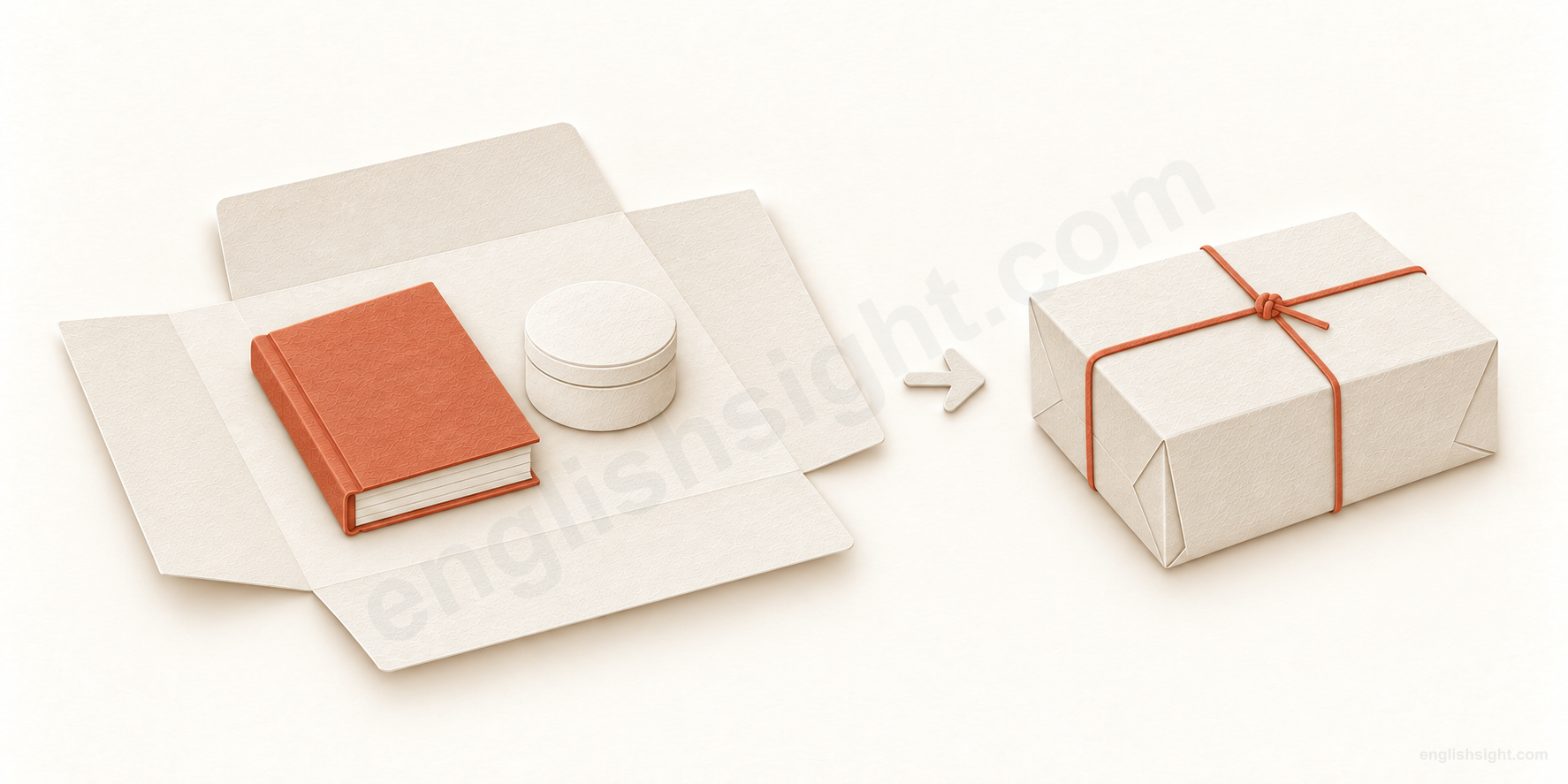
A book and a round tin rest on unfolded wrapping paper.
parcel
One closed parcel is secured with string.
Wrapping encloses the contents together as one unit.
Wrapping brings these contents together as one parcel. The picture illustrates the package sense, not land parcels or parcel out.
Wrapping brings the contents together into one package that can be carried, given, or sent.
The picture illustrates the package branch. A parcel of land is a defined plot without wrapping; the fixed expressions need their own explanations.
A parcel can hold several things together as one package. A parcel of land is one distinct plot. These uses share a useful teaching idea—treating something as a unit—but they are not interchangeable.
Start with the wrapped package, then read the construction and situation. This model supports understanding; it does not claim a single picture shared by every native speaker.
01
Packages to send, carry, or give
Start with a countable wrapped unit, then notice its contents and the service used to send it.
01
a / the + parcel; parcels; send / receive / collect / open + a parcel
a parcel / two parcels
a wrapped or packed unit to carry, give, or send
Starting situation
Several things need to travel together.
What this means here
Wrapping holds them as one package.
Count the package, not every item inside it.
Parcel is a countable noun: a parcel, the parcel, several parcels. One parcel can contain several objects. In British English it is a normal word for this kind of package; North American speakers usually say package, though parcel is also used.
A parcel need not already be in the post. You can carry one or give one to somebody. A box can hold the contents, but parcel names the packed unit rather than insisting on a particular container shape.
For delivery, send or post a parcel, receive a parcel, collect a parcel, and open a parcel describe different steps. In a parcel from Jo for Sam, from identifies the sender and for the intended recipient; send it to Sam identifies the destination or recipient.
In a sentence
A parcel from Jo arrived for Sam this morning.
Watch the difference Say a parcel or some parcels, not some parcel when counting packages. A letter is not normally called a parcel.
02
a parcel of + contents; a food parcel
a food parcel / a parcel of clothes
a package identified by what it contains
Starting situation
Volunteers gather basic supplies.
What this means here
Each household receives one packed collection.
A modifier or of-phrase identifies the contents.
A parcel of clothes names what is inside. Food parcel is an established expression especially in British English for basic foods supplied to people who need help. It can contain several kinds of food, not just one serving.
The same general packaging sense appears in a parcel of books. Food parcel in an aid context differs from a pastry parcel on a menu: the first is a collection of provisions, the second is a wrapped portion for cooking.
In a sentence
The volunteers packed a food parcel for each household.
Watch the difference Do not assume a food parcel means cooked food or a pastry dish; the situation determines the reading.
03
parcel + noun; send something by parcel post
parcel delivery / by parcel post
services and materials associated with sending packages
Starting situation
You have packed the goods.
What this means here
You choose how to send them.
Parcel can modify another noun; parcel post names a service.
In parcel delivery or parcel tape, parcel comes before the head noun and tells you the purpose or type. Parcel delivery is the delivery of packages; parcel tape is tape used to seal them. The main noun carries the plural when needed: parcel deliveries.
Parcel post is an uncountable name for a postal service for packages. By parcel post tells how something is sent. The expression does not by itself guarantee a particular price, speed, or tracking arrangement.
In a sentence
We sent the spare parts by parcel post.
Watch the difference Use by parcel post for the method, not by a parcel post. A parcel is an item; parcel post is the service.
02
A defined piece or enclosed portion
Land and cooking use parcel in different ways. A plot is defined by its boundaries; a cooking parcel encloses a portion in pastry, paper, or foil.
04
a parcel of land; a land parcel; adjoining parcels
a parcel of land
a distinct plot or tract of land
Starting situation
A larger area can be divided into separate plots.
What this means here
One plot is identified as a unit.
The boundary defines a portion; there is no wrapping.
In property descriptions, a parcel of land is a defined piece of land. Parcel can stand alone when the land context is already clear: They bought two adjoining parcels.
Here of land identifies the substance or area being divided, not the contents of a paper package. A map or property description may mark the limits; the word does not require a visible fence.
In a sentence
The council bought a parcel of land beside the station.
Watch the difference Do not interpret the land as being inside a delivered package. Parcel does not specify a fixed area or size.
05
pastry / spinach parcels; cook something in a foil parcel
pastry parcels / a foil parcel
a portion of food enclosed for cooking
Starting situation
A filling or piece of fish lies on a wrapper.
What this means here
The wrapper is folded around the food.
The enclosed portion is treated as one cooking unit.
British recipes and menus use parcel for a small portion wrapped before cooking. Pastry parcels have an edible wrapper; fish cooked in a foil parcel has foil around it, which is not eaten.
In spinach parcels, spinach identifies the filling rather than the wrapping. Read the recipe to see whether pastry, baking paper, foil, or something else encloses the food.
In a sentence
Fold the pastry around the filling to make six small parcels.
Watch the difference A cooking parcel is not necessarily sent anywhere, and the wrapper is not always edible.
03
Make a package or distribute portions
Up and out distinguish two actions: wrapping contents together and dividing something for distribution.
06
parcel something (up); parcel up + noun; parcel it / them up
parcel something up
wrap something to make a package
Starting situation
The contents are still unwrapped.
What this means here
They form a parcel ready to carry or send.
Up belongs to the wrapping expression; it does not mean upward movement.
Parcel something up describes making it into a parcel. The verb without up is also possible, especially in British English. Wrap something up is an ordinary alternative.
The object names what you wrap: parcel up the gifts or parcel the gifts up. With a personal pronoun, put it between the verb and particle: parcel them up. You can also use a passive: The gifts were parcelled up yesterday.
In a sentence
Please parcel these samples up before the courier arrives.
Watch the difference Say parcel them up, not parcel up them. Wrapping does not itself mean the parcel has been posted.
07
parcel something out to / among people; parcel something out into portions
parcel something out
divide something into portions or shares for distribution
Starting situation
A supply or area is held together.
What this means here
It is divided into separate shares or plots.
Out marks distribution; physical wrapping is not required.
Parcel out is a separable phrasal verb. You can parcel out the supplies or parcel the supplies out, but with a pronoun use parcel them out. Among names a group receiving shares; to can name particular recipients; into introduces the resulting portions or plots.
The things distributed can be food or money. Land can be parcelled out into smaller plots. Neither equal shares nor fairness is guaranteed by the verb; add equally or fairly if that matters.
In a sentence
They parcelled the supplies out among the three shelters.
Watch the difference Parcel out means divide or distribute, whereas parcel up means wrap. Do not infer that the shares are equal.
08
parcel out + tasks / duties / responsibilities; be parcelled out among people
parcel out tasks / responsibilities
allocate parts of work or responsibility
Starting situation
A team has a body of work to complete.
What this means here
Different members receive different assignments.
Abstract work can be divided into shares too.
Work, duties, and responsibilities can be parcelled out just as physical resources can. The whole expression describes allocation, not packaging tasks in paper.
A passive keeps the assigned work in focus: The tasks were parcelled out among the team. Contrast this with people merely passing an unresolved problem on to avoid responsibility; that is the critical image in play pass-the-parcel.
In a sentence
The project leader parcelled out the remaining tasks at the meeting.
Watch the difference Parcel out does not itself mean avoid responsibility or delegate badly; the context supplies any criticism.
04
Learn the whole expression
The fixed idiom part and parcel and the British game pass the parcel have meanings that need the complete phrase.
09
be part and parcel of + noun / -ing; it is all part and parcel
part and parcel of something
an integral or inseparable part of a situation or activity
Starting situation
You consider what an activity involves.
What this means here
You identify a feature that belongs with it.
Learn the fixed expression, rather than interpreting parcel as a package.
Part and parcel of emphasizes that something comes with a larger experience or is integral to it. It often explains why an ordinary difficulty should be expected, but it can describe positive or neutral features as well.
After of, use a noun or an -ing form: part and parcel of the job; part and parcel of learning. When the situation is clear, a speaker can say It’s all part and parcel. The expression does not say that every individual case must be identical.
In a sentence
Making mistakes is part and parcel of learning a new language.
Watch the difference Keep the fixed wording: part and parcel of, not a part and a parcel of. It is not a claim about physical packages.
10
play pass the parcel; play pass-the-parcel with + responsibility / blame / a problem
play pass the parcel
play a wrapping game; figuratively, pass responsibility to someone else
Starting situation
A wrapped prize moves around a group.
What this means here
When the music stops, the holder removes a layer.
The game name also supports a critical metaphor about responsibility.
Pass the parcel, also written pass-the-parcel, is a British children’s party game. Players pass a multiply wrapped prize while music plays; when it stops, the holder takes off one layer. The activity name uses the ordinary package meaning of parcel.
In British figurative usage, play pass-the-parcel with a problem, responsibility, or blame criticizes people for handing it on instead of taking responsibility. For example: The two offices kept playing pass-the-parcel with my complaint. This is different from simply allocating tasks to get work done.
In a sentence
After lunch, the children played pass the parcel.
Watch the difference The game and the criticism are distinct readings. The figurative phrase needs context; it does not mean every act of passing a package avoids responsibility.
Choose the unit and the construction
Package, plot, and portion
Use the contents and context to choose the meaning: a parcel of clothes contains clothes; a parcel of land is a plot. Parcel is countable in these noun uses. The bare word is not a general replacement for piece in a piece of advice or a piece of music.
Forms and object position
The plural and third-person verb form are parcels. British spelling normally has parcelled and parcelling; American spelling normally has parceled and parceling. Both up and out permit a noun object in either position; a personal pronoun goes before the particle. These are transitive actions and can be progressive or passive when the context calls for them. Dictionaries also record parcel without out for dividing into portions; here parcel out is the main pattern taught for distribution.
What this lesson leaves outside the main route
Dictionaries also record parcel as a group or lot, including a parcel of lies and commercial lots of goods. Recognize these as collection or portion uses, but prefer a group, lot, or collection in ordinary beginner production. Scientific air parcels, nautical rope-wrapping, and historical adjective or adverb uses are outside this everyday lesson.
Choose the intended meaning
Read the situation, including the particle or the whole expression.
1. A notice offers a parcel of land for sale. What is being sold?
2. The gifts are unwrapped. Ask someone to make them into a package.
3. A manager parcels out the duties. What does the sentence itself tell you?
4. Someone says that setbacks are part and parcel of a long project. What do they mean?
Sources and teaching notes
The dictionary pages below support the meanings and usage distinctions. Explanations and examples are original; the wrapping model is a teaching aid with stated limits.
The diagram illustrates a useful relationship, not a picture shared by every native speaker.