From portions and members to roles, participation, and separation.
One constituent, a larger whole
One constituent, a larger whole
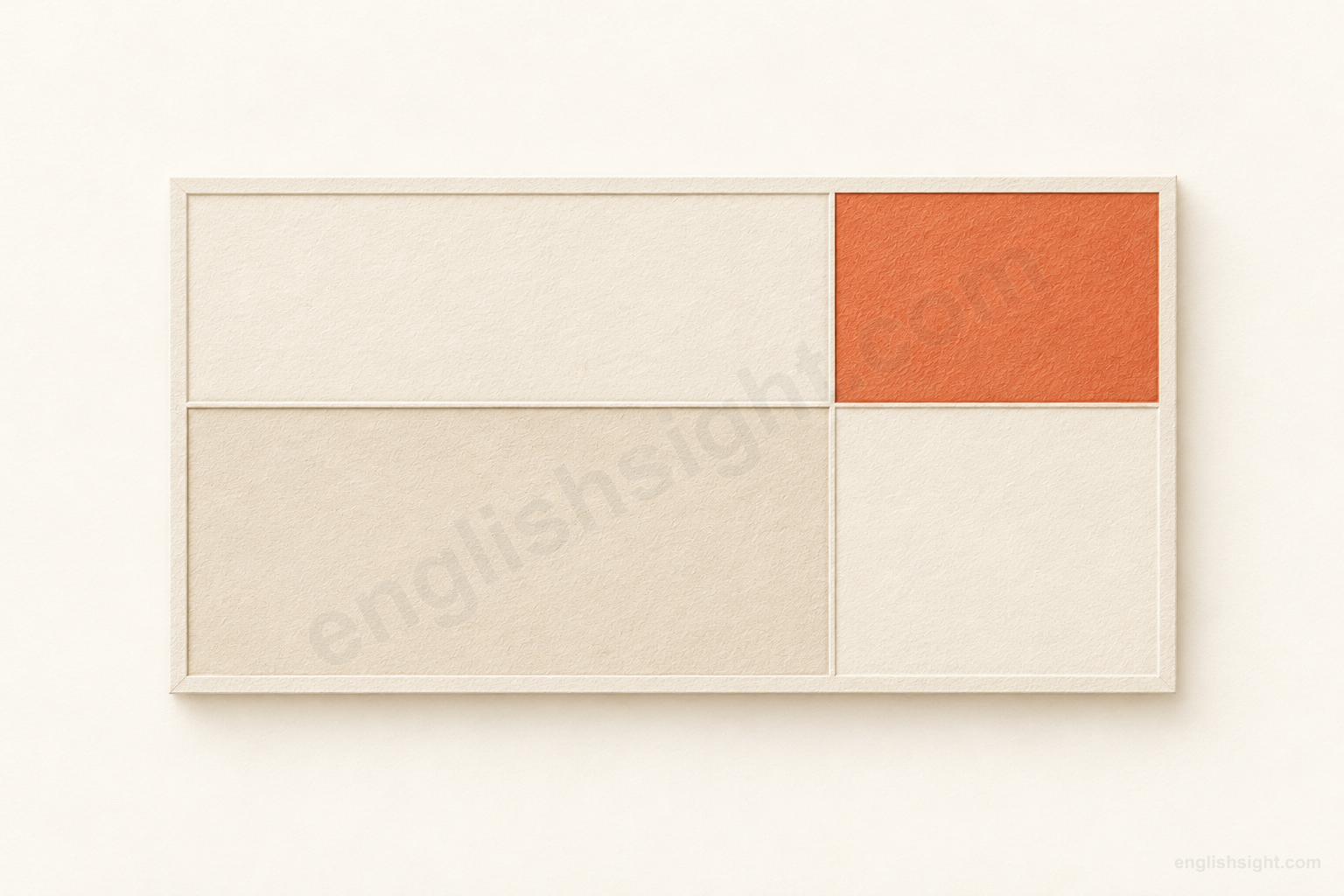
Consider the full rectangle as one whole.
part
The selected region remains one part within the whole.
Focus on the orange upper-right region without removing it.
The orange region is one part of the whole; the four regions are unequal.
A part is something considered as a portion, constituent, or contribution within a larger whole; it need not be detached, equal in size to other parts, or physically separate.
The sketch focuses on the noun’s relation to a whole. The verb’s separation branch and established idioms are explained in their own entries. The regions have different sizes deliberately.
A part is understood against a larger whole: some money, one section of a book, a machine component, or a contribution to a shared activity. The relation matters more than the shape or size of the part.
The verb part follows a related but distinct branch: things or people separate. Fixed expressions such as take part and for my part have their own grammar and uses; a picture cannot predict them all.
01
A portion, a component, or a member
Ask what the larger whole is: an amount, a place, an object, a group, or even a person’s feelings. A part need not be detached or small.
01
part / a part of + a whole or amount
part of the money
some of an amount, rather than all of it
Situation / whole
There is a total bill to pay.
Meaning in context
You pay some of that total now.
The amount is understood against a larger total.
Part of the money leaves the size unspecified. A large part, a small part, and the remaining part add information about size or which amount you mean. Part alone does not mean half.
Both part of the bill and a part of the bill are possible. Bare part of is especially useful for an unspecified amount; a part presents it as a portion. Before a specific total, keep the determiner: part of the money, not part of money.
The same pattern works with time and distance: We talked for part of the evening. I walked part of the way home. Neither sentence says that the whole evening or journey was completed.
In a sentence
I paid part of the bill and will pay the rest tomorrow.
Watch the difference Do not assume a part is an equal share. Equal parts needs the word equal or a clear measuring context.
02
the + description + part of…; parts of…; in parts; part + number
the final part / parts of the body
an identifiable section, area, or stage
Situation / whole
A course, body, place, or task has distinguishable sections.
Meaning in context
You identify one section within it.
A boundary may be physical, geographical, or simply a way of organizing information.
The final part of the course is a stage within the whole course. The northern part of the island identifies an area, and parts of the body identifies bodily areas or structures; nothing has to be cut off.
A story can come in three parts. Part two is a numbered label, normally without the: Part two starts tomorrow. Compare the second part, which uses an ordinal and the.
In parts can mean in some sections: The report is confusing in parts. The best part of a holiday can simply be its most enjoyable aspect: The best part was meeting your family. These uses organize or evaluate sections rather than measuring equal pieces.
In a sentence
The final part of the course includes a short interview.
Watch the difference Part two and the second part are natural; avoid the part two as an ordinary numbered heading.
03
a part for + device; a part of + device; spare / replacement parts
a replacement part / spare parts
a component used in a larger device
Situation / whole
A machine has a damaged component.
Meaning in context
One component is replaced so the machine can function.
A component has a place or function within the larger object.
A part for a fan is a component made to fit it. A part of a fan identifies a component that belongs to its structure. A replacement part takes the place of another; spare parts are kept or supplied for repairs.
Compare a piece of plastic, which tells you about the material or a separate bit of it. A plastic part tells you that it is a component. A random piece of plastic will not necessarily fit the fan.
In a sentence
The repair shop ordered a replacement part for my fan.
Watch the difference Parts is the regular noun plural. It does not name the whole machine.
04
be / become / remain (a) part of…; as part of…; form part of…
be part of / form part of
belong to or be included in a larger whole
Situation / whole
There is a group or larger arrangement.
Meaning in context
A person or thing is included in it.
Membership and inclusion do not require physical attachment.
Being part of a team describes belonging. Working as part of a team describes how you work: within a larger group. Both be part of and be a part of are possible in this inclusion sense.
Form part of means constitute a portion of something: The interview forms part of the assessment. It sounds more formal than is part of. Part of everyday life similarly identifies something included in an experience.
Compare take part in the meeting, which describes participation in an event. You can be part of the club without taking part in today’s meeting.
In a sentence
The garden is part of the school, and pupils help care for it.
Watch the difference Use of for the whole you belong to: part of the team. In normally follows participation expressions such as take part.
05
number + parts + substance + to + number + part(s) + substance
two parts water to one part juice
equal measuring units in a mixture
Situation / whole
You choose one consistent unit of volume.
Meaning in context
You combine two units of water with one of juice.
Here each part is the same measuring unit; the numbers set the ratio.
In this recipe, one part might be one spoonful or one cup. The chosen unit stays the same for both ingredients, so two parts water to one part juice means twice as much water as juice.
This is a special measuring use. The ordinary phrase three parts of the building does not promise three equal areas. In technical labels, parts per million is also a ratio; it does not mean a million separate machine components.
In a sentence
For this drink, mix two parts water to one part juice.
Watch the difference Two parts water and one part juice make three units altogether, not two.
06
part of + object pronoun + wants / feels / thinks…
part of me wants to…
one side of a person’s mixed feelings
Situation / whole
You feel pulled toward different choices.
Meaning in context
You express only one side of your feelings.
The whole is a person’s attitude; the part is one competing feeling.
Part of me wants to leave can coexist with another wish to stay. This is a figurative use, not a reference to a body part and not necessarily a precise measure of how strongly you feel.
It is useful when explaining hesitation: Part of me wants to accept, but I would miss my friends. Compare I partly agree, which directly limits the extent of agreement rather than presenting competing wishes.
In a sentence
Part of me wants to move abroad, but I like living near my family.
Watch the difference Keep the object form after of: part of me, not part of I.
02
Roles, contributions, and participation
A play, a piece of music, and a shared activity all contain different contributions. The surrounding verb tells you whether someone performs, helps, belongs, or participates.
07
play the part of + character; have / get / learn a part
play the part of…
perform a character in a play or film
Situation / whole
A production has a character to portray.
Meaning in context
An actor performs that character’s words and actions.
An acting part is a role within a larger performance.
Play the part of the doctor identifies the character being acted. Have a part in the play says someone has a role; get the part means be chosen for it. Learn your part can refer to learning the words and actions required.
This is different from play a part in improving the school. That expression means contribute to an outcome and need not involve actors. The nouns and context show which meaning is intended.
Outside theatre, play a part can describe pretending to be someone you are not: He seemed relaxed, but he was playing a part. This is a figurative acting use. It differs from play a part in an outcome, where the focus is a contribution rather than pretence.
In a sentence
Nina plays the part of the doctor in our school play.
Watch the difference For a named character, say the part of the doctor; do not automatically replace of with in.
08
the + voice / instrument + part
the piano part
music assigned to one voice or instrument
Situation / whole
Several musicians perform one piece together.
Meaning in context
Each musician follows the music for their instrument or voice.
One musical line contributes to the combined performance.
The piano part is what the piano plays within the complete music. It can also mean the written music for that contribution. Learn the piano part does not mean learn a physical piece of the piano.
Compare the middle part of the song, which is a section in time. The piano part may continue across several sections. Musical parts separate contributions, not necessarily successive moments.
In a sentence
I know the melody, but I still need to practise the piano part.
Watch the difference Context distinguishes a musical part from a component: a broken piano part is usually a physical component.
09
play a/an + description + part in + noun / -ing; have a part to play
play a part in / have a part to play
contribute to an event, process, or result
Situation / whole
An outcome has several influences or contributors.
Meaning in context
One person or factor contributes to it.
The contribution belongs within a larger process.
A person or a factor can play a part in something. Good lighting played a part in the success of the exhibition means it helped produce that outcome; there is no literal acting role.
Have a part to play points to a possible or expected contribution: Parents have a part to play in the project. An active, important, or small part tells you more about the contribution. In can be followed by a noun or an -ing form.
Someone’s part in an accident may mean involvement or responsibility, not helpful work. The result and context determine whether the contribution is welcome.
In a sentence
Clear signs played an important part in keeping visitors safe.
Watch the difference Do not call every play + part expression acting. Here in introduces the event or process affected.
10
do + possessive + part; do your part to + verb / in + -ing
do your part
make your contribution to a shared effort
Situation / whole
A group needs several people to help.
Meaning in context
You carry out your share of the effort.
Your contribution is one part of a collective task.
Do your part often encourages responsibility. It asks you to contribute rather than leave all the work to others. The possessive changes with the contributor: I did my part; they did their part.
Do your part to help and do your part in organizing the event are both useful patterns. They need not imply that each person does exactly the same amount, or that one person can finish the whole task alone.
In a sentence
We can all do our part to keep the shared kitchen clean.
Watch the difference Compare do a part of the work, which names a portion of work, with do your part, which emphasizes your contribution.
11
take part (in + noun / -ing)
take part in
participate in an activity
Situation / whole
An activity is open to participants.
Meaning in context
You join in and participate.
The whole expression describes participation, not possession of a piece.
Take part in a discussion means participate in it. Without a following activity, take part can stand alone: Everyone is welcome to take part. Take changes tense normally: took part, has taken part.
Contrast be part of a committee, which describes membership. A committee member may miss an event; a guest can take part in an event without being a member. Attend a discussion only guarantees presence, while take part presents involvement.
In a sentence
Would you like to take part in our weekend clean-up?
Watch the difference For ordinary participation, use take part, without a: take part in it, not take a part in it.
12
have no part in…; want no part of…
have no part in / want no part of
deny involvement or refuse it
Situation / whole
There is a plan or action you are discussing.
Meaning in context
You deny involvement, or state that you do not want it.
A fact about involvement differs from a wish to stay out.
I had no part in the decision states that you were not involved in making it. I want no part of the plan expresses refusal: you do not want to be involved at all.
Want no part of often sounds firm or disapproving. It is stronger than I’m not sure I can help. Keep the full phrase together rather than reading no part as a physical quantity.
In a sentence
I want no part of a plan that hides the real cost from customers.
Watch the difference The prepositions differ in these patterns: no part in the decision; want no part of the plan.
13
take + possessive + part; take someone’s side
take someone’s part
support someone in a disagreement
Situation / whole
Two people disagree, and someone else responds.
Meaning in context
That person supports one side.
The possessive identifies the person being supported, not an activity being joined.
In British English, take someone’s part means support that person, especially in an argument. The possessive names the person receiving support: She took her brother’s part means she sided with her brother. Take changes tense normally: took her part; has taken his part.
Compare take part in an argument, which means participate in it and does not specify whose side you support. Taking someone’s part does not mean taking over their role. Take someone’s side is a familiar alternative.
In a sentence
When the brothers argued about the repairs, their aunt took Ben’s part.
Watch the difference Keep the possessive for support: take Ben’s part. Participation uses take part in, without a possessive.
03
Extent, viewpoints, and familiar expressions
Learn these expressions as complete patterns. Changing in to on or for can change the job the expression does.
14
for + possessive + part, + clause
for my part
as far as my own view or contribution is concerned
Situation / whole
Different people have different responses.
Meaning in context
You introduce what one particular person thinks or does.
For introduces a person’s side of the situation.
For my part introduces your own opinion, feeling, or response. It can contrast with someone else’s: Others want to leave; for my part, I’d rather stay. For her part similarly turns attention to her response.
This is somewhat formal. Personally is often easier in everyday conversation. It does not mean on my behalf: For my part, I approve states your view, while She spoke on my behalf says she represented you.
In a sentence
For my part, I would rather repair the old table than buy a new one.
Watch the difference Do not confuse for my part, which introduces my view or response, with on my part, which attributes an action to me.
15
noun + on + possessive + part; noun + on the part of + person / group
on my part / on the part of…
done, felt, or shown by a particular person
Situation / whole
An action or attitude needs to be attributed.
Meaning in context
You identify the person responsible for it.
On the part of names the source of an action or attitude.
An error on my part is an error I made. Patience on the part of the staff is patience that the staff show. The expression can attribute praise as well as blame.
On my part and on the part of me follow the same idea, but the possessive version is the natural compact choice with a pronoun. With a longer noun phrase, on the part of the new staff is useful.
Compare For my part, I’m satisfied, which presents my own response. An apology on my part identifies who gives the apology; the two prepositions are not freely interchangeable.
In a sentence
The delay was caused by a mistake on my part.
Watch the difference Say on my part, without the before my; say on the part of the manager with the full of phrase.
16
in part; in large part; due in part to…
in part / in large part
to some extent, or to a large extent
Situation / whole
An explanation has more than one factor.
Meaning in context
You identify one contributing factor and leave room for others.
The claim applies to a portion of the explanation or result.
In part limits a statement: The closure was in part due to costs leaves room for other reasons. It sounds more formal than partly, but the basic meaning is similar.
In large part increases the extent: The delay was due in large part to the weather makes weather a major explanation. Neither expression by itself gives a precise percentage.
Compare in parts: The essay is weak in parts identifies some sections. The essay is weak in part because it lacks examples gives one reason for its weakness.
In a sentence
The event succeeded in part because local shops provided free materials.
Watch the difference In part is about extent; in parts can mean in some sections or in separate pieces.
17
for the most part + clause; clause + for the most part
for the most part
mostly or generally, allowing exceptions
Situation / whole
You assess a whole experience or a collection of cases.
Meaning in context
You give the general picture without claiming every detail fits.
The larger share supports the general statement.
For the most part can qualify a description or a generalization. The trip was pleasant for the most part allows some unpleasant moments. The volunteers are, for the most part, local means most of them are local.
Compare in part, which only says partly. The work is finished in part could leave much unfinished; the work is, for the most part, finished presents completion as the general picture.
In a sentence
For the most part, the instructions were easy to follow.
Watch the difference Keep the fixed phrase for the most part; do not replace it with for most part.
18
the best / better part of + time / amount
the best / better part of an hour
most of a period or amount
Situation / whole
A task takes a substantial amount of time.
Meaning in context
You emphasize that it used most of the stated period.
Best or better refers to quantity in this idiom, not enjoyment.
The better part of an hour means most of an hour. The best part of the afternoon can similarly emphasize how much time was used. Context, rather than a fixed number of minutes, sets the approximation.
Compare The best part of the afternoon was the picnic. There best selects the most enjoyable section. In We spent the best part of the afternoon waiting, it measures a large amount of time; the wait need not have been enjoyable.
In a sentence
We spent the better part of an hour looking for the missing key.
Watch the difference Do not interpret best as praise whenever it precedes part. The following amount and sentence context matter.
19
be part and parcel of + noun / -ing
part and parcel of
a normal or integral feature of something
Situation / whole
An activity includes a recurring feature.
Meaning in context
You present that feature as belonging naturally to the activity.
The expression emphasizes inclusion as a normal feature.
Part and parcel of learning describes something that goes with learning as an ordinary feature. It often helps someone accept an inconvenience, but it can describe a neutral feature too.
Parcel is part of the established expression; no actual package is involved. Compare part of, which simply states inclusion. Part and parcel emphasizes how closely the feature belongs with the larger activity.
In a sentence
Making small mistakes is part and parcel of learning a new skill.
Watch the difference Use of, not with, after the full expression: part and parcel of learning.
20
look / dress the part (of + role)
look / dress the part
have the appearance expected for a role
Situation / whole
Someone has a role, job, or character to present.
Meaning in context
Their appearance or clothing fits that role.
The whole is a role; appearance matches what is expected of it.
Look the part says someone appears suitable for a role. Dress the part focuses on the clothes. An actor can dress the part of a sailor, but the expressions also apply outside theatre.
Looking the part does not prove competence. In a chef’s jacket, I looked the part, but I still needed help with the recipe separates appearance from ability. British informal usage can also use looks the part of a thing that appears impressive.
In a sentence
In her new uniform, Maya certainly looked the part of a tour guide.
Watch the difference Keep the in this expression: look the part. Compare play a part in a project, which describes contribution.
21
be greater / more than the sum of its / their parts
greater than the sum of its parts
more effective together than the individual elements suggest
Situation / whole
Several elements have individual strengths.
Meaning in context
Their combination produces a stronger overall effect.
The relation between parts can add value to the whole.
This expression evaluates how things work together. A team that is greater than the sum of its parts achieves more through cooperation than you would expect just from considering each member separately.
The same teaching idea can apply to a performance or design. It is a comparison of combined effect, not necessarily a literal mathematical calculation. Its must refer to the whole under discussion; with a plural subject, use their parts.
In a sentence
Together, the musicians create a performance greater than the sum of its parts.
Watch the difference Sum belongs to this established comparison. It does not mean that ordinary arithmetic has stopped working.
04
Mixtures and established compounds
Part also means partly before descriptions. Some combinations have their own established meanings and spelling.
22
part + noun / adjective, part + noun / adjective; part-funded; part owner
part comedy, part mystery
partly one thing and partly another
Situation / whole
A thing has features of more than one kind.
Meaning in context
You describe its mixed nature.
Different descriptions contribute to one combined identity.
The film is part comedy, part mystery presents two aspects of the same film. Part works like partly here; it is not a count noun naming two detached pieces, and the proportions need not be equal.
Part can also mean partly in forms such as part-funded and part owner. A part owner shares ownership rather than owning the whole thing. Hyphenation varies with the particular compound; learn the written form with the expression.
In a sentence
The film is part comedy, part mystery, with a surprisingly sad ending.
Watch the difference Do not insert of into this pattern: part comedy, not part of comedy. Part of the comedy would name a section of a particular comedy.
23
part-time + noun; work / study part-time
a part-time job / work part-time
work or study for fewer than full-time hours
Situation / whole
A schedule could occupy the usual full working period.
Meaning in context
It occupies only part of that period.
The contrast is with a full-time schedule.
Part-time describes a job, worker, or course, and can also describe how someone works or studies: a part-time course; I study part-time. The hyphenated form is standard in these examples.
The expression does not specify a universal number of hours. A part-time job is not necessarily temporary: someone can hold one for years. Compare a full-time job, which occupies the normal full working schedule in that setting.
In a sentence
I have a part-time job at the library while I study.
Watch the difference Part-time concerns hours; temporary concerns duration. The two descriptions answer different questions.
24
a part of speech; plural: parts of speech
a part of speech
a grammatical word class
Situation / whole
Words do different grammatical jobs.
Meaning in context
You classify a word by its grammatical behavior.
This established term names a class, not a slice of spoken sound.
Noun, verb, and adjective are parts of speech. When asking What part of speech is this word?, you are asking about its grammatical class.
The same spelling can serve different classes in different sentences. In This part is missing, part is a noun. In We part at noon, part is a verb. Look at the sentence rather than assuming every use of a word has one class.
In a sentence
In “They parted quietly,” what part of speech is “parted”?
Watch the difference The plural is parts of speech, not part of speeches. This term does not mean a section of a speech someone gives.
25
possessive + private parts; private parts + plural verb
private parts
a polite indirect term for sexual organs
Situation / whole
Someone needs an indirect bodily term.
Meaning in context
They use a conventional euphemism.
Private parts has a narrower meaning than ordinary body parts.
Private parts is a plural expression used to avoid naming sexual organs directly. It is an established euphemism, not a general description of every part of the body covered by clothes.
Body parts is the broad neutral term, which includes hands, knees, and many other areas. Choose the more specific anatomical term when precision is needed; the euphemism is deliberately indirect.
In a sentence
The children learned that their private parts should remain covered in the changing area.
Watch the difference Use the plural form private parts for this conventional expression.
05
When part is a verb
The verb describes separation: things move apart, people leave each other, or a person gives something up. Read the object and the following preposition.
26
things + part; person + part + things
the curtains parted / part the curtains
move apart, or cause things to move apart
Situation / whole
Two things or sides are together.
Meaning in context
A gap opens between them.
The verb presents separation, with or without an expressed person causing it.
The curtains parted describes their movement. I parted the curtains adds the person causing it and puts the curtains in object position. The crowd parted similarly describes people moving aside; no object is required.
Part does not necessarily involve cutting or damage. A curtain can be parted and then closed again. Compare I cut the curtain, which changes the material itself. The noun diagram shows a part within a whole; this verb branch focuses instead on things moving apart.
In a sentence
I parted the curtains slightly to see whether it was still raining.
Watch the difference With an object, say I parted the curtains. The curtains parted is already complete; it does not need themselves.
27
part + hair + in the middle / on one side; a part (US) / a parting (UK)
part your hair / a side part
arrange hair in two directions along a line
Situation / whole
Hair lies without the desired division.
Meaning in context
A comb creates a line with hair arranged to either side.
Parting hair creates a division without cutting it.
Part your hair in the middle describes making the dividing line near the middle of the head. Part it on the left describes the location of the line; neither means cut the hair into pieces.
The verb is used in both British and American English. For the line itself, American English commonly uses a part or a side part; British English commonly uses a parting or a side parting. Her hair was neatly parted uses a past participle to describe its arrangement.
In a sentence
He usually parts his hair on the left.
Watch the difference The noun a part can name the line in American English; the verb part still names arranging the hair, not cutting it.
28
people + part; part from + person; be parted from + person
part from / be parted from
leave another person, or be kept apart from them
Situation / whole
People have been together.
Meaning in context
They leave each other or are separated.
The people and the grammar show whose separation is being described.
We parted at the station means we left each other there. I parted from my friends names the other people after from. This verb is more formal or literary than We said goodbye or We went our separate ways.
Parting does not always mean ending a relationship permanently. Friends can part for the evening. Context can also describe a couple separating more permanently.
Be parted from often presents separation imposed by circumstances: The children were parted from their parents during the evacuation. The passive focuses on those affected. Compare They parted, which simply reports the people leaving each other.
In a sentence
We parted at the station after agreeing to meet again in June.
Watch the difference Ordinary leave takes a direct object, but this use of part takes from: leave my friends; part from my friends.
29
part with + possession / money / pronoun
part with something
give up possession of something, often reluctantly
Situation / whole
You own something you could keep.
Meaning in context
You give it away, sell it, or otherwise give it up.
With links separation to the possession being given up.
Part with an old bicycle means stop keeping it, perhaps by selling or giving it away. The expression often highlights reluctance or value. Part with money can describe paying money that you would prefer to keep.
Keep the object after with, including pronouns: I can’t part with it, not I can’t part it with. This is different from the direct-object verb in part the curtains: you are not moving two sides of the bicycle apart.
In a sentence
I could sell the old camera, but I’m not ready to part with it.
Watch the difference Part from normally concerns leaving people; part with a possession means giving it up.
30
part company / ways (with + person / organization)
part company / part ways
go separate ways or end an association
Situation / whole
People are travelling or working together.
Meaning in context
They separate or stop their association.
Company refers to being together, not necessarily a business.
We parted company at the bridge can describe travellers taking different routes. The club parted company with its coach describes ending a working association. Context determines whether the separation is a brief goodbye or a more lasting end.
Part ways is a familiar alternative: The band and its singer parted ways last winter. With can introduce the other party: The band parted ways with its singer. These phrases do not themselves say who was at fault.
In a sentence
The band parted company with its manager after the tour.
Watch the difference Do not read company as always a business, and do not assume parting company necessarily involves a quarrel.
31
part company / ways with + person + on / over + issue
part company with someone on an issue
disagree with someone about a point
Situation / whole
People share some views or follow the same reasoning.
Meaning in context
Their views diverge on a particular issue.
The separation concerns opinions rather than physical location.
I part company with her on this issue means I disagree with her about it. With identifies the person whose view differs; on identifies the subject of disagreement.
This is a figurative, fairly formal use of part company or part ways. You can disagree on one issue while continuing to work together. Compare The band parted company with its manager, which normally reports an ended association.
In a sentence
I agree with Leon about the problem, but part company with him on the solution.
Watch the difference Disagreement on a point does not automatically mean a friendship or job has ended.
Read the relation and the full expression
Part is broader than a detached piece
A piece of broken glass is separate material; a part of a city, a team, or a performance may remain within its whole. A member is a person or individual entity in a group; part is broader. A section usually identifies a division or area. Choose the noun that describes your intended relation.
Articles depend on the pattern
Both part of the team and a part of the team can describe inclusion. Counted sections take articles or numbers: a difficult part, three parts. Fixed expressions have their own forms: take part, do your part, look the part, for the most part. Do not apply one article rule to all of them.
Forms, agreement, and active or passive grammar
The noun plural is parts. The regular verb forms are part, parts, parted, parting; parted has an extra final syllable. The doors are parting is a possible progressive for an ongoing movement. The curtains were parted is passive or describes their resulting position. I parted the curtains already expresses causing separation; no extra causative template is needed. Keep clear agreement in counted uses: One part is missing; two parts are missing.
A teaching connection with limits
The whole-and-constituent diagram helps connect portions, membership, and contributions. It does not show every verb use or explain idioms by itself. This is a teaching model, not a claim that all English speakers imagine the same picture.
Scope of the lesson
This selection covers modern everyday noun and verb uses, major fixed expressions, and useful compounds. Old-fashioned regional these parts, literary a person of many parts, less central idioms and proverbs, specialized technical separation, and the abbreviation part. are not expanded. The entries are grouped for learning, not ranked by measured frequency.
Choose the relation
Read the whole sentence. Decide whether part describes membership, participation, quantity, responsibility, or separation.
1. You joined the discussion and gave your views. Which sentence directly describes participating?
2. Complete the invitation to participate: “Would you like to ___ in the quiz?”
3. You made a mistake. Which phrase attributes it to you?
4. “We waited for the better part of an hour.” What does this mean?
5. You own a camera you are reluctant to sell. Which sentence fits?
6. A drink uses two parts water to one part juice. What works if one part is one cup?
7. “I part company with her on the price, but we still work together.” What is being separated?
8. Which sentence explicitly names someone causing curtains to move apart?
Sources and teaching notes
Dictionary meanings, constructions, and idioms were checked against the publisher pages below. The explanations, examples, comparisons, and relationship sketch were created for this lesson.
The diagram is a teaching aid for the relation between a part and a whole.