Connect earlier time with going beyond a place, time, or stage.
Beyond a reference point
Beyond a reference point
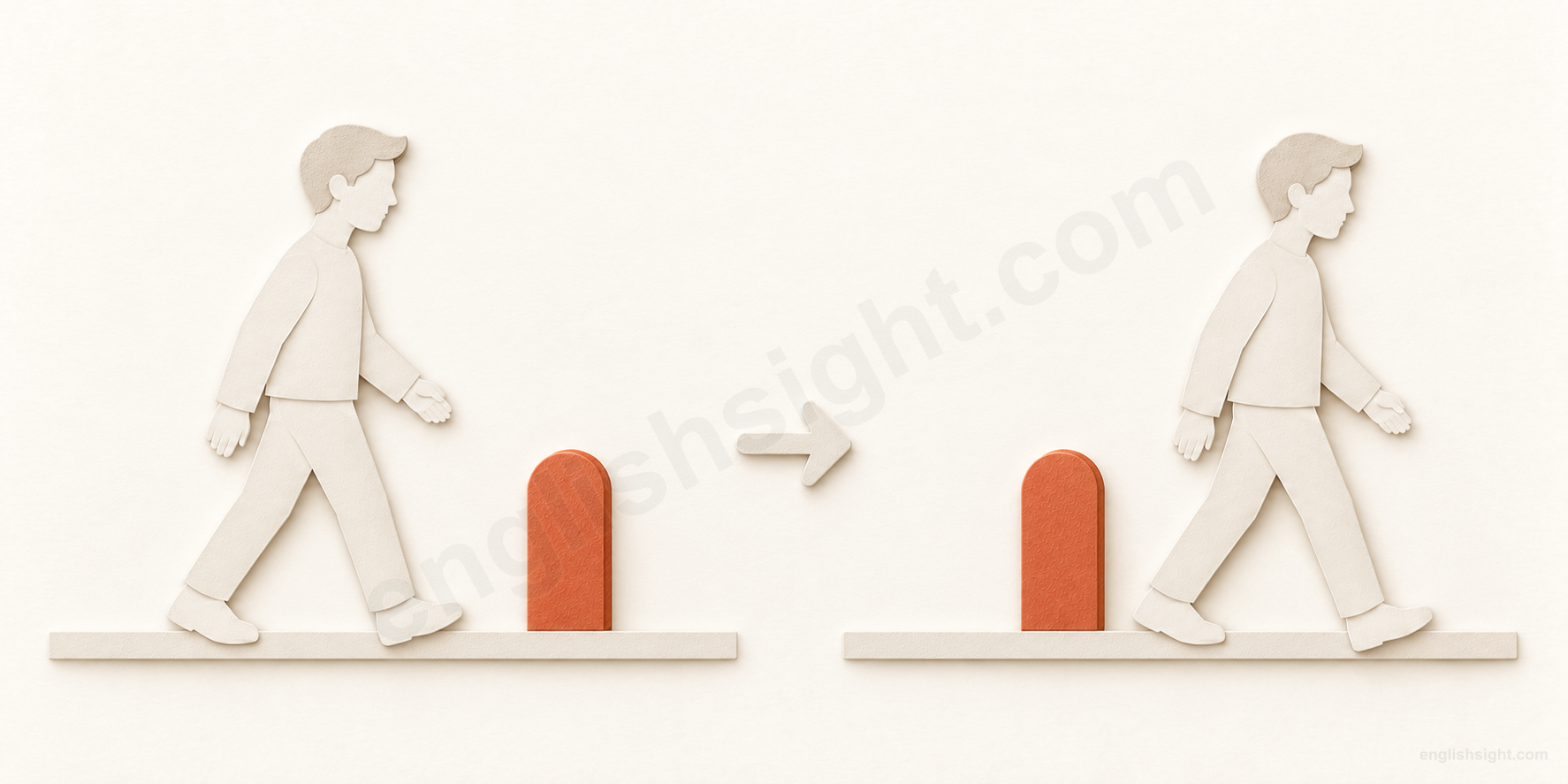
The walker approaches the upright orange marker.
past
The same marker is now behind the walker.
He walks alongside the marker and continues to the right.
He walks past the marker, leaving it behind.
Past can mark what lies beyond a reference point, while the past names time and events now behind us.
The sketch demonstrates the spatial relation. Earlier time and stages can be compared with landmarks, but the picture does not predict every idiom or every grammatical use.
Past works as a noun, adjective, preposition, and adverb. The past names earlier time; past experience describes earlier experience; walk past the door describes a route beyond it. The grammar tells you which relationship is intended.
A useful teaching connection is a reference point that has been passed: something is beyond it, or belongs to what is now behind us. This connection supports memory, but fixed expressions still need to be learned in context.
01
Earlier time, history, and clocks
Past can name earlier time, describe earlier things, locate a recent period, or place a time after a stated hour. Read the whole phrase to identify the reference point.
01
in / from / of the past; the recent / distant past
in the past
at an earlier time
Reference / situation
A town has changed.
Meaning in context
You compare its earlier life with today.
The past is earlier than the present.
The past is a noun phrase for earlier time or earlier events. In the past sets that time as the background: In the past, we paid in cash. From the past identifies an earlier source; learn from the past means use earlier experience.
The recent past is fairly close to now; the distant past is much farther away. These phrases do not give exact dates. In the dim and distant past is a familiar, sometimes humorous way to place something a very long time ago.
In a sentence
In the past, this street had only a few houses.
Watch the difference Use the: in the past, not in past. For a dated event, in 2012 is more precise.
02
possessive + past; have a past
her past
a person’s or place’s earlier history
Reference / situation
You learn about a colleague’s earlier career.
Meaning in context
Those experiences form part of her history.
A possessive identifies whose history is meant.
My past, the city’s past, and our shared past refer to particular histories, not all earlier time. A past can contain good and bad experiences; it is not inherently shameful.
Has a past can suggest a hidden or disreputable earlier life when said without further description. A chequered past (US also checkered) suggests a mixed or troubled history. That implication belongs to the wording and context.
In a sentence
Her past as a nurse helps her stay calm in emergencies.
Watch the difference Her past is a noun phrase; her past jobs uses past as an adjective before jobs.
03
past + noun
past experience / past presidents
belonging to an earlier time
Reference / situation
You consider earlier events or office holders.
Meaning in context
You describe them in relation to the present.
Past modifies a noun and places it in an earlier period.
Past mistakes and past experience concern earlier actions or learning. Past presidents are people who formerly held that office. Past does not imply that a former president has died.
Former is often the clearer choice for one person’s previous role: my former teacher. Past experience is natural; past history can be useful in a specific context but often adds little to history. Choose the noun that expresses the information you need.
In a sentence
Past presidents of the club were invited to the anniversary dinner.
Watch the difference Past is not the ordinary adjective for every old object: an old chair describes its age; a past chair usually means a former chairperson.
04
for / in / over the past + period; this past + day / season
for / in / over the past few days
a recent period leading up to now
Reference / situation
You look back over three days.
Meaning in context
You report a state or events during that interval.
The duration reaches back from now or another established reference time.
For the past three days describes how long a situation has lasted. In or over the past three days places events within that period. Compare I’ve been ill for the past three days with I’ve called twice in the past three days.
The present perfect is common when the period connects with now. A past narrative can establish an earlier reference point: She had been ill for the past three days. This past Monday identifies the most recent Monday; it is not a three-day duration.
In a sentence
We’ve had two meetings in the past week.
Watch the difference In the past means earlier in general. In the past week specifies a recent interval; it does not automatically mean the previous calendar week.
05
be + past
the worst is past
a difficult situation has ended
Reference / situation
The most difficult period has happened.
Meaning in context
It is no longer ahead of you or continuing.
Past after be can describe an ended situation.
The danger is past means that the danger has ended. The worst is past presents the most difficult part as over. This adjective use often sounds more formal or literary than over.
Compare The danger has passed: passed is the verb form after has. In The danger is past, past describes the situation. Similar meaning does not make the spellings interchangeable.
Times past and years past place the adjective after a plural time noun. They are literary alternatives to earlier times or earlier years, rather than the default pattern for everyday conversation.
In a sentence
The storm has weakened, and the worst is past.
Watch the difference Write has passed with -ed when pass is the verb; do not write has past.
06
the past (tense) of + verb; past participle
past tense / past participle
names for verb forms
Reference / situation
You compare go, went, and gone.
Meaning in context
You identify the forms used in different constructions.
The past form and the past participle may differ.
In a grammar discussion, the past of go means went. The adjective past also occurs in past tense and past perfect. A regular verb often has the same past and past participle forms, such as worked; an irregular verb may have different forms, such as went and gone.
A past participle is used after have in perfect constructions and after be in passives, and can also act as an adjective. I have finished and The door is locked show why its name does not require the whole sentence to be in the past tense. This unit identifies the terms rather than teaching every tense use.
In a sentence
The past of “go” is “went”, but its past participle is “gone”.
Watch the difference Do not use a participle as an ordinary simple past: I went home, not I gone home.
07
(number of minutes / a quarter / half) + past + hour
ten past six / half past six
minutes after the named hour
Reference / situation
The clock has reached six.
Meaning in context
Ten or thirty minutes of that hour have elapsed.
The hour after past is the hour already reached.
Ten past six is 6:10; a quarter past six is 6:15; half past six is 6:30. Minutes is optional after a number: ten minutes past six. At half past six places an event at 6:30.
This pattern is especially familiar in British English. After is also used in North American English, as in ten after six. If the hour is already clear, an answer such as ten past can omit it. For 6:50, ten to seven or six fifty is clearer than extending the usual past pattern.
In a sentence
The lesson starts at a quarter past six.
Watch the difference Half past six is 6:30, not 5:30 or 6:50.
08
past + time / deadline
past midnight / past bedtime
later than a specified time
Reference / situation
Midnight or bedtime serves as a reference.
Meaning in context
The actual time is later.
Past places a time beyond a named point.
It’s past midnight means it is later than midnight. Stay past six means remain after six. Unlike ten past six, these expressions do not state an exact number of minutes.
Past does not always mean before now: Tomorrow’s concert may continue past midnight refers to a future event. The reference point is midnight, not necessarily the moment of speaking.
In a sentence
Please don’t work past midnight tomorrow.
Watch the difference Past midnight describes a time after midnight; before midnight describes the opposite side of the same point.
09
time period + go / fly / whizz + past
the hours went past
time elapsed
Reference / situation
You begin an activity.
Meaning in context
Several hours elapse.
Time is presented as moving by a reference point.
Go past can describe time elapsing: Two days went past without a reply. Fly, rush, or whizz past adds a feeling of speed. Past is an adverb here; it is not a past-tense verb.
Compare Two days passed with Two days went past. In the first, passed is the only main verb. In the second, went supplies the past-tense verb and past describes the passage of time.
In a sentence
The afternoon went past before I noticed the time.
Watch the difference Do not write The afternoon past as a complete sentence in ordinary modern English.
02
Moving or looking beyond a place
A landmark stays where it is while a movement or line of sight continues beyond it. Past can also locate something on the farther side.
10
movement verb + past + person / landmark; movement verb + past
walk / drive / go past something
move near a landmark and continue beyond it
Reference / situation
A cyclist approaches a gate.
Meaning in context
The cyclist continues, leaving the gate behind.
Past supplies a route beyond a reference point.
Walk past the shop describes movement alongside or near the shop and onward. It does not say that you enter the shop, cross its interior, or stop there. Walk through the shop instead puts the route inside it.
With no named landmark, a bus drove past uses past as an adverb; the reference is understood. Get past the gate can emphasize managing to go beyond it. In get past a difficulty, the obstacle is figurative. The verb supplies the action or success; past supplies the beyond relation.
In a sentence
I cycled past the gate without stopping.
Watch the difference Use object pronouns after the preposition: past me, past her, past us. These are not separable particle constructions.
11
be / lie + (just) past + landmark
just past the bridge
on the farther side of a landmark
Reference / situation
You follow a route toward a bridge.
Meaning in context
Your destination is a little farther along.
The location depends on the direction from which you approach.
The café is just past the bridge locates the café beyond the bridge along the relevant route. Just means a short distance beyond. Two blocks past the bridge gives a distance instead.
No movement by the café is implied: is past gives its position. Go past the bridge tells someone how to move. The speaker needs a shared route or viewpoint for the direction to be useful.
In a sentence
The pharmacy is just past the bridge on your left.
Watch the difference Past the bridge means beyond it, not under it or inside it.
12
look / stare / point + past + reference + at / toward + target
look / point past someone
direct your eyes or gesture beyond someone
Reference / situation
A person stands between you and a clock.
Meaning in context
Your attention goes to the clock beyond that person.
The line of sight continues beyond the intervening person.
Look past someone at the clock describes the direction of looking. Past names the intervening reference; at names the target. The same structure can describe pointing past a tree toward a house.
The person does not have to move or be physically transparent: the sightline can go beside them. Staring past someone can suggest ignoring them in context, but past itself does not prove deliberate rudeness.
In a sentence
She looked past me at the clock on the wall.
Watch the difference Look at me makes me the target; look past me places the target beyond me.
03
Beyond a stage or useful limit
An age, number, stage, or level of ability can serve as a reference point. Some expressions describe decline or exhaustion and need care when used about people.
13
be / go / count + past + number / age / stage
past a limit / past the stage
further along than a stated point
Reference / situation
A number, age, or stage is used as a marker.
Meaning in context
The subject is beyond that marker.
A reference point need not be a physical place.
Count past ten continues to numbers higher than ten. Be past retirement age means be older than the age in question. Be past the planning stage means the work has advanced beyond planning.
Well past and long past emphasize the distance beyond a point, often in time: The project is well past its original deadline. Past is followed by a noun phrase here; a following clause can describe the stage, as in past the stage where small repairs will help.
In a sentence
The project is now past the planning stage.
Watch the difference Being past a stage does not automatically mean success; the context tells you whether the change is welcome.
14
be + past + repair / understanding / belief
past repair / past understanding
beyond what a process or ability can achieve
Reference / situation
You assess damage or a puzzling action.
Meaning in context
Repair or understanding is judged no longer possible.
Past can mark the limit of an ability or process.
Past repair says that repair cannot restore something. Past understanding or past belief can express that something is impossible to understand or believe, often with strong emotion.
These combinations are more formal or emphatic than ordinary too damaged to fix or I can’t understand it. Beyond repair is also a familiar choice. This is a limit relation, not a statement that repair happened earlier.
Past redemption makes a strong judgment that someone or something is too bad to save or improve: After repeated failures, they considered the scheme past redemption. The idiom can describe a plan or reputation, so it need not have a religious meaning.
In a sentence
The old engine was past repair.
Watch the difference Do not assume that past combines naturally with every noun. Learn established combinations; beyond is often the more flexible choice.
15
be + past + possessive + best / prime / sell-by date
past its best / past his prime
beyond the period of best quality or performance
Reference / situation
Something had a peak of quality.
Meaning in context
It no longer performs or looks as good.
The reference point is a peak, not a complete end.
Flowers past their best have begun to lose their finest appearance. A player past his prime is beyond his strongest period; this does not say that he has lost all ability.
Past its sell-by date can literally locate something after a marked date. Applied figuratively to a programme or idea, especially in British English, it means outdated or no longer effective. It can sound dismissive, particularly about people.
In a sentence
These flowers are past their best, but they still smell lovely.
Watch the difference Past your best is an evaluation, not a neutral synonym for old.
16
be + past + -ing; be past caring + clause
be past caring
no longer feel able or willing to care
Reference / situation
Someone has dealt with repeated trouble.
Meaning in context
They have stopped worrying about the outcome.
The person feels beyond the point of caring.
I’m past caring often conveys exhaustion, frustration, or resignation. It does not mean that I cared at a particular earlier hour. A clause can name the issue: I’m past caring whether they agree.
Past doing something can also refer more broadly to being beyond a stage or capacity: past being able to help. The -ing form follows past as a preposition. The precise reason—age, exhaustion, or circumstances—comes from the context.
In a sentence
After the fifth delay, I was past caring which train we took.
Watch the difference Say past caring, not past to care. It can sound blunt or resigned.
17
be + past it
be past it
no longer function or perform as before
Reference / situation
An item or person once worked well.
Meaning in context
The speaker judges that earlier ability has declined.
It belongs to a fixed informal expression.
This printer is past it suggests that the printer is worn out or no longer useful. About a person, past it means judged too old or no longer capable of doing what they once did.
The expression is especially British and informal. It can be insulting when applied to people. In contrast, He walked past it may simply mean he walked beyond a particular object; that it has a normal reference.
In a sentence
This old printer is past it; we need one that works reliably.
Watch the difference Past it is not a neutral way to give someone’s age.
04
Familiar expressions to learn as a whole
These combinations add meanings such as asking for feedback, suspecting someone, or moving on from earlier experiences. The spatial sketch alone cannot predict them.
18
run + idea / plan / it + past + person
run something past someone
tell someone an idea to get their reaction
Reference / situation
You have a proposal.
Meaning in context
You ask a person to consider it before you proceed.
The whole expression means seeking a reaction or opinion.
Run an idea past someone is informal workplace and everyday English. The idea is the thing presented; the person after past is the person you consult. It need not involve any physical running.
Keep the idea between run and past, including pronouns: run it past her. Run something by someone is an alternative. Getting a reaction does not by itself guarantee approval.
In a sentence
Can I run an idea past you before the meeting?
Watch the difference Say run it past you, not run past you it. This is a fixed verb expression, unlike simply running past a building.
19
would not put it past + person + to-infinitive
I wouldn’t put it past someone to…
think someone might do something bad or surprising
Reference / situation
You know someone’s questionable behaviour.
Meaning in context
You do not rule out a particular action by them.
The idiom expresses suspicion, not permission or proof.
I wouldn’t put it past him to cheat means cheating would not surprise me given what I think of him. It normally criticizes the person’s character or behaviour. The negative wording is part of the familiar expression.
It points forward to the action in the to-clause, which can be omitted if already clear: Would she hide the letter? I wouldn’t put it past her. Use an object pronoun after past.
In a sentence
I wouldn’t put it past him to read our messages without asking.
Watch the difference This is a suspicion, not an assertion that he has already done it. Do not read it as refusing to let him pass.
20
put + the past + behind + person
put the past behind you
stop allowing earlier trouble to dominate your life
Reference / situation
Earlier mistakes or conflict still trouble you.
Meaning in context
You choose to move forward.
Behind is a metaphor for moving on from earlier experience.
Put the past behind you means stop dwelling on earlier events, often painful ones. The past is a noun phrase, the object of put; behind you supplies the metaphorical new relationship.
It does not require erasing memories or denying responsibility. It’s all in the past can similarly reassure someone that an event is over. Whether moving on is appropriate depends on the situation.
In a sentence
We talked about the argument and agreed to put the past behind us.
Watch the difference Match the pronoun to the people moving on: behind me, behind you, behind us.
21
live in the past
live in the past
focus too much on earlier life or fail to accept change
Reference / situation
A person keeps judging today by earlier times.
Meaning in context
They are criticized for not engaging with the present.
The phrase evaluates someone’s attitude, not their literal location.
Living in the past can mean repeatedly dwelling on earlier events or behaving as if society has not changed. It usually carries disapproval.
Compare People lived in the past without modern medicine. In that historical statement, lived has its literal meaning and in the past simply names an earlier period. The surrounding sentence distinguishes the idiom from a factual time reference.
In a sentence
He keeps demanding the old system back; he’s living in the past.
Watch the difference Enjoying an old song does not by itself mean someone is living in the past.
22
be / become / make something + a thing of the past
a thing of the past
something no longer used, happening, or relevant
Reference / situation
An old practice was once normal.
Meaning in context
People now regard it as obsolete or ended.
The expression presents something as belonging to an earlier era.
A thing of the past can refer to a custom, problem, or technology that has disappeared or become uncommon. Make delays a thing of the past promises to eliminate delays; it does not mean building a historical object.
Speakers sometimes exaggerate. Saying paper tickets are a thing of the past expresses a change toward new systems, but the claim may need a specific place or context.
In a sentence
At this station, paper tickets are now a thing of the past.
Watch the difference Keep the articles in the expression: a thing of the past.
23
a blast from the past
a blast from the past
a familiar person or thing encountered again in the present
Reference / situation
Something belongs to an earlier part of your life.
Meaning in context
Meeting it again brings that earlier time to mind.
A past connection is experienced again in the present.
This informal expression can describe a song, photograph, old game, or person that unexpectedly reconnects you with an earlier time. It often expresses surprise or nostalgia.
The whole phrase is idiomatic: blast does not describe an actual explosion, and past remains the noun for earlier time. A blast from the past is not just any old object with no connection to the speaker’s experience.
In a sentence
Hearing our old school song was a blast from the past.
Watch the difference Use from the past, not from past or from the passed.
Find the reference point and the grammar
Past and passed sound alike
Past usually has /pɑːst/ in British English and /pæst/ in American English; passed has the same pronunciation in each variety. Passed is the past tense and past participle of pass: We passed the shop. Past needs the verb in We walked past the shop. Compare The deadline has passed with It is past the deadline.
A past reference need not be before now
Tomorrow we will drive past the lake and stay past six both concern the future. Past locates something beyond a reference point. Only the noun the past and the relevant adjective uses inherently point to earlier time.
Read the whole construction
Past is not an ordinary modern verb in this lesson, so there is no productive conjugation, causative, or passive family to list for past itself. Other verbs in expressions can change form: drove past, ran an idea past her, and the plan was run past the team. Do not classify every verb plus past as a separable phrasal verb.
A learning connection with limits
The spatial sketch is a teaching model, not a picture shared by all English speakers. Common grammar terms and idioms have conventional meanings; learn them alongside the broader connection rather than forcing a physical journey into every sentence.
Choose the relation
Find the reference point, then read the whole construction.
1. A meeting starts at half past eight. What time is that?
2. Complete the sentence with the main verb: The bus ___ our stop without stopping.
3. You mean a recent period leading up to now. Which phrase fits?
4. You walked past a shop. What does this necessarily tell us?
5. A colleague asks, “Can I run this plan past you?” What do they want?
6. “I wouldn’t put it past her to hide the keys.” What does the speaker mean?
Sources and teaching notes
Dictionary meanings and patterns were checked against the sources below. The explanations, examples, and reference-point sketch are original teaching material.
The sketch shows a teaching connection; English speakers need not share one mental picture.