A thick mixture, an attached piece, a digital insertion.
Connect the material and the action, then let the context choose the meaning.
From a soft layer to an attached piece
From a soft layer to an attached piece
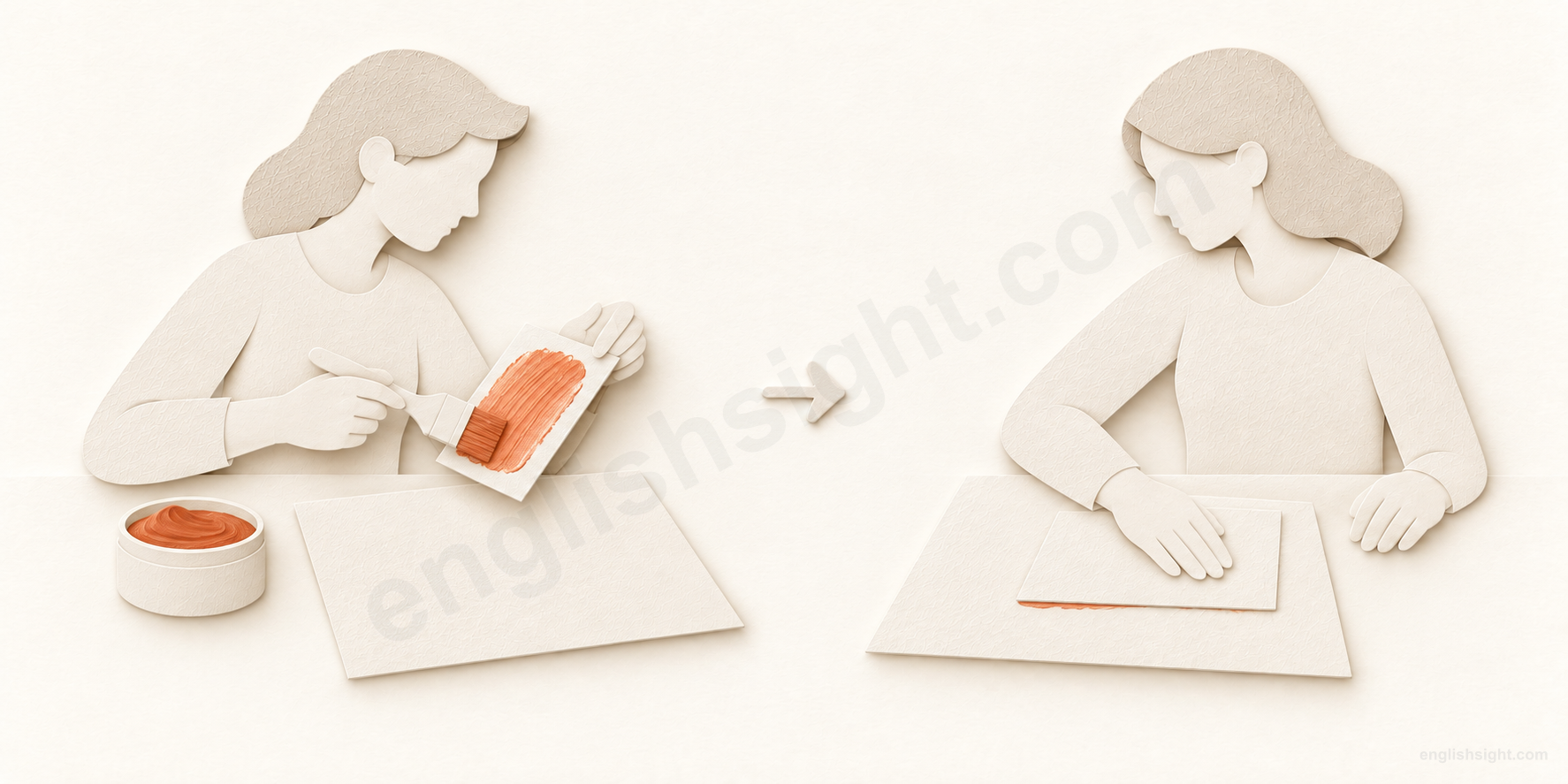
A woman holds a loose paper piece above a larger page; a tub contains thick adhesive paste.
paste
The piece lies flat on the page, held by the thin adhesive layer.
She brushes paste onto the back of the piece, then presses it onto the page.
Adhesive paste holds the paper piece against the page.
Paste can be a soft, spreadable mixture. When used as an adhesive, it forms a layer that holds one thing against another; to paste something is to attach it in this way.
The picture links the adhesive noun and verb. Food pastes share the consistency without necessarily sticking things together; digital paste inserts content, while jewellery and slang require separate context.
Paste /peɪst/ is both a noun and a verb. The noun often describes a thick, spreadable material; the physical verb describes attaching something with adhesive. A computer command uses an established extended meaning: insert prepared content.
This lesson groups useful modern uses and marks two additional branches for recognition. The picture is a teaching aid, not a claim that all English speakers share one mental image.
01
A soft material: texture and purpose
Paste can name a mixture, an adhesive, or a food. The material and its purpose matter: a paste is not necessarily glue.
01
make / form a paste; mix / grind something into a paste
make a paste
produce a soft, thick mixture
Starting situation
The dry powder and the liquid are separate.
Result or interpretation
They combine into a mixture that can be spread.
Paste names the resulting consistency, not a particular ingredient.
In a recipe or practical instruction, a paste is a moist, thick mixture rather than a freely flowing liquid. Mixing, grinding, or crushing may produce it; the word does not require one particular method.
Make a paste and mix something into a paste describe the result. Thick, smooth, and stiff describe different aspects of its texture: smooth concerns lumps, while stiff concerns how readily it moves.
A paste is natural when identifying a resulting mixture. Paste without an article can refer to material in general; pastes can mean different preparations, not individual spoonfuls.
Original example
Mix a little water into the powder to make a thick paste.
Watch the difference A paste is not necessarily adhesive or edible. The ingredients and context tell you its purpose.
02
some paste; a tub of paste; stick something on with paste
wallpaper paste
an adhesive material used to attach paper
Starting situation
The paper needs something to hold it to the wall.
Result or interpretation
A layer of paste provides the adhesion.
Here paste is a substance used for sticking, usually treated as uncountable.
Wallpaper paste and flour paste name adhesive preparations. Use some paste, a little paste, or a tub of paste when talking about an amount.
Glue is the broader everyday name for an adhesive. Paste commonly suggests a thick preparation used with paper; not every glue is a paste. In stick the label on with paste, stick names attachment and with paste names the material.
Spread some paste on the back tells you where to apply the substance. It is different from paste the label on, where paste is the action of attaching the label.
Original example
Brush some wallpaper paste onto the back of the paper.
Watch the difference For an amount of adhesive, say some paste or a tub of paste, rather than counting each application as a paste.
03
tomato / almond / fish / curry paste; a spoonful of paste
tomato paste / curry paste
a concentrated or finely processed food mixture
Starting situation
The recipe calls for a thick prepared ingredient.
Result or interpretation
You add a small quantity for flavour or texture.
The food name tells you what kind of paste you mean.
Tomato paste, almond paste, and fish paste are food expressions. They share a thick consistency, but their ingredients and uses differ. A paste may be cooked into a dish or spread on food; it is not always a spread eaten on bread.
Use two spoonfuls of tomato paste for an amount. Say a paste made from almonds to identify one preparation, or several curry pastes to identify different varieties.
Toothpaste is another familiar material word, written as one word. Its texture helps the comparison, but it is not food and does not belong to the food family.
Original example
Stir a spoonful of tomato paste into the soup.
Watch the difference Paste and sauce are not interchangeable names in a recipe; keep the ingredient name the recipe specifies.
02
Attach paper and describe the result
As a physical verb, paste usually involves adhesive. Read the object and the following words to see what is attached, where it goes, or which surface is covered.
04
paste + item + on / onto / into + place; be pasted + place
paste a label onto a jar
attach an item using adhesive
Starting situation
The label is separate from the jar.
Result or interpretation
The label is fixed to the jar’s surface.
The object is the item attached; on or onto gives its destination.
Paste the label onto the jar names the label as the object and the jar as the receiving surface. Paste a picture into an album uses into for placement within the album. The preposition adds the location; paste supplies adhesive attachment.
The passive reverses the focus: The label was pasted onto the jar describes what happened to the label. It does not mean that the jar was filled with paste.
Stick the label on is a broader alternative: it may involve a self-adhesive label. Paste normally suggests using paste or glue, so it is a more specific choice for a paper craft instruction.
Original example
We pasted a paper label onto each jar.
Watch the difference Keep the thing attached as the object in this pattern: paste a label onto a jar, not paste a jar onto a label.
05
paste something down / up; paste it down / up; paste pieces together
paste down / up / together
specify the position or arrangement produced by sticking
Starting situation
A loose paper edge lifts, or separate paper pieces need joining.
Result or interpretation
Adhesive holds the edge flat or joins the pieces.
The added word describes the physical result, not a new kind of paste.
Paste down the edge means secure it flat against a surface. Paste up a poster means attach it for display. Paste the pieces together means join them using adhesive.
With down and up, a noun object can come before or after the particle: paste the edge down or paste down the edge. A personal pronoun goes between them: paste it down, not paste down it.
These are understandable result or position combinations, not three unrelated idioms. In a craft activity, cutting and pasting a paper hat can describe making it by cutting pieces and sticking them together.
Original example
The corner is lifting, so paste it down again.
Watch the difference Up does not mean that the paste itself moves upward. The poster is put up for display.
06
paste + surface + with + attached items; a surface pasted with items
paste a wall with posters
cover a surface with items attached by adhesive
Starting situation
The wall is bare.
Result or interpretation
Posters are stuck over the wall.
Here the surface is the object, and with introduces the attached material.
Compare paste posters onto the wall and paste the wall with posters. The first highlights the posters; the second presents the wall as the surface being covered.
With posters does not name the adhesive. In paste the label on with flour paste, with flour paste names the sticking material instead. Read the noun after with.
A wall pasted with notices is a compact passive description of the resulting surface. You can also say The wall was covered with notices; paste makes the manner of attachment more specific.
Original example
The entrance wall was pasted with notices about the closure.
Watch the difference In paste the wall with posters, posters are what cover the wall, not a tool or a type of glue.
03
Put prepared content into a digital place
The computing sense uses the familiar idea of placing something in a chosen position. No physical adhesive is involved.
07
paste + content + into + destination; paste it in; Paste
paste text into a document
insert digital content that has been copied or cut
Starting situation
The text is ready to insert and a destination is selected.
Result or interpretation
The text appears at the chosen position.
Paste is the insertion step; into or in identifies the destination.
Paste the address into the box inserts prepared content at that location. Text and images can both be pasted. This digital use resembles placing an item in a chosen position, but involves no adhesive.
In ordinary computer instructions, copy or cut prepares content for a later paste, commonly through a clipboard. Paste does not mean type the text again.
You can say paste it into the box or paste it in. With the short particle pattern, paste in the text and paste the text in are possible; use paste it in with a pronoun. A menu command can simply say Paste when the content and position are understood.
Original example
Paste the booking number into the search box.
Watch the difference Paste it in is natural; paste in it is not the normal pronoun order in this particle construction.
08
copy and paste + content; cut and paste + content
copy and paste / cut and paste
reuse content by copying it, or move it by cutting it first
Starting situation
A paragraph is in one part of a document.
Result or interpretation
It is duplicated elsewhere or moved to a new position.
Copy versus cut determines what happens to the source; paste inserts the content.
In ordinary text editing, copy and paste duplicates a selection while leaving the original in place. Cut and paste moves the selection: cut removes it from its old position, and paste places it at the new one.
These are coordinated actions, not a phrasal verb made from copy and a particle paste. You can mention the two steps separately: Copy this sentence, then paste it below the heading.
Cutting and pasting can also be literal paper work. A document, cursor, or app signals the digital reading; scissors, paper, and glue signal the craft reading.
Original example
Copy the heading and paste it above the second table.
Watch the difference If the instruction says copy, the original normally stays. Do not replace copy with cut when it needs to remain.
04
Other meanings to recognize in context
Jewellery and informal reports use additional meanings. Learn these as separate branches rather than forcing them into the adhesive picture.
09
paste + jewellery / jewels / necklace
paste jewellery
glass material used for imitation gems
Starting situation
An old necklace has stones that look like precious gems.
Result or interpretation
The description identifies the stones as imitation material.
This noun names a jewellery material, not wet glue.
A paste necklace has imitation stones made from a glass-like material. The stones can be hard and shiny; the modern jewellery meaning does not describe their current texture as soft.
Paste here is commonly an uncountable material noun used before another noun, as in paste jewels. This specialist branch is useful for reading descriptions of old or imitation jewellery; it is not a general replacement for fake.
Original example
The catalogue describes it as a silver necklace with paste jewels.
Watch the difference Do not interpret paste jewels as instructions to glue real jewels onto something.
10
paste + person / team; take a pasting; give someone a pasting
paste an opponent / take a pasting
hit hard, win decisively, or receive a heavy defeat or severe criticism
Starting situation
A fight, an uneven match, or a harsh review is being described.
Result or interpretation
The report emphasizes a hard blow, a decisive loss, or severe criticism.
These informal uses concern force, defeat, or criticism, not adhesive attachment.
In slang, paste someone can mean hit them hard. In a sports report, a team can paste its opponents, meaning defeat them decisively. Neither reading is predicted simply by imagining glue.
The related noun pasting appears in take a pasting or give someone a pasting, especially in British English. Depending on context, it refers to a heavy defeat, a severe beating, or severe criticism. It is not always the activity of applying paste.
For example, He pasted the attacker in the face describes a blow; Our side took a pasting in the final describes a bad loss. Use more neutral wording such as hit or defeated easily when an informal tone is unsuitable.
For criticism, The film got a pasting from reviewers means that reviewers criticized it severely. This is a figurative use of the noun pasting; it does not say that anyone was hit or that a team lost a match.
Original example
Our team took a pasting in the final and lost by six goals.
Watch the difference A pasting in a sports report or review can be entirely figurative: a heavy defeat or severe criticism does not imply physical assault.
Let the material, object, and context guide you
Noun countability depends on the meaning
Some paste refers to material; a paste can identify a mixture; different pastes are varieties. Use a spoonful or a tub when counting quantities. Dictionary countability labels differ because they divide these uses differently.
Forms and pronunciation
Forms are paste, pastes, pasted, pasting. Drop the final e before -ing; pasted has an extra syllable: /ˈpeɪstɪd/. Past and pasta are different words. Ordinary progressive and passive forms are possible: She is pasting labels; the labels were pasted on.
Paste, stick, spread, and glue
Spread describes distributing material across a surface and need not involve adhesion. Stick is broader attachment; glue names an adhesive or attachment with it. Physical paste usually evokes an adhesive preparation and paper-like items. Digital paste is a separate conventional use.
Scope of this lesson
The lesson covers materials, food, adhesive constructions, computer editing, and brief recognition of jewellery and slang. Specialist porcelain mixtures, older pastry terminology, printing paste-up work, and rare historical uses are not developed. There is no special everyday paste + object + adjective or paste + person + infinitive causative family to memorize.
Choose by situation and construction
Decide what paste names or does in each context.
1. A recipe says to grind almonds into a paste. What result does it ask for?
2. You need an amount of adhesive for wallpaper. Which request is natural?
3. A paper corner is lifting. Which instruction uses the ordinary pronoun order?
4. You want a paragraph in two places and need the original to remain. What should you do?
5. A team took a pasting and lost the match by seven goals. What happened?
Sources and teaching notes
Dictionary entries support the usage distinctions below. The explanations, examples, and visual connection were created for this lesson; the diagram is a teaching interpretation.
The diagram illustrates one useful connection; it does not represent a mental picture shared by every English speaker.