Use payment to connect a sum, the people involved, and what it is for.
A return connected to a reason
A return connected to a reason
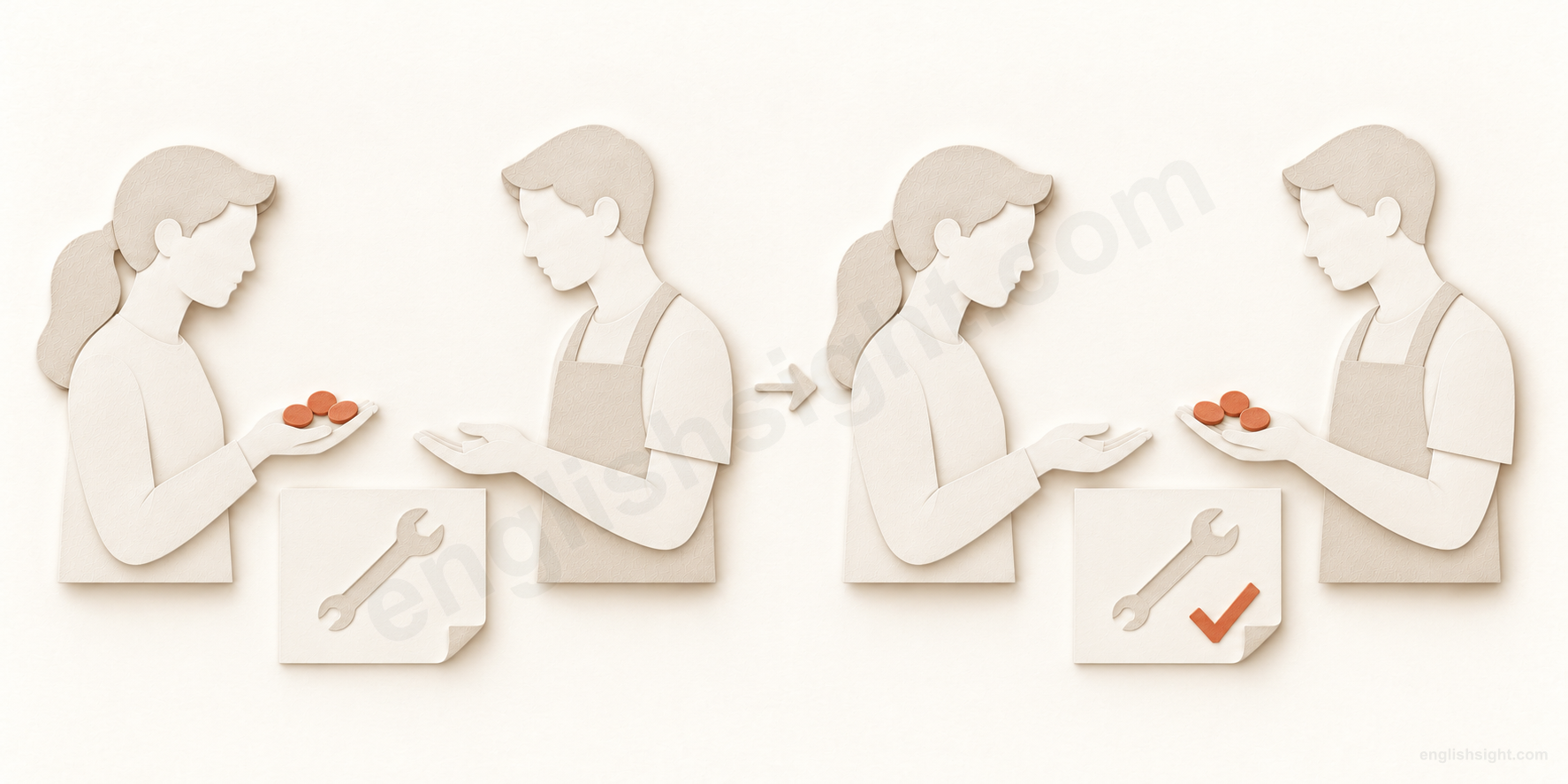
The customer holds three coins beside a repair bill awaiting payment.
payment
The repairer holds the coins, and a check mark shows this bill is settled.
The customer pays the repairer for the repair.
The money is given for the repair; this example shows a full payment.
Payment names paying, or what is paid or payable to someone for something or toward an obligation.
The sketch shows a completed full payment for a repair. Other payments may be future, partial, or non-cash; the word alone does not mean that every obligation has been settled.
A payment is more than money changing hands: the money has a purpose, such as covering a purchase, work, or a debt. Payment can name paying itself, a particular sum, or sometimes something given in return.
An expected payment can still be unpaid. Learn the surrounding verbs and phrases to see whether money is due, sent, received, delayed, or withheld.
01
The action, the amount, and the people
Payment is a noun. Decide whether you mean paying in general or a particular sum, then identify what it is for and who receives it.
01
make / receive / accept / demand + payment
make / receive payment
paying, viewed as an action
Situation / expectation
A repair has been completed.
What happens / what it means
The customer pays and the repairer receives the money.
One action can be described from the payer’s or receiver’s side.
Payment without a or a plural often names the process: We require payment before delivery. Make payment describes the payer’s action; receive payment describes the other side. Accept payment means agree to take it.
Payment is a noun, so say Please pay today or Please make a payment today. Do a payment and Please payment today are not the ordinary forms. Make payment is common in formal instructions; make a payment is an easy everyday choice for one transaction.
In a sentence
We accept payment when you collect the repaired bike.
Watch the difference Pay is the verb; payment needs a verb if it is to describe an action in a sentence.
02
a payment of + amount; two / three + payments
a payment of £40
one particular sum paid or payable
Situation / expectation
A notice lists an amount you must send.
What happens / what it means
That sum is treated as one payment.
Countable payment can be owed or expected; it need not have arrived yet.
Use a payment for one sum or transaction and payments for more than one. A payment of £40 states its amount. In Three payments of £40, each payment is £40; the three together total £120.
Make a payment and receive a payment focus on a particular transaction. Compare Payment is required, where the noun names paying in general. The shift is a choice of viewpoint rather than a different spelling or pronunciation.
In a sentence
Your first payment of £40 is due on Friday.
Watch the difference A payment due next week is not proof that anyone has already paid.
03
payment for + goods / services; to / from + person; payment on + loan / purchase
payment for something / to someone / from someone
identify the purpose, receiver, or source
Situation / expectation
Maya orders a translation from a freelancer.
What happens / what it means
Maya sends money to the freelancer for the translation.
For gives the reason; to gives the receiver; from gives the payer or source.
In a payment to the translator for the work, to points to the recipient and for explains what the money covers. A payment from Maya looks at the same event from the receiving side.
Payment on a loan or on a car links a payment to an ongoing debt or purchase arrangement. It does not put money physically on the object. Rent payments, tax payments, and interest payments use a noun before payment to name its purpose.
In a sentence
We received a payment from Maya for the translation.
Watch the difference Payment to Maya would reverse her role: she would be the recipient.
04
payment of + bill / amount; on payment of + fee
payment of the bill / on payment of a fee
name what is paid, or make access depend on paying
Situation / expectation
A visitor needs a ticket.
What happens / what it means
The ticket is issued after the fee is paid.
Of can introduce a bill or amount; on payment of gives a condition and timing.
Payment of the bill means paying that bill. Payment of £25 specifies the amount instead. Compare payment for lunch, which names what you are paying for rather than the document being settled.
On payment of the fee is a formal way to say once the fee has been paid. The full phrase sets a condition; on does not name the payment method here. Everyday instructions can say You can enter after you pay.
In a sentence
Your ticket will be issued on payment of the booking fee.
Watch the difference Do not use on payment of to mean by card or in cash.
02
Ways to arrange payment
Method, timing, and size are different questions. The surrounding words tell you whether money goes now, later, all at once, or in parts.
05
method of payment; payment by card / bank transfer; payment in cash
method of payment
how money is paid
Situation / expectation
A shop offers cash and card options.
What happens / what it means
The customer chooses a way to pay.
By introduces a means such as card or transfer; in cash names the form of money.
A method of payment answers How will you pay? You can ask What payment methods do you accept? A cash payment is a payment made using cash; a card payment uses a card.
Use payment by card, by bank transfer, or in cash. Payment in advance answers When?, not How? A payment method can stay the same even when the amount and date change.
Electronic payments use electronic systems rather than handing over cash. Online payment locates paying on the internet. These descriptions can overlap: a card payment at an online checkout is both.
In a sentence
Please choose your method of payment at checkout.
Watch the difference The usual expressions are in cash and by card, not by cash as the default learner pattern.
06
payment in advance; an advance / upfront payment
payment in advance
pay before the goods or service are provided
Situation / expectation
A teacher reserves time for a lesson.
What happens / what it means
The learner pays before the lesson takes place.
In advance places payment before the relevant service or delivery.
Payment in advance means paying ahead of the agreed event. An advance payment is a payment made ahead of it. You may also hear an upfront payment in a purchase arrangement.
This wording tells you about time. It does not by itself say whether the amount is the entire price or only part of it. In Payment in full is required in advance, full gives the amount relationship and in advance gives the timing.
In a sentence
The tutor asks for payment in advance for the first lesson.
Watch the difference Advance payment and full payment answer different questions.
07
payment in full; full / part / partial payment
payment in full / part payment
pay all of an amount, or only some of it
Situation / expectation
An invoice totals £90.
What happens / what it means
A £90 payment settles it; a £30 part payment leaves £60.
Full concerns completeness, not the date or method.
Payment in full covers the entire amount owed. Full payment has the same basic amount focus. A part payment or partial payment covers only some of it; there is a remainder.
In full payment of the invoice links the complete sum to that invoice. In payment for the repair instead names what the money is for. A large payment is not necessarily full payment: the total might be larger still.
In a sentence
We received £30 as part payment of the £90 bill.
Watch the difference A partial payment does not normally settle the whole balance.
08
monthly payments; pay in / by instalments; a one-off / lump-sum payment
monthly payments / payment in instalments
divide paying into regular amounts
Situation / expectation
A buyer cannot pay the whole price now.
What happens / what it means
The price is paid in agreed parts over time.
Each instalment is a payment; plural payments can form a series.
Monthly payments are made or expected each month. In an instalment arrangement, several payments together cover a purchase or debt. British spelling is instalment; North American spelling is usually installment.
Compare four monthly payments with a one-off payment or a single lump-sum payment: the latter describe one amount rather than a sequence. A monthly payment might also be rent for that month, so regularity alone does not prove it is part of a fixed purchase price.
In a sentence
We agreed to make six monthly payments for the furniture.
Watch the difference Do not assume every monthly payment is an instalment toward owning something.
09
make / save for + a down payment on + purchase
a down payment on a house
pay the first portion of a larger price
Situation / expectation
A buyer has saved part of a house price.
What happens / what it means
That first amount is paid, with the rest still to be funded.
Down payment identifies the first part, not full settlement.
A down payment is an initial portion of a larger payment, often in a major purchase. Say make a down payment on a house or save for a down payment. Down does not describe physical downward movement.
A deposit can also be an initial part of a purchase price. However, a security deposit for a rented home has a different purpose, so the words are not interchangeable in every context.
In a sentence
They are saving for a down payment on a small flat.
Watch the difference Down payment does not tell you that the remaining price has been paid.
10
agree / arrange + a payment plan; a payment schedule
a payment plan / payment schedule
agree how and when amounts will be paid
Situation / expectation
A bill is too large to pay immediately.
What happens / what it means
The parties agree amounts and dates.
Payment modifies plan or schedule; it is not a verb in these noun phrases.
A payment plan sets out arrangements for paying, often by spreading a bill over time. A payment schedule focuses on when the amounts are due. You can agree a payment plan or arrange a schedule.
For example, a plan might require £20 now and £20 each Friday for four weeks. The payment dates are part of the plan; the word payment alone does not contain those terms.
In a sentence
The clinic offered a payment plan for the remaining bill.
Watch the difference Payment plan describes an arrangement; it does not mean a payment has already been made.
03
When money is due or does not arrive
A payment can be expected before it is made. These expressions describe deadlines, difficulty, and a decision to hold money back.
11
payment is due + on / by + date; payment due date
payment is due
payment is expected by an agreed time
Situation / expectation
An invoice gives a deadline.
What happens / what it means
The payer must pay by that time.
Due describes an obligation or deadline, not a completed transfer.
Payment is due on Friday tells you when the money should be paid. The payment due date is the deadline shown on a bill. In Payments are due on the first of each month, the plural describes a recurring obligation.
Compare Payment has been received, which reports arrival. Something can be due without being paid; it can also be paid early.
In a sentence
Payment is due by 12 November.
Watch the difference Due and paid are different states.
12
late / prompt payment; miss + a payment
late payment / miss a payment
pay after a deadline, or fail to pay an expected amount
Situation / expectation
A regular amount should have arrived yesterday.
What happens / what it means
It arrives late or is still missing.
Late concerns timing; miss concerns failing to make the expected payment.
A late payment is made after the required time; late payment can also name paying late in general. Miss a payment means fail to make one when required. A missed payment might be paid later, but the expression itself does not promise that.
Prompt payment means paying without unnecessary delay. Contrast a late payment with a late delivery: the noun tells you which action happened after its expected time.
In a sentence
I missed a payment while I was away, then paid it the following week.
Watch the difference Miss a payment does not mean you miss the money emotionally.
13
keep up with / meet + the payments; fall behind with / on + payments
keep up with the payments
continue meeting regular payment obligations
Situation / expectation
A family has regular car payments.
What happens / what it means
They manage each payment as it becomes due.
Keep up concerns maintaining the required pace over time.
Keep up with the payments means continue paying the required amounts regularly. Meet the payments also describes managing to pay them. Fall behind with or on payments means fail to keep to the required schedule.
These expressions describe the payer’s continuing situation. They do not specify a payment method. A person might keep up with payments by bank transfer or in cash, depending on the arrangement.
In a sentence
They sold the car because they could not keep up with the payments.
Watch the difference Keep up with payments does not mean increasing how much you pay.
The customer keeps back the money pending a response.
Withhold highlights keeping money back; defer highlights a later time.
Withhold payment means deliberately keeping back the money. Defer payment means postpone it. Neither phrase means the money has been received; the verbs change what happens to the expected transfer.
Compare The customer withheld payment with Payment was withheld by the customer. The passive belongs to withhold; payment remains a noun. Non-payment names the failure to pay, without itself explaining whether the cause is a dispute, lack of money, or something else.
In a sentence
The customer withheld payment until the missing parts arrived.
Watch the difference Withholding payment and cancelling the debt are different ideas.
15
stop payment on + a cheque / check; a stop-payment order
stop payment on a cheque
tell a bank not to pay a particular cheque
Situation / expectation
A cheque has been issued but needs to be stopped.
What happens / what it means
The account holder asks the bank not to pay it.
This banking expression concerns an instruction blocking a cheque payment.
Stop payment on a cheque means instruct the bank not to pay that cheque. A stop-payment order names the instruction. American spelling is check; British spelling is cheque.
This is more specific than simply missing an instalment or choosing not to pay a bill. The expression describes blocking the bank transaction; it is not the word for getting money back after a completed purchase, which is a refund.
In a sentence
I asked the bank to stop payment on the lost cheque.
Watch the difference Do not confuse stop payment with receive a refund.
04
Something given in return
Money is the ordinary starting point, but payment can also take another form or describe a reward. Read the whole expression.
16
payment in kind; pay / be paid in kind
payment in kind
pay using goods or services rather than money
Situation / expectation
A gardener and a baker agree an exchange.
What happens / what it means
The gardener receives bread for the work.
In kind changes what is given as payment.
Payment in kind consists of goods or services instead of money. In the example, bread counts as what is given for the gardening. The exchange still has two sides, even though no coins or bank transfer are involved.
In kind is an established expression. Kind here does not mean friendly. Also distinguish reply in kind, meaning respond with the same sort of behavior: that is another use of the expression, not a payment method.
In a sentence
The gardener accepted fresh bread as payment in kind.
Watch the difference Payment in kind does not mean a friendly cash payment.
17
give / offer + something + in payment for + help / effort
in payment for your help
give something as a return or reward
Situation / expectation
A neighbor helps without asking for money.
What happens / what it means
You offer a gift as a return for that help.
The return can be a gift or a reward rather than a commercial price.
Payment can extend to something given in return for an effort or favor. In this use, in payment for means as a return for; it need not refer to a bill or an agreed wage.
The question Is this all the payment I get? can express disappointment at the reward for effort. Stronger literary uses can describe punishment as payment, but that is not the main everyday financial meaning. Thank you for your help is a simpler way to express gratitude when you do not want to suggest an exchange.
In a sentence
We offered to cook dinner in payment for her help with the move.
Watch the difference An offered return is not necessarily a debt that the helper demanded.
Keep the noun and the surrounding words together
Pay, payment, and repayment
Pay is the verb: pay the bill, pay the repairer, pay for a repair. Payment is the noun: make a payment. Pay as a noun often refers to earnings from work; a payment can cover many kinds of obligation. Repayment specifically involves paying money back.
Price, bill, and receipt
A price states what something costs, a bill requests an amount, a payment supplies money toward it, and a receipt records that payment was received. A payment is not automatically the whole price.
Grammar and boundaries
Payment is pronounced /ˈpeɪmənt/ and its plural is payments. It has countable and uncountable uses. There are no verb tenses or phrasal verbs of payment itself; constructions such as make a payment and stop payment combine other verbs with this noun. Detailed banking procedures, national accounts, and technical payment-system terms are outside this lesson.
Choose what the payment expression tells you
Use the amount, people, and timing to choose the natural expression.
1. Maya sends money to a translator for work. Which description has the correct direction?
2. You must pay before your lesson, but the notice does not say whether it is the whole price. Which phrase states only that timing?
3. An invoice says your payment is due next Friday. What can you conclude?
4. You send £30 toward a £90 bill. What have you made?
5. A baker gives bread instead of money to someone who worked in the garden. What is this?
Sources and teaching notes
Dictionary entries and usage notes support the meanings and patterns below. Explanations, examples, and the compatibility sketch are original teaching material; the sketch is a teaching model.
This sketch illustrates a relationship; it does not describe a picture shared by every native speaker.