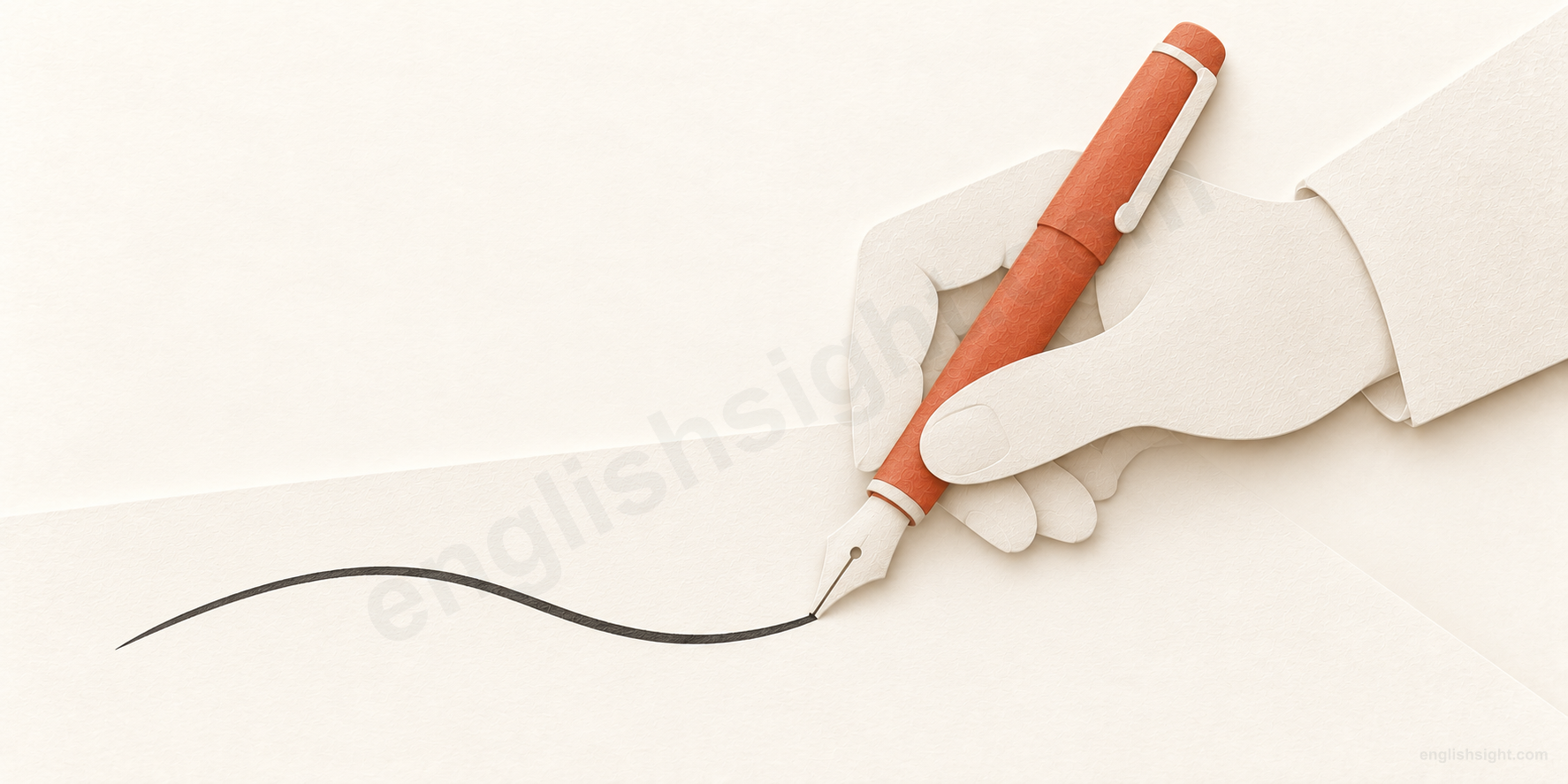
Use pen for writing, follow its familiar expressions, and recognize a separate enclosure family.
From pen tip to ink marks
A tip delivers ink to a surface
Blank paper is ready for marks.
pen
A continuous curved ink mark remains behind the tip.
The hand guides the pen tip across the paper, depositing ink.
The pen tip deposits ink, leaving a visible mark.
A writing pen delivers ink through its tip to make marks on a surface, allowing someone to write or draw.
The diagram explains the ordinary writing tool. Writing and authorship expressions can build on it; an animal enclosure, a prison short form, and sports penalties are not predicted by it.
Begin with a pen tip touching a surface and leaving ink marks. That physical function connects the object to writing, drawing, and several expressions about authorship.
Not every pen belongs to that picture. An animal pen and the verb meaning confine form a separate family. Regional short forms and specialist names also need their own context.
This lesson offers a teaching model based on established uses, not a claim that all English speakers imagine the same picture.
01
Writing tools and useful object names
Start with the writing tool and its ink marks. Then recognize the separate compound pen drive in computer contexts.
01
a / the / possessive + pen; plural pens
a pen / two pens
an instrument for writing or drawing with ink
Situation
You need to sign a form.
What is expressed
You ask someone for a writing tool.
The noun names an object, not the act of writing.
A pen has a tip that puts ink on a surface. It can make words, numbers, or a drawing; it is not limited to writing sentences.
The object is countable: a pen, my pen, two pens. A pencil normally makes graphite or similar marks rather than ink, so English distinguishes a pen from a pencil.
Can I borrow a pen? asks to use one temporarily. Can you lend me a pen? asks the owner to provide it. Pen keeps the same meaning in both requests.
Example in context
Could I borrow a pen to sign this form?
Watch the difference For one unspecified object, say a pen, not I need pen.
02
write with + a pen; write in + pen / blue pen
with a pen / in pen
name the tool or specify ink writing
Situation
A form needs a handwritten answer.
What is expressed
You specify how the answer should be written.
With identifies an instrument; in identifies the medium or form of the marks.
Write with a pen tells us which tool you use. Write in pen tells us to use ink writing rather than pencil. In the medium expression, pen normally has no article.
In blue pen specifies the color of the writing. With a blue pen identifies the tool, although the context may need to make clear whether blue means its ink or its outer body.
Pen and ink can name an artistic medium: a drawing in pen and ink. Pen and paper refers to the traditional materials for writing, sometimes contrasted with a computer.
Example in context
Please fill in the form in black pen.
Watch the difference In a pen usually means inside an enclosure; in pen means using ink as a writing medium.
03
ballpoint / fountain / felt-tip + pen
ballpoint pen / fountain pen / felt-tip pen
specify the kind of writing tool
Situation
A shop offers several different pens.
What is expressed
You choose the type suited to the task.
A word before pen narrows the type; it does not create a new grammar pattern.
A ballpoint pen uses a small ball at its tip; a fountain pen uses a nib supplied with ink; a felt-tip pen delivers ink through a felt or similar fiber tip. These are established names of tools.
In a clear context, ballpoint can stand alone: Have you got a ballpoint? A fountain pen is not a small fountain, and felt-tip describes the tip rather than a feeling.
Pen cap, pen nib, and pen ink name a cover, a writing point, and the ink. The specific pen type determines which parts it has.
Example in context
I use a fine felt-tip pen for the labels.
Watch the difference Not every pen has a removable cap or a fountain-pen nib. Choose the name for the actual tool.
04
pen + run out (of ink); pen + won’t write
My pen has run out.
the pen has no usable ink left
Situation
The pen stops making a continuous mark.
What is expressed
You need more ink or another pen.
The pen is the tool; run out supplies the meaning of an exhausted supply.
My pen has run out is a familiar way to say that its ink supply is exhausted. My pen has run out of ink makes the missing material explicit.
This pen won’t write says that it fails to produce writing now. It does not tell us the cause: there may be no ink, or the tip may be blocked.
These are uses of run out and write with pen as their subject. They do not make run out a phrasal verb built from pen.
Example in context
My pen has run out of ink. Can I use yours?
Watch the difference A pen that won’t write is not refusing deliberately; the wording describes a tool that fails to work.
05
save + file + on a pen drive; copy + file + to a pen drive
a pen drive
a small device for storing and moving computer files
Situation
You need to carry a presentation to another computer.
What is expressed
You save the file on a portable memory device.
The full compound names a storage device, not an ink-writing tool.
A pen drive is a small portable memory device, also called a USB drive or flash drive. Thumb drive is another name, especially in North American English.
Save a file on a pen drive and copy a file to a pen drive are useful combinations. On treats the device as a storage medium; to identifies the destination of copying.
The compound must be learned as a whole. A pen drive is not the same as an electronic pen or stylus, which you use to write or draw with a screen.
Example in context
I saved the slides on a pen drive before leaving.
Watch the difference Do not shorten pen drive to pen when the context does not clearly establish the device.
02
Writing and people who write
The tool can stand for creating a text, its author, or a relationship built through writing. Some expressions are neutral; others sound formal or literary.
06
pen + text; text + be penned by + writer
pen a letter / a song
write or compose a text
Situation
A person creates a letter, article, or song.
What is expressed
You describe that person as its writer.
The verb shifts attention from the tool to the creation of the words.
Pen is a transitive verb meaning write or compose. Its object is the resulting text: pen a letter, pen a novel, pen a song. It often sounds formal or literary; write is the ordinary broad choice.
The expression need not report the physical tool used. Someone can pen a novel on a laptop: the claim concerns authorship, not ink.
You can say pen a letter to someone, or use a passive: The song was penned by two friends. The forms are pens, penned, penning; double the final n before -ed and -ing.
Example in context
Maya penned a short song for the school play.
Watch the difference Pen a letter is more formal than write a letter. Pen does not replace every use of write, such as a computer writing data to a disk.
07
put pen to paper
put pen to paper
write something or begin writing
Situation
You have been thinking about a story without writing it.
What is expressed
You finally begin to produce a written text.
The complete expression highlights writing, often the decision to begin.
Put pen to paper is an established expression for writing or starting to write. The physical contact in the diagram makes it memorable, but the expression can focus on getting ideas into written form.
It does not necessarily mean that a whole work is finished. In a contract context, putting pen to paper can refer to signing, so read what is being written.
The verb put changes for tense in the normal way: puts pen to paper, put pen to paper, putting pen to paper. The fixed expression usually has no articles before pen or paper.
Example in context
After weeks of planning, I finally put pen to paper.
Watch the difference Do not infer that the work is complete merely because someone has put pen to paper.
08
a work + from the pen of + author
from the pen of…
written by a particular author
Situation
A review introduces a writer’s latest work.
What is expressed
The writer is identified through the image of a pen.
The writing tool stands for authorship, not a particular physical pen.
From the pen of someone means written by that person. It is a literary way of naming an author, especially in descriptions of books or other texts.
Here the pen represents writing as an activity. The expression does not tell you where the author keeps a pen or which brand was used.
For everyday attribution, a novel by Sara Lee is simpler than a novel from the pen of Sara Lee.
Example in context
This tale comes from the pen of a local novelist.
Watch the difference This is a figurative authorship expression, not a productive rule for replacing every person with pen.
09
write / publish under + a pen name
write under a pen name
use an alternative name as an author
Situation
An author does not publish under her real name.
What is expressed
Readers see a chosen author name on the book.
Pen modifies name to identify a name used for writing.
A pen name is a name an author uses instead of their real name on published work. The tool stands for the activity of writing; the name does not belong to a physical pen.
Write or publish under a pen name is a useful pattern. Under introduces the identity used for publication, not a position beneath something.
The noun is countable: a pen name, two pen names. Pseudonym is a broader word for an assumed name; pen name specifically connects it to authorship.
Example in context
She publishes her detective stories under a pen name.
Watch the difference A pen name is not simply any nickname used among friends.
10
have / write to + a pen pal; a pen pal in + place
a pen pal / a penfriend
a friend you communicate with through letters or emails
Situation
Two people get to know one another through written messages.
What is expressed
They maintain a friendship by corresponding.
The compound names a kind of friendship, not a special type of pen.
A pen pal is a friend you make or keep in touch with by writing letters or emails, often someone you have not met. The relationship can be international but does not have to be.
Pen pal is especially associated with North American English; penfriend is also used in British English. Both are countable: a pen pal, my penfriends.
The modern expression includes email correspondence. It does not require handwritten letters or the use of an ink pen.
Example in context
My pen pal in Brazil sends me an email every month.
Watch the difference An email pen pal is possible. The word does not require that the friends have never met.
03
Fixed expressions and their tone
Learn these complete expressions. Their meanings and attitudes cannot be worked out from the physical pen alone.
11
with a stroke of the pen; at the stroke of a pen
with a stroke of the pen
through a written decision or signature that brings a major change
Situation
An authorized person is about to sign a document.
What is expressed
A single official act changes people’s situation.
A small writing action stands for the power of an official decision.
A stroke is a mark made by moving a pen or brush across a surface. In with a stroke of the pen, that small movement represents signing or issuing a written decision.
The expression often contrasts an easy official action with its large consequences. At the stroke of a pen is another form. It is not a promise that all practical effects happen instantly.
The pen still connects to writing, but the authority comes from the person and document. A random pen mark does not automatically change a law or contract.
Example in context
With a stroke of the pen, the director cancelled the entire project.
Watch the difference Here stroke is a movement or mark, not the medical condition with the same spelling.
12
a slip of the pen
a slip of the pen
a small accidental mistake in writing
Situation
You write the wrong date without intending to.
What is expressed
You explain that it was a writing mistake.
Slip describes an accidental error; the pen stands for writing.
A slip of the pen is a small unintended mistake in something written. It can involve a wrong word, number, or spelling.
A slip of the tongue is the corresponding expression for speech. The contrast is between writing and speaking, not two different kinds of pen.
Calling something a slip suggests an accident. It does not excuse a deliberate falsehood or mean the whole text is wrong.
Example in context
I wrote Tuesday instead of Thursday—a slip of the pen.
Watch the difference This is an idiom about an error, not necessarily a pen physically sliding across a page.
13
the pen is mightier than the sword
The pen is mightier than the sword.
writing and ideas can have greater influence than armed force
Situation
People discuss how writing can change society.
What is expressed
They contrast the influence of words with the power of weapons.
The pen represents writing; the sword represents force or warfare.
This traditional saying claims that writing and ideas can shape human affairs more powerfully than weapons. It is a general rhetorical claim, not a comparison of two physical objects.
The fixed wording uses the pen and the sword as representatives of whole activities. Mightier means more powerful.
Use it when discussing influence, public debate, or history. It is not a factual guarantee that every piece of writing will defeat violence.
Example in context
Her article changed the debate; it reminded me that the pen is mightier than the sword.
Watch the difference Learn the proverb as a complete saying rather than treating mightier as a description of a pen’s physical strength.
14
receive / send + a poison pen letter
a poison pen letter
an unsigned letter intended to upset its recipient
Situation
Someone receives a deliberately cruel anonymous letter.
What is expressed
The message is described by its hostile purpose.
Poison is figurative: the message is meant to hurt, not deliver a chemical.
A poison pen letter is a malicious, unsigned letter intended to upset the reader. The expression emphasizes both hostility and the writer’s hidden identity.
Pen represents the writing. The harmful intention comes from the whole established expression, especially poison, rather than from pen by itself.
It is a negative description. An ordinary complaint with a named sender and a clear request is not automatically a poison pen letter.
Example in context
The mayor received a poison pen letter with no signature.
Watch the difference Do not use this label for every critical letter; malicious intent and anonymity matter.
15
a pen-pusher; plural pen-pushers
a pen-pusher
a dismissive term for someone doing routine paperwork
Situation
Someone belittles a job involving a lot of office writing.
What is expressed
The label conveys disapproval of the person or their work.
The expression carries an attitude; it is not a neutral job title.
A pen-pusher is an informal, disapproving name for someone whose work involves a lot of routine writing or paperwork. It is especially British.
Paper-pusher and pencil pusher are usual North American alternatives. The literal image of pushing a pen suggests repetitive office work, but the insult belongs to the established expression.
Use office worker or administrator when you want a neutral description. Calling a colleague a pen-pusher can sound disrespectful.
Example in context
He dismissed the officials as pen-pushers.
Watch the difference The expression reveals the speaker’s dismissive view; it does not objectively establish that the work is useless.
04
A separate family: keeping something inside
A pen can also be an enclosure. This is a separate historical word family, not a place made by drawing a line with a writing pen.
16
a + animal / holding + pen; animals in + a pen
a sheep pen / a holding pen
a small enclosed area for keeping animals
Situation
Sheep need a secure space while a farmer works with them.
What is expressed
They stay inside a fenced area.
Here pen is the enclosure, not a writing tool.
An animal pen is a small fenced enclosure. Sheep pen, pig pen, and cattle pen identify the animals kept there; a holding pen emphasizes keeping them there while they wait.
This noun is countable: one pen, several pens. In a pen is a location: the animals are inside the enclosure.
The writing-tool and enclosure meanings have different historical origins. Do not invent a connection in which a drawn line becomes a fence.
Example in context
The farmer moved the sheep into a holding pen.
Watch the difference A pen need not be a roofed building. Barn names a building; fence names the boundary, not the enclosed area itself.
17
pen + animal + (in / up); pen in / up + noun; be penned (in / up)
pen the goats in / pen them up
confine animals in a limited space
Situation
Goats are outside the enclosure.
What is expressed
Someone confines them for part of the day.
The verb means to enclose; in or up emphasizes confinement.
Pen the goats means put or keep them in an enclosure. Pen the goats in and pen the goats up make the confinement explicit. A location can follow: pen the goats in a small yard.
With the particles in and up, a noun object can go before or after the particle: pen the goats up or pen up the goats. A pronoun goes between them: pen them up, not pen up them.
Passive wording is common: The goats were penned up overnight. The forms are penned and penning. These words belong to the enclosure family, not the write-a-text meaning.
Example in context
They penned the goats up before the visitors arrived.
Watch the difference In pen the goats in, in can be a particle; in pen the goats in a yard, in introduces the location. Read the full construction.
18
person + be / feel penned in; person + be penned up + location / time
feel penned in / be penned up
be or feel restricted to a small space
Situation
Heavy rain keeps a family inside a tiny holiday cabin.
What is expressed
They feel unable to move around freely.
People are compared with animals confined in an enclosure.
Be penned in or penned up can describe people forced to stay in a cramped or restricted place. There does not have to be a literal farm fence.
Feel penned in foregrounds a person’s experience of restriction. The situation may be physically enclosed or may feel limiting; context determines how literal the comparison is.
The passive often leaves the restricting cause unstated: We were penned up all afternoon. A by-phrase can identify it. The writing meaning would instead need a text as its object or passive subject.
Example in context
We felt penned in after three rainy days in the tiny cabin.
Watch the difference I feel penned in does not mean I feel like writing. The confinement family supplies this meaning.
05
Regional meanings to recognize
In particular settings, pen is an informal short form. The surrounding topic tells you which meaning applies.
19
in / out of + the pen
in the pen
in prison, in informal North American usage
Situation
A North American crime story mentions a sentence in the pen.
What is expressed
The context identifies a prison, not an animal enclosure.
This pen is a short form of penitentiary.
The pen can mean prison in informal North American English. In this use it is often singular with the, as in years in the pen.
It is a shortened form of penitentiary. Although confinement fits the situation, do not treat it as an extension of the writing instrument.
Use prison or jail where appropriate in neutral everyday communication; the choice between those words also depends on the legal and regional setting.
Example in context
In the film, he says he spent five years in the pen.
Watch the difference This is regionally marked informal vocabulary, not the usual international word for a prison.
20
a pen; win / lose on pens
win on pens
win through penalties, in informal British sports language
Situation
A football match is settled by a penalty shoot-out.
What is expressed
A report uses a shortened sports expression.
In this context pens is short for penalties, not writing tools.
In informal British football language, a pen can mean a penalty, and win on pens means win a penalty shoot-out. Sports context supplies the interpretation.
Collins also records pen for a penalty in rugby. The action and scoring system depend on the sport; a football shoot-out and a rugby penalty are not the same event.
Use the full word penalty or penalty shoot-out when your audience may not know the informal shortening.
Example in context
Our team won on pens after a goalless match.
Watch the difference On pens is a fixed informal sports expression here; it is not a general way to say with pens.
Keep the families and constructions distinct
Forms and pronunciation
Pen is pronounced /pen/. The object and enclosure nouns have plural pens. Both main verbs have pens, penned, penning. The enclosure verb also has the variant past form pent in some dictionaries; penned is the straightforward choice in this lesson. Pent-up is a related adjective, as in pent-up frustration, rather than another ordinary tense pattern to practice here.
Object, medium, text, or enclosure?
A pen is a countable tool; in pen describes a writing medium. Pen a poem has a text object; pen the sheep has animals as its object. Both verbs can be passive, but a song penned by an author and sheep penned in a yard describe different actions. Neither verb has a general pen someone to do something causative pattern.
Specialist devices and less useful senses
An electronic pen or stylus works with a screen and need not contain ink. An insulin pen is an injection device, not a writing instrument. These device names require their full context. Technical uses for a squid’s internal shell or a submarine shelter, pen for a female swan, and old senses referring to feathers are outside the expanded lesson. Capitalized PEN as an organization name is also separate.
Learn expression meanings as wholes
Pen does not by itself mean an error, hostility, a chosen name, or influence. Those meanings belong to a slip of the pen, poison pen letter, pen name, and the proverb. Do not create new meanings by replacing the other words at random.
Choose the meaning that fits
Use the object, the grammar, and the situation to identify the family.
1. The instructions specify ink rather than pencil. Which wording fits?
2. A review says the novel was penned by Ana. What does it tell you?
3. Replace the goats with them in Pen the goats up. Which form works?
4. You accidentally wrote 2036 when you meant 2026. Which expression describes the error?
5. Someone says I feel penned in after days in a small room. What do they mean?
Sources and teaching notes
Dictionary entries support the meanings, patterns, and labels. Explanations and examples are original; the picture is a teaching interpretation of the writing-tool sense.
The diagram supports one meaning family; it is not a shared mental picture of every English speaker.