From the writing tool to pencil marks, useful compounds, and plans that may change.
A point makes a trace
A point makes a trace
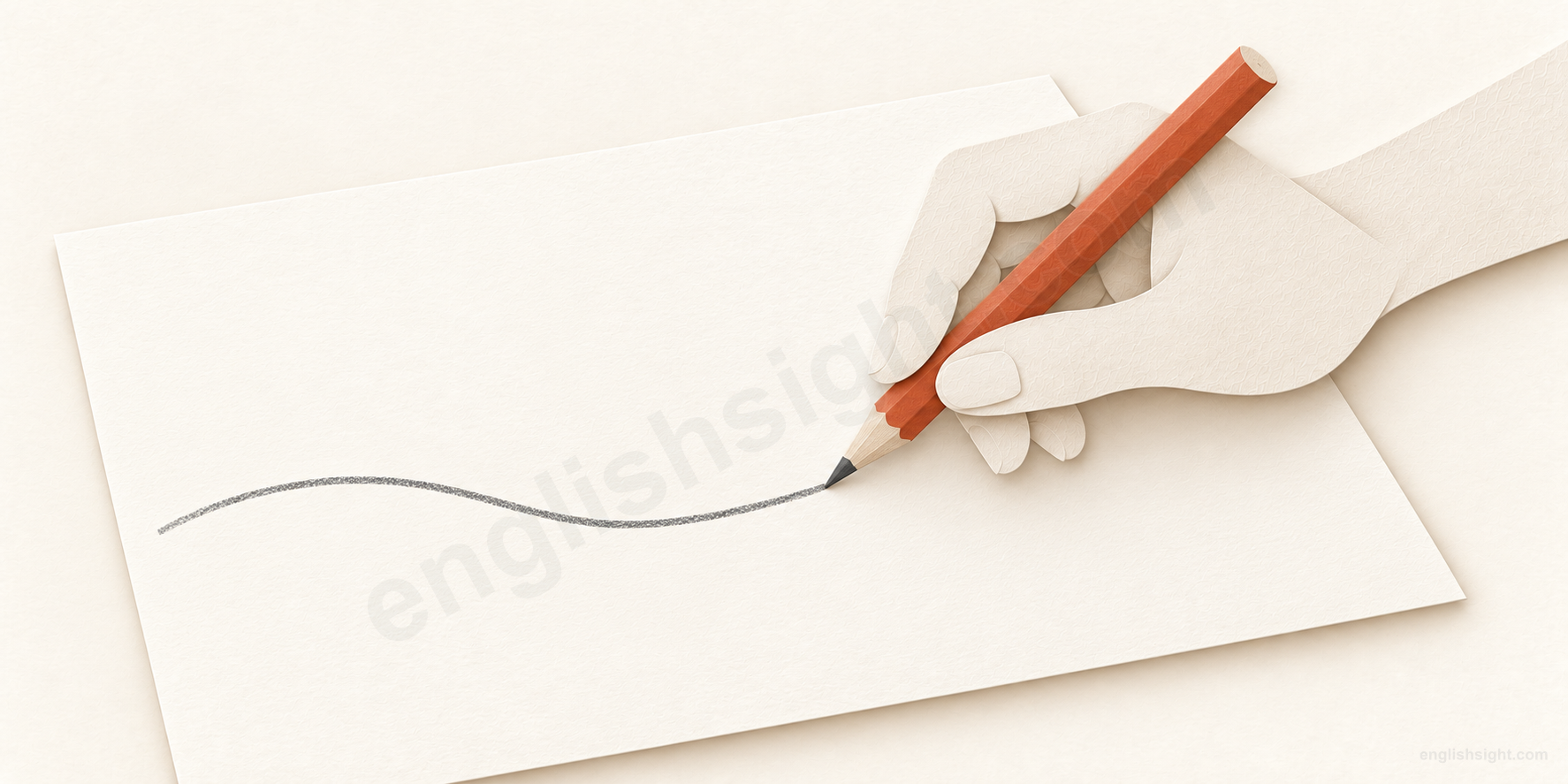
The paper ahead of the pencil point is unmarked.
pencil
A curved grey graphite line remains behind the point.
A hand guides the pencil point across the paper.
The solid point leaves a trace as it moves.
A pencil is a slender tool whose solid core leaves a mark when its point moves across a surface.
Ordinary graphite marks can often be erased, which helps explain the teaching link to provisional plans. Erasability is not a promise about every pencil mark, and the narrow-shape compounds form a separate branch.
Start with a pencil’s solid marking core and its contact with a surface. That gives you the everyday tool, the medium in pencil, and the verb pencil a note.
Other uses need their whole expression: pencil in makes an arrangement provisional, while pencil skirt borrows the tool’s narrow shape. One picture cannot predict every compound.
01
Choose, use, and look after the tool
Start with the object and its marks. Everyday classroom and drawing instructions need different forms for an individual pencil, a medium, and equipment.
01
a / the / my + pencil; number + pencils
a pencil / two pencils
a tool with a solid core for making marks
Situation / starting point
You need something to write with.
Result / intended meaning
You borrow one writing tool.
Count the tools when you mean individual objects.
A pencil makes marks with a solid core, often held in wood or a reusable case. A pen normally delivers ink. The name does not require every pencil to have a wooden body.
Use a determiner with one countable tool: a pencil, my pencil, or this pencil. The plural is pencils. In Can I borrow a pencil?, pencil is the object of borrow; it names the thing you want.
In a sentence
Can I borrow a pencil for the test?
Watch the difference Say I need a pencil when asking for one tool; I need pencil is not the normal form for that request.
02
write / draw in pencil; write / draw with a pencil
in pencil / with a pencil
identify the medium or the instrument
Situation / starting point
You must fill in a form.
Result / intended meaning
You choose pencil rather than ink.
In pencil describes the marks; with a pencil identifies the tool.
Write in pencil tells someone which medium to use. There is normally no article in this expression. Compare in ink: the focus is on what the writing consists of.
Write with a pencil focuses on the instrument, with a countable noun phrase after with. Both patterns can describe the same action. With pencil also occurs when treating pencil as an artistic medium; do not turn the beginner pattern into an absolute ban.
On paper names the surface, not the medium: She wrote in pencil on the back of the form. These prepositions contribute different information.
In a sentence
Please write your answers in pencil.
Watch the difference In a pencil does not mean using pencil as a medium; it would normally describe a location inside a tool.
A modifier selects a type; it does not change the countable head noun.
A coloured pencil supplies colour for drawing. American spelling is colored pencil; the difference in spelling does not change the object. Compare a red pencil, which may describe the marks it makes or simply its outer colour, depending on context.
A mechanical pencil advances a replaceable core through its casing, usually by clicking or turning part of the mechanism. Propelling pencil is a British name for this type. It does not need its casing shaved away like a wooden pencil.
Keep the plural on the head noun: coloured pencils and mechanical pencils. A lead pencil specifies the familiar graphite type; it is not another name for a pen.
In a sentence
We used coloured pencils to draw the fruit.
Watch the difference A mechanical pencil is still a pencil, even though its body need not be wood.
Sharpen acts on the tool; lead names its marking core.
A sharp pencil has a fine point; a blunt pencil has a worn or unpointed end. Dull is also used for an unsharp point. Sharpen my pencil means make its point sharp again.
The pencil’s marking core is called its lead, pronounced /led/. In an ordinary graphite pencil this is graphite, not the metal lead. The word lead names the core by convention; it does not identify its chemical composition.
If the core breaks, say The lead broke or I broke the lead. This identifies the damaged part more precisely than I broke the pencil, which could suggest a broken body.
In a sentence
The lead broke, so I sharpened my pencil again.
Watch the difference Sharpen is the verb; sharp is the adjective. Say sharpen a pencil, not sharp a pencil.
05
pencil + case / sharpener / eraser / mark
pencil case / pencil sharpener
name things used with pencils
Situation / starting point
Your writing materials are loose in a bag.
Result / intended meaning
You put them in a small case.
The second noun names the item; pencil explains its use.
A pencil case holds writing materials, including pens as well as pencils. The compound does not mean a case made out of pencil material.
A pencil sharpener is a device for making a pencil’s point sharp. Compare the action sharpen a pencil with the object a pencil sharpener.
In these compounds, pencil normally stays singular while the final noun takes the plural: two pencil cases, two pencil sharpeners. The same noun-modifier pattern appears in pencil marks and a pencil eraser.
In a sentence
My pencil sharpener is in the front pocket of my pencil case.
Watch the difference A pencil case can contain pens too; the name does not limit its contents to pencils.
02
Name the artwork or the action
Pencil can name what a picture is made with, or become a verb meaning to write, draw, or mark with that tool.
06
a pencil drawing / sketch; a drawing in pencil
a pencil drawing / sketch
a picture made using pencil
Situation / starting point
An artist works on a sheet.
Result / intended meaning
The finished work consists of pencil marks.
Pencil identifies the medium of the artwork.
A pencil drawing is a drawing made in pencil. The head noun drawing names the picture, while pencil tells you about its medium. Compare a drawing of a pencil, which tells you what the picture depicts.
A pencil sketch can be a quick or preliminary drawing. The idea of a sketch comes from sketch, not from a rule that every pencil picture must be unfinished. Pencil work can be a finished artwork.
In a sentence
The exhibition includes a pencil drawing of an old bridge.
Watch the difference A pencil drawing can depict anything; it need not be a picture of a pencil.
07
pencil + note / line / words; be pencilled / penciled + on / beside + place
pencil a note / pencilled marks
write, draw, or mark something using pencil
Situation / starting point
You notice a correction to make.
Result / intended meaning
You add a pencil note beside the text.
The noun becomes a verb describing use of the tool.
In pencil a note, the subject is the writer and the object is the written content. Pencilled marks or a pencilled note describes the resulting marks. You can also use the more explicit write a note in pencil.
British English commonly uses pencilled and pencilling; American English commonly uses penciled and penciling. The present forms are pencil and pencils. The verb can describe an ongoing action: She is pencilling a note in the margin.
The passive is possible when the marks matter more than the writer: A date was pencilled on the envelope. This literal verb does not by itself say that an appointment is tentative.
In a sentence
He pencilled a reminder beside the address.
Watch the difference Pencilled a note says how it was written; pencilled in a meeting describes an arrangement open to change.
03
Leave an arrangement open to change
Pencil in is an established expression for a provisional arrangement or selection. You can use it even when your calendar is digital.
08
pencil in + event; pencil + event / it + in; be pencilled in for + time
pencil in a meeting
make a provisional arrangement
Situation / starting point
A date seems possible, but one person must check.
Result / intended meaning
You record it as a plan that may change.
The whole phrasal verb signals a tentative arrangement.
Pencil in a meeting means provisionally put it in the schedule. The connection with erasable writing is a useful teaching link: the entry can be changed. No physical pencil is required.
With an ordinary noun object, pencil in a meeting and pencil a meeting in are possible. With it, put the pronoun between the verb and particle: pencil it in. For Tuesday gives the proposed time.
The passive is natural: The meeting is pencilled in for Tuesday. The plan exists, but it still needs confirmation. The phrase does not mean cancel the meeting or guarantee that it will happen.
In a sentence
We have pencilled in a video call for Thursday afternoon.
Watch the difference Use pencil it in, not pencil in it. A calendar entry alone does not make the arrangement definite.
09
pencil + person + in for + time / event; pencil + person + in as + role
pencil someone in for… / as…
provisionally give someone a time or role
Situation / starting point
A client wants a time that is not yet confirmed.
Result / intended meaning
You reserve a possible slot for that person.
The person is the object; the following phrase identifies the provisional arrangement.
Pencil you in for ten means put your name against a proposed appointment time. It does not mean draw your portrait or physically place you somewhere. For can also introduce an event: pencil me in for the workshop.
With a proposed role, as introduces the description: They pencilled Maya in as the team’s photographer. A passive plus infinitive is also possible: Maya was pencilled in to take the photographs. The selection remains provisional.
The person-object pattern and the event-object pattern express the same planning family. Learn the complement because it tells you whether the plan concerns a time, an event, or a role.
In a sentence
Could you pencil me in for eleven, while I check my train times?
Watch the difference As introduces a role; for often introduces a time or event. Neither makes the arrangement final.
04
Recognize familiar compounds and comparisons
Some expressions borrow the tool’s marking function, others its narrow shape. An office expression adds a judgment about work; learn the complete expression and its tone.
10
an eyebrow pencil; eyebrow pencils
an eyebrow pencil
a pencil-shaped cosmetic used on eyebrows
Situation / starting point
Someone wants to define their eyebrows.
Result / intended meaning
They use a cosmetic marking stick.
Shape and marking function connect this item with the writing tool.
An eyebrow pencil is make-up used to add colour or definition to eyebrows. It is a cosmetic product, rather than an ordinary writing pencil selected for use on skin.
Here pencil remains the countable head noun: an eyebrow pencil, two eyebrow pencils. The compound tells you the intended area of application. The familiar tool shape helps recognition, but the material and purpose differ.
In a sentence
She chose a brown eyebrow pencil to match her hair.
Watch the difference Do not infer from the shared name that a stationery pencil and an eyebrow pencil are interchangeable.
11
a pencil skirt; pencil-thin + noun; be pencil-thin
a pencil skirt / pencil-thin
describe a narrow shape
Situation / starting point
You want to describe a skirt’s cut or a very thin feature.
Result / intended meaning
You use an established comparison based on the pencil’s shape.
These expressions borrow narrowness rather than writing.
A pencil skirt has a close, narrow, straight shape. Pencil modifies skirt; it does not say the skirt is made from pencils or decorated with pencil drawings.
Pencil-thin means very thin. A pencil-thin moustache is a narrow strip, not a moustache made of pencil material. The compound adjective can stand before a noun or after be.
These shape expressions form a separate branch from leaving marks. Thin supplies the quality explicitly in pencil-thin, while pencil skirt is a conventional clothing name.
In a sentence
The actor wore a grey suit and had a pencil-thin moustache.
Watch the difference Pencil is not a general adjective meaning thin in every sentence; use the established compound pencil-thin.
12
a pencil pusher; pencil pushers
a pencil pusher
a disapproving name for someone doing routine office paperwork
Situation / starting point
A speaker thinks office paperwork is dull or unimportant.
Result / intended meaning
The speaker uses a dismissive label for its worker.
This fixed compound carries an attitude about the work.
Pencil pusher is an informal, disapproving expression, especially in North American English, for someone whose job involves routine writing or office paperwork. It can sound insulting rather than simply descriptive.
British English also uses pen-pusher. The reference to writing equipment stands for a kind of work; the person need not literally use a pencil. Use office worker or administrator when you want a neutral description.
In a sentence
He complained that the company treated him like a pencil pusher.
Watch the difference This is not a neutral job title and does not mean a person who sells or moves pencils.
Keep the tool, the mark, and the whole expression distinct
Objects and media use different grammar
Countable a pencil names a tool. In pencil names a medium without an article. A pencil drawing identifies its medium; a drawing of a pencil identifies its subject.
A provisional plan can still be on a digital calendar
Pencil in is an established separable phrasal verb, not a requirement to use a physical pencil. Compare pencil it in for Friday with a note written in pencil: only the planning expression necessarily conveys provisional status.
Forms and limits
The verb has pencils, pencilled/penciled, and pencilling/penciling. It allows ordinary active and passive forms; there is no special pencil causative construction to memorize. This lesson covers everyday tools, art, planning, and selected familiar compounds, not technical geometry, optics, or historical brush senses.
Choose what pencil contributes
Check whether the sentence is about a tool, a medium, a provisional plan, or a fixed expression.
1. An instruction asks for graphite answers rather than ink. Which wording fits?
2. You want to reserve a possible time and confirm it later. Which sentence fits?
3. A meeting is possible but not definite. Replace the meeting with it after pencil.
4. A pencil drawing of a boat is displayed. What does pencil tell you?
5. Which description is more neutral in a professional introduction?
Sources and teaching notes
Definitions and usage were checked against the sources below. Explanations, example sentences, and the diagram were written for this lesson; the visual connection is a teaching interpretation.
The diagram is a teaching aid for the tool’s marking function, not a shared mental picture of every speaker.