From drawings and photographs to imagined scenes and an understanding of a situation.
A subject and its representation
A subject and its representation
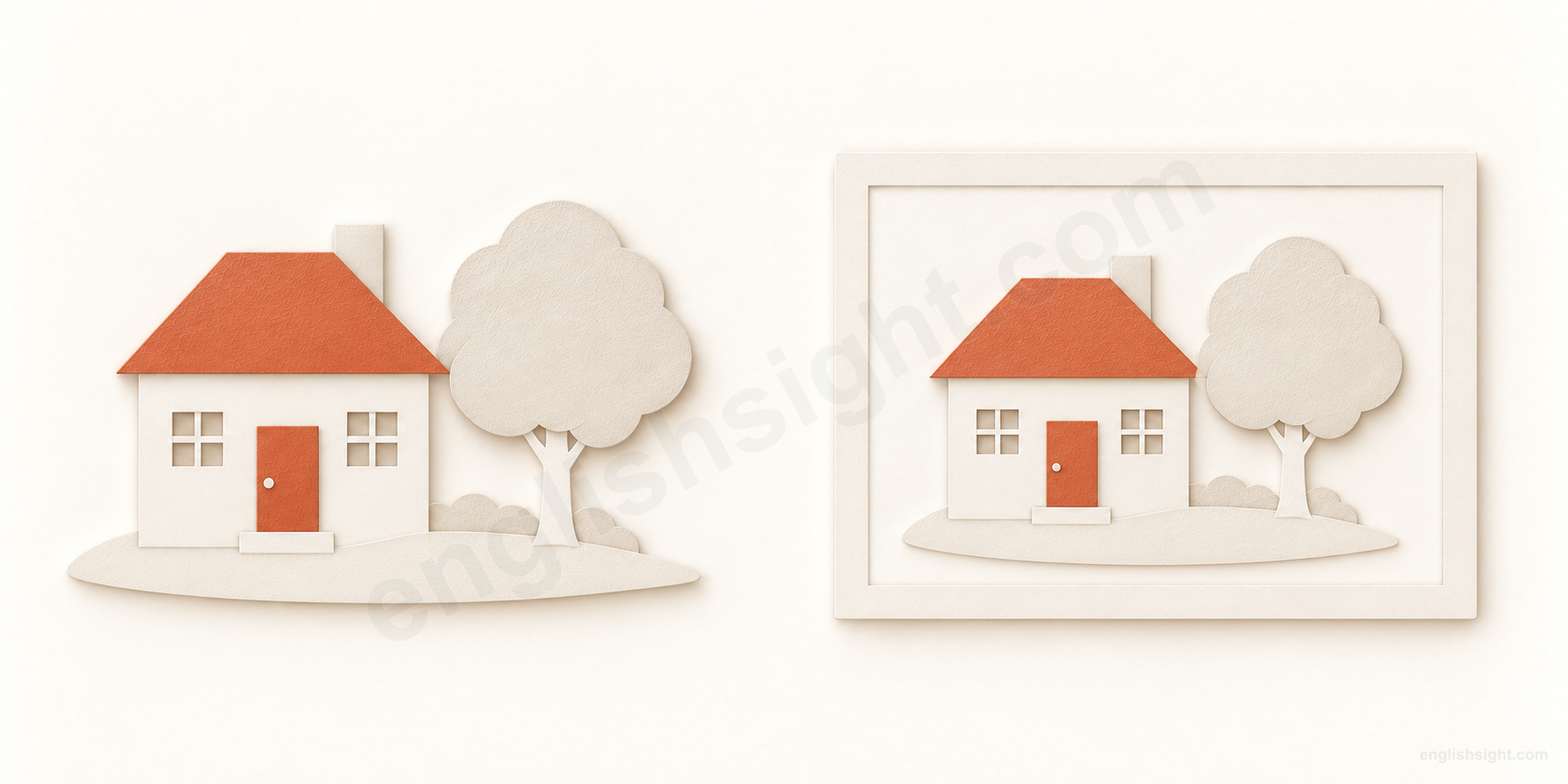
A house stands beside a tree.
picture
A picture shows the same house and tree.
An image represents the scene.
The house and tree are the subject; the smaller scene inside the border represents them. A picture can also be imagined or described in words.
A picture represents someone, something, or a situation in a form you can see or imagine.
The subject may be real or imagined. The image need not be accurate or complete. This connection helps organize the uses; it cannot predict every established expression.
A picture lets something be represented: a person, an object, a scene, or a situation. It may be visible on a surface, present in imagination, or expressed through a description.
As a noun, picture names an image or impression. As a verb, it can mean imagine, portray, or show in an image. Familiar expressions add meanings that need to be learned with their full wording.
01
Pictures you can see
Name a representation on paper, in a photograph, or on a screen. The surrounding words tell you how it was made and what it shows.
01
draw / paint + a picture + of somebody/something
draw / paint a picture
make a visual representation
Situation / context
A child looks at a small house.
Meaning in context
Her drawing shows the house on paper.
The picture represents the subject; it is not the subject itself.
A picture is a countable thing: a picture, two pictures. It may be drawn, painted, photographed, or produced in another visual form. In this scene, draw names making it with lines; paint names using paint.
Picture is broader than painting or drawing. A painting is made with paint; a drawing uses drawn marks. A portrait specifically shows a person. These words help you say what kind of picture you mean.
Picture can also come before another noun: a picture book, a picture frame. Here picture identifies what the book contains or what the frame holds; it is not a new verb meaning.
In a sentence
Maya drew a picture of the little house.
Watch the difference Picture does not mean only a photograph. Choose draw or paint when the method matters.
02
take a picture of + subject; have + one’s picture + taken
take a picture
make a photograph with a camera
Situation / context
Two friends stand together for a photograph.
Meaning in context
A camera records their image.
Take a picture names photographing; the subject follows of.
In ordinary camera use, take a picture means photograph someone or something. Can you take a picture of us? asks the listener to operate the camera. It does not ask them to carry an existing picture away.
Picture and photo can both refer to the result. Photo or photograph makes the camera meaning explicit; picture also covers drawings and other images. You can send, post, or upload a picture after making it.
We had our picture taken means someone photographed us. In have + object + taken, our picture is what was made, and the photographer need not be named. Compare We took their picture: we operated the camera.
In a sentence
Could you take a picture of us by the lake?
Watch the difference For a normal request to use a camera, say take a picture. Draw a picture requests a different activity.
03
a picture of + subject; a picture by + maker; somebody/something + in the picture
a picture of / by; in a picture
distinguish the subject, maker, and location
Situation / context
You examine a drawing that Ana made of her brother.
Meaning in context
You identify who made it and who appears in it.
Of identifies what is represented; by can identify the maker.
A picture of Ana shows Ana. A picture by Ana was made by Ana. Those are different relationships, so a picture of me does not by itself say who took or drew it.
Say Ana is in the picture when her image appears within it. Say The picture is on the wall for its physical position, or There is a picture in the book for where it is printed. The prepositions do different jobs.
My picture can mean a picture I own, made, or appear in, depending on context. If that matters, use a fuller description such as a picture of me or a picture I took. In the picture also has a figurative involvement meaning, explained later.
In a sentence
This is a picture of my brother, drawn by Ana.
Watch the difference In this picture describes something represented within the image; on this picture usually concerns its surface.
04
the picture + be + adjective; picture quality; live pictures of + event/place
picture quality / live pictures
the visual image on a screen
Situation / context
A television has clear sound but a blurred image.
Meaning in context
You adjust it to improve the picture.
Picture can name the visual part of a broadcast or display.
The picture is blurry describes what you can see on the screen. The sound is fine, but there is no picture contrasts the visual image with the audio. Neither sentence requires a printed photograph.
Picture quality concerns how clear or good the displayed image is. In news reports, live pictures means images being broadcast as events happen; the plural can refer to a sequence of moving images.
This use stays close to visible representation. A report can also give a picture of a problem in words; that is the account meaning, not necessarily the broadcast image.
In a sentence
The sound is clear, but the picture is blurry.
Watch the difference Live pictures can be moving broadcast images. Do not assume pictures always means separate still photographs.
05
a picture (= a film); go to the pictures; be / work in pictures
a picture / the pictures
a film, or the cinema in a traditional expression
Situation / context
An awards programme discusses a film.
Meaning in context
It calls the film a picture.
Film language and the fixed plural the pictures need different readings.
A picture can mean a film, especially in film-industry or awards language. Best Picture names an award for a film; it is not a competition for a single photograph.
Go to the pictures means go to the cinema, especially in British English. Dictionaries mark this expression as old-fashioned or traditional; go to the cinema or go to the movies is a useful everyday alternative.
In pictures can also mean working in the film industry, especially in North American usage. That marked expression differs from in the picture, which may mean visible in an image or involved in a situation.
In a sentence
The studio’s latest picture opens on Friday.
Watch the difference The pictures is a fixed cinema expression. A picture, the pictures, and in pictures are not interchangeable.
02
Pictures in the mind
Remember or imagine a scene. As a verb, picture takes the person, thing, activity, or situation being imagined.
06
have / form + a (mental) picture + of somebody/something
a mental picture of…
an image, memory, or impression in the mind
Situation / context
Someone describes a seaside village.
Meaning in context
You form an idea of how it looks.
The picture can be internal rather than printed or displayed.
A mental picture can come from memory, description, or imagination. Form a picture of a place means develop such an idea. A picture in your mind is another way to express this.
The picture may be vivid, vague, accurate, or mistaken. The noun does not guarantee that it matches reality. A person can form a picture of a place they have never visited.
The link with visible pictures is representation: something is understood through an image or impression. This is a teaching connection, not a claim that everyone experiences mental images in the same way.
In a sentence
Her description helped me form a mental picture of the village.
Watch the difference A mental picture is not necessarily a true memory. It can represent an imagined scene.
As a verb, picture directly takes what is being imagined.
I can picture the room means I can imagine it or recall how it looked. The room is the object of picture. There is no need for of: compare the noun a picture of the room with the verb picture the room.
Can and cannot often describe how easy or difficult this imagining is. I can’t picture it means I cannot form a useful idea of it in my mind; it does not necessarily mean I cannot take a photograph.
Picture this: a quiet beach at sunrise uses an imperative to invite the listener to imagine a scene. The following words supply its content. You can also say I’m picturing a quiet beach when describing the current act of imagining.
In a sentence
I can still picture our old kitchen.
Watch the difference Say picture the room, not picture of the room, when picture is the verb.
08
picture + somebody / oneself + -ing
picture somebody doing something
imagine a person in an activity
Situation / context
You consider a possible future for yourself.
Meaning in context
You imagine yourself carrying out the work.
The person after picture is also the person doing the -ing activity.
Picture Lena teaching a class places Lena in an imagined activity. Lena is the object of picture and the understood subject of teaching. This does not say that teaching is happening now.
Use a reflexive pronoun when the imagined person is the same as the subject: I picture myself teaching; she pictures herself teaching. I picture her teaching imagines a different person.
The activity can be remembered, possible, expected, or unlikely. I can’t picture him doing that often conveys that the behavior is hard to imagine for that person, not that the speaker lacks a camera.
In a sentence
I can picture myself teaching a small class.
Watch the difference For this activity pattern, use picture myself teaching, not picture myself to teach.
09
picture + object + as + noun; picture + object + with + noun; picture + object + adjective
picture somebody as… / with…
imagine someone in a role or with a feature
Situation / context
You hear about a new colleague without seeing her.
Meaning in context
You imagine a particular appearance or role.
The complement supplies the imagined identity, feature, or condition.
Picture someone as a teacher imagines that person in the role of a teacher. As introduces the role or description; it does not prove that the person actually has it.
Other complements fill in the imagined scene: I pictured her with short hair or I pictured the room empty. With adds a feature; the adjective empty gives the room an imagined condition.
Keep this private act of imagining distinct from She was pictured as a hero in the article. In the latter, a report presents her in a certain way; the lesson treats that portrayal meaning separately.
In a sentence
I had pictured the room as a quiet place to work.
Watch the difference The complement describes the imagined object. Picture is not a linking verb like seem.
10
picture + what / how + subject + verb
picture what / how…
imagine the situation described by a clause
Situation / context
You consider life in a very small home.
Meaning in context
You imagine how that life would feel or look.
A question-word clause supplies the content being imagined.
Picture what the room will look like uses a whole clause as the object of picture. What introduces the imagined appearance; how can introduce the way something will happen.
In I can’t picture what it would be like, would can describe a hypothetical situation. Picture does not mean predict with certainty. You may imagine a possibility that never becomes real.
The embedded clause uses statement order: what the room will look like. Compare the direct question What will the room look like? The question word remains, but its position does not require question order inside the sentence.
In a sentence
Can you picture what it would be like to live on a boat?
Watch the difference Use picture what it would be like, not picture what would it be like.
03
How someone is pictured
Separate being shown in an actual image from being presented in a particular way. Both are often expressed with passive forms.
11
be pictured + here / above / with…; be pictured + -ing
be pictured here / doing something
appear in a photograph or other picture
Situation / context
A newspaper publishes a photograph of a musician.
Meaning in context
The caption identifies what she is doing in the image.
This passive describes what the image shows, not what someone imagines.
She is pictured here with her violin means the photograph here shows her with it. Captions often use the passive because the person shown matters more than the photographer.
She is pictured playing the violin identifies the visible activity. It is not the same as I picture her playing the violin, which describes my mental act.
A shortened caption can say Ava Chen, pictured above, will perform tonight. Pictured above means who is shown in the picture above. The time of the photograph can differ from the time of the reported event.
In a sentence
The musician is pictured rehearsing with her band.
Watch the difference Is pictured rehearsing is passive picture plus an activity description; it is not the progressive form is picturing.
12
be pictured as + noun; an account / writer + picture + object + as…
be pictured as…
be presented or described in a certain way
Situation / context
An article selects details about a local business.
Meaning in context
Readers receive a particular impression of the business.
The representation can be made with words rather than a camera.
The company is pictured as a success means it is presented that way. This often passive use concerns portrayal: how a person or thing is made to appear in an account.
The portrayal can be fair, incomplete, favorable, or misleading. Pictured as does not itself confirm that the description is true. In an active version, an account or writer can picture a person or situation in a particular way.
Context separates this from imagination and literal imagery. I pictured her as a doctor describes my imagining; The article pictured her as a leader describes the article’s presentation.
In a sentence
The article pictured the owner as a generous neighbor.
Watch the difference A written portrayal need not include a photograph. Read who or what is doing the picturing.
04
A picture of a situation
Facts and descriptions can give you a picture without giving you a photograph. Read whether the expression concerns an account, the present situation, or its wider context.
13
give somebody / build up + a picture of + noun / what-clause; a picture emerges
give / build up a picture of…
provide or develop an account of what something is like
Situation / context
You collect interviews about how an accident happened.
Meaning in context
The details form a connected account.
The picture is an understanding assembled from information.
Give someone a picture of something means help them understand what it is like. Build up a picture emphasizes gradually putting details together. No drawing is required.
Of can introduce a noun or a clause: a picture of daily life; a picture of what happened. Adjectives such as clear, detailed, accurate, and incomplete evaluate the resulting account.
A picture emerges when the available details begin to reveal a recognizable account. This describes understanding becoming available, rather than a literal image coming out of a container.
In a sentence
The interviews helped us build up a picture of what happened.
Watch the difference A clear picture may still be inaccurate. Clarity and truth are different qualities.
14
paint + a/an + adjective + picture of + somebody/something
paint a rosy / grim picture of…
describe something so it gives a particular impression
Situation / context
A report chooses what to emphasize about a town.
Meaning in context
Its description leaves readers optimistic or worried.
Paint describes shaping an impression; the adjective gives its tone.
Paint a picture of life in a town can mean describe that life in words. Paint a rosy picture presents things positively; paint a grim or gloomy picture presents a worrying or unhappy situation.
The expression connects description with the way a visual picture presents a scene. It is an established metaphor, so paint does not require actual paint or a physical canvas.
A rosy picture is not automatically dishonest. Other information may show that it is accurate, exaggerated, or incomplete. Compare paint a picture of the town with paint the town: the latter can describe applying paint in a literal context and does not carry this whole expression by itself.
In a sentence
The report paints a gloomy picture of the town’s future.
Watch the difference The adjective describes the impression given, not a required color used in a painting.
15
the overall picture + be / change; have / give + the full picture
the overall / full picture
the situation, or a sufficiently complete view of it
Situation / context
One figure suggests that a project is going well.
Meaning in context
Other facts reveal delays and extra costs.
Picture can refer to the general situation or to how fully it is understood.
The overall picture is improving summarizes the general situation. In this use, picture is usually singular and often has the. It is not necessarily a report or an image.
We don’t have the full picture means we lack some relevant information. Give someone the full picture asks for a sufficiently complete account, not for a larger photograph.
The situation and our knowledge of it are related but different. The picture has changed can report a change in circumstances; our picture of the situation has changed can report a change in our understanding.
In a sentence
The sales figures alone do not give us the full picture.
Watch the difference Full concerns relevant completeness here, not the physical size or resolution of an image.
16
see / look at / focus on + the big picture
see / look at the big picture
consider the wider situation as a whole
Situation / context
A team is arguing about one button on a website.
Meaning in context
They consider what users need from the whole service.
Big contrasts the wider context with individual details.
The big picture is the whole situation and the connections that matter beyond one small part. Look at the big picture asks someone to take that wider view.
This is informal figurative language. Big does not refer to the dimensions of a painting. A big photograph is literally large; the big picture in a planning discussion is a broad perspective.
The full picture stresses having the relevant facts; the big picture stresses their wider context and relationships. In practice the ideas can overlap, but neither expression means details never matter.
In a sentence
Before we change the price, let’s look at the big picture.
Watch the difference Use the fixed article the in this idiom. Big is not simply a substitute for physically large.
17
A picture is worth a thousand words; Every picture tells a story.
A picture is worth a thousand words.
an image can communicate a great deal
Situation / context
A long description has not made a layout clear.
Meaning in context
A simple image helps the listener understand it quickly.
The saying praises the communicative power of an image.
A picture is worth a thousand words is a saying used when an image communicates an idea or feeling effectively. Worth concerns its usefulness for communicating; it is not a price for buying the picture.
A thousand is an expressive large number here. The saying does not give a measured conversion rate between pictures and words, and it does not guarantee that every image explains every subject well.
A related saying, Every picture tells a story, draws attention to what an image can suggest about people or events. Tells a story is figurative: the picture need not contain written sentences or reveal everything that actually happened.
In a sentence
I’ll show you the layout—a picture is worth a thousand words.
Watch the difference The saying uses a thousand words, not a thousand word. Its number is figurative, not a factual word count.
05
Understanding, involvement, and striking appearances
These established expressions use the idea of a picture in different ways. Learn the whole wording, including its articles and prepositions.
18
get the picture; I get / got the picture; Do you get the picture?
get the picture
understand what someone means or what is happening
Situation / context
A friend explains why the group has changed its plans.
Meaning in context
You understand the situation from the explanation.
Get marks reaching understanding, not receiving a photograph.
I get the picture is an informal way to say that you understand the situation. You may understand from a few useful details without hearing a complete explanation.
You get the picture can also invite a listener to infer the rest. A direct Do you get the picture? may sound impatient if the tone suggests that the listener should already understand.
The article belongs to the idiom: get the picture. Get a picture of the house more naturally concerns obtaining an image, though context can also make it about forming an impression.
In a sentence
“The car has five seats, but there are seven of us.” “I get the picture—we need another car.”
Watch the difference Keep the in the understanding idiom. It is not a separable phrasal verb.
19
be / come back + in the picture; be / be left + out of the picture
in / out of the picture
involved or no longer involved in a situation
Situation / context
Two suppliers are being considered for a contract.
Meaning in context
One withdraws and is no longer an option.
The picture stands for the situation and its participants.
If a person or option is in the picture, they are involved or being considered. If they are out of the picture, they are no longer involved or relevant in that context. Where do I fit into the picture? asks what your role or connection is.
With our main rival out of the picture means that rival no longer plays a part in the current competition. It does not by itself explain why they are absent.
Literal in the picture means appearing within an image. In the involvement sense, the picture is a situation rather than a camera image. In British English, be in the picture can also mean be informed about the situation; that reading connects with put or keep someone in the picture, explained next. Context decides whether involvement or knowledge is meant.
In a sentence
With the first supplier out of the picture, we contacted another one.
Watch the difference Say out of the picture, not out the picture. The expression does not automatically mean death or physical removal.
20
put / keep + somebody + in the picture + (about something); be in the picture (= be informed, British)
put / keep somebody in the picture
give someone the information they need
Situation / context
A colleague returns after a week away.
Meaning in context
You explain the changes and continue to send updates.
The whole expression concerns informing, not placing someone in a photograph.
Put someone in the picture means explain enough of a situation for them to understand it. Keep someone in the picture means continue to give them relevant information as things develop.
The person comes between put or keep and in the picture: put me in the picture; keep her in the picture. About can introduce the topic: keep me in the picture about the move.
This informal expression is especially associated with British English. Keep me informed and bring me up to date are useful alternatives. Be in the picture can itself mean be informed in British English: Now I’m in the picture means I now know the relevant facts. An informed person need not be a participant; the involvement reading is separate.
In a sentence
Please keep me in the picture about the office move.
Watch the difference Keep the person before in the picture: keep me in the picture, not keep in the picture me.
21
be / look + the picture of + health / misery / guilt / innocence
the picture of health / misery
look like a striking example of a state
Situation / context
A friend looks energetic and well.
Meaning in context
You describe that very healthy appearance.
The person’s appearance strongly represents a quality or condition.
The picture of health means looking extremely healthy. The picture of misery means looking extremely unhappy. Guilt and innocence can also name the condition a person seems to display.
Here a person is not being called a photograph. Their appearance is treated as a clear example of the named state. It is an expressive description of appearance, not a medical or factual guarantee.
The is familiar in this expression, although a picture of health is also established. Compare a picture of a healthy child: that normally names an actual image showing the child.
In a sentence
After her holiday, Jo looked the picture of health.
Watch the difference Use a noun after of: the picture of health, not the picture of healthy.
22
somebody + be + the picture of + another person
be the picture of somebody
look remarkably like another person
Situation / context
A child has facial features very like her mother’s.
Meaning in context
Someone comments on their close resemblance.
Picture expresses likeness between people, rather than ownership of an image.
She is the picture of her mother means she looks very much like her mother. This resemblance use is useful to recognize in family descriptions, though looks just like her mother is a straightforward alternative.
The mother is the person being resembled. Compare This is a picture of her mother, where this identifies an actual image. The grammar and the subject help choose the reading.
A similar phrase with an abstract state, the picture of health, means a striking example of that condition. The noun after of is therefore important: a person invites resemblance; a state invites an appearance description.
In a sentence
With those dark eyes, Ella is the picture of her mother.
Watch the difference The resemblance does not mean the two people are identical in character or every other respect.
23
be / look + a picture; (as) pretty as a picture
look a picture / as pretty as a picture
look especially attractive
Situation / context
A garden is full of flowers.
Meaning in context
Someone makes an admiring comment about its appearance.
These expressive phrases compare beauty with an attractive picture.
The garden looks a picture means it looks especially beautiful or impressive. This is an expressive, traditional way to praise the appearance of a place or person; it does not mean it looks like a flat drawing.
As pretty as a picture means very pretty. Oxford marks this comparison as old-fashioned, so it is mainly useful for recognizing familiar descriptions rather than as a neutral default in every conversation.
These expressions are learned as whole phrases. A picture can show something ugly or upsetting, so the noun picture alone does not always mean beautiful.
In a sentence
The garden looks a picture with all the roses in bloom.
Watch the difference In look a picture, look links the subject to a description. Look at a picture means direct your eyes toward an image.
24
somebody’s face + be + a picture + (when-clause)
somebody’s face is a picture
someone’s face shows a striking reaction
Situation / context
A person hears unexpected news.
Meaning in context
Their surprised or angry expression is very noticeable.
The face itself displays a memorable reaction.
His face was a picture comments on an expressive reaction, often surprise or anger. It invites the listener to imagine how striking the person’s face looked at that moment.
The surrounding situation supplies the emotion. Her face was a picture when she found the extra charge suggests a strong reaction to the charge; the phrase alone does not identify the exact feeling.
This is different from She looks a picture, an admiring description of appearance. A face that is a picture need not be beautiful, and no photograph needs to have been taken.
In a sentence
Sam’s face was a picture when he heard that the tickets were free.
Watch the difference Read the reaction and context. A face being a picture does not automatically mean a pretty face.
Choose the form and the whole expression
Noun and verb grammar
The noun is countable in its ordinary image meanings: a picture, pictures. Abstract uses are often singular: a clear picture, the overall picture. Verb forms are picture, pictures, pictured, pictured, picturing; drop the final e before -ing. Picture has the same main pronunciation as noun and verb: /ˈpɪktʃə(r)/.
An image, a photo, or a painting?
Picture is a broad everyday word. Photo specifies a camera image; painting specifies paint. Image can also refer to a visual representation and has other uses, such as public reputation. Do not assume these words replace one another in every expression: get the picture is a fixed way to express understanding.
Active, passive, and arranged photography
I am picturing the room describes imagining in progress. The room is pictured above is passive and refers to an image. We had our picture taken uses have + object + past participle to describe someone photographing us; it is not a causative sense of the verb picture. The lesson contains no productive separable particle-verb family for picture.
The model has limits
Pictures can represent invented or mistaken scenes. Descriptions can select only part of a situation. Fixed expressions, regional wording, and film language need their own context. The image relationship is a teaching aid, not a claim about a mental picture shared by every native speaker.
Read the relationship
Decide whether the sentence concerns an image, imagination, a portrayal, or a situation.
1. You want a stranger to use your camera and photograph your group. Which request fits?
2. You imagine yourself working in a library. Which sentence uses the ordinary activity pattern?
3. A caption says, “Noor is pictured here with her team.” What does this mean?
4. A written report “paints a rosy picture” of a project. What is it doing?
5. A colleague asks, “Please keep me in the picture about the move.” What do they want?
6. After hearing an explanation of a problem, you say, “I get the picture.” What are you saying?
7. A team is stuck on one small detail. Someone says, “Look at the big picture.” What do they mean?
Sources and teaching notes
The linked dictionaries support the meanings, patterns, and usage labels. The explanations, examples, contrasts, and representation model were written for this lesson.
The diagram is a teaching aid. People do not all experience mental pictures in the same way.