Recognize the animal, read the tone, and learn fixed expressions as wholes.
Recognize the animal; interpret the phrase
Start with the animal; check what the phrase adds
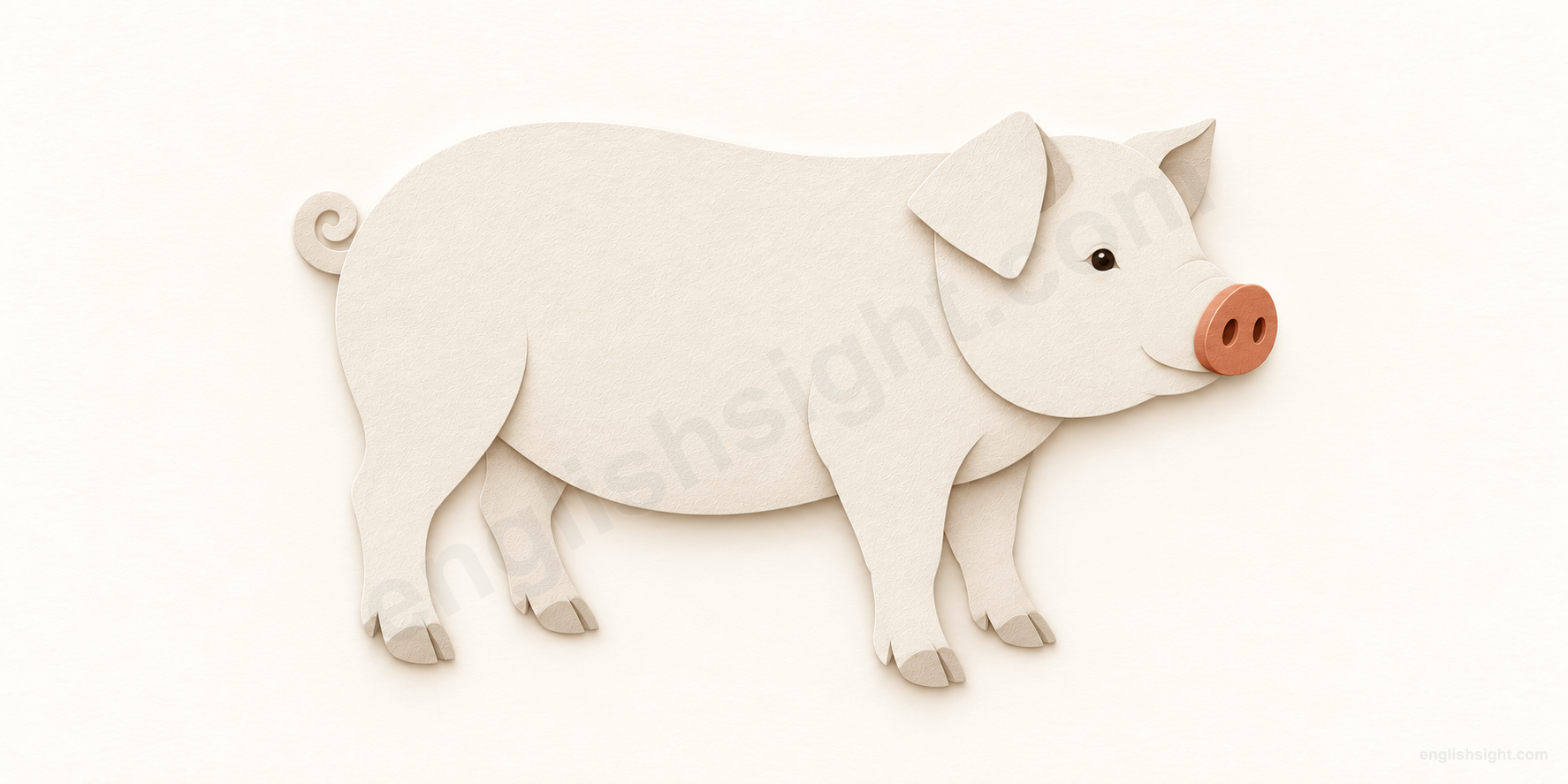
A pig stands facing right.
pig
The picture anchors the literal animal sense.
Its broad snout, short legs, and curled tail identify the animal.
Recognize the animal; interpret human comparisons and idioms in context.
Pig names an animal; when it is applied to people or situations, the surrounding expression supplies the comparison, judgment, or idiomatic meaning.
The sketch anchors the literal animal. It does not show that pigs are necessarily dirty or greedy, and it cannot explain every fixed idiom by itself.
Pig first gives you a concrete animal to recognize. English also uses the word in judgments about people and in established expressions. Those uses depend on the full phrase and the situation.
The animal is a useful starting point for memory, not a single hidden rule that generates every meaning. Some expressions are insulting, some playful, and some regionally marked.
01
Name the animal; notice the human judgment
Start with the countable animal noun. Applying the same noun to a person adds a negative judgment, not an animal classification.
Pig names the animal; a pig farm uses pig to classify the farm.
Pig is normally a countable noun: one pig, two pigs. Use a determiner for a single animal: We saw a pig. Pigs are… can describe the kind in general. The pronunciation is /pɪɡ/, with the short vowel in sit.
Keep pigs and raise pigs describe looking after them; British English also uses rear pigs. In a pig farm or pig farmer, the singular noun pig modifies another noun. It does not become plural just because the farm has many animals.
Pork is the usual everyday name for the meat: We bought some pork. Pig can refer to the animal as a whole in roast pig. Hog is another animal word, especially in North America; everyday pig is not restricted to one exact age or weight.
In a sentence
Two pigs were sleeping near the gate.
Watch the difference Say a pig farm, not a pigs farm. For ordinary meat shopping, use pork.
02
be a pig; call + person + a pig
call someone a pig
insult someone as greedy, dirty, rude, or unpleasant
Situation
Someone takes everything and ignores the other people.
What the expression communicates
An angry speaker calls that person a pig.
The noun expresses the speaker’s disapproval, not a neutral fact about a person.
With a human referent, pig is an informal insult. Greedy pig may criticize taking too much, while rude or arrogant pig criticizes behavior more generally. The situation supplies the particular complaint.
Call someone a pig has someone as its object and a pig as the label applied to that person. A male chauvinist pig is a strongly disapproving expression for a man with sexist attitudes; chauvinist supplies that specific criticism. Do not use pig as a neutral description of someone who is hungry.
In a sentence
They called him a pig for taking all the cake.
Watch the difference A joking tone does not guarantee that the other person will accept the insult.
02
Talk informally about eating too much
These expressions overlap in meaning but use different grammar. They can be self-mocking; comments about another person can sound hurtful.
03
person + pig out + (on + food)
pig out (on something)
eat a large amount, often more than you need
Situation
There are plenty of snacks during the film.
What the expression communicates
You eat far more than you intended.
Out belongs to the established eating expression; it does not mean going outdoors.
Pig out is an informal intransitive phrasal verb. The eater is the subject. You can stop at We pigged out, or add on plus the food: We pigged out on snacks.
The food follows on; it is not a movable direct object. With a pronoun, say pig out on them, not pig them out. The expression can be playful about your own eating, but it is unsuitable as a neutral description in a formal report.
In a sentence
We pigged out on snacks during the film.
Watch the difference Use pig out on pizza, not pig out pizza.
04
pig + food; pig + myself / yourself / etc. + (on + food)
pig something / pig oneself on something
eat too much, in an informal British expression
Situation
A box of chocolates is open.
What the expression communicates
You finish the whole box.
The plain verb can take food directly or appear with a reflexive pronoun.
In informal British English, pig can be a verb: I pigged the lot means I ate all of it greedily. In pig oneself on something, the reflexive pronoun refers back to the eater: I pigged myself on chocolate.
The forms are pig, pigs, pigged, pigged, pigging; double g before -ed and -ing. The plain verb is regionally marked. Eat too much is a neutral alternative, while pig out is a useful separate expression. These eating verbs do not form a general family of movement meanings.
In a sentence
I opened the chocolates and pigged the lot.
Watch the difference Pigged has double g. Do not infer this eating meaning whenever pig is a noun.
05
eat / eats / ate + like a pig
eat like a pig
eat a lot, especially greedily or with bad manners
Situation
Food is being grabbed and eaten messily.
What the expression communicates
Someone criticizes the way the person eats.
Like introduces a comparison; it can criticize manner as well as amount.
Eat like a pig often suggests greedy or unpleasant eating, rather than simply having a healthy appetite. Unlike pig out, it can draw attention to table manners as well as quantity.
The verb eat changes for tense and agreement: eats like a pig, ate like a pig. Like a pig remains the comparison phrase. I ate a lot is less judgmental when you only mean a large amount.
In a sentence
He ate like a pig, grabbing food with both hands.
Watch the difference The comparison is a criticism or self-criticism, not a polite way to praise enjoyment.
06
make a pig of + myself / yourself / oneself; make pigs of ourselves
make a pig of oneself
eat far too much at a meal
Situation
You keep returning to the dessert table.
What the expression communicates
You admit that you overdid it.
The reflexive pronoun identifies the person who overindulges.
Make a pig of oneself is an informal idiom, often used as a self-mocking admission after a big meal. It describes overindulgence rather than a real transformation into an animal.
Match the pronoun to the subject: I made a pig of myself; We made pigs of ourselves. Make changes tense, and pig becomes pigs with the plural subject in this pattern. Compare make a pig’s ear of something, which means doing a task badly and has no reflexive pronoun.
In a sentence
I made a pig of myself at the dessert table.
Watch the difference Keep of and the reflexive pronoun; made a pig myself is not this idiom.
03
Learn the whole expression
A difficult task, a failed attempt, a doubtful promise, and an untested purchase need different fixed expressions. The animal sketch cannot predict these meanings.
07
a pig of a + singular noun; something is a pig
a pig of a job
a very difficult or unpleasant task
Situation
A repair takes much more effort than expected.
What the expression communicates
You complain about how difficult it is.
The a…of a… pattern turns pig into an informal negative evaluation.
This British informal pattern describes something difficult or unpleasant. A pig of a job evaluates a task; a pig of a day evaluates the experience of the day. It does not describe ownership by an animal.
Keep the two articles in the singular pattern: a pig of a job. You can also hear This lock is a pig, with the same general complaint. A difficult job is the neutral alternative; do not confuse this with make a pig’s ear of a job, which says the work was done badly.
In a sentence
Removing that broken screw was a pig of a job.
Watch the difference Difficulty is not the same as failure: you may finish a pig of a job successfully.
08
make / made + a pig’s ear of + task; make a pig’s ear out of something
make a pig’s ear of something
do a task very badly
Situation
You try to assemble a shelf without reading the instructions.
What the expression communicates
The pieces end up in the wrong places.
The complete idiom evaluates the failed execution of a task.
In British informal English, make a pig’s ear of something means handle it badly or make a mess of it. The object after of names the task or result being criticized.
You can change the tense: made a pig’s ear of the repair. Oxford also records make a pig’s ear out of something. Neither form is a separable phrasal verb. Learn the noun phrase pig’s ear with the whole expression rather than trying to calculate the meaning from ear.
In a sentence
I made a pig’s ear of assembling the shelf.
Watch the difference The possessive is pig’s ear; a pig of a job describes difficulty instead.
09
when pigs fly; (and) pigs might fly!
when pigs fly / pigs might fly
dismiss a prediction as extremely unlikely
Situation
Someone promises to finish an implausible task by tomorrow.
What the expression communicates
You respond with sarcastic disbelief.
An impossible image supports an established skeptical response.
When pigs fly is especially associated with North American English; pigs might fly is the British form. Both can reject a promise or prediction as something the speaker does not expect to happen.
I’ll believe it when pigs fly uses a time clause to make a sarcastic point. And pigs might fly! can stand alone as a reply. Might here belongs to the humorous expression; the speaker is not seriously estimating the chance of flying animals.
In a sentence
“Will he finish all that by tomorrow?” “When pigs fly!”
Watch the difference This can sound dismissive. It is not an encouraging way to discuss someone’s plan.
10
buy + a pig in a poke
buy a pig in a poke
buy something without inspecting it or knowing enough about it
Situation
A seller wants payment before showing you the item.
What the expression communicates
You worry about accepting an unknown purchase.
The whole noun phrase represents a purchase made without adequate checking.
The idiom concerns uncertainty before buying. It can apply to goods, a service, or an arrangement whose quality you have not checked. It does not mean the purchase must turn out badly.
A pig in a poke is a fixed phrase; do not replace poke with another container word and expect the idiom to remain. You may meet it in advice or commentary. In straightforward everyday advice, Check it before you buy it makes the intended action explicit.
In a sentence
Paying for the used laptop without seeing it felt like buying a pig in a poke.
Watch the difference The risk comes from not checking; this does not itself mean the seller has proved dishonest.
11
put / putting + lipstick on a pig
put lipstick on a pig
make superficial improvements while leaving basic problems
Situation
An unreliable service receives a new name and logo.
What the expression communicates
Its appearance changes but its faults remain.
The idiom contrasts a surface change with an unchanged underlying problem.
This informal, often humorous criticism says that attractive presentation does not fix what is wrong underneath. The subject is the person or organization making the cosmetic change; the pig metaphor stands for the flawed thing.
The idiom can describe a policy, service, or product. It does not mean every small design improvement is useless: the criticism applies when presentation is offered in place of fixing the main problem. The phrase can sound harsh in a discussion of someone’s work.
In a sentence
A new logo won’t fix the broken service; that’s just putting lipstick on a pig.
Watch the difference Use the full expression; this is not a literal instruction or a claim about animal care.
04
Experiments and being caught between people
Guinea pig and pig in the middle have established meanings of their own. Read the complete noun phrase and the situation.
12
a guinea pig; act as a guinea pig for + trial; use + person + as a guinea pig
a guinea pig
a small pet animal; also a person used to test something
Situation
A team wants volunteers to try a new teaching method.
What the expression communicates
A learner agrees to test it and give feedback.
Guinea pig is a complete animal name with a separate experimental extension.
A guinea pig is a small animal often kept as a pet. The compound is a distinct animal name, not simply pig with an optional description. Do not drop guinea when you mean that animal.
Applied to a person, guinea pig means someone used in an experiment or trial. Be a guinea pig, act as a guinea pig, and use someone as a guinea pig describe different participants in the same testing situation. It can be humorous for a harmless trial or critical if someone feels experimented on.
In a sentence
I agreed to be a guinea pig for the new teaching method.
Watch the difference Calling someone a guinea pig describes a testing role; calling them a pig alone is an insult.
13
play pig / piggy in the middle; be pig / piggy in the middle
pig / piggy in the middle
a ball game; also someone caught between opposing sides
Situation
Two friends argue and each wants you to support them.
What the expression communicates
You feel trapped between the two.
The established role is being between other participants, not being greedy.
British English uses pig in the middle or piggy in the middle for a game in which the middle player tries to intercept a ball thrown between others. North American English uses monkey in the middle.
The figurative use describes someone caught between people or groups who are arguing. I’m piggy in the middle can express frustration about being pulled into their disagreement. The metaphor concerns the middle role, so it is different from the direct insult You’re a pig.
In a sentence
I’m piggy in the middle when my two friends argue.
Watch the difference The middle role can be literal in the game or figurative in a dispute; context decides.
05
Emphatic comparisons
These informal comparisons intensify a description. They do not make literal claims about the behavior or health of pigs.
14
sweat / be sweating + like a pig
sweat like a pig
sweat very heavily
Situation
You climb a long hill on a hot day.
What the expression communicates
Your clothes are soaked with sweat.
Like a pig intensifies sweating in this informal comparison.
This is a vivid informal way to say someone is sweating a lot, often because of heat or physical effort. Change sweat for tense: I was sweating like a pig.
The comparison is conventional language, not a lesson in animal biology. Sweat a lot is the neutral alternative. This phrase describes a physical condition; it does not automatically accuse the person of being greedy or rude.
In a sentence
I was sweating like a pig after climbing that hill.
Watch the difference Avoid it when a neutral or formal description is needed.
15
be + (as) happy as a pig in muck
(as) happy as a pig in muck
very happy and contented
Situation
You spend an afternoon doing your favorite hobby.
What the expression communicates
You are completely content.
The whole comparison describes enjoyment, not cleanliness.
This British informal expression emphasizes how content someone is in a situation they enjoy. The first as may be present or omitted after be: as happy as a pig in muck or happy as a pig in muck.
It can sound affectionate or teasing. It does not necessarily mean the person’s surroundings are dirty: a comfortable reader in a quiet room can be described this way. Very happy is a neutral alternative.
In a sentence
With a whole afternoon to paint, she was as happy as a pig in muck.
Watch the difference The emotional meaning belongs to the full comparison, not pig alone.
16
be / feel + (as) sick as a pig + (about / at + situation)
(as) sick as a pig
very upset, annoyed, or disappointed
Situation
You discover that you missed a chance to get tickets.
What the expression communicates
You are deeply upset about missing it.
In this British idiom, sick can express emotional distress rather than physical illness.
In British usage, sick as a pig can describe being very upset or annoyed about a setback. A missed opportunity or disappointing result makes that interpretation clear.
Do not assume the person has an infection or has vomited just because sick appears. Read the situation. In a medical conversation, say exactly what is wrong rather than relying on this idiom; very disappointed states the emotional meaning plainly.
In a sentence
I felt sick as a pig when I realized I’d missed the ticket sale.
Watch the difference This emotional idiom is regional; do not teach it as a universal replacement for ill.
Keep the animal, the grammar, and the tone apart
Forms and food words
Pig is countable in the main animal and person senses; the usual plural is pigs. Pig’s is singular possessive and pigs’ is plural possessive. Pork is normally uncountable when naming meat. The verb has pigged and pigging, with double g.
An offensive police label
Pig also occurs as offensive slang for a police officer, especially in hostile speech or dialogue. Recognize that meaning when reading; police officer is the neutral term. This use is not the ordinary animal meaning and is not a polite occupational label.
What the picture can explain
The broad snout identifies the literal animal. Greed and dirtiness in insults are human stereotypes, not definitions of animal behavior. Fixed phrases can express doubt, failure, contentment, or disappointment without sharing one predictable mechanism.
Scope and grammar
This lesson includes the everyday animal noun, human judgments, informal eating verbs, and selected established expressions. Technical metal castings and pipeline devices, specialized breeding verbs, historical pottery senses, and further derived words are not expanded. Passive and causative families do not need invented entries for this mainly noun-based lesson.
Read the phrase and the situation
Choose the expression that fits the intended meaning and register.
1. You want a neutral word for meat bought at a butcher’s. Which sentence fits?
2. You ate too many chocolates. Which sentence uses pig out correctly?
3. The repair was difficult, but you completed it well. Which expression describes the difficulty?
4. Someone replies “When pigs fly!” to a promise. What is the response doing?
5. You volunteer to test a new learning method. Which label describes that role?
6. In a British conversation about missing a ticket sale, someone says “I’m sick as a pig.” What is the idiomatic reading?
Sources and teaching notes
The linked dictionary entries support the usage distinctions. The explanations and examples are original; the animal sketch is a teaching aid, not evidence for the origins of idioms.
The diagram is a teaching aid, not a claim that every native speaker imagines the same picture.