A small fastener. A way to hold something in place.
Follow pin from sewing and noticeboards to restraint, precise answers, and digital markers.
Keep something in a chosen position
Keep something in a chosen position
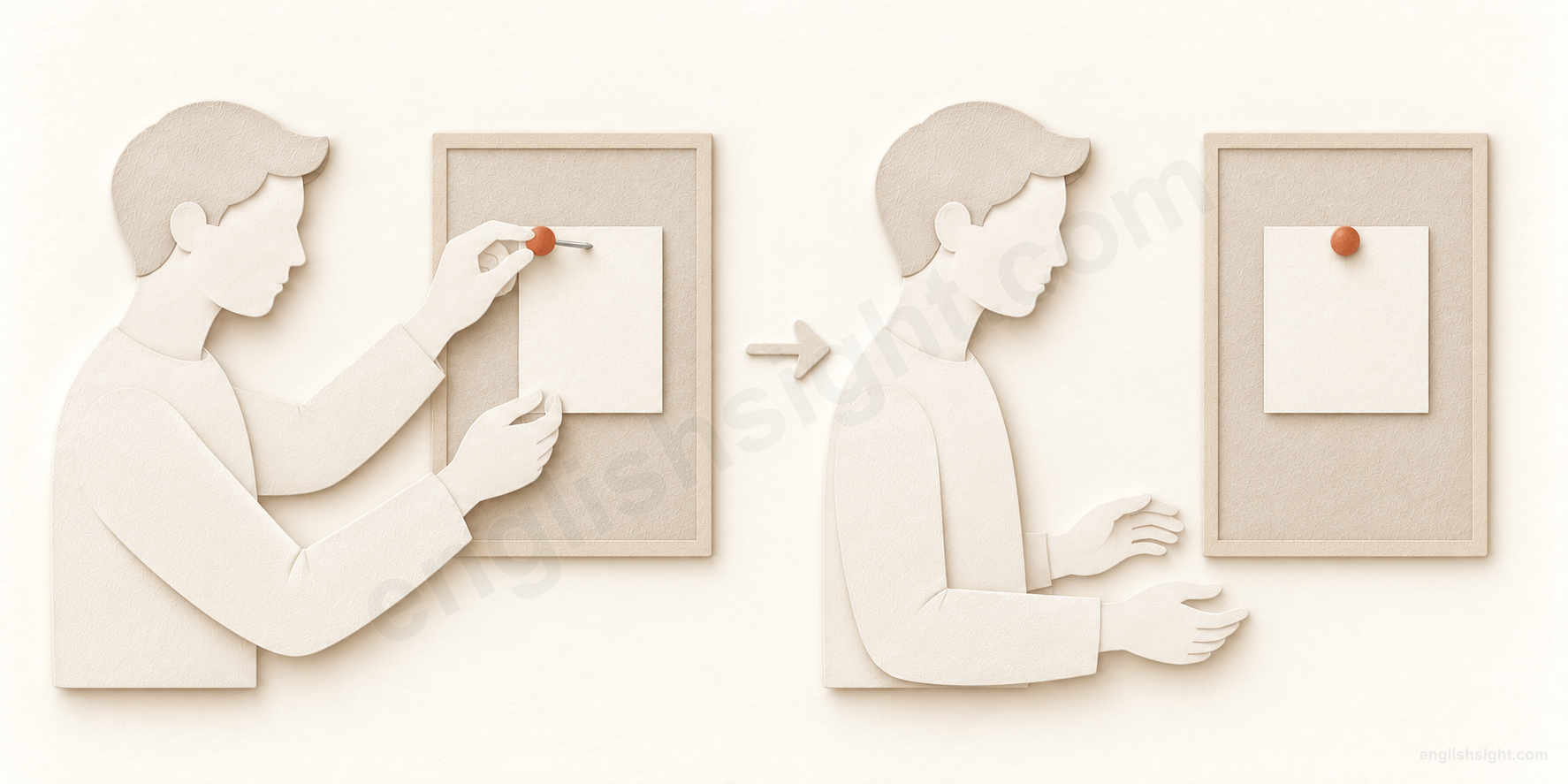
A person holds a loose note against a board, with a pin ready in the other hand.
pin
With both hands clear, the note stays attached in the chosen position.
The pin fastens the note to the board.
Pinning changes the note from hand-supported to attached. The arrow shows this change of state.
A pin holds something in a chosen position; to pin something is to fasten or keep it there.
The fastening model helps connect physical attachment, restraint, and digital placement. It does not explain every named object, idiom, or the unrelated abbreviation PIN.
A pin can be a small object that holds things together. As a verb, pin often means fasten something or prevent it from moving. That connection helps with several everyday extensions.
Some familiar compounds and expressions must be learned separately. This lesson offers a useful teaching connection, not a single mental picture shared by every English speaker.
01
Pins you can hold, wear, or use
The basic noun names a small fastener. Several established compounds and specialized objects have their own shapes and purposes.
01
a pin; pins; hold something in place with pins
a pin / pins
a small pointed fastener
Starting situation
Two pieces of fabric need to stay together.
Result or meaning
A small metal pin holds them for sewing.
A straight pin has a point and a head, but no eye for thread.
A pin is countable: one pin, several pins. In sewing, it can hold layers in place before they are stitched. A needle normally carries thread through fabric; a straight pin normally holds the fabric.
A drawing pin (British English), often called a thumbtack in American English, has a broad head and is useful for attaching paper to a board. Name the type when the shape or purpose matters.
In a sentence
Put a pin through both layers before you sew the edge.
Watch the difference Do not use needle and pin as interchangeable names for every sewing tool.
02
a safety pin; fasten something with a safety pin
a safety pin
a pin whose point closes into a protective catch
Starting situation
A scarf needs a temporary fastening.
Result or meaning
The closed safety pin keeps it together.
The closing catch distinguishes a safety pin from a straight pin.
A safety pin bends back so its sharp end can be covered when closed. Safety is part of the compound name, not a promise that any use is harmless.
Use the whole noun for this particular fastener: a safety pin, two safety pins. Compare a straight pin, whose point remains exposed.
In a sentence
I fastened the loose end of my scarf with a safety pin.
Watch the difference A safe pin is a description; safety pin is the established object name.
03
wear + a pin; a lapel pin
wear a pin
wear a small ornament or badge attached to clothing
Starting situation
You want to show support for a local club.
Result or meaning
A club badge is attached to your jacket.
Here pin can name the visible badge or ornament, not just its fastener.
Especially in North American English, a pin can be a piece of jewellery or a badge worn on clothing. A lapel pin is worn on the folded front edge of a jacket.
British English often uses brooch for an ornamental piece of jewellery. A club pin may identify membership or support rather than merely decorate.
In a sentence
She wore a small bird-shaped pin on her coat.
Watch the difference Wear a pin describes having it on; pin it on describes attaching it.
04
a three-pin plug; a metal pin in something
a plug pin / a metal pin
a projecting connector or a rod that holds parts
Starting situation
A plug must connect to a socket.
Result or meaning
Its metal pins fit the matching holes.
A pin may be a functional rod or connector without a needle-like point.
Electrical pins project from a plug or connector. A three-pin plug has three such parts; pin stays singular inside the compound adjective.
Metal pins can also hold mechanical parts together. In a medical context, a pin may support a broken bone. The shared name does not mean these objects all have the shape of a sewing pin.
In a sentence
This charger has a two-pin plug.
Watch the difference Write a two-pin plug, not a two-pins plug.
05
knock down + number + pins
a bowling pin
an upright target knocked down in bowling
Starting situation
The targets stand at the end of the lane.
Result or meaning
The ball knocks some of them over.
A bowling pin is a shaped target, not a sharp fastener.
In bowling, pins are the upright, roughly bottle-shaped objects that the ball is intended to knock over. The game context often makes bowling unnecessary: She knocked down six pins.
This is an established object sense. Knowing the small fastener alone would not tell you the rules or shape of the sporting target.
In a sentence
His first ball knocked down eight pins.
Watch the difference A pin is the target; a point is a unit in a score.
06
near / short of / beyond + the pin
the pin in golf
the flagstick marking the hole
Starting situation
A golfer needs to locate the hole.
Result or meaning
The flagstick shows the target.
The golf pin marks a location rather than fastening two things together.
In golf, the pin is the stick bearing the flag at the hole. Near the pin describes where a ball comes to rest relative to that marker.
The setting selects this meaning. A bowling pin is knocked down; a golf pin marks the hole. Do not carry one sport’s interpretation into the other.
In a sentence
Her ball landed just beyond the pin.
Watch the difference Pin does not mean the golf ball or the hole itself.
07
a rolling pin; roll dough with a rolling pin
a rolling pin
a cylindrical kitchen tool for flattening dough
Starting situation
The dough is thick.
Result or meaning
Rolling the tool over it makes it flatter.
This compound names a kitchen tool, not the act of moving a sewing pin.
A rolling pin is the long rounded tool used to roll dough or pastry flat. Learn the complete compound, including its ordinary plural rolling pins.
Rolling describes how the tool is used. This object belongs to a different practical scene from the fastening model in the diagram.
In a sentence
Use a rolling pin to flatten the pastry.
Watch the difference A rolling pin is not a pin that is coming loose or rolling away.
02
Fasten, hold, and keep visible
With the verb, the object is the thing or person held in position. Read the following words to see where it is held and whether a physical pin is involved.
08
pin + object + to / on / onto + surface
pin something to / on something
attach an object with a pin or similar fastener
Starting situation
A notice is loose.
Result or meaning
It stays attached to a board.
The object is what is attached; to or on names the supporting surface.
Pin the notice to the board says how it is attached, while put the notice on the board does not specify a fastener. To, onto, and on can introduce the attachment surface.
The passive shifts attention to the object: The notice was pinned to the board. The fastening can be temporary; pin does not itself mean permanent.
In a sentence
Please pin this notice to the corkboard.
Watch the difference Pin a badge on someone’s jacket can be literal; pin a crime on someone assigns blame.
09
pin + pieces + together; pin + object + in place
pin pieces together / pin something in place
hold parts in the required arrangement
Starting situation
A patch slips as you position it.
Result or meaning
Pins keep it aligned with the fabric.
Together joins parts; in place emphasizes the intended position.
Pin the pieces together keeps them connected while another task is done. Pin the patch in place focuses on keeping its position. Neither expression says that sewing is already complete.
With together, a noun can precede or follow the particle: pin the pieces together or pin together the pieces. A pronoun goes before it: pin them together.
In a sentence
Pin the patch in place before stitching around it.
Watch the difference Pinning fabric and sewing fabric are different stages.
10
pin something up; pin something back; pin it up / back
pin up a poster / pin your hair back
secure something in an upright or pulled-back position
Starting situation
A poster needs displaying; hair falls across a face.
Result or meaning
Pins keep the poster up or the hair back.
Up and back contribute the resulting arrangement.
Pin up a poster puts it on display using pins. You can say pin the poster up, and with a pronoun, pin it up.
Pin your hair back holds it away from your face; pin it up arranges and secures it higher on the head. Hairpins or bobby pins can do this. These spatial combinations do not all require separate idiomatic meanings.
In a sentence
She pinned her hair back before washing her face.
Watch the difference Say pin it up, not pin up it. The noun pin-up is a separate vocabulary item.
11
pin + person / thing + against / to + surface; be pinned under + object
be pinned against / under something
be held so firmly that movement is prevented
Starting situation
A fallen beam traps a worker’s boot.
Result or meaning
The boot cannot move until the beam is lifted.
Force or weight can pin something without any small metal pin.
The subject causing restraint may be a person or a heavy object. Against marks the surface someone is pressed against; under names what is above a trapped person or object.
The passive is natural when the trapped participant matters: His boot was pinned under a beam. This is stronger than simply being under a beam, which does not necessarily prevent movement.
In a sentence
His boot was pinned under a fallen beam.
Watch the difference This use does not imply piercing or attaching a literal pin.
12
pin someone down; pin an opponent; be pinned down by something
pin someone down
hold someone so that they cannot move
Starting situation
Two wrestlers struggle on the mat.
Result or meaning
One holds the other against the mat.
Down adds a holding-down relation; the person is physically restrained.
Pin someone down can mean hold them firmly, often on the ground. In wrestling, pin an opponent also has a specific sporting use involving holding the opponent’s shoulders down; the noun a pin names that result.
Outside direct contact, troops can be pinned down by gunfire: moving from their position is prevented by danger. Read the context before choosing the physical or conversational meaning of pin down.
In a sentence
The wrestler pinned his opponent down on the mat.
Watch the difference Pin him down can also mean obtain a definite answer; it need not describe physical force.
13
pin + digital item; pin something to + interface location
pin a message / an app
keep a digital item prominently available
Starting situation
An important message is buried in a discussion.
Result or meaning
Pinning keeps it easy to find.
The physical fastening idea is used for a digital position or access point.
A pinned message stays in a prominent place or a designated list, depending on the service. Pin an app to the taskbar keeps a convenient access point for that app.
Pinning does not necessarily create a copy or change the contents. The precise behavior depends on the interface. Unpin reverses the pinning action and usually removes that special placement rather than deleting the item.
In a sentence
I pinned the meeting link to the top of the chat.
Watch the difference A pinned message and a deleted message have different states.
14
drop a pin on + map; pin a location
drop a pin / pin a location
mark a particular place on a map
Starting situation
A friend does not know your meeting point.
Result or meaning
A map marker shows the exact spot.
A digital pin can identify a location without physically fastening anything.
Drop a pin places a marker at a chosen point on a digital map. Pin a location is also used for marking or saving the spot; the available action depends on the map service.
Here drop does not mean accidentally let a real pin fall. The marker is useful when describing the position precisely matters, such as choosing a particular entrance.
In a sentence
Drop a pin on the map at the entrance we should use.
Watch the difference A map pin is a place marker, not a PIN used to unlock an account.
03
Make something definite or attach responsibility
These expressions extend the idea of fixing something in place. Their exact meanings belong to the whole construction.
15
pin down + noun / what-clause; pin something down (to something)
pin down a cause / a detail
identify or explain something precisely
Starting situation
The machine sometimes stops for an unknown reason.
Result or meaning
Tests identify the exact fault.
The uncertain answer becomes definite, as though fixed in place.
Pin down the cause means establish exactly what it is. You can also pin down a date, a location, or what someone means. This is an established figurative use, not a claim that the idea is literally on a board.
It is separable: pin down the cause or pin the cause down, but pin it down with a pronoun. Pin it down to a faulty cable narrows the explanation to that cable.
In a sentence
We finally pinned the problem down to a damaged cable.
Watch the difference Write pin it down, not pin down it. Merely suggesting a possible cause is not pinning it down.
16
pin someone down; pin someone down to + noun / -ing; pin someone down on + topic
pin someone down to a decision
get a definite answer or commitment from someone
Starting situation
A colleague keeps avoiding the question of a meeting date.
Result or meaning
You get the colleague to choose a date.
The person’s answer or commitment becomes definite.
Pin someone down can mean get hold of an elusive person and obtain the information you need. With to a date or to doing something, the focus is a clear decision or commitment.
You can also pin someone down on a topic, pressing for a definite position. To names the commitment; on names the subject. This wording often suggests persistence because the person has been evasive.
In a sentence
Can you pin Maya down to choosing a date this week?
Watch the difference After the preposition to here, use choosing, not choose. This is not the infinitive marker.
17
pin + blame / crime / it + on + person
pin the blame / a crime on someone
assign responsibility for something bad
Starting situation
A mistake has been discovered.
Result or meaning
Someone accuses a particular person of causing it.
The accusation is attached to a person; it is not proof of guilt.
Pin something on someone often suggests that blame is being shifted unfairly. The object can be the blame, a crime, a failure, or it referring to the event.
Pin it on me puts it before on, while the person stays after on. Compare pin a medal on her jacket: the object and context make that a physical attachment instead.
In a sentence
They tried to pin the theft on the new assistant.
Watch the difference Do not infer that an accusation proves the person actually did it.
rely strongly on a person or possibility for success
Starting situation
Only one funding application remains.
Result or meaning
You depend on it to keep the project running.
Hope or trust is directed toward a chosen source of success.
Pin your hopes on something presents it as the outcome or help you are relying on. Pin your faith on someone or something similarly emphasizes trust.
On is followed by a noun or an -ing form: pin our hopes on winning the contract. The expression describes reliance; it does not guarantee the hoped-for result or always mean there are no alternatives.
In a sentence
We are pinning our hopes on getting the grant.
Watch the difference Say on getting, not on get. Keep the possessive: our hopes, her hopes.
19
put a pin in + topic / it / that
put a pin in that
pause a topic and keep it for later
Starting situation
A discussion is interrupted by a more urgent matter.
Result or meaning
You set the topic aside with a view to returning to it.
The expression marks a thought for later attention rather than settling it now.
In conversation, especially at work, Let’s put a pin in that can suggest pausing the current discussion and remembering it for later. It is an idiom with put, not the same construction as pin the answer down.
The wording often presents the pause as temporary, but it does not promise that the topic will actually be reopened. A concrete follow-up, such as after lunch, makes the intended return clearer.
In a sentence
Let’s put a pin in that idea and discuss it after lunch.
Watch the difference Putting a pin in a discussion postpones it; pinning down a decision makes it definite.
04
Sensations, waiting, silence, and a code
Learn these familiar expressions as units. Similar spelling does not make them all instances of fastening.
20
have / get + pins and needles + in + body part
have pins and needles
feel an uncomfortable prickling or tingling sensation
Starting situation
You have been sitting awkwardly on your foot.
Result or meaning
Your foot feels numb and prickly.
The expression compares a sensation with many tiny pricks.
Pins and needles names a physical sensation, often after a part of the body has been in an uncomfortable position. You can have or get pins and needles in a foot, leg, hand, or arm.
Treat the expression as an uncountable sensation: I have pins and needles, without a before it. No actual sewing equipment is involved.
In a sentence
I got pins and needles in my foot after sitting on it.
Watch the difference Have pins and needles in a foot describes a sensation; be on pins and needles usually describes anxious waiting.
21
be / keep someone + on pins and needles
be on pins and needles
wait in an anxious or excited state
Starting situation
The results have not been announced.
Result or meaning
You wait restlessly to hear the outcome.
On is part of a figurative expression about suspense.
Especially in North American English, be on pins and needles describes anxious or excited anticipation. The person is waiting for news or an outcome, not reporting an injured foot.
Compare have pins and needles in my leg, which describes bodily tingling. The small grammatical difference helps select the meaning; do not interpret the nouns in isolation.
In a sentence
We were on pins and needles waiting for the final result.
Watch the difference The fixed expression uses plural pins and needles, not a pin and a needle.
22
you could hear / could have heard a pin drop
you could have heard a pin drop
the place was extremely quiet
Starting situation
A surprising announcement stops the conversation.
Result or meaning
Everyone stays silent.
An imagined tiny sound emphasizes the depth of the silence.
You could hear a pin drop or You could have heard a pin drop is an emphatic description of quiet. Nobody has to drop a pin, and you need not actually hear anything.
The perfect form could have heard suits a past scene. You is often general here, inviting the listener to imagine how quiet the place was.
In a sentence
After the announcement, you could have heard a pin drop.
Watch the difference After hear, use drop here, not to drop. Do not confuse this idiom with placing a map pin.
23
enter / change + your PIN; a four-digit PIN
enter your PIN
type a personal identification number
Starting situation
A payment terminal asks for a number.
Result or meaning
You enter the code associated with your card.
Capitalized PIN is an abbreviation with the same pronunciation as pin.
PIN stands for personal identification number. It names a code used with cards or devices, rather than an object that fastens things. Say it as one word, /pɪn/.
Enter your PIN, change your PIN, and a four-digit PIN are useful combinations. PIN number is also established in ordinary usage, although number is already represented by N.
In a sentence
The terminal asked me to enter my PIN.
Watch the difference A PIN is a code; a map pin marks a place. Capitalization helps distinguish them in writing.
Read the object and the whole expression
Forms and grammar
The noun has plural pins. The verb forms are pin, pins, pinned, pinning; double n before -ed and -ing. The verb /pɪn/ is normally transitive in these uses. Active, progressive, and passive forms are natural: She is pinning it up; It was pinned up. Have someone pin it up uses an ordinary causative construction rather than a special sense of pin.
Fasten, pierce, or stop movement?
Pin usually emphasizes attachment or restraint. Prick emphasizes making a tiny hole or causing a sharp sensation; stab suggests a forceful piercing action. Someone pinned against a wall need not have been pierced at all.
Particles and prepositions
Pin it down and pin it up put a pronoun before the particle. In pin it on someone, on introduces the person receiving blame. In pin your hopes on success, on belongs to the established expression. These are not all the same grammatical construction.
Coverage boundary
This lesson covers everyday objects, the main modern verb uses, and selected familiar expressions. Golf and medical or electrical pins receive brief recognition treatment. Technical chess, nautical and machinery subtypes, slang pins for legs, old-fashioned for two pins, pin money, and the separate noun pin-up are not developed here.
Choose what is being fixed or described
Look at the object and the words following pin.
1. You want the notice displayed on the board. Which word order is standard with it?
2. Tests have identified the precise cause of a fault. Which expression fits?
3. You are anxious while waiting for exam results, without a physical tingling sensation. Which sentence fits?
4. A payment terminal asks you to identify yourself with a number. What does it need?
5. Someone tries to pin a theft on a worker. What has happened?
6. The group needs to pause a discussion and come back to it after lunch. Which expression fits?
Sources and teaching notes
Usage was checked against the publisher pages below. The explanations, examples, and visual connection are original teaching material; the visual connection is not a dictionary claim about every meaning.
The diagram illustrates a teaching connection, not a picture shared by every native speaker.