Recognize the object, follow what is being carried, and learn the fixed expressions as wholes.
A hollow tube gives a flow a route
A hollow tube gives a flow a route
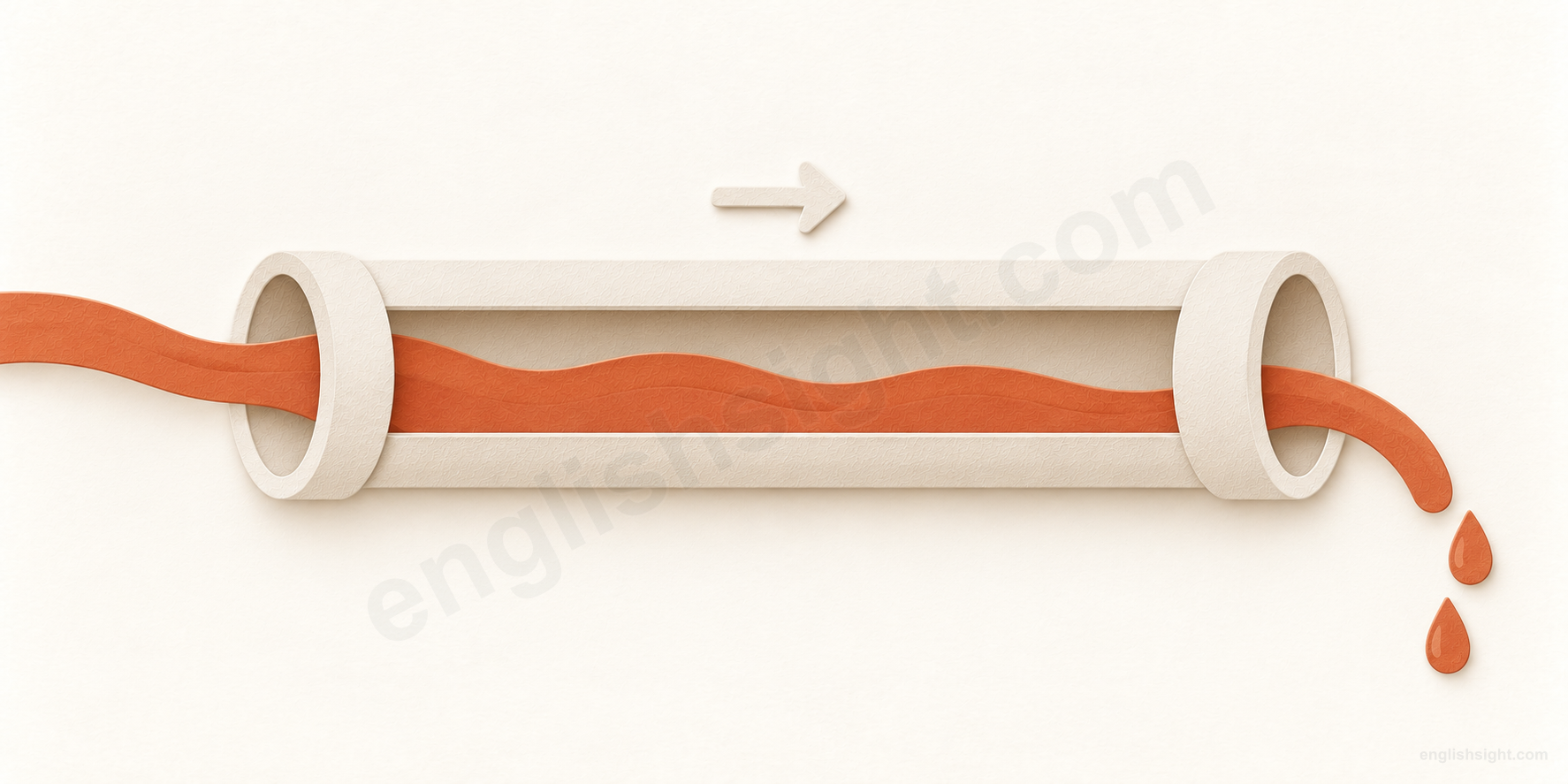
Liquid enters the left opening.
pipe
Liquid leaves the right opening and falls in drops.
The hollow interior provides a route to the right.
The pipe is the surrounding hollow tube; the orange highlights liquid moving inside it. This illustrates one possible flow, not every meaning of pipe.
A pipe provides a hollow route along which liquid or gas can travel.
The sketch illustrates the physical tube and transport senses. Musical sound, voices, decoration, and idioms need their own explanations; not every pipe contains water or has flow at every moment.
A pipe is often a hollow tube that gives liquid or gas a route. Related objects use a hollow stem or vibrating air; the verb can describe sending something through a controlled route. Other uses concern sound or belong to fixed expressions.
These connections are a teaching model, not a claim that every English speaker pictures the same thing. Start with the context: plumbing, music, cooking, computing, or conversation can select very different uses.
01
Tubes, smoking devices, and musical instruments
Start with a hollow tube, then distinguish plumbing, smoking equipment, and musical instruments. Context tells you which object is meant.
01
a / the + pipe; plural pipes; a length of pipe
a water pipe / copper pipe
a hollow tube for carrying a substance
Starting situation
Water needs a route between a supply and a tap.
Meaning in context
It can travel inside a connected tube.
Pipe names the object; water or copper identifies its use or material.
Use a pipe for one tube and pipes for several. A water pipe carries water; a gas pipe carries gas. Copper pipe describes the material. An exhaust pipe carries waste gases away from an engine.
In construction, pipe can also name material without counting separate pieces: We need two metres of pipe. Pipe and tube overlap, but pipe is the usual choice for household water and gas lines. It does not have to be made of metal.
In a sentence
A copper pipe runs behind the kitchen wall.
Watch the difference The pipe is the container or route, not the water inside it. Do not call every hollow object a plumbing pipe.
02
a leaking / burst / blocked pipe; a pipe leaks / bursts
a burst / leaking / blocked pipe
describe different failures of a pipe
Starting situation
A plumbing system is not working properly.
Meaning in context
You identify damage, escaping water, or an obstruction.
The adjective or verb explains the fault; pipe keeps its ordinary object meaning.
A leaking pipe lets water escape through a hole or joint. A burst pipe has broken open. A blocked or clogged pipe has something inside that stops or restricts flow. These are different problems, not three meanings of pipe.
Use install or lay pipes when putting them in place; repair or replace a pipe when dealing with damage. In The pipe burst, pipe is the subject and burst is the verb. In a burst pipe, burst describes its condition.
In a sentence
The plumber replaced the pipe because it was leaking at the joint.
Watch the difference A blocked pipe need not leak, and a leaking pipe need not be blocked. Choose the word for the actual problem.
03
smoke / fill + a / one’s + pipe; pipe tobacco
smoke a pipe
use a bowl-and-stem device for smoking
Starting situation
Tobacco is placed in a small bowl attached to a stem.
Meaning in context
Smoke can be drawn through the stem.
The whole smoking device is called a pipe, not just its narrow stem.
This countable noun names a particular object with a bowl and a mouthpiece. Smoke a pipe describes using it; fill a pipe describes putting tobacco in its bowl. Pipe tobacco is tobacco intended for this device.
The hollow stem helps connect this object with the tube model, but a smoking pipe is not interchangeable with a water pipe. The surrounding words, such as tobacco, bowl, or smoke, select the intended object.
In a sentence
In the photograph, her grandfather is holding a pipe.
Watch the difference Holding a pipe does not say that the person is smoking it at that moment.
04
play a pipe; pipe; pipe + a tune
play a pipe / pipe a tune
a wind instrument, or music played on it
Starting situation
A player blows into a small tubular instrument.
Meaning in context
Vibrating air produces musical notes.
Here pipe names an instrument; the related verb can name playing it.
A pipe can be a simple wind instrument. The verb pipe can describe playing such an instrument, either without an object or with music as the object: pipe a tune. A piper is the player.
The tube connection is physical, but producing musical sound is the defining function here. For a specifically identified flute or recorder, use that instrument’s name rather than assuming pipe is always an equally natural replacement.
In a sentence
A musician piped a short tune before the dance began.
Watch the difference Pipe a tune is about playing music, not carrying the tune through plumbing.
05
an organ pipe; organ pipes; a pipe organ
organ pipes / a pipe organ
sound-producing tubes in an organ
Starting situation
Air is supplied to an organ’s tubes.
Meaning in context
Different pipes produce notes.
A pipe can be one component of a larger musical instrument.
An organ pipe is one of the organ’s sound-producing tubes. A pipe organ is the whole instrument that uses those tubes. Changing the order of the nouns changes which thing is being named.
This is related to the wind-instrument sense through sound produced by air in a tube. It does not mean that every organ has pipes: the description pipe organ distinguishes this type from electronic instruments.
In a sentence
The restored organ has hundreds of pipes.
Watch the difference Organ pipes are parts; a pipe organ is the instrument.
06
play the pipes; a set of bagpipes
play the pipes
play the bagpipes
Starting situation
A player fills and squeezes a bag connected to pipes.
Meaning in context
Air passes through the pipes to produce music.
In a musical context, plural pipes can refer to bagpipes as an instrument.
The pipes often means the bagpipes, especially in Scottish music. It does not merely mean several disconnected tubes. A pipe band is associated with this musical tradition.
Treat the plural noun as plural: The pipes are loud. To refer to a single instrument explicitly, a set of bagpipes is clear. The verb pipe also occurs in descriptions of welcoming or leading people with pipe music.
In a sentence
My cousin plays the pipes in a local band.
Watch the difference Do not infer bagpipes from pipes alone in a plumbing conversation. Musical context selects this sense.
02
Sending something along a route
As a verb, pipe can describe carrying a substance, transmitting sound, or directing computer data. Food decoration uses a small opening to control a soft material.
07
pipe + substance + from / through / to + place; be piped; pipe something in
pipe water from… to…
carry a liquid or gas through pipes
Starting situation
A supply is available in one location.
Meaning in context
A pipe system carries it to another location.
The object is the substance being transported; location phrases show its route.
In They pipe water to the houses, they arrange or operate the supply and water is what moves. From names the source, to the destination, and through the route. These ordinary prepositions add route information; they are not all separate idioms.
The passive is useful when the supply matters more than the operator: Water is piped to the houses. Piped water is water supplied through pipes. With in, both pipe water in and pipe in water are possible; use pipe it in with a pronoun.
In a separate installation use, pipe a building means fit it with pipes. The object is then the place being equipped, rather than the liquid or gas being carried. This use occurs especially in building and utility descriptions.
In a sentence
The farm pipes water from the tank to the greenhouse.
Watch the difference For transport, name the substance as the object: pipe water to the house. Pipe the house has a different installation meaning: fit the house with pipes.
08
pipe + music / a message + into / through / over…; be piped
pipe music into a room
transmit sound through an audio system
Starting situation
Music or a message originates elsewhere.
Meaning in context
Speakers make it audible in another place.
This is transmission as if along a pipe; the sound need not travel inside a physical water pipe.
Pipe music into a room describes sending it through a sound system. The verb can also take a speech or announcement as its object. The passive is natural when the source operator is unimportant.
Piped music commonly means background music supplied through speakers. Into identifies the receiving space; over can introduce the system used. Contrast someone piping a tune live on an instrument: that belongs to the playing sense.
In a sentence
Soft music was piped into the waiting room.
Watch the difference Piped music is transmitted music; the phrase does not specify that the instrument is a pipe.
09
a pipe between processes; pipe + output + to + program
pipe output to another program
a data connection, or sending data along it
Starting situation
One program produces output.
Meaning in context
Another program receives that output as input.
In computing, pipe names the connection and can also name the transfer.
A software pipe connects an output to an input. As a verb, pipe the output to another program describes using that connection. This is a technical extension of the route model, not a claim that data moves through a metal tube.
This is a technical computing use. The exact mechanism depends on the system; here the useful idea is that the results of one program become material for another program to process. The verb does not by itself say that the results are saved as a file.
In a sentence
We piped the output to a program that counted the lines.
Watch the difference The receiving program gets the first program’s output; pipe does not necessarily mean save that output as a file.
squeeze a soft food through a nozzle to place it in a controlled shape
Starting situation
Soft icing is held in a bag fitted with a nozzle.
Meaning in context
It emerges as a line or shaped decoration.
The controlled outlet connects this use with a narrow passage.
Pipe icing onto a cake makes icing the material object and the cake the destination. Pipe a border makes the resulting decoration the object. The same technique can be used with cream or soft potato mixtures.
The action is not spreading with a knife or pouring freely. A narrow outlet lets the cook control the line or shape. Icing is the usual British term here; frosting is common in American English. Piping can name the action.
In a sentence
She piped a border of cream around the tart.
Watch the difference The object can name the material or the resulting shape; pipe a border does not mean move a ready-made border through a tube.
11
be piped in + colour; be piped with + trim
edges piped in a contrasting colour
trim an edge with a narrow decorative strip
Starting situation
A fabric edge is plain.
Meaning in context
A narrow rounded trim outlines it.
This is a separate established decorating sense, rather than transferring liquid.
A cushion piped in blue has a narrow blue trim along its edges. The trim is called piping and is often made around a cord. You may also read that an edge is piped with a particular fabric or colour.
The narrow rounded shape provides a visual connection with a small tube. Do not confuse textile piping with the action of piping cream: the material and the surrounding nouns tell you which decorative technique is meant.
In a sentence
The cream cushion is piped in dark blue.
Watch the difference Piped in blue describes the trim’s colour; it does not mean blue liquid was sent into the cushion.
03
A voice comes in, or the noise stops
The sound branch concerns a high voice and established conversational phrasal verbs. It does not require an actual tube.
12
pipe; pipe + quoted speech
“Wait!” she piped
speak or make a high, thin sound
Starting situation
A person or bird is quiet.
Meaning in context
A high sound is heard.
This sound sense is connected with a pipe’s tone, not with a physical transfer.
Pipe can introduce quoted speech or describe a high bird call. In stories, it often characterizes a child’s high voice. It is more descriptive than the neutral verb say and is not the usual choice for every conversation.
The verb can stand without an object when a bird or instrument makes a sound. With speech, the quotation supplies what is said. High describes pitch; it does not automatically mean the person is shouting loudly.
In a sentence
“There’s my hat!” the little girl piped.
Watch the difference For a neutral report, use said. Do not use piped simply because someone spoke through a microphone.
13
have + a great / fine + set of pipes
a great set of pipes
a powerful or impressive singing voice
Starting situation
You hear someone sing.
Meaning in context
You praise the strength or quality of the voice.
Informal plural pipes refers to the vocal equipment or voice.
In a compliment about a singer, pipes can mean the person’s voice or vocal cords. A great set of pipes praises vocal ability. This is informal wording, not an anatomical term or a claim about a musical instrument.
The musical setting separates this meaning from play the pipes, which refers to bagpipes. She has great pipes describes her voice; she plays the pipes describes an instrument she plays.
In a sentence
I had never heard him sing before—he has a great set of pipes.
Watch the difference Use this as informal praise for vocal ability, not as a neutral way to say that someone has a throat.
14
pipe up; pipe up with + a remark; pipe up + quoted speech
pipe up (with a suggestion)
start speaking, often unexpectedly
Starting situation
A discussion is going on, or someone has been quiet.
Meaning in context
That person joins in with a remark.
Up belongs to an established phrasal verb about entering the conversation.
Pipe up is informal. Someone who pipes up begins to speak, often drawing attention by doing so suddenly. The speaker need not be a child and need not have an unusually high voice. With can introduce the remark or contribution.
This use has no direct object: Maya piped up with an idea, not Maya piped an idea up. A quotation can follow as well. Compare speak up, which can ask someone to speak louder or express an opinion; pipe up highlights starting to speak.
In a sentence
During the discussion, Maya piped up with a practical suggestion.
Watch the difference Piped up does not by itself mean she shouted or interrupted rudely; the context decides the tone.
15
pipe down; tell / ask someone to pipe down
Pipe down!
stop talking or become less noisy
Starting situation
People are talking noisily.
Meaning in context
Someone tells them to be quiet.
Down marks the established noise-reduction meaning of this phrasal verb.
Pipe down is an informal instruction or request to reduce noise. It is often an order, so it can sound impatient or bossy. Please keep your voices down is a gentler choice in many situations.
It does not take a direct object in this meaning: tell the children to pipe down, not pipe the children down. Compare pipe up, starting to speak, with pipe down, becoming quieter. These are conventional expressions, not literal vertical movement.
In a sentence
“Pipe down—the baby’s asleep!” he called from the hallway.
Watch the difference Adding please can soften the request, but pipe down remains informal and may still sound abrupt.
04
Learn the whole expression
These expressions have settled meanings. A drawing of flowing water will not tell you what they mean or how they sound to a listener.
16
be / remain + a pipe dream
a pipe dream
an unrealistic hope or plan
Starting situation
Someone imagines an attractive outcome.
Meaning in context
The speaker judges it impractical or unlikely to be achieved.
The whole compound carries a judgment about feasibility.
Calling something a pipe dream dismisses it as unrealistic. It may be a plan that lacks money, time, or a workable method, rather than a dream someone has while asleep.
The expression has a historical link with opium smoking, but modern use does not imply that anyone has taken a drug. Learn it as a countable compound: a pipe dream or several pipe dreams. The tube diagram cannot predict this meaning.
In a sentence
Without any funding, opening the museum this year is a pipe dream.
Watch the difference An ambitious plan is not automatically a pipe dream; the expression adds a dismissive assessment of its practicality.
17
put that in your pipe and smoke it; someone can put that in their pipe and smoke it
put that in your pipe and smoke it
accept an unwelcome fact
Starting situation
Someone doubts or dislikes what has been said.
Meaning in context
The speaker insists that they must accept it.
This whole idiom delivers a defiant response.
The speaker is effectively saying that the listener must accept the stated fact, whether they like it or not. It can sound triumphant or confrontational, so it is mainly useful to recognize in dialogue rather than copy into a polite disagreement.
That refers back to the fact just stated. Your can change with the person being discussed: He can put that in his pipe and smoke it. The expression is not a real instruction to use tobacco.
In a sentence
“You said I’d never finish, but I have—put that in your pipe and smoke it!”
Watch the difference This is stronger and less friendly than Please accept that. Use the whole idiom rather than interpreting its individual actions literally.
18
piping hot + noun; be / serve something + piping hot
piping hot
very hot, especially food or drink
Starting situation
Food has just been heated or served.
Meaning in context
It is still extremely hot.
Piping belongs to a fixed heat expression here.
Piping hot intensifies hot. It can describe soup, tea, or food straight from the oven. It says nothing about whether the food was decorated with a piping bag or carried through a pipe.
The phrase can come before a noun or after a linking verb: piping hot soup; the soup is piping hot. Unlike is piping icing, is piping hot does not describe an action in progress: hot is an adjective in this expression.
In a sentence
The rolls arrived piping hot from the oven.
Watch the difference Do not use piping by itself as a general replacement for very: piping hot is the established combination.
Keep the branches and grammar distinct
Forms and pronunciation
Pipe is pronounced /paɪp/. The plural noun and third-person verb are pipes. The past and past participle are piped /paɪpt/; the -ing form is piping, with the final e dropped and no doubled p.
Countability and compounds
Count individual objects with a pipe and two pipes; use pipe as material in a length of pipe. Water pipe and copper pipe have different kinds of modifiers. The pipes may mean bagpipes, while a singer’s pipes can mean their voice.
Read the verb’s object
Pipe water transports a substance; pipe music transmits sound or, in a playing context, performs music; pipe cream places it through a nozzle. Passive forms are natural for supply, audio transmission, and decoration. The word has no general pipe someone to do something causative pattern.
Scope of this lesson
The course covers useful modern senses, common phrasal verbs, and selected expressions for recognition. Specialist geology, metallurgy, old barrel measures, naval signaling procedures, and rare slang are outside the lesson. Pipeline and its figurative idioms are separate vocabulary, not additional meanings of pipe.
Choose the meaning from the context
Notice the object, the setting, and any fixed expression.
1. A village receives drinking water through a network of tubes. Which sentence describes the supply?
2. A quiet participant suddenly offers an idea. Which phrase fits?
3. A hotel sends recorded music through speakers into its lobby. What does piped describe?
4. A recipe says Pipe a border around the cake. What should the cook do?
5. Someone calls a project a pipe dream. What are they saying?
Sources and teaching notes
The references support the English senses and usage. Explanations and examples are original teaching material; the diagram is a limited teaching model.
The diagram illustrates the tube-and-flow relationship; it is not a shared mental picture of every English speaker.